
Virginia Beach, VA Live Wildfire Smoke Map
Get Alerts For Wildfires In Your Area
The moment a wildfire starts near you, you'll get an instant alert and simple tips to reduce your smoke exposure.
What's In The Smoke
30xSmaller than a human hair
Fine enough to reach deep into the lungs. A MERV 13 is built to capture it.
How Far It Travels


It Doesn't Stay Local
Smoke rides the wind far downwind — you can get smoky air with no fire nearby.
What To Do During A Smoke Event
Simple steps to reduce indoor exposure.
- Stay In, Close UpShut windows and doors to keep smoke out.
- Set Fan To "On"Keeps air cycling through your filter, not just when heating or cooling.
- Recirculate AirSwitch off fresh-air intake so you're not pulling smoke in.
- Run A MERV 13Built to capture the fine PM2.5 in smoke.
- Add A PurifierExtra filtration for the room you use most.
- Wear an N95 if OutsideFits snug to block fine particles — a cloth mask won't.


The Best Air Filter For Wildfire Smoke
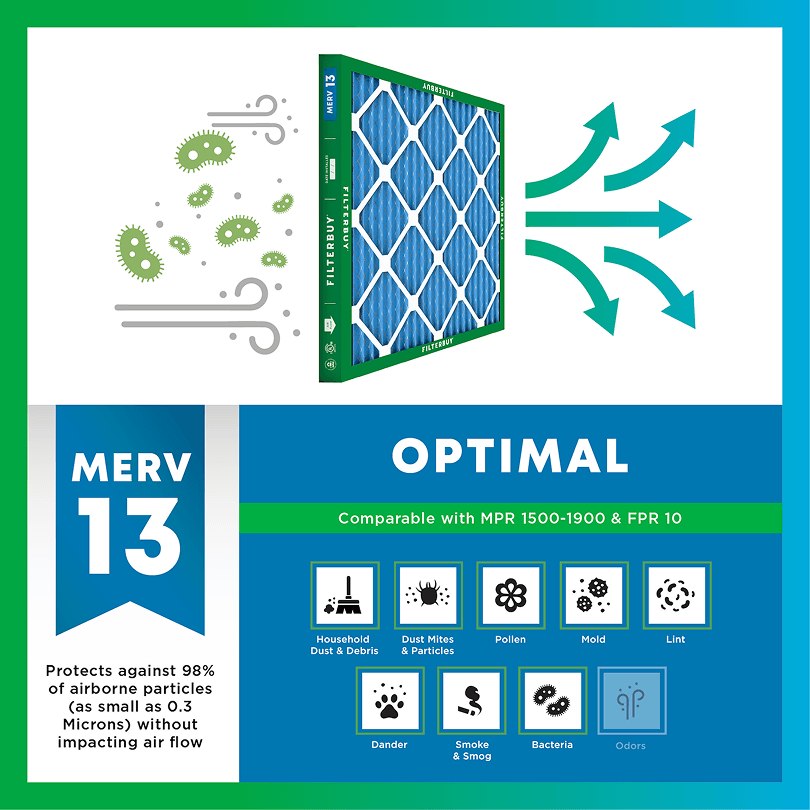
During smoke events, the EPA recommends upgrading to a MERV 13 filter — or the highest-rated filter your system can handle — to help reduce the fine particles smoke brings indoors. MERV 13 is the level most home HVAC systems can run while still capturing PM2.5, the fine particulate that makes up the bulk of wildfire smoke.
- Captures PM2.5 particles
- Blocks ash, soot, and smoke odor
- Keeps your indoor air safe—even when the outdoor air is dangerous
- Meets the EPA's recommended rating for filtering fine wildfire smoke particles.

Wildfire Smoke FAQs
Facts About Wildfires
Over 70,000 wildfires burn in the U.S. every year.
Wildfire smoke can travel 1,000+ miles, affecting states that aren't even near the blaze.
Exposure to wildfire smoke can worsen asthma, trigger heart issues, and lead to ER visits.
Indoor air can hold more fine particles during wildfire events unless it's properly filtered.
The EPA advises using MERV 13 filters or portable HEPA air cleaners during wildfire smoke events.
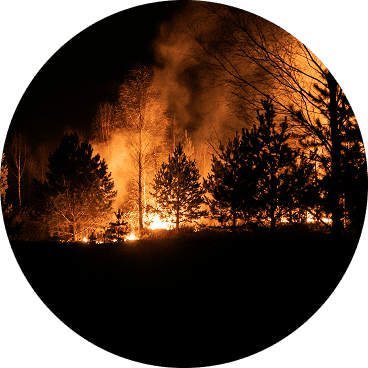
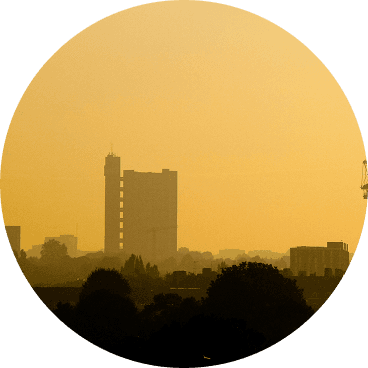
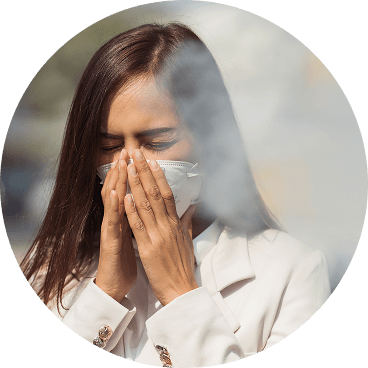
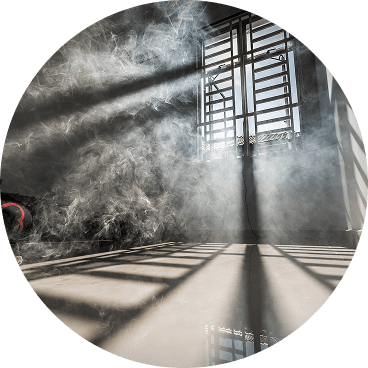
Don't Wait Until The Smoke's Inside.
Use the live wildfire smoke tracker and upgrade your air filters today to protect your lungs and your home.
Shop Filters For Smoke Protection
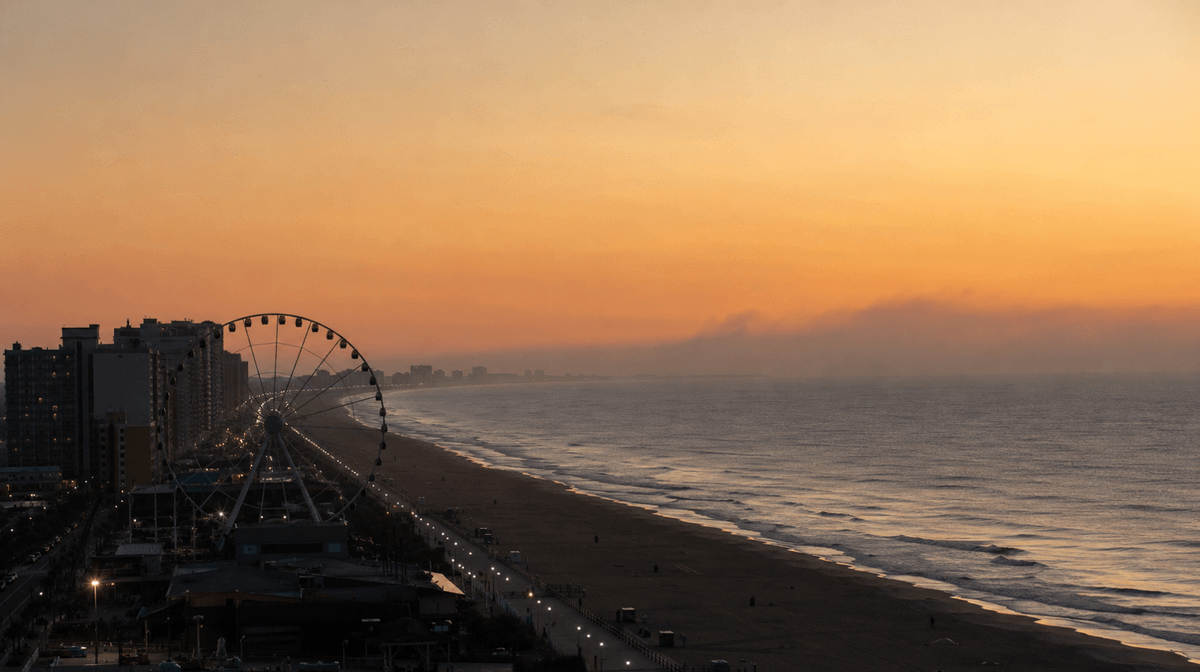
Current Live Wildfire and Smoke Map Virginia Beach VA Today From Filterbuy.com
Author: Michelle Wan — https://filterbuy.com/author/michelle-wan/
Reviewer: David Clark, Licensed HVAC Technician
Publish Date: July 13, 2026
Updated Date: July 13, 2026
In August 2011, families at Red Wing Park could see a haze settle over the Chesapeake Bay while the sun sat low and orange above the Oceanfront. No fire was burning in Virginia Beach that week. The smoke had traveled roughly twenty-five miles from a peat fire smoldering in the Great Dismal Swamp, and it kept drifting into Hampton Roads for weeks. That single week explains why a coastal city with almost no wildfire risk of its own still needs a live wildfire and smoke map. Fires you never see can still change the air you breathe.
This page tracks current wildfire activity and smoke drift affecting Virginia Beach, Virginia, explains what today's air quality forecast from the National Weather Service Wakefield office and Virginia DEQ actually means for your household, and walks through how to protect the air inside your home when smoke moves in from a fire hundreds or even thousands of miles away.
At Filterbuy, we build a version of this page for every market we ship filters to, from Los Angeles to Milwaukee, and the pattern repeats everywhere. The households who stay comfortable during a smoke event are the ones who understood their air before the haze showed up, not the ones searching for a filter once the sky has already turned orange. Virginia Beach's version of that pattern runs through a swamp most of the country has never heard of, which is exactly why this page exists.
TL;DR Quick Answers
Filterbuy's quick take: Virginia Beach, VA has no wildfire risk of its own but regularly receives smoke drift from two sources: the Great Dismal Swamp about 25 to 30 miles southwest, which burned for weeks in 2008 and 2011, and Canadian wildfires whose smoke reached Virginia in 2025 and again in June 2026. Check the AirNow Fire and Smoke Map and the Virginia DEQ forecast for today's readings, and keep a MERV 13 filter on hand to protect your home's indoor air when smoke arrives.
Top Takeaways
Virginia Beach has no dedicated AirNow ground monitor. Check the Hampton monitors at NASA Langley Research Center or the Virginia Tech Agricultural Research Center for the nearest live reading.
The Great Dismal Swamp, about 25 to 30 miles southwest of Virginia Beach, is the closest real wildfire risk and has sent smoke directly over the city twice, in 2008 and 2011.
Canadian wildfire smoke drifted into Virginia in 2025 and again in June 2026, and the pattern has repeated most summers in recent years.
The Hampton Roads air quality forecast is issued jointly by the National Weather Service Wakefield office and Virginia DEQ using the standard EPA color-coded AQI scale.
A MERV 13 filter captures fine wildfire smoke particles far more effectively than the MERV 8 filters common in many residential HVAC systems.
Running your HVAC fan continuously on recirculate mode during a smoke event keeps air moving through the filter without pulling in more outdoor smoke.
Ordinary coastal haze and wildfire smoke can look alike at the Oceanfront. The AQI number, not the sky, is the reliable way to tell them apart.
Live Wildfire And Smoke Map For Virginia Beach, VA
How To Read Today's Map
The map above layers two kinds of information. Colored dots mark ground-level air quality monitors reporting fine particle pollution, called PM2.5, in real time. Shaded gray or brown regions mark smoke plumes detected by satellite, whether or not a monitor sits underneath them. A monitor can read Good while a plume still sits overhead, because monitors update roughly once an hour and satellites can spot smoke moving in first. For a full walkthrough of every marker on the map, see Filterbuy's guide on how to read a wildfire smoke map.
Telling Wildfire Smoke Apart From Ordinary Coastal Haze
A hazy sky at the Oceanfront does not always mean smoke. Virginia Beach sees plenty of salt haze and morning sea fog that soften the horizon the same way smoke does, with none of the same health risk. A few quick differences separate the two.
Sea fog and salt haze usually burn off by midday as the sun warms the air. Wildfire smoke often lingers or thickens through the afternoon instead.
Ordinary coastal haze rarely carries a smell. Wildfire smoke usually brings a faint campfire odor even at low concentrations.
Marine haze is a moisture event and will not move the AQI number. If the sky looks hazy and the AQI on the map is climbing at the same time, treat it as smoke.
When the sky and the number disagree, trust the number.
Where Wildfire Smoke Reaching Virginia Beach Actually Comes From
Virginia Beach sits on the coast in a region that rarely burns on its own. The nearest real wildfire risk is the Great Dismal Swamp National Wildlife Refuge, a 113,000-acre peatland refuge that straddles the Virginia and North Carolina border about 25 to 30 miles southwest of the city. Peat fires there burn deep in partially decomposed soil rather than open flame, which makes them slow to contain and heavy producers of smoke. The refuge's fire management program runs prescribed burns roughly nine months a year specifically to reduce the dead fuel that feeds these larger events.
Two fires in the swamp reached Virginia Beach directly. The 2008 South One Fire burned nearly 4,900 acres over 121 days, the longest-duration fire on record in the state. The 2011 Lateral West Fire grew past 6,300 acres and pushed smoke as far as Washington, D.C., with plumes visible over Red Wing Park in Virginia Beach at lunchtime on August 9 of that year. Virginia's Department of Environmental Quality issued Code Red and Code Purple air quality forecasts across the state while that fire burned. That distance is not unusual. See how far wildfire smoke can travel for more on why a fire dozens of miles away can still gray out a coastal city's sky.
Wind direction is the simplest clue to which source is in play. The Great Dismal Swamp sits southwest of Virginia Beach, so wind blowing out of the southwest is the most common way its smoke reaches the city. Wind blowing onshore, straight off the Atlantic, usually keeps Virginia Beach's air clean regardless of what is burning inland or up the coast.
The second, more frequent source is smoke that never touches Virginia soil at all. Canadian wildfire smoke drifted into Virginia repeatedly across 2025 and again in June 2026, carried thousands of miles by upper-level winds from fires burning in British Columbia, Alberta, Saskatchewan, and Manitoba. Roanoke and Charlottesville logged Air Quality Index readings in the Very Unhealthy range during the July 2025 episode. Coastal cities like Virginia Beach typically see a milder version of the same smoke once it disperses over that distance, but the pattern repeats most summers now and is worth checking before you plan a beach day. Filterbuy's guide on how Canadian wildfire smoke affects U.S. air quality breaks down which states get hit hardest and when the cross-border season peaks.
What Virginia Beach's Air Quality Forecast Means For Your Health Today
The daily air quality forecast for Hampton Roads, including Virginia Beach, Norfolk, and Chesapeake, is issued jointly by the National Weather Service Wakefield office and the Virginia Department of Environmental Quality. The forecast uses the EPA's Air Quality Index scale, the same color-coded system used nationwide, running from Green (Good) through Yellow (Moderate), Orange (Unhealthy for Sensitive Groups), Red (Unhealthy), Purple (Very Unhealthy), and Maroon (Hazardous).
Category thresholds match the EPA's national Air Quality Index scale used by Virginia DEQ and the National Weather Service Wakefield office.
In Virginia Beach's coastal climate, ground-level ozone is the more common summer pollutant, formed when sunlight reacts with vehicle exhaust in hot, still air. Wildfire smoke adds a second, separate pollutant, fine particulate matter, that behaves differently indoors and calls for a different response, which the next section covers.
Who Faces The Most Exposure At The Oceanfront
Children, older adults, and people with asthma or heart disease face the highest risk everywhere. Virginia Beach's biggest employer is its own beach, though, and that changes who else is outside all day when the AQI climbs.
Lifeguards and boardwalk staff working full shifts outdoors regardless of the forecast.
Hotel and short-term rental guests who may not see a local air quality alert the way residents do.
Oceanfront hospitality and event staff working festivals and concerts through the summer season.
Naval Air Station Oceana personnel and contractors training or working outdoors on base.
How To Protect Your Home's Indoor Air When Smoke Reaches Virginia Beach
Wildfire smoke particles are small enough to slip through a standard fiberglass filter and through gaps around windows and doors. The EPA and CDC both recommend closing windows, running your HVAC system on recirculate rather than pulling in fresh outside air, and upgrading to a filter that actually captures particles in the PM2.5 size range during a smoke event. Filterbuy's step-by-step guide on keeping wildfire smoke out of your house covers the full walkthrough. Here is the short version for Virginia Beach households.
1. Close windows and set your thermostat fan to run continuously so air keeps passing through the filter, not just when heating or cooling cycles on.
2. Switch a fresh air intake to recirculate mode if your system has one, so incoming outdoor air is not actively pulled through the house.
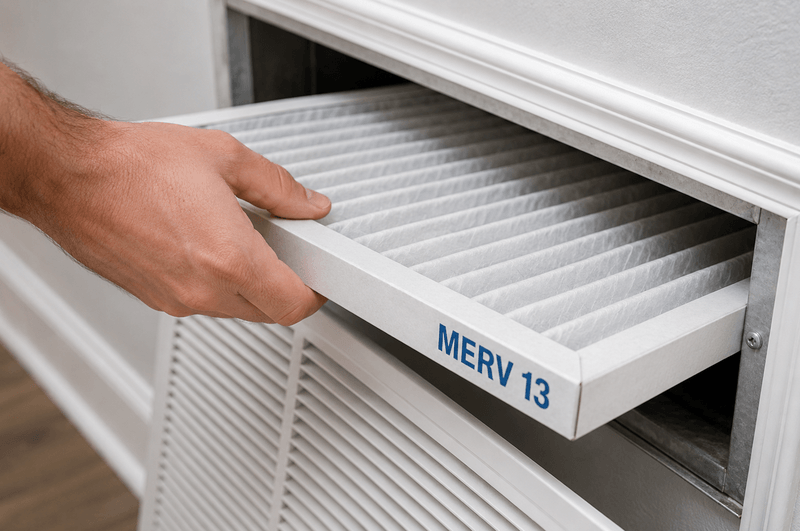
3. Upgrade to a MERV 13 filter for the duration of the smoke event. MERV 13 filters are rated to capture the fine and very fine particles common in wildfire smoke far more effectively than the MERV 8 filters found in many standard HVAC systems, while most residential blowers can still handle the added airflow resistance.
4. Check your filter more often. Smoke loads a filter faster than normal household dust, and a clogged filter restricts airflow and stops protecting your air even before it looks visibly dirty.
5. Set up one clean room with a sealed door and a portable air cleaner if smoke is heavy or lasts more than a day or two, especially for household members with asthma, COPD, or heart disease.
A MERV rating alone will not tell you if the swap is right for your specific system. If your blower already struggles at MERV 8, jumping straight to MERV 13 can restrict airflow further. Filterbuy's guide on confirming the right MERV rating for your HVAC system walks through how to check your system's tolerance, or ask an HVAC technician before changing filter ratings on an older or undersized system.
Virginia Beach families call us during smoke events from fires they never see burning, sometimes a thousand miles north in Canada, sometimes twenty-five miles away in the Great Dismal Swamp. After manufacturing filters for over a decade and serving more than two million households, we have learned that the households who fare best are the ones who already have a MERV 13 filter on hand before the smoke arrives, not the ones scrambling to find one once the sky turns orange.
David Heacock, Founder and CEO, Filterbuy
Essential Resources For Tracking Virginia Beach Wildfire Smoke
Filterbuy keeps this list current for every wildfire and smoke page we publish, so it only includes sources our own team actually checks during a live event.
1. Check The National Map Before Fires Reach Your Area
Source: AirNow Fire and Smoke Map, the official EPA and U.S. Forest Service map of active fires, smoke plumes, and ground-level PM2.5 monitors across North America.
2. Get Virginia's Official Daily Air Quality Forecast
Source: Virginia DEQ Air Quality Forecast, the state's live AQI map and subscription service for Hampton Roads air quality alerts.
3. Know What Symptoms Warrant A Doctor's Call
Source: CDC Wildfire Smoke Safety Guidelines, federal guidance on protecting your health during a smoke event, including who is at higher risk.
4. Learn How Smoke Gets Into A Sealed House
Source: EPA Wildfires and Indoor Air Quality, the EPA's guide to how outdoor smoke infiltrates homes and how HVAC systems and filters reduce it.
5. See The Fire Risk Closest To Virginia Beach
Source: Great Dismal Swamp National Wildlife Refuge Fire Program, the U.S. Fish and Wildlife Service's overview of the refuge's prescribed burn and wildfire suppression program.
6. Track Local Fire Weather Watches And Warnings
Source: National Weather Service Wakefield Forecast Office, the NWS office that issues fire weather watches and the joint air quality forecast for Hampton Roads.
7. Follow National Fire Activity As It Develops
Source: National Interagency Fire Center National Fire News, a daily nationwide count of new fires, large fires, and acres burned, useful for spotting smoke sources before they reach Virginia.
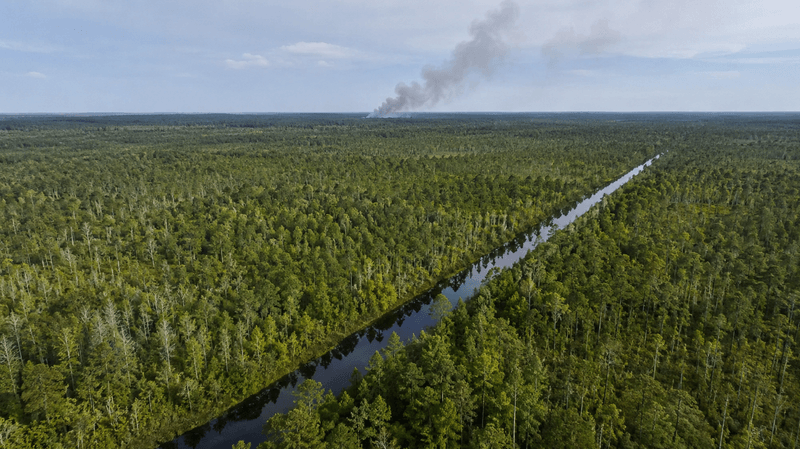
Supporting Statistics
1. The 2011 Lateral West Fire Sent Smoke As Far As Washington, D.C.
A local swamp fire proved smoke does not stay local.
Burned 6,358 acres by August 26, 2011.
Sent smoke plumes over 175 miles to Washington, D.C.
Confirmed by NASA satellite imagery of the event.
Source: NASA Earth Observatory, Hurricane Irene Dampens Great Dismal Swamp Fire.
2. One Avoided Catastrophic Swamp Fire Is Worth An Estimated $3.69 Million In Public Health Benefits
Preventing a major swamp fire pays off directly in public health.
Estimated value: $3.69 million per avoided catastrophic wildfire.
Savings driven mainly by fewer emergency department visits.
Benefit spans seven Virginia counties during smoke exposure periods.
3. Nearly Half Of Americans Now Live With Failing Air Quality Grades
Air quality is worsening nationwide, and wildfire smoke is a named cause.
44 percent of Americans, or 152.3 million people, live in counties with a failing grade.
The 2026 report names Canadian wildfire smoke as a driver of the decline.
That same smoke pattern reached Virginia in 2025 and again in 2026.
Source: American Lung Association, State of the Air 2026 Key Findings.
Final Thoughts And Opinion
Virginia Beach will likely never see a wildfire evacuation notice of its own. That is exactly why so many residents assume smoke maps are for someone else's city. Our view at Filterbuy is the opposite. Coastal cities that rarely think about wildfire smoke are often the least prepared when a distant fire's plume finally reaches them, because the household filter on hand is whatever came with the house, not one rated for fine particles. Checking the map on a smoky day is useful. Having a MERV 13 filter already installed before that day arrives is what actually protects the people inside the house. We have watched this exact gap play out in market after market, and Virginia Beach is simply the next city where it applies.
Next Steps
Filterbuy's checklist for Virginia Beach households heading into smoke season:
Bookmark the AirNow Fire and Smoke Map and check it before spending a full day outdoors this summer.
Subscribe to Virginia DEQ's email alerts for Hampton Roads air quality forecasts.
Check your current HVAC filter's MERV rating and confirm your system can support a MERV 13 upgrade.
Keep at least one spare MERV 13 filter in your home before smoke season, not after, or set up auto-delivery so a fresh one arrives on schedule.
Identify one interior room in your home that could serve as a clean room during a multi-day smoke event.
Frequently Asked Questions
Protect Your Home's Air Before The Next Smoke Event
Filterbuy manufactures MERV 13 air filters in over 600 sizes, made in the USA, so you can find the exact fit for your system before the next smoke event reaches Virginia Beach. Shop MERV 13 Air Filters at Filterbuy to check your filter size and have a replacement ready.
Glossary
AQI (Air Quality Index): The EPA's 0 to 500 scale for reporting how clean or polluted outdoor air is, color coded from Green (Good) to Maroon (Hazardous).
PM2.5: Fine particulate matter measuring 2.5 micrometers or smaller in diameter, small enough to reach deep into the lungs. It is the primary pollutant tracked in wildfire smoke.
MERV Rating: Minimum Efficiency Reporting Value, a 1 to 20 scale rating of how effectively an HVAC filter captures airborne particles of different sizes. Higher numbers capture smaller particles.
HEPA Filter: High Efficiency Particulate Air filter, a filtration standard that captures at least 99.97 percent of particles 0.3 micrometers in size, commonly used in portable air cleaners rather than whole home HVAC systems.
Fire Weather Watch: A National Weather Service alert issued when weather conditions, such as low humidity and high wind, could support rapid wildfire growth in the coming days.
Peat Fire: A slow-burning fire that smolders in partially decomposed organic soil rather than open vegetation, making it difficult to fully extinguish and a heavy producer of smoke over long periods.
Clean Room: A single room in a home sealed off from outside air and equipped with a portable air cleaner, used as a refuge from smoke during a multi-day air quality event.
Ground Level Ozone: A pollutant formed when sunlight reacts with vehicle and industrial emissions, most common in hot, still weather and a separate concern from wildfire smoke particulates.
Marine Haze: Moisture-driven haze from salt spray and coastal humidity. It looks similar to smoke but carries no smell, usually clears by midday, and does not move the AQI reading.
Subscribe to wildfire smoke alerts for Virginia Beach, VA, to get a heads-up before the next event reaches your area.