The moment a wildfire starts near you, you'll get an instant alert and simple tips to reduce your smoke exposure.
30xSmaller than a human hair
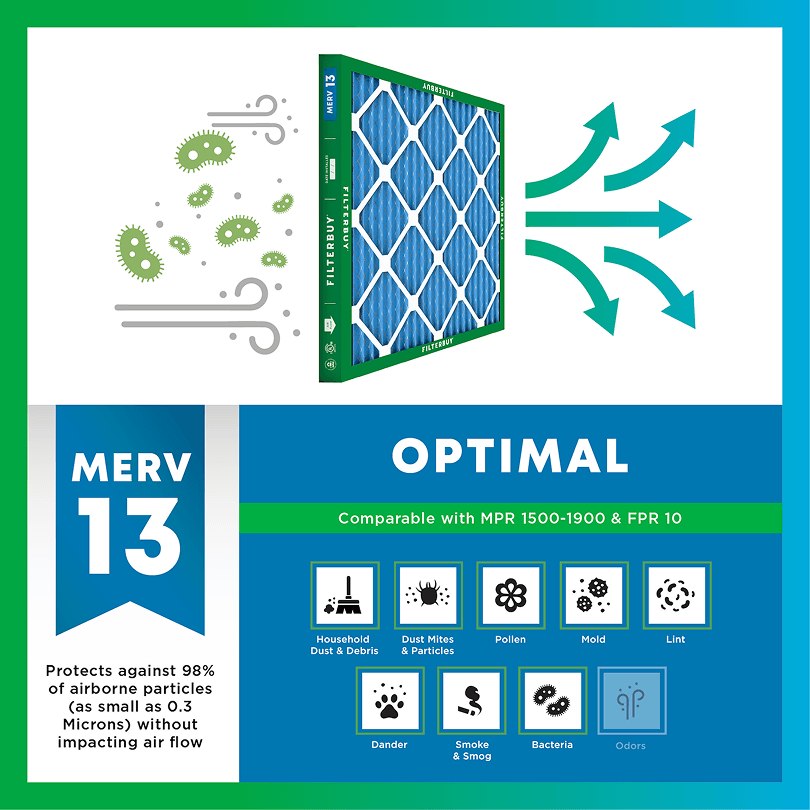
Fine enough to reach deep into the lungs. A MERV 13 is built to capture it.
It Doesn't Stay Local
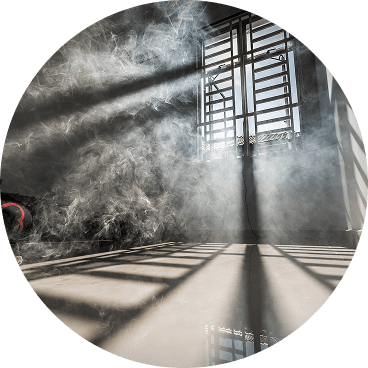
Smoke rides the wind far downwind — you can get smoky air with no fire nearby.
Simple steps to reduce indoor exposure.
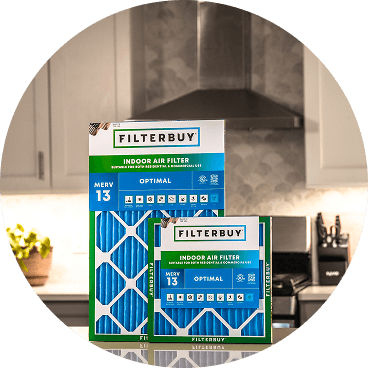
During smoke events, the EPA recommends upgrading to a MERV 13 filter — or the highest-rated filter your system can handle — to help reduce the fine particles smoke brings indoors. MERV 13 is the level most home HVAC systems can run while still capturing PM2.5, the fine particulate that makes up the bulk of wildfire smoke.
Over 70,000 wildfires burn in the U.S. every year.
Wildfire smoke can travel 1,000+ miles, affecting states that aren't even near the blaze.
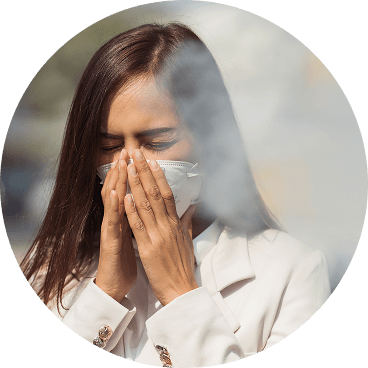
Exposure to wildfire smoke can worsen asthma, trigger heart issues, and lead to ER visits.
Indoor air can hold more fine particles during wildfire events unless it's properly filtered.
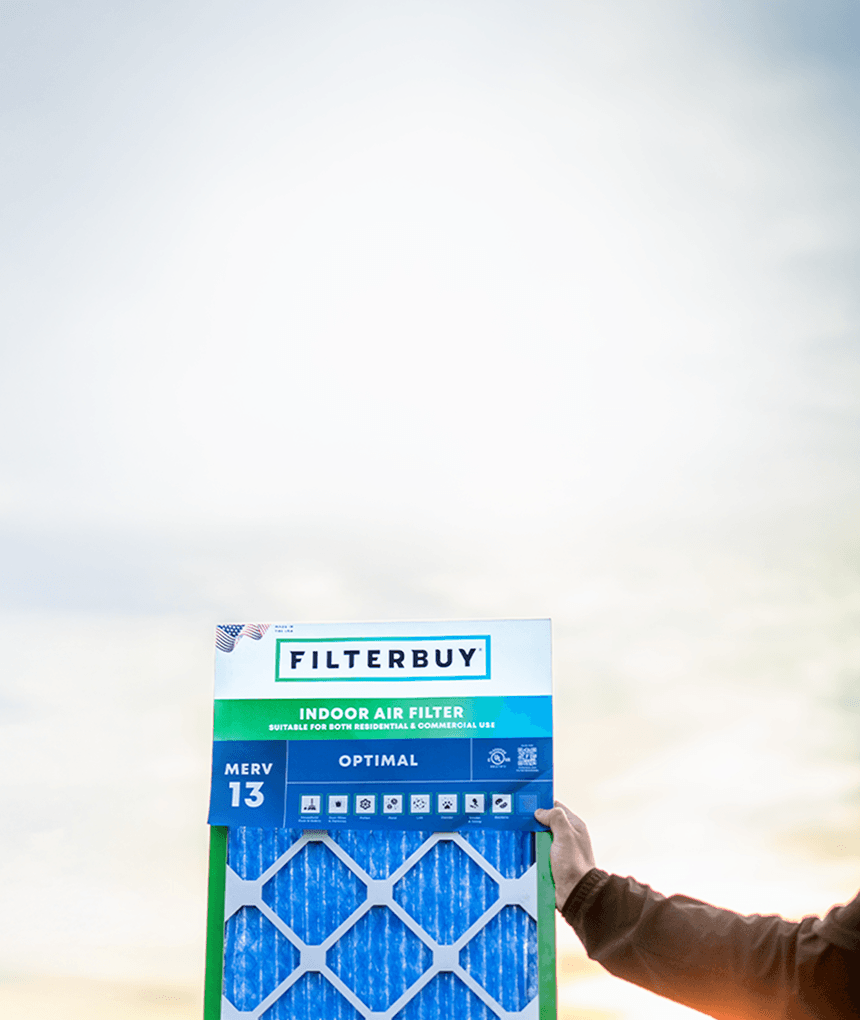
The EPA advises using MERV 13 filters or portable HEPA air cleaners during wildfire smoke events.
Use the live wildfire smoke tracker and upgrade your air filters today to protect your lungs and your home.
Shop Filters For Smoke Protection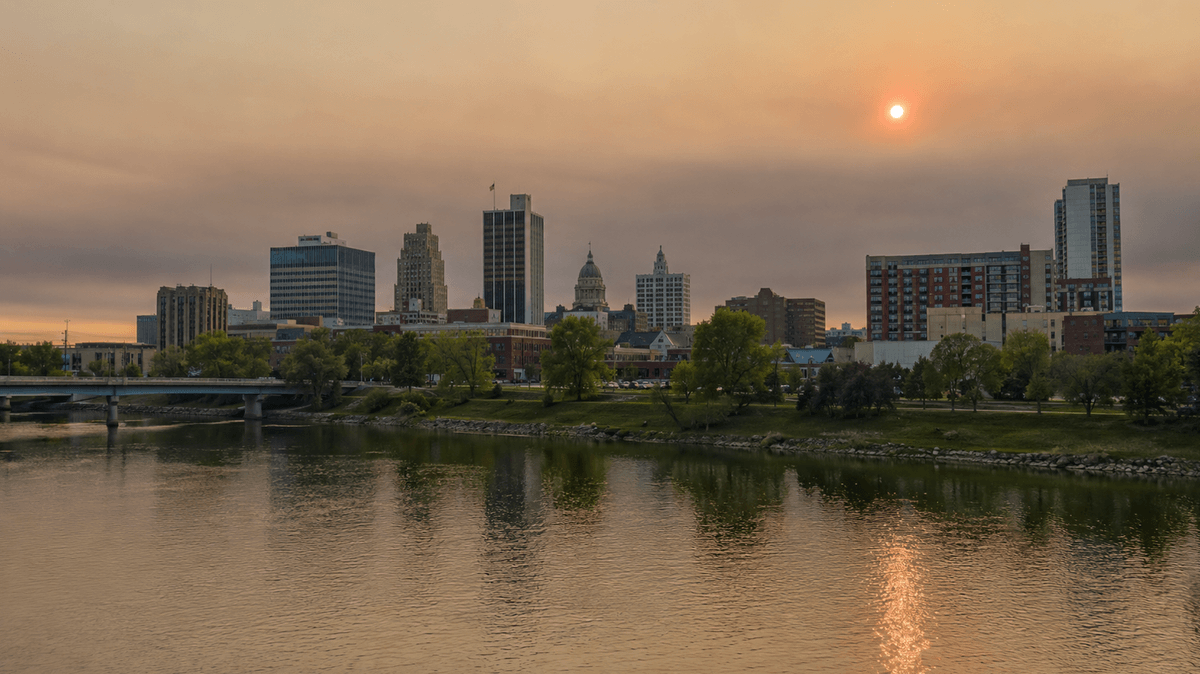
By Michelle Wan, Brand Manager and Air Quality Writer · Reviewed by David Clark, Licensed HVAC Technician · Updated August 9, 2026 · Published August 9, 2026
Fort Wayne seldom burns, which is exactly why smoke season catches Allen County off guard. The haze that turns the Maumee River valley gray in July starts in a boreal forest a thousand miles north, and it arrives with no siren and no fire on the horizon. The Filterbuy live smoke map above tracks it. Below is what the reading means and what to do about it indoors.
Fort Wayne carries almost no wildfire risk of its own. Its smoke arrives from Canadian boreal fires on northerly flow, which can push Allen County PM2.5 from Good into Unhealthy in under a day, as it did over five days in mid-July 2026. Install a MERV 13 filter, seal the house, and set the HVAC fan to On once the AQI passes 100. Central air conditioning stays on.
Fort Wayne sits inside the IDEM Northeast Indiana forecast region, with Angola, Auburn, Decatur, Hartford City, Huntington, LaGrange, Marion, Portland, and Wabash. Any Air Quality Action Day for that region covers Allen County.
Smoke reaches Fort Wayne with no fire burning in Indiana, because plumes travel thousands of miles downwind of the flames.
An AQI of 200 is not twice as bad as 100. The PM2.5 concentration behind it is roughly three and a half times higher.
MERV 13 captures 90 percent or more of PM2.5 and runs in most Fort Wayne homes without starving airflow.
Running central air conditioning during a smoke event is correct, not a mistake. It recirculates indoor air through your filter.
Read the map in one order: smoke plumes first, ground monitors second, fire locations third. Fort Wayne is downwind, so the fire layer often shows nothing while the air outside turns brown.
Fort Wayne is a downwind city, so the fire layer often shows nothing while the air outside turns brown.
Layer one traces to the NOAA Hazard Mapping System, mapping North American smoke since 2002. Layers two and three match the EPA AirNow Fire and Smoke Map.
Fort Wayne AQI shifts hour by hour during a smoke event. The live reading above comes from the Beacon Street and Coliseum monitors inside the 73-site IDEM network and refreshes hourly. Because the AQI is an index rather than a measurement, the table also gives the concentration behind each band.
Concentrations in micrograms per cubic meter, using the PM2.5 breakpoints the EPA revised in May 2024. The EPA 24-hour standard is 35.
The jump worth noticing runs from 150 to 200. The index moves 50 points while the concentration more than doubles, so an orange day and a red day are not one step apart in what your filter has to remove. Our Indiana AQI map and Fort Wayne air quality readings break the number down by pollutant.
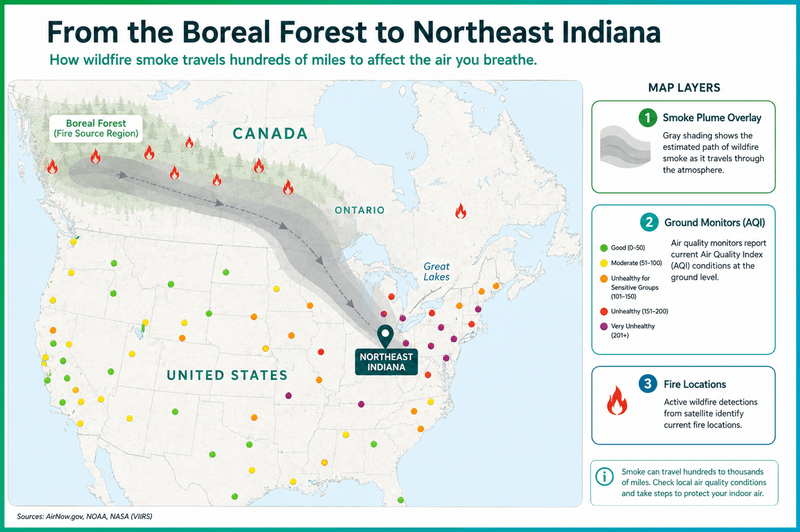
A wildfire in the Canadian boreal forest lifts fine particulate high into the atmosphere, where upper-level winds carry it across the Great Lakes into the Ohio Valley. By the time that smoke settles over Fort Wayne, the fire may be a thousand miles away. The particles are not. They load your filter and settle in your ductwork.
The part you can smell is the smallest part of the problem. Wood smoke odor comes from gases a pleated filter does not capture, which is where an activated carbon filter earns its place, while PM2.5 carries no reliable odor at moderate levels. A household can breathe an Unhealthy reading all afternoon and take the gray sky for ordinary July haze.
Fort Wayne lived through exactly this a few weeks ago. Over roughly five days in mid-July 2026, IDEM issued and extended Air Quality Action Days across Northeast Indiana, naming Fort Wayne. The cause was Canadian wildfire smoke, and no meaningful fire burned in Indiana. Fine particulate rather than ozone drove the advisories, and the forecast reached the Very Unhealthy purple range before settling back to Unhealthy red across the weekend.
Three lessons. The advisories ran consecutive days, so one day of caution was not enough. They were issued by region rather than by city, so a household watching only for its own city name would have missed them. And the worst category arrived partway through, so judging the event by its first morning underestimated it.
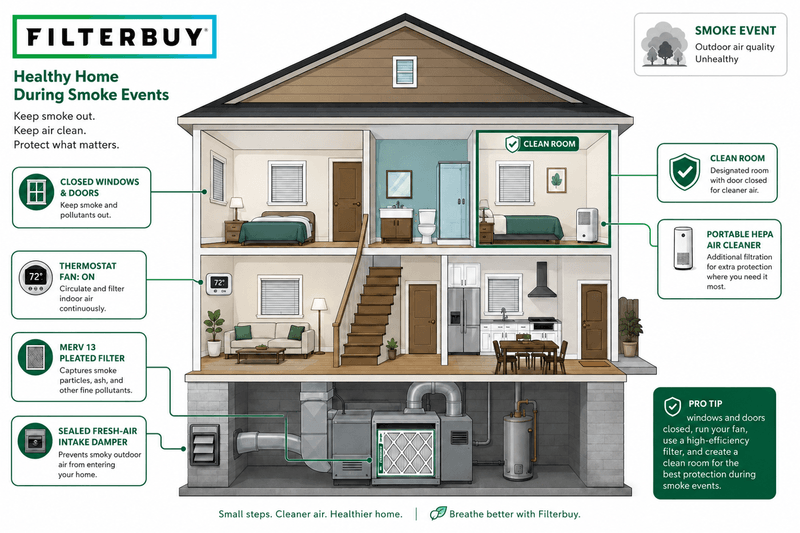
Four moves do most of the work. Three cost nothing. The one that costs money has to happen before the smoke arrives rather than during it, which is the mistake that repeats here every July.
Check the filter every 30 days through smoke season rather than following the calendar. Smoke loads a filter far faster than household dust.
Run your central air conditioning. A residential system recirculates indoor air across a cold coil rather than pulling outdoor air in, so it is the mechanism doing the filtering rather than a conflict with sealing the house.
Three setups do work against you. A window air conditioner with its fresh air vent open draws outdoor air straight past the filter, so close that lever. A whole house or attic fan pulls outdoor air through the whole structure, so leave it off. Any fresh air intake or economiser damper needs closing for the duration, often a manual lever at the air handler. If your only cooling is a window unit that cannot be sealed, the clean room stops being optional.
Filters do not fail in Fort Wayne the way they fail in a fire zone. A house downwind of a Canadian burn never sees ash or heat. It gets three or four days of steady fine particulate, which loads a filter quietly, without the grey mat a homeowner would recognise as a warning. After more than a decade of manufacturing filters and serving two million households, the pattern we see across the Midwest is not people choosing the wrong filter. It is people choosing the right one mid-event, when the useful window closed a week earlier.
David Heacock, Founder and CEO, Filterbuy
EPA AirNow Wildfires publishes the official Fort Wayne AQI, hosts the Fire and Smoke Map, and offers free email alerts.
Indiana SmogWatch is the IDEM system that declares Air Quality Action Days by region, with free alert signup. Northeast Indiana covers Allen County.
NWS Northern Indiana issues Air Quality Alert products for 24 Indiana counties including Allen.
EPA Protect Yourself From Wildfire Smoke, And Ash covers filtration, portable air cleaners, and respirator fit.
CDC: How Wildfire Smoke Affects Your Body names the groups at elevated risk, including children, people who are pregnant, and anyone managing asthma, COPD, or heart disease.
The 2026 United States fire year had produced 45,050 wildfires and 5,253,328 acres burned as of August 4, 2026.
Source: National Interagency Fire Center.
Respiratory hospitalizations rose 1.3 to 10 percent for each 10 microgram per cubic meter rise in wildfire-specific PM2.5, against 0.67 to 1.3 percent for PM2.5 from other sources.
Source: Aguilera et al., Nature Communications, 2021.
Roughly 44 percent of people in the United States live where the air earned an F on at least one measure in the 2026 State of the Air report.
Yes, and it usually happens that way. Canadian boreal smoke has driven Air Quality Action Days across Northeast Indiana with no meaningful wildfire burning in the state.
MERV 13 is the EPA-recommended level for smoke and works in most Fort Wayne homes. Systems with limited static pressure can run MERV 11 instead, which still captures a meaningful share of smoke particulate. If you are weighing a portable unit too, see MERV 13 versus HEPA.
Check the filter every 30 days during smoke season rather than following the calendar. Heavy smoke loads a filter far faster than household dust, and a saturated filter restricts airflow.
The AirNow data refreshes hourly, and satellite smoke polygons update daily or more often during active plume events.
Fort Wayne cannot control what burns in Ontario. It can control what its HVAC systems do about it. Filterbuy has built pleated filters in its own American plants since 2013, in 600 stock sizes plus custom sizes. Shop MERV 13 filters, set up automatic delivery, and bookmark this page so the map stays one click away.
Subscribe to wildfire smoke alerts for Fort Wayne, IN, to get a heads-up before the next event reaches your area.