
Wisconsin Live Wildfire Smoke Map
Get Alerts For Wildfires In Your Area
The moment a wildfire starts near you, you'll get an instant alert and simple tips to reduce your smoke exposure.
What's In The Smoke
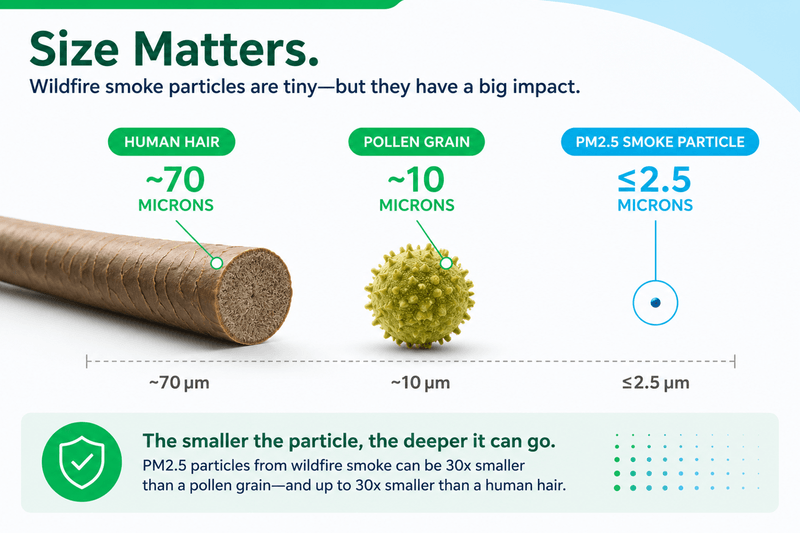
30xSmaller than a human hair
Fine enough to reach deep into the lungs. A MERV 13 is built to capture it.
How Far It Travels


It Doesn't Stay Local
Smoke rides the wind far downwind — you can get smoky air with no fire nearby.
What To Do During A Smoke Event
Simple steps to reduce indoor exposure.
- Stay In, Close UpShut windows and doors to keep smoke out.
- Set Fan To "On"Keeps air cycling through your filter, not just when heating or cooling.
- Recirculate AirSwitch off fresh-air intake so you're not pulling smoke in.
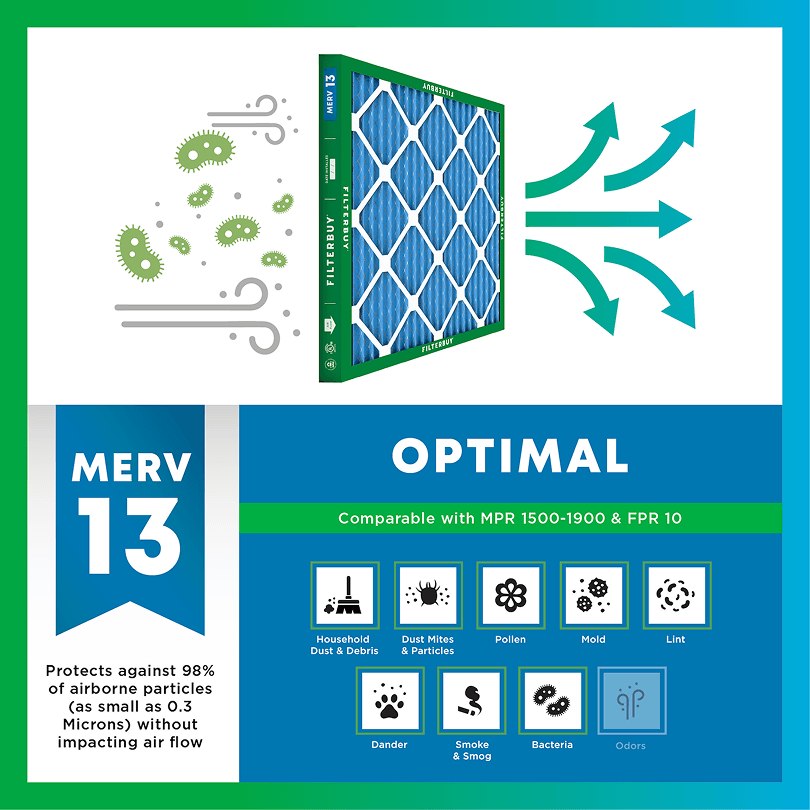
- Run A MERV 13Built to capture the fine PM2.5 in smoke.
- Add A PurifierExtra filtration for the room you use most.
- Wear an N95 if OutsideFits snug to block fine particles — a cloth mask won't.


The Best Air Filter For Wildfire Smoke
During smoke events, the EPA recommends upgrading to a MERV 13 filter — or the highest-rated filter your system can handle — to help reduce the fine particles smoke brings indoors. MERV 13 is the level most home HVAC systems can run while still capturing PM2.5, the fine particulate that makes up the bulk of wildfire smoke.
- Captures PM2.5 particles
- Blocks ash, soot, and smoke odor
- Keeps your indoor air safe—even when the outdoor air is dangerous
- Meets the EPA's recommended rating for filtering fine wildfire smoke particles.

Wildfire Smoke FAQs
Facts About Wildfires
Over 70,000 wildfires burn in the U.S. every year.
Wildfire smoke can travel 1,000+ miles, affecting states that aren't even near the blaze.
Exposure to wildfire smoke can worsen asthma, trigger heart issues, and lead to ER visits.
Indoor air can hold more fine particles during wildfire events unless it's properly filtered.
The EPA advises using MERV 13 filters or portable HEPA air cleaners during wildfire smoke events.
Don't Wait Until The Smoke's Inside.
Use the live wildfire smoke tracker and upgrade your air filters today to protect your lungs and your home.
Shop Filters For Smoke Protection
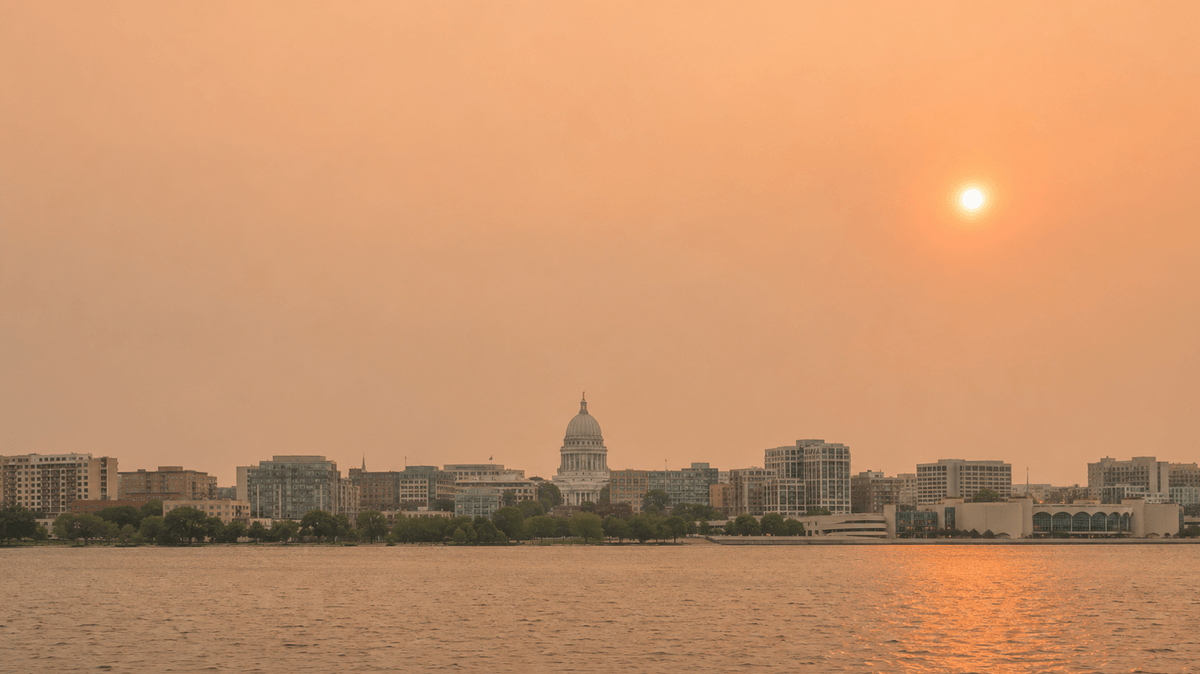
Current Live Forest Wildfire and Smoke Map Today in Wisconsin: Track Fire Activity, Smoke Drift & Air Quality Alerts Across the Badger State in Real Time
By Michelle Wan | Reviewed by David Clark, Licensed HVAC Technician
Published: July 5, 2026 | Updated: July 5, 2026
How To Check Wisconsin’s Live Wildfire And Smoke Map Right Now
Wisconsin’s most reliable live wildfire and smoke view combines two free tools. The AirNow Fire and Smoke Map, built by the EPA and the U.S. Forest Service, layers active fire icons, gray smoke plumes, and color-coded air-quality readings across North America and refreshes about every hour. The Wisconsin DNR Wildfire Dashboard adds in-state fire detections and updates its fire-danger and occurrence data roughly every five minutes. Open both, find your county, and read the dot closest to you.
TL;DR Quick Answers
Wisconsin rarely burns on the scale of the western states, yet its air turns unhealthy almost every summer because Canadian wildfire smoke drifts hundreds of miles south into the Badger State. The fastest way to know what you are breathing right now is the AirNow Fire and Smoke Map from the EPA and U.S. Forest Service, paired with the Wisconsin DNR wildfire and air-quality dashboards. When the map shows orange or worse near you, close up the house, set your HVAC fan to run continuously, and run a MERV 13 filter to capture the fine particles that make smoke dangerous. Filterbuy, a U.S. air-filter manufacturer, built this guide to keep those live maps and the filter steps that protect your home in one place.
Key Takeaways
Wisconsin’s summer smoke almost always originates in Canada, not in-state. The Wisconsin DNR reports that smoke must sink to the surface to harm health, which is why a hazy sky does not always mean unhealthy air.
2023 and 2025 were Wisconsin’s two heaviest smoke years on record. In 2023, the DNR issued the most wildfire-smoke air-quality advisories the state had seen in more than a decade, including its first-ever Very Unhealthy advisory.
PM2.5 is the pollutant that matters. These particles measure 2.5 micrometers or smaller, slip past your body’s natural defenses, and reach deep into the lungs and bloodstream.
The EPA recommends a MERV 13 filter for smoke. It is the lowest household rating that meaningfully captures PM2.5. A MERV 13 filter is high-efficiency, but it is not a HEPA filter.
Layered protection works best. Close the house, set the HVAC fan to On, run a MERV 13 filter, add a portable or DIY air cleaner in one room, and add activated carbon for lingering smoke odor.
Reading The Map In Three Steps
Find your location. Let the map use your device location, type your city or ZIP, or zoom to your street.
Read the nearest dot. Every dot is a current air-quality reading, colored by the U.S. Air Quality Index. Green is good, yellow is moderate, orange means unhealthy for sensitive groups, red is unhealthy, purple is very unhealthy, and maroon is hazardous.
Check the marker shape. Circles are permanent government monitors and the most accurate. Other shapes are temporary monitors and lower-cost sensors. When two nearby readings disagree, trust the closest official monitor, and when you are unsure, act on the worse number.
For a deeper walkthrough of every icon and color, read our guide on how to read a wildfire smoke map.
What To Do At Each Air Quality Level In Wisconsin
Reading the map is step one. Here is what each level means for a Wisconsin household.
Air Quality Index categories and colors follow the U.S. EPA scale shown on the AirNow Fire and Smoke Map.
Wisconsin’s Wildfire And Smoke Reality: Why The Badger State Keeps Getting Smoked
Wisconsin’s wildfire-smoke problem is mostly an imported one. The Wisconsin DNR Air Management Program traces the state’s worst recent smoke episodes to fires burning thousands of miles away in Canada, carried south on the jet stream until the particles sink to ground level. That is why residents can smell smoke and see an orange sun on a day when no Wisconsin forest is burning.
We watch this from an unusual angle. Filterbuy is a U.S. air-filter manufacturer, so we build and test our filters here at home, and when Canadian smoke pushes south, families in smoke-affected states ask us the same thing: whether their everyday filter is enough. For most homes it is not, and closing that gap is what this resource is for.
The pattern has intensified fast. According to the Wisconsin State Climatology Office and the DNR, Wisconsin issued springtime wildfire-smoke advisories in 2023, 2024, and 2025, after roughly a decade without a single spring advisory. In 2023, Canadian smoke drove the most Wisconsin air-quality advisories in more than a decade and prompted the DNR’s first-ever Very Unhealthy advisory.
2025 rivaled it. Through late July, Wisconsin logged 17 days of air quality degraded by wildfire smoke, and Eau Claire reached an Air Quality Index of 174 on July 31, 2025, its highest reading since the city began keeping records in 2009. Milwaukee recorded 15 smoke-driven advisory days that year, compared with zero in 2024.
Wisconsin does have its own fire season. The DNR reports that debris burning is the leading cause of in-state wildfires, with risk peaking in spring before green-up. For homeowners, the takeaway is simple. Whether the smoke starts in Manitoba or in a Wisconsin backyard burn pile, the air you breathe indoors is something you can control.
Wisconsin Wildfire Smoke At A Glance
Compiled by Filterbuy from Wisconsin DNR, the Wisconsin State Climatology Office, and EPA guidance. Figures reflect the 2023–2025 seasons and are not live values.
What Wildfire Smoke Does To Your Health
Wildfire smoke is a mix of gases and fine particles, and the fine particles do the real damage. The main concern is PM2.5. To picture how small that is, a human hair is about 70 microns across and a grain of pollen about 10 microns, while PM2.5 particles measure 2.5 microns or less. They slip past the nose’s natural filtering, settle deep in the lungs, and can pass into the bloodstream.
Research suggests smoke particles may be harsher than ordinary city pollution. In a widely cited Southern California study published in Nature Communications, Aguilera and colleagues found that PM2.5 from wildfires was associated with a larger rise in respiratory hospital visits than the same amount of PM2.5 from other sources. Wisconsin health officials describe the same real-world symptoms during smoke events, including irritated eyes, sore throat, coughing, wheezing, and shortness of breath.
Who Is Most At Risk In A Smoke Event
The CDC identifies several groups who should be extra careful when wildfire smoke moves in. Everyone can feel the effects, but these groups feel them sooner and more severely.
Children and teens, whose lungs are still developing and who breathe more air for their body size.
Older adults, who are more likely to have undiagnosed heart or lung conditions.
People with asthma, COPD, heart disease, diabetes, or chronic kidney disease.
People who are pregnant.
If you or a family member falls into one of these groups, the DNR and CDC advice is to watch symptoms closely, limit heavy exertion outdoors on advisory days, and move activities inside. The CDC publishes specific steps for people with chronic conditions. Air filtration is a supporting tool that reduces exposure indoors. It is not a substitute for medical guidance, so follow your healthcare provider and any asthma action plan you have.
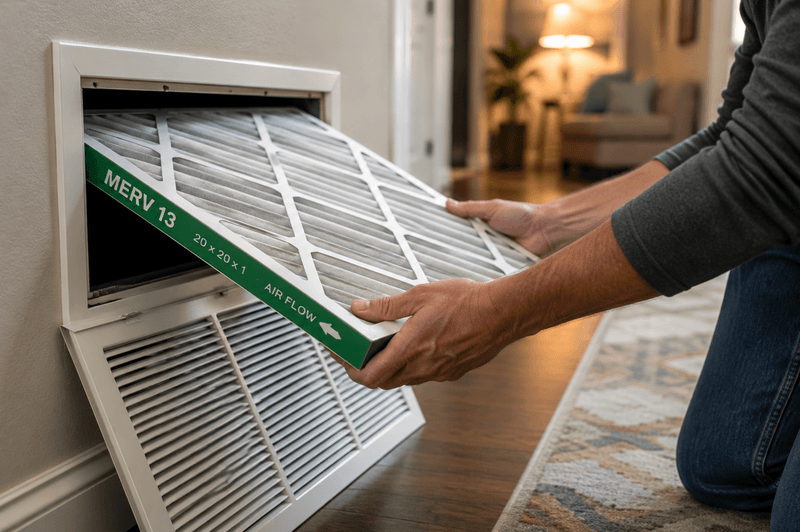
How To Protect Your Home And Family When Smoke Reaches Wisconsin
When the map turns orange, your goal is two-part. Keep outdoor smoke from getting in, and clean the air that is already inside. This is the routine we walk families through, and it lines up with guidance from the EPA, the CDC, and the Wisconsin DNR. None of it is expensive.
Seal the house. Close windows and exterior doors, and block gaps at the bottom of doors. If your HVAC or window unit has a fresh-air intake, close it or set the system to recirculate.
Run the fan continuously. Switch your thermostat fan from Auto to On so indoor air keeps cycling through the filter instead of only running during heating or cooling.
Install a MERV 13 filter. The EPA recommends MERV 13 or higher because it captures a large share of the fine PM2.5 in smoke. Make sure it fits snugly with no air slipping around the edges.
Set up one clean room. Pick a room with few windows, keep the door closed, and run a portable air cleaner sized for the space. This gives sensitive family members a low-smoke place to rest and sleep.
Replace filters more often. Heavy smoke can load a MERV 13 filter in 30 to 60 days instead of the usual three months. Check it about every 30 days during smoke season and swap it when it looks dark or airflow drops.
Cut indoor sources. Hold off on frying, broiling, burning candles, using gas appliances, and vacuuming with a non-sealed vacuum, since all of these add particles to indoor air.
Mask up outdoors. If you must be outside during heavy smoke, a well-fitted NIOSH-approved N95 respirator reduces how much smoke you breathe in.
Why MERV 13 Is The Sweet Spot For Smoke
A MERV rating measures how well a filter captures particles, and higher numbers capture smaller particles. Most homes ship with a thin fiberglass filter rated MERV 1 to 4, which stops lint and large dust but lets most smoke particles pass straight through. MERV 8 and MERV 11 improve everyday dust and allergen capture, yet neither reaches the fine-particle range the EPA recommends for smoke. MERV 13 is the lowest household rating that captures PM2.5 well, which is why it has become the smoke-season standard. Because Filterbuy manufactures and tests its own MERV 13 media in the USA against real-world contaminants, including wildfire smoke, that recommendation comes from building the filter rather than reading a rating chart.
One caution matters here. A MERV 13 filter is high-efficiency, but it is not the same as HEPA, and it is not a portable HEPA purifier. MERV 13 also asks more of your blower than a thin filter does, so confirm your system can handle it before fire season. If you are unsure, ask a licensed HVAC technician to check airflow, which is exactly what our reviewer recommends below.
For a rating-by-rating breakdown built specifically around smoke, see our guide to the best MERV filter for wildfire smoke.
A Low-Cost Backup: The DIY Box-Fan Air Cleaner
When portable air cleaners sell out during a smoke event, the EPA endorses a do-it-yourself alternative. You tape a MERV 13 filter to a box fan, matching the airflow arrow to the fan direction, and run it on high in a closed room. EPA testing on DIY air cleaners found well-built versions reduce indoor smoke particles quickly, and adding a cardboard shroud or a thicker filter improves the result. Use only a certified box fan from 2012 or newer for safety.
Do Not Forget The Smell: Particles Versus Gases
Standard filters capture particles, not gases, which is why a campfire odor can linger after the visible haze clears. The EPA notes that smoke also contains gases and odors that a particle filter does not remove. To capture that lingering smell, pair your MERV filter with an activated-carbon option such as an Odor Eliminator filter, which adds a layer that adsorbs odor molecules a particle-only filter misses.
Common Smoke-Season Mistakes Wisconsin Homeowners Make
After a few smoke seasons, the Filterbuy team keeps seeing the same avoidable mistakes in Wisconsin homes. These are the ones worth fixing first.
Judging a filter by how it looks. A MERV 13 can fill with fine smoke particles before it looks dirty. During an event, go by time rather than appearance, and check it about every 30 days.
Leaving the fan on Auto. Auto filters the air only while the system heats or cools. Set the thermostat fan to On so indoor air keeps cycling through the filter.
Reading the sky instead of the map. The Wisconsin DNR notes that smoke has to reach the surface to affect your health, so a clear-looking day can still be unhealthy and a hazy one can be fine. Trust the nearest monitor.
Expecting a MERV 13 to remove the smell. Particle filters capture particles, not the gases behind smoke odor. Add an activated-carbon option when the campfire smell lingers.
Opening the windows too soon. Air the house out only after the map shows the air near you has returned to green or yellow, because smoke can settle back in quickly.
Working alongside our U.S. manufacturing team, I have watched how much a filter’s rating actually matters once smoke is in the air. The filters we build get tested against real-world contaminants, including wildfire smoke, so when I tell a Wisconsin family to put in a MERV 13 before the season, it is because I have seen what that media does and does not catch. A live map tells you when smoke arrives. The filter decides how much of it your kids breathe at home.
Michelle Wan, Brand Manager and Copywriter, Filterbuy
7 Essential Resources For Tracking Wisconsin Wildfire Smoke
These are the free, authoritative tools we recommend bookmarking before smoke season. Each opens to live or near-live conditions for Wisconsin.
Live fire, smoke plume, and PM2.5 air-quality map for all of North America, from the EPA and U.S. Forest Service.
Source: AirNow Fire and Smoke Map
Near-real-time in-state fire detections, fire danger, and burn activity from Wisconsin’s forestry agency.
Source: Wisconsin DNR Wildfire Dashboard
Wisconsin DNR forest fire program hub for fire danger, burn restrictions, and air-quality advisory sign-up.
Source: Wisconsin DNR Forest Fire Program
National fire news and large-incident summaries from the interagency wildfire coordination center.
Source: National Interagency Fire Center
Fire-weather watches, warnings, and forecasts for southern Wisconsin from the National Weather Service.
Source: NWS Milwaukee Fire Weather
CDC guidance on who is most at risk from wildfire smoke and how to protect them.
Source: CDC Wildfire Smoke Health Guidance
AQI readings shown alongside the U.S. Drought Monitor, useful for tracking the conditions that fuel smoke.
Source: Drought.gov Fire and Smoke Map
3 Supporting Statistics On Wildfire Smoke And Air Filtration
Three numbers back up the guidance above, drawn from a federal agency, peer-reviewed research, and a national health nonprofit.
A high-efficiency filter cuts indoor PM2.5 by about 50%. That is the drop the U.S. EPA reports when you run the HVAC fan continuously with the filter in place.
Source: EPA: Strategies to Reduce Exposure Indoors
Wildfire PM2.5 is more dangerous than ordinary PM2.5. A 10 µg/m³ rise tracked a 1.3% to 10% increase in respiratory hospitalizations, versus 0.67% to 1.3% for other sources (Aguilera et al., 2021).
Source: Aguilera et al., Nature Communications (2021)
802,686 Wisconsin children breathe unhealthy air. The American Lung Association ties the fine-particle pollution behind those failing grades partly to wildfires.
Source: American Lung Association: State of the Air 2026 (Wisconsin)
Final Thoughts And Opinion
Wisconsin summers now come with a new seasonal question, which is whether the air outside is safe to breathe. You cannot stop Canadian wildfires, and you cannot control the wind that carries their smoke over Lake Superior. What you can control is the air inside the walls where your family sleeps.
At Filterbuy, we are air-obsessed for a reason. The invisible part of a smoke event, the fine PM2.5 that you cannot see, is the part that reaches the lungs. A live map tells you when it has arrived, and the right filter decides how much of it your family actually breathes. We build these filters and run them in our own homes, so the advice here is the same advice we follow when the smoke reaches us. Check the map in the morning, keep a MERV 13 filter on the shelf before the smoke rolls in, and you turn a stressful advisory day into a manageable one.
Next Steps
Bookmark the AirNow Fire and Smoke Map and the Wisconsin DNR Wildfire Dashboard from the resources above, then sign up for Wisconsin DNR air quality advisories by email or text so you know the moment smoke moves in.
Confirm your system fits a MERV 13 filter, then read our step-by-step guide to keep wildfire smoke out of your house.
Stock at least one spare MERV 13 filter before smoke season so you are not searching for one the day the sky turns orange.
Frequently Asked Questions
Protect Your Wisconsin Home’s Air With Filterbuy
At Filterbuy, we are obsessed with better air for all, and we build our filters in the USA in more than 600 sizes. When Canadian smoke drifts over the Badger State, the right MERV 13 filter helps you protect your greatest assets, which are your family, your home, and your HVAC system. Check the live map, then get the filter that keeps your indoor air clean when the outdoor air is not.
Ready when you are: shop MERV 13 air filters made in the USA and shipped to your door.
Glossary
AQI (Air Quality Index): A color-coded scale from the U.S. EPA that reports how clean or polluted the air is, from green (good) through maroon (hazardous).
PM2.5: Fine particulate matter measuring 2.5 micrometers or smaller. It is the main harmful pollutant in wildfire smoke and can reach deep into the lungs and bloodstream.
MERV (Minimum Efficiency Reporting Value): A 1-to-16 rating scale for household air filters. Higher numbers capture smaller particles. The EPA recommends MERV 13 or higher for wildfire smoke.
HEPA: High-Efficiency Particulate Air, a filter standard used in portable air purifiers that captures very fine particles. A MERV 13 HVAC filter is high-efficiency but is not HEPA.
AirNow Fire and Smoke Map: A free live map from the EPA and U.S. Forest Service showing fires, smoke plumes, and PM2.5 air-quality readings across North America.
Wisconsin DNR: The Wisconsin Department of Natural Resources, the state agency that tracks wildfires, sets burn restrictions, and issues air-quality advisories for Wisconsin.
Clean room: A single room, chosen for having few windows and doors, where a portable or DIY air cleaner keeps smoke particles low during an event.
Activated carbon: A filter material that adsorbs gases and odor molecules, used alongside particle filtration to reduce lingering smoke smell.
Subscribe to wildfire smoke alerts for Wisconsin to get a heads-up before the next event reaches your area.