
Stockton, CA Live Wildfire Smoke Map
Get Alerts For Wildfires In Your Area
The moment a wildfire starts near you, you'll get an instant alert and simple tips to reduce your smoke exposure.
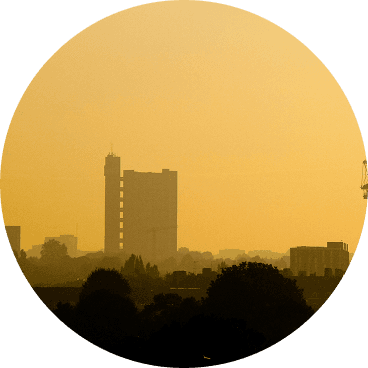
What's In The Smoke
30xSmaller than a human hair
Fine enough to reach deep into the lungs. A MERV 13 is built to capture it.
How Far It Travels


It Doesn't Stay Local
Smoke rides the wind far downwind — you can get smoky air with no fire nearby.
What To Do During A Smoke Event
Simple steps to reduce indoor exposure.
- Stay In, Close UpShut windows and doors to keep smoke out.
- Set Fan To "On"Keeps air cycling through your filter, not just when heating or cooling.
- Recirculate AirSwitch off fresh-air intake so you're not pulling smoke in.
- Run A MERV 13Built to capture the fine PM2.5 in smoke.
- Add A PurifierExtra filtration for the room you use most.
- Wear an N95 if OutsideFits snug to block fine particles — a cloth mask won't.


The Best Air Filter For Wildfire Smoke
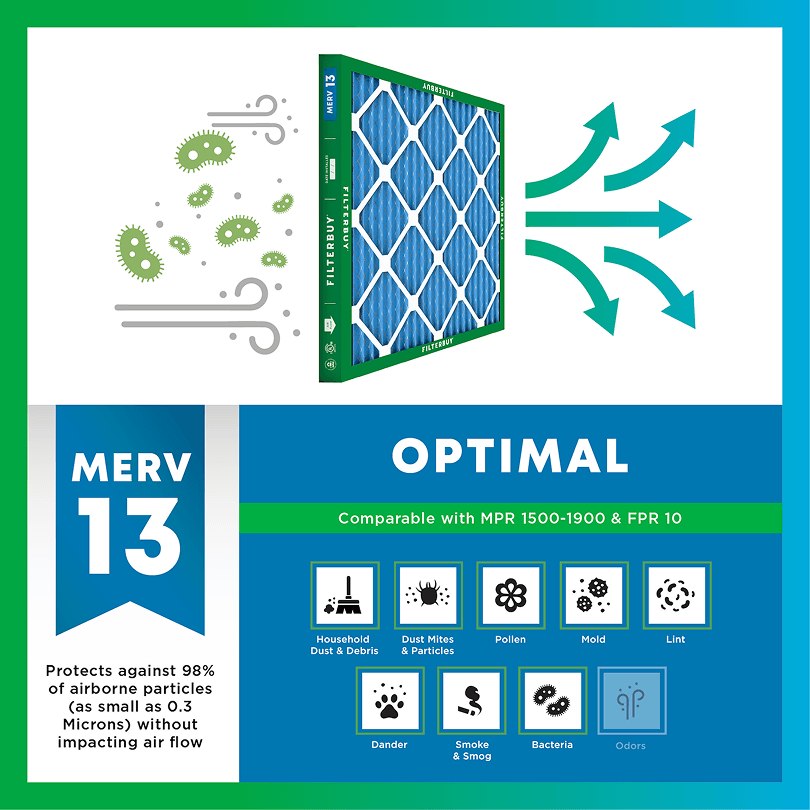
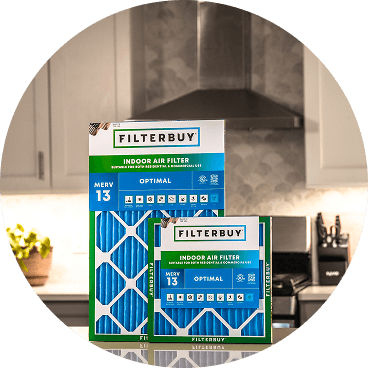
During smoke events, the EPA recommends upgrading to a MERV 13 filter — or the highest-rated filter your system can handle — to help reduce the fine particles smoke brings indoors. MERV 13 is the level most home HVAC systems can run while still capturing PM2.5, the fine particulate that makes up the bulk of wildfire smoke.

- Captures PM2.5 particles
- Blocks ash, soot, and smoke odor
- Keeps your indoor air safe—even when the outdoor air is dangerous
- Meets the EPA's recommended rating for filtering fine wildfire smoke particles.

Wildfire Smoke FAQs
Facts About Wildfires
Over 70,000 wildfires burn in the U.S. every year.
Wildfire smoke can travel 1,000+ miles, affecting states that aren't even near the blaze.
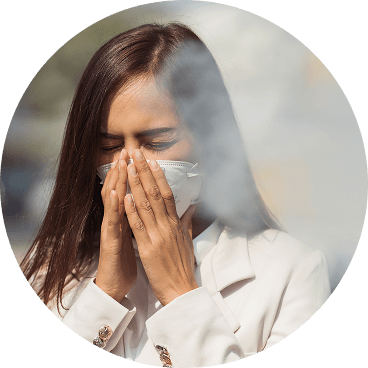
Exposure to wildfire smoke can worsen asthma, trigger heart issues, and lead to ER visits.
Indoor air can hold more fine particles during wildfire events unless it's properly filtered.
The EPA advises using MERV 13 filters or portable HEPA air cleaners during wildfire smoke events.
Don't Wait Until The Smoke's Inside.
Use the live wildfire smoke tracker and upgrade your air filters today to protect your lungs and your home.
Shop Filters For Smoke Protection
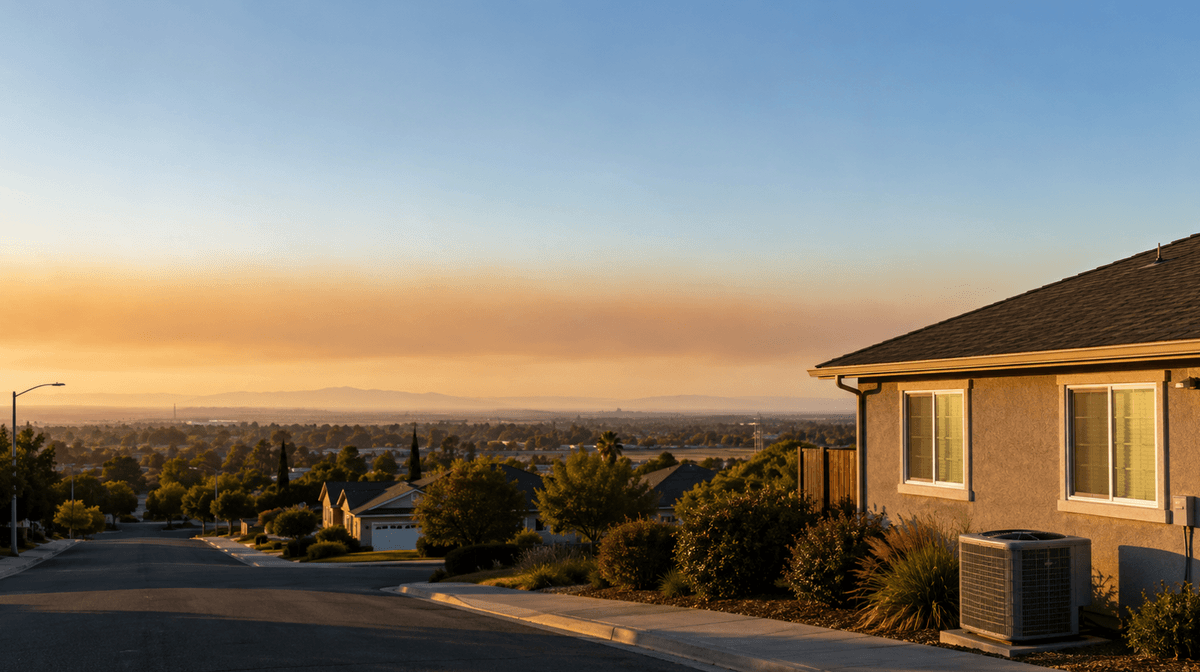
Smoke Gets Trapped in the Valley, Current Live Forest Wildfire and Smoke Map Today in Stockton, CA – Track Wildfires and Smoke Drifting In From Sierra Foothills
By Michelle Wan, Brand Manager and Air Quality Writer at Filterbuy
Reviewed by David Clark, CEO of Filterbuy HVAC Solutions and Licensed HVAC Technician
Published July 28, 2026
Updated July 28, 2026
Is there wildfire smoke in Stockton today? The map above answers that. Here is what other smoke maps leave out: Stockton vents through one gap, the Delta breeze, and it stalls on the same hot, high-pressure days the foothills burn hardest. Filterbuy manufactures the air filters that catch what gets inside, which is why we read these maps closely all season.
TL;DR
Wildfire smoke drifting west from the Sierra Nevada foothills settles over Stockton instead of blowing through, because the city sits on the San Joaquin Valley floor. The Filterbuy live map below shows active fires, smoke plumes, and real-time AQI for Stockton and San Joaquin County. When smoke arrives, close windows, set your HVAC fan to "On," switch to recirculate, and run a MERV 13 filter, the rating the EPA recommends during smoky periods.
Key Takeaways
Stockton’s air clears mainly through the Delta breeze, which often fails on the hottest, most fire-prone days.
The San Joaquin Valley does not meet federal standards for ozone or PM2.5, carrying an extreme ozone nonattainment classification. Smoke lands on a baseline that is already high.
Fires in the Mokelumne, Calaveras, and Stanislaus canyons sit 40 to 70 miles east, close enough for plumes to arrive the same day.
Valley smoke often peaks overnight and just after sunrise, hours after most people last checked.
The EPA recommends MERV 13 or higher during smoky periods, with the fan set to "On" rather than "Auto."
How to Check Stockton Wildfire Smoke Conditions Right Now
Four free tools cover Stockton. Start with the live map above, then confirm the reading where you actually live, because smoke is patchy and the Stockton monitor can differ from Weston Ranch, Lincoln Village, or Morada by a full AQI category. The other three are the EPA's AirNow Fire and Smoke Map, the Valley Air District's RAAN network, and the CAL FIRE incident list.
Check all four during an active smoke event. On a normal day, the live map alone is enough. Links to each tool appear in the paragraph above this table.
One trap, and it bites Stockton harder than most cities. An AQI dial reports whichever pollutant is worst right now, and EPA warns that if no PM2.5 monitor is nearby, the dial may not show how smoke is affecting your air. Stockton's dominant summer pollutant is ozone, so during a smoke event your phone may be describing something else entirely.
Why Smoke Gets Trapped in Stockton: The Delta Breeze Paradox
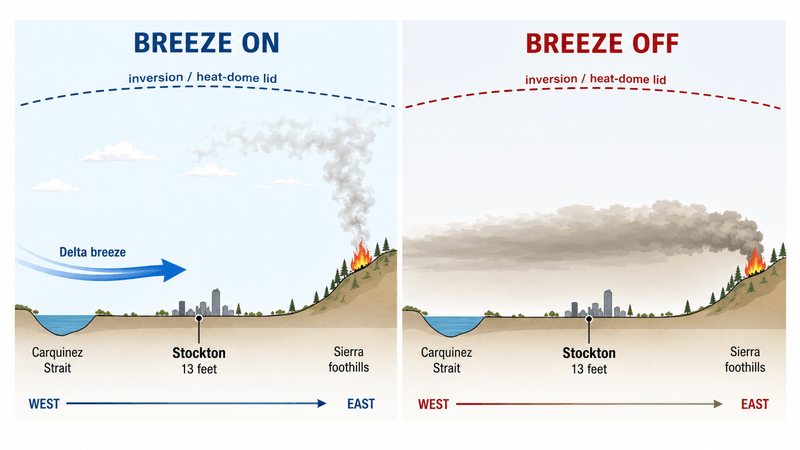
Stockton has one real exhaust vent, and it fails on the worst possible days. The city sits at roughly 13 feet above sea level, walled by the Coast Ranges to the west and the Sierra Nevada to the east. The single low gap is the Carquinez Strait, which funnels marine air inland as the Delta breeze, strongest from June through September and most reliable when valley temperatures top 95°F.
Heat dome conditions that suppress the Delta breeze are the same conditions that drive extreme fire behavior. When high pressure shuts down onshore flow, Stockton loses its ventilation precisely when the foothills burn hardest. That is why the AQI can slide from Moderate to Unhealthy in hours, why a smoke event here outlasts the fire that caused it, and why winter repeats the trapping through temperature inversions.
Which Wildfires Actually Send Smoke to Stockton
Most of Stockton’s summer smoke starts 40 to 70 miles east, in the foothill and canyon country of Amador, Calaveras, and Tuolumne counties. Fires in the Mokelumne, Calaveras, and Stanislaus drainages sit directly upwind under typical summer flow, and their plumes can reach the city the same day they ignite.
Distances are approximate. Foothill fires sit roughly 40–70 miles east of Stockton, close enough for plumes to arrive the same day.
When Stockton’s Smoke Is Worst: The Overnight Window
Stockton smoke concentrations often peak between roughly 2:00 a.m. and 9:00 a.m., not in the afternoon when most people check. After sunset, air drains downslope out of the Sierra canyons onto the valley floor, carrying smoke with it, while a nocturnal inversion caps it near the ground. The bad-air window opens while you sleep. Check twice: before bed, and before you open up. The Stockton RAAN monitor reports hourly.
I check smoke maps across Filterbuy’s coverage areas most mornings during fire season. Stockton is the one where the overnight reading and the afternoon reading tell completely different stories, and almost nobody is looking at the first one.
Michelle Wan, Brand Manager and Air Quality Writer, Filterbuy
What to Do When Smoke Reaches Stockton
Five steps, in order of impact, following EPA guidance on creating a clean room and reducing exposure indoors.
Close windows and doors, including overnight, even when it is cooler outside.
Set your HVAC fan to "On," not "Auto." The filter only works while air moves through it.
Close the fresh-air intake or switch to recirculate. With an evaporative cooler, the EPA advises covering the outside intakes with 4-inch MERV 13 filters or using it sparingly.
Install a MERV 13 filter. EPA notes most systems accommodate one without equipment problems when it is replaced frequently. Check your maximum rating first. Our comparison of MERV 13 versus HEPA explains why MERV 13 is the whole-home answer, and HEPA is the bedroom one.
Replace filters far more often than the box says. Smoke loads media fast. Change it when it looks dark brown or black. See the best MERV filter for wildfire smoke.
Add a portable HEPA cleaner in the bedroom if you can. Then reopen deliberately: EPA advises airing out whenever air quality improves. In Stockton, that window is the evening after the Delta breeze returns, not midday.
If You Cool with a Swamp Cooler, That Is Your First Problem
An evaporative cooler pulls outdoor air through wet pads and blows it inside: a continuous, unfiltered intake. No filter upgrade fixes it, because the cooler bypasses the furnace. EPA advises against relying on evaporative coolers during smoky periods, and warns the same about single-hose portable air conditioners. Decide before fire season how you will cool without it. The Valley Air District operates Clean Air Centers for this reason.
Renting, or Cannot Get at the Filter?
Plenty of Stockton households do not control their HVAC, and most smoke advice assumes otherwise. The fallback is the EPA's DIY air cleaner: a box fan made in 2012 or later with a UL or ETL mark, plus one or more MERV 13 filters, run where you sleep. Filterbuy stocks MERV 13 in 600+ sizes, including the 20x20 panels most builds use. Buy in June, because portable cleaners sell out within days of a smoke event.
A filter only does its job while the blower is moving air, and most systems I open up in the Valley are set to "Auto," so they sit idle overnight, which is exactly when Stockton’s smoke peaks. Switching that fan to "On" is the first change I make in a Stockton house during fire season.
David Clark, CEO of Filterbuy HVAC Solutions and Licensed HVAC Technician
Essential Resources
Seven tools, in the order worth reading them.
AirNow Fire and Smoke Map – EPA monitors, sensors, fire locations, and plumes in one view.
myRAAN – hourly Valley readings by street address, with alerts, from the Valley Air District.
CAL FIRE Incidents – acreage, containment, and evacuations for every fire over 10 acres.
Valley Air District Daily Forecast – next-day air quality by county, issued each afternoon.
NWS Stockton point forecast – wind speed and direction, which decide whether smoke clears or pools. Wind is the variable; AQI is only the result.
EPA Clean Room guide – room selection, recirculate settings, MERV 13, and DIY cleaners.
CARB Certified Air Cleaning Devices – required for purifiers sold in California. Certification covers ozone and electrical safety, not effectiveness, so use it to rule products out.
Supporting Statistics
Three findings from U.S. federal agencies, each retrieved from the issuing source.
52% of all PM2.5 emitted in the United States comes from wildland fires. Smoke is now the single largest source of the pollutant your filter has to catch. EPA, 2020 National Emissions Inventory
Indoor PM2.5 runs 55–60% of outdoor levels during a smoke event with windows closed and no air cleaner running, reaching 100% in leakier homes. Sealing the house is step one, not the finish. EPA, Strategies to Reduce Exposure Indoors
Asthma-related ER visits ran 17% above expected across 19 wildfire smoke days in 2023. CDC counted a smoke day at AQI 101 or higher, a line Stockton crosses routinely. CDC, MMWR Vol. 72, No. 34
Frequently Asked Questions
The Smoke Is Trapped. Your Indoor Air Does Not Have to Be.
Keep the live map open through fire season to track foothill fires and the smoke drifting toward the valley. Then find your filter size and put a Filterbuy MERV 13 in the house before the next plume, not after it.
About the Author and Reviewer
Michelle Wan is Brand Manager and Air Quality Writer at Filterbuy, covering AQI trends, wildfire smoke, and indoor air quality. She holds a B.A. in Sociology from UC Santa Cruz and works directly with Filterbuy’s U.S. manufacturing team across plants in Alabama, Florida, Pennsylvania, and Utah.
David Clark is CEO of Filterbuy HVAC Solutions and a Licensed HVAC Technician. He reviewed this article’s claims on HVAC systems, MERV ratings, airflow, and filter compatibility.
Glossary
AQI: The EPA’s 0–500 air pollution scale. Above 100 is Unhealthy for Sensitive Groups; above 150 is Unhealthy for everyone.
PM2.5: Fine particles 2.5 micrometers or smaller, the primary health hazard in wildfire smoke.
Delta breeze: Cool marine air funneling through the Carquinez Strait into the Delta and inland toward Stockton, usually arriving in the early evening.
Temperature inversion: Warm air sitting above cooler surface air, which stops vertical mixing and traps smoke near the ground.
MERV: Minimum Efficiency Reporting Value, the 1–16 filter efficiency scale. MERV 13 captures PM2.5-range particles.
RAAN: The Valley Air District’s hourly monitoring network, reporting by address across the San Joaquin Valley.
Subscribe to wildfire smoke alerts for Stockton, CA, to get a heads-up before the next event reaches your area.