
20x21.5x1 Air Filters
Actual Size: 19.88x21.5x0.75

3 month filters
2. Select Quantity
Buying multiple sizes?


Made in the USA
Ships in 24 hours
20x21.5x1 Air Filters Air Filter Description
Available In MERV Rating: 8, 13, 11
Made in the USA
Ships in 24 hours
Merv comparison
Scroll to see more.
 MERV 8 |  MERV 11 |  MERV 13 | |
|---|---|---|---|
| Best for | Standard Residential/Commercial Healthy Families | Superior Residential/Commercial Allergy Sufferers | Optimal Residential/Commercial Hospital Grade |
| Comparable ratings | MPR 600 & FPR 5 | MPR 1000-1200 & FPR 7 | MPR 1500 - 1900 & FPR 10 |
| Filtration | Captures 90% of Airborne Particles | Captures 95% of Airborne Particles | Captures 98% of Airborne Particles |
| Dust, lint & debris | |||
| Mold, pollen | |||
| Dander, dust mites | |||
| Smoke & Smog | |||
| Bacteria | |||
| Odor, vocs |
Is it time to change your filter?
Generally, we recommend you replace your air filters every 90 days. Find out below if you should change your filters more often.

If someone in your home has asthma or allergies...
Change your filter every
6 weeks
to ensure indoor air quality is at its best.
If you have pets...
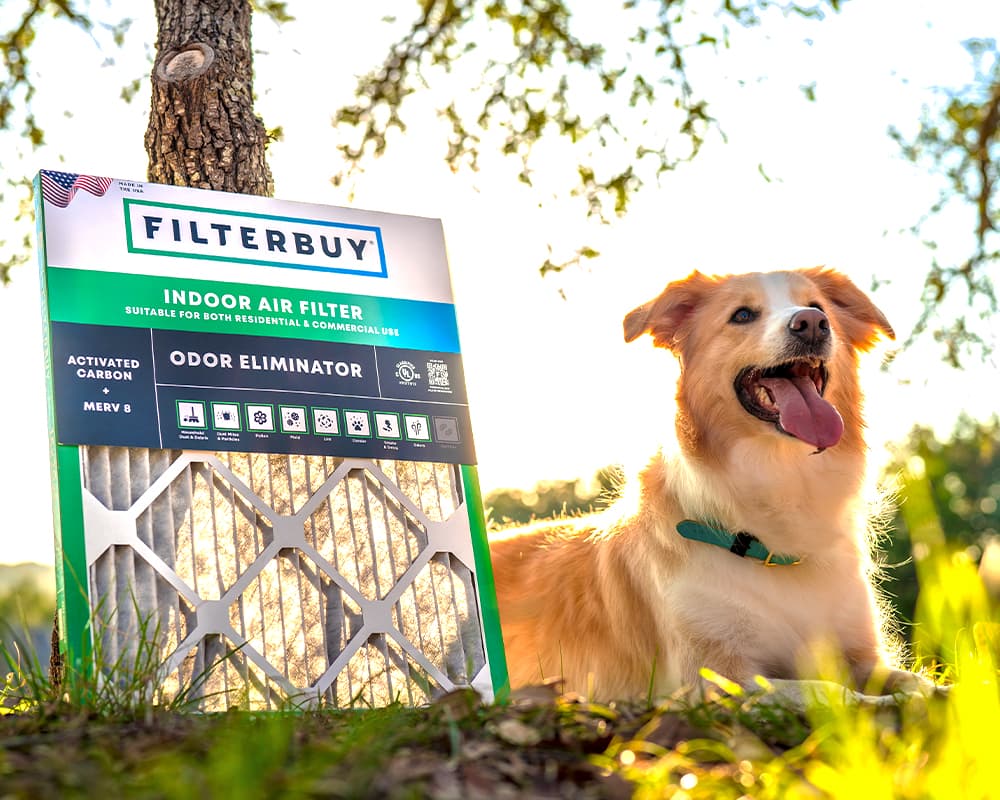
Change your filter every
2 months
to avoid shedding and odor buildup.

If you have young children...
Change your filter every
2-3 months
as having clean air is even more important with children in your home.
If someone in your home has asthma or allergies...
Change your filter every
6 weeks
to ensure indoor air quality is at its best.
If you have pets...
Change your filter every
2 months
to avoid shedding and odor buildup.
If you have young children...
Change your filter every
2-3 months
as having clean air is even more important with children in your home.
Benefits of Filterbuy 20x21.5x1 Air Filters
Filterbuy 20x21.5x1 air filters improve your HVAC system's efficiency while enhancing air quality. These air filters are like dedicated goalkeepers. They block harmful airborne particles from going into your house.Result? Clean, fresh air that occupants get to enjoy throughout the day. Not to forget, their larger surface area captures more particles.
Key Takeaways
Filterbuy filters measuring 20x21.5x1 boost HVAC efficiency and also trap harmful contaminants. So the HVAC will last longer.
They are one of the best options for homes with pets due to their reliable filtration power.
Maintenance involving assessments, cleaning, or exchanges happens every month or every three months.
By capturing allergens along with dust particles, these filters enhance the quality of indoor air.
Filterbuy pleated air filters are more effective than standard filters. They capture more dust and allergens. They last longer and offer superior performance.
Filterbuy 20x21.5x1 Air Filter Size
Dimensions, as specified in its name, detail the filter's physical size. Length (20 inches), width (21.5 inches), thickness (1 inch). Correctly sizing these dimensions ensures a perfect fit in the HVAC and prevents air bypass. Which is a factor that could affect indoor air quality.
Filterbuy air filter 20x21.5x1 provide better airflow and particle capture. Which contributes to maintaining excellent air quality. Surface area, determined by size, further influences its capacity for particle capture. Bigger filters usually have higher capacities due to their increased surface area. Despite not being the largest, Filterbuy 20x21.5x1 air filter offers a great surface area for trapping particles.
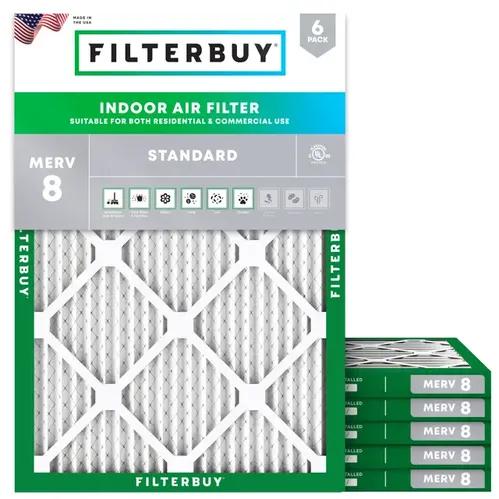
Key Benefits of Filterbuy 20x21.5x1 Pleated Air Filters
Filterbuy pleated air filter offers significant benefits. Energy efficiency is one of the key advantages.
They effectively trap harmful particles and contaminants. These filters enable your HVAC to function smoothly and reduce its workload. This leads to energy savings and lower utility bills.
Filterbuy 20x21.5x1 pleated air filters reduce allergies. Allergens such as dust mites, mold spores and pet dander get captured by these filters. This prevents their circulation in indoor air.
These filters contribute to the longevity of HVAC systems. It prevents the build-up of harmful substances which also reduces HVAC strain. This leads to less frequent repairs and extends the time between replacements.
Installation Steps
Knowing how to correctly install Filterbuy 20x21.5x1 air filters boosts their performance. This process is simple, needing no special tools.
Find the filter compartment on your furnace or AC unit, usually near the fresh air return duct entrance. Use a screwdriver to open this compartment.
Pay attention to the filter's orientation. Incorrect placement obstructs airflow, reducing system efficiency. Arrows on the filter frame show the proper airflow direction. Ensure these arrows point towards your furnace or air conditioner, aligning with the airflow.
Insert the filter into its slot, ensuring a snug fit. If you opened a cover earlier, replace it now.
Maintaining Your Filterbuy 20x21.5x1 Air Filter
Do you check the state of your Filterbuy 20x21.5x1 pleated air filter frequently? Sustaining its condition is crucial for longevity and optimal performance. Which enhances the air quality indoors. Depending on environmental conditions and equipment usage, the frequency of inspections will vary. But a monthly evaluation is beneficial.
Focus on cleaning and replacement to maintain them. Dispose it when clogged or dirty every one to three months. For reusable filters, clean them as needed with a suitable cleaning agent. But ensure they dry thoroughly before reinserting. A wet filter must never go back in, as it encourages mold growth.
Taking care of it purifies the air and also promotes efficient HVAC system operation. Which leads to reduced energy use and less wear on your system. Maintenance involves more than cleaning or changing filters. Monitoring is important. Any variations in air quality or HVAC efficiency might hint at a problem.
Why Choose Filterbuy Air Filters
Filterbuy pleated air filters offer significantly superior performance compared to standard fiberglass filters.
These filters feature a strong beverage board frame that ensures durability in high-temperature and humid environments. Unlike traditional filters that use basic cotton media, our filters utilize a special synthetic electrostatic media, which is far more effective at capturing dust, allergens and bacteria. With at least 20 times greater efficiency, Filterbuy pleated air filters provide exceptional filtration performance.
Frequently Ask Questions
How do I know what size air filter I need for my HVAC?
Determining the correct size of your HVAC filter is a crucial step in maintaining optimal performance. This process involves measuring dimensions and checking compatibility. Begin by physically measuring the existing filter's length, width, and thickness. These measurements are typically recorded in inches.
How do you read an air filter number?
These numbers are critical as they provide details about the filter's dimensions and, in some cases, its efficiency. Typically, air filter numbers are in three parts representing the length, width, and thickness (or depth).
Does a bigger air filter mean more power?
The relationship between the size of an air filter and the power of an HVAC is an aspect often overlooked when considering energy efficiency. Larger filters have a greater surface area, improving filter efficiency by trapping more particles and pollutants. This enhances the HVAC system's performance and power output.
Do thicker air filters restrict airflow?
Thicker ones typically offer higher filtration capacity, enhancing filter efficiency by capturing more particulates. However, they also present greater airflow resistance, potentially increasing energy consumption and noise levels. This necessitates a delicate balance to ensure optimal HVAC operation.
How many microns should your air filter be?
Understanding the importance of filter thickness paves the way for another key aspect to consider in air filters, the ideal micron levels. Micron efficiency relates to its ability to trap particles of specific sizes, measured in microns. The ideal micron level varies based on the specific needs of a system. Residential HVAC require filters with a micron level of 5 to 10 microns, which effectively captures common household pollutants.
Does the size of your air filter matter?
The size directly affects the filter efficiency and the replacement frequency. An incorrectly sized filter leads to decreased efficiency, as it may not fit properly in the system, allowing unfiltered air to pass. This results in the accumulation of dust and harmful particles, affecting the air quality and causing potential damage to the system.
How do you read filter size?
Filter size abbreviations are length x width x depth, represented in inches. Understanding these abbreviations is key to preventing common sizing mistakes. Misinterpretation of these notations leads to purchasing an ill-fitting filter, negatively affecting your HVAC system's efficiency and performance. Always remember that the first number represents the length, the second number is the width, and the third number signifies depth.
What do the sizes of filters mean?
Decoding the significance of size is a critical aspect of maintaining optimal HVAC performance. The size not only determines the amount of air that passes through but also affects the efficiency and lifespan. A properly sized one ensures efficient trapping of airborne particles without restricting the airflow. The filter material also plays a role in determining the filter's efficiency.
What happens if your air filter is too big?
This leads to reduced filter performance and airflow efficiency. Over-sized filters may not fit properly, leading to system compatibility and installation challenges. They may require higher maintenance frequency due to improper sealing, increasing costs.
What is the formula for filter sizing?
The formula for sizing relies on precise measurement techniques. Its dimensions are length x width x depth. The first number signifies the length, the second number indicates the width, and the third denotes the filter's thickness or depth.
How to calculate air filters?
The filter dimensions are on the edge of your current filter, listed in terms of length, width, and depth. For example, a 20x21.5x1 filter is 20 inches long, 21.5 inches wide, and 1 inch deep. A ruler or tape measure helps you measure the size if not visible.
How to select filter size?
Here are some filter selection tips. Firstly, refer to your system's manual for the manufacturer's recommended size. Using an improperly sized filter leads to common sizing mistakes, such as reduced system efficiency or increased wear and tear. Secondly, consider the filter's purpose.