
AC Running but No Air? Here's How to Find the Problem Fast
August 25, 2026
If your AC is running but no air is coming out, it's one of three things: restricted airflow, a refrigerant problem, or a failed electrical or safety component. Start with the filter — pull it out and hold it up to a light, and if you can't see through it, you've found it. What you feel at the vent narrows down the rest.
Little or no air at any vent — clogged filter, tripped safety switch, or blower failure.
Air is flowing, but it's warm — dirty condenser coil or low refrigerant.
Ice on the copper line — airflow restriction or a refrigerant leak.
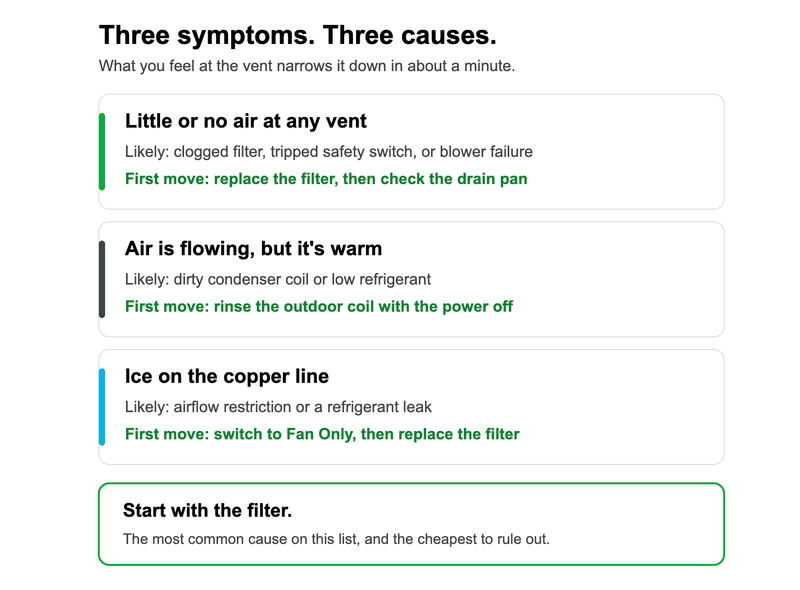
A fresh filter is the cheapest fix on the list, and the one that clears the most airflow problems.
Have a ductless mini split? Answer a few quick questions and we'll match you to the right filter for your system.
If your AC is running but nothing is coming out of the vents, you are looking at one of three things: restricted airflow, a refrigerant problem, or a failed electrical or safety component. Which one depends on what you're feeling at the vent right now — warm air, no air, or ice on the line. Identify your symptom, then work the checks below in order. Most homeowners solve this at step one.
Do These Three Things First (60 Seconds)
- Pull your air filter and hold it up to a light. Can't see light through it? That's your answer.
- Check the thermostat. Set to Cool, fan on Auto, target at least 5°F below the room. Dim display means dead batteries.
- Look at the indoor unit's drain pan. Standing water usually means a tripped float switch, which shuts the blower off on purpose.
If all three check out, keep reading — your symptom below will narrow it down.
TL;DR
Why Is My Central AC Running but Not Blowing Air?
A central AC that runs but delivers no air comes down to one of three things: restricted airflow, a refrigerant problem, or a component that shut the blower off on purpose. Start with the filter — hold it up to a light, and if you can't see through it, that's your answer. Most homeowners solve it right there.
Check these three, in this order:
- The filter. A loaded filter starves the evaporator coil, the coil ices over, and that ice becomes a physical wall across the airflow path. Replace it — don't vacuum or rinse a disposable pleated filter.
- The drain pan. Standing water means the condensate float switch cut the blower off to keep water out of your ceiling. That's the cause most troubleshooting guides skip, and it's why plenty of "dead blower" service calls end in a five-minute fix.
- The blower access panel. If it isn't seated and clicked shut — common right after a filter change — the safety switch won't let the blower run at all.
Outdoor unit humming, indoor vents silent, and all three above check out? The blower motor or start capacitor has likely failed. That's a technician call.
Turn the system off while you troubleshoot. Running an AC with no airflow puts the compressor under load it wasn't built for, and the compressor is the most expensive part to replace.
Match Your Symptom
| What You Notice | Most likely Cause | First Move | DIY or Pro |
|---|---|---|---|
| Air is flowing but warm | Dirty condenser coil or low refrigerant | Rinse the outdoor coil | DIY coil · Pro for refrigerant |
| Little or no air at any vent | Clogged filter, tripped safety switch, or blower failure | Replace filter, check drain pan | DIY first · Pro for blower |
| Ice on the copper line | Airflow restriction or refrigerant leak | Switch to Fan Only, then replace filter | DIY thaw · Pro for leak |
| Runs, then shuts off within minutes | Short cycling from restriction or refrigerant | Check filter and coil | DIY first · Pro if it repeats |
| Outdoor unit on, indoor vents silent | Float switch, blower door switch, or start capacitor | Check drain pan and panel seating | DIY switches · Pro for capacitor |
Shop Air Filters by Size Not sure what size you need? Take the MERV Match quiz — three questions, instant recommendation.
“I Feel Air, but It’s Warm”
Warm air at the vent means your blower is working fine. The problem is downstream, in the part of the system that actually removes heat.
Dirty Condenser Coil DIY
The outdoor unit's job is to dump heat outside. When grass clippings, cottonwood, and dust pack the fins, that heat has nowhere to go and the system can't cool. Fix it:
- Shut off power at the disconnect box or breaker. Confirm it's off before touching anything.
- Rinse the fins with a garden hose from the inside out. Never use a pressure washer — the fins bend easily.
- Let it dry fully, restore power, and restart.
Low refrigerant PRO ONLY
Refrigerant doesn't get consumed. If the level is low, it leaked. Signs: frost on the thin copper line, a faint hiss near the line set, or cooling that gets steadily worse over weeks rather than failing all at once.
Handling refrigerant requires EPA Section 608 certification, so this is not a DIY repair — and topping off a leaking system without finding the leak just buys a few weeks.
“Almost Nothing Is Coming Out”
A severely loaded filter DIY
This is the most common cause and the cheapest fix, which is exactly why it gets skipped. A filter loaded to the point of restriction starves the evaporator coil of the warm air it needs to stay above freezing. The coil ices over, and that ice becomes a physical wall across the airflow path. You end up with a system that runs hard and delivers nothing.
Hold the filter up to a light source. If you can't see light through the media, replace it. Don't try to vacuum or rinse a disposable pleated filter — it damages the media and the restriction gets worse.
One thing worth getting right: a filter that's too restrictive for your system can cause the same airflow symptoms as a dirty one. Check your HVAC owner's manual for the filter rating your system is designed to handle before moving up a MERV tier. The EPA notes that MERV 13 filters capture a higher share of fine particles, but also that some systems can't move enough air through them — so the manual is the final word, not the packaging.
A Tripped Safety Switch DIY CHECK
This is the one most troubleshooting guides skip, and it's the reason plenty of “dead blower” service calls end in a five-minute fix. Your air handler has switches designed to shut the blower down on purpose:
- Condensate float switch. Your AC pulls moisture out of the air, and that water drains away. If the drain line clogs, water backs up in the pan and a float switch cuts the system off to keep it from overflowing into your ceiling or floor. Standing water in the pan is the tell.
- Blower door safety switch. If the access panel isn't seated properly — common right after a filter change — the blower won't run at all. Reseat the panel firmly and listen for it to click closed.
Clearing a clogged condensate line is often a wet/dry vac job at the outdoor drain outlet. If water returns quickly or you see staining on drywall near the air handler, stop and call a technician — that's a water damage risk, not just an airflow one.
Blower Motor or Start Capacitor PRO
Outdoor unit humming along, fresh filter installed, drain pan dry, panel seated, and the vents are still dead? Now you're looking at the blower itself or the capacitor that starts it. A capacitor is a relatively minor part; a full blower motor replacement is a bigger job. Either way it's a technician call.
Duct Leaks or Blocked Registers MIXED
Strong airflow in one room and nothing in another points to distribution, not the equipment. Walk the house: check for furniture or rugs over supply vents, closed dampers, and any accessible ductwork in an attic or crawlspace with separated joints or crushed flex duct. Small gaps you can reach are a DIY seal with mastic or foil tape. Never use cloth duct tape — it fails within a season or two. Major duct repair is a pro job.
“There’s Ice on the Refrigerant Line”
Ice has two possible causes — airflow restriction or a refrigerant leak — and they look identical from the outside. The good news is that one sequence tells you which:
- Thaw it. Switch the thermostat to Fan Only — not Cool — for about two hours. Never chip at the ice or aim a heat gun at the coil; you'll puncture it.
- Remove the restriction. Replace the filter, open and unblock every return and supply vent, then restart on Cool.
- Watch the clock. If ice reappears within an hour on a clean filter and clear vents, it's a refrigerant leak. Shut the system down and call a licensed technician.
Don't wait this one out. Running a system that keeps freezing puts the compressor under load it wasn't designed for, and compressor replacement is among the most expensive repairs on a residential system.
When to Stop and Call a Technician
Call now:
- You smell something chemical or hear hissing near the refrigerant lines
- The AC breaker trips more than once — stop using the system entirely
- The outdoor unit hums but the compressor never engages
- Water is staining drywall or ceiling near the air handler
Call soon:
- Ice returns after a full thaw and a fresh filter
- Airflow is still dead with a clean filter, clear registers, dry drain pan, and seated panel
- The system short cycles repeatedly after you've cleaned the filter and coil
Everything else on this page — filter, registers, thermostat, condenser rinse, Fan Only thaw, drain pan check — you can handle without a service call.
How Your System Actually Moves Air
Knowing the loop makes you harder to oversell, because you can tell which link a technician is describing.
The blower motor pulls warm indoor air through the return, past the filter, and across the evaporator coil. Refrigerant inside that coil absorbs heat from the air. The cooled air gets pushed back out through the supply ducts. The absorbed heat rides the refrigerant out to the condenser coil in the outdoor unit, where it's released, and the compressor keeps that whole cycle under pressure.
Break any link — blower can't spin, filter blocks intake, refrigerant escapes, expansion valve sticks, compressor quits — and you feel it at the vent. Which link broke is the difference between a filter you swap yourself this afternoon and a repair that needs scheduling.
Keeping It From Happening Again
Most airflow failures build up gradually and give you warning. Two habits catch nearly all of them.
Stay ahead of the filter
General guidance is every 1–3 months, but runtime matters more than the calendar. Homes with pets, heavy dust, or an AC running most of the day in summer load filters faster — sometimes monthly. A filter that lasted the whole spring can be restricted in three weeks during a July heat wave, because the system is simply pulling far more air through it.
Set Up Filter Auto-Delivery Pick your size and schedule — the right filter shows up before the old one becomes a problem.
Book One Professional Visit a Year
An annual service covers coil cleaning, refrigerant level checks, capacitor testing, condensate line clearing, and electrical inspection — the exact list of things that cause mid-July failures. Schedule it in early spring, before the season rush, when availability is better.
Between visits: keep about two feet of clear space around the outdoor unit and rinse the condenser coil at the start of each cooling season.
Frequently Asked Questions
My Outdoor Unit Is Running but No Air Comes From the Indoor Vents. What’s Wrong?
The problem is inside your air handler, not outside. Check three things in order: the air filter, the condensate drain pan for standing water that would trip the float switch, and the blower access panel for proper seating. If all three are clear, the blower motor or its start capacitor has likely failed and needs a technician.
Is It Safe to Keep Running My AC With No Airflow?
No. Turn it off. A system running without airflow can overheat and damage the compressor, which is the most expensive component to replace. Shut it down until you've identified the cause.
Can a Dirty Air Filter Really Stop Airflow Completely?
Yes, indirectly. A heavily loaded filter restricts intake enough that the evaporator coil drops below freezing and ices over. That ice forms a solid barrier across the airflow path. Replace the filter and thaw the coil on Fan Only.
Can the Thermostat Cause This?
Occasionally. A failing thermostat can fail to signal the blower. Before assuming worse, confirm it's set to Cool, the fan is on Auto rather than Off, the target is below room temperature, and the batteries are fresh.
Does Hot Weather Make Airflow Problems Worse?
Yes. Extended heat means near-continuous runtime, which loads filters faster, produces more condensate for the drain line to handle, and keeps the blower and capacitor under sustained load. Marginal components tend to fail during the first long heat stretch of the season.
Start with the filter. It's the cheapest fix and the most common cause.
Find Your Filter Size