
Most Wildfires Are Human-Caused: What It Means for Your Indoor Air
September 1, 2026
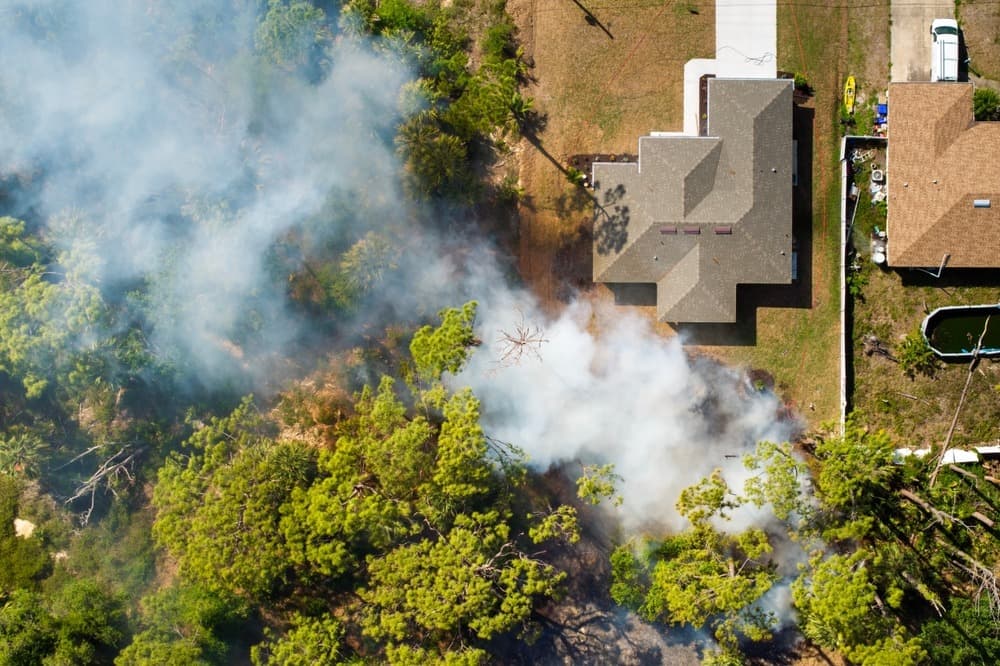
Air Quality News | September 1, 2026 | 4 min read
Most Wildfires Are Human-Caused: What It Means for Your Indoor Air
The National Interagency Fire Center's latest tally shows 69,556 human-caused wildfires burned across the U.S. in 2025 alone, scorching roughly 2.27 million acres. It is not a one-year blip. A 2017 study in Proceedings of the National Academy of Sciences, led by University of Colorado Boulder fire scientist Jennifer Balch, reviewed more than 1.5 million government wildfire records and found that people start roughly 84 percent of U.S. wildfires.
A 30-year ignition dataset from Headwaters Economics, spanning 1992 to 2024, puts the human-caused share at 77 to 85 percent depending on how unknown-cause fires are counted, and identifies debris and open burning as the single largest ignition source nationally. A 2026 review from The Colorado Sun reached the same conclusion from a different angle: total fire counts have declined since the 1990s, but the acreage burned each year has roughly doubled, and human-started fires now stretch the natural fire season by more than 100 days.
Most coverage of that fact stops at prevention: who started it, how to stop the next one. But the practical effect for households already living through smoke season is simpler. More human ignitions across more months mean more days when smoke is a possibility, and smoke has an indoor reach longer than most homeowners assume. Here is what the data actually shows and what it changes about the air inside your home.
What are people actually doing to start these fires?
Debris and open burning lead by a wide margin, tied to more than 611,000 fires and an estimated 8.6 million acres burned since 1992, per Headwaters Economics. The trend is accelerating in some states: Texas went from 6,979 debris-burning fires between 1992 and 2001 to 22,593 between 2015 and 2024, and Colorado's count rose fivefold over the same period.
Equipment and vehicle use ranks next, linked to more than 216,000 fires and 10.9 million acres. Power line ignitions are rarer but the most damaging per incident, averaging around 125 acres burned per fire, and have climbed roughly 13-fold since the early 1990s. Arson and smoking-related fires, by contrast, have both been trending down for two decades.
Why does it matter that a fire started with a match instead of lightning?
Because human-caused fires don't just add to the count, they add to the calendar. The 2017 PNAS study found that human ignitions roughly tripled the length of the national fire season by extending burning into wetter, cooler periods when lightning-sparked fires would be unlikely to catch. That is a ground-level shift for households: more months where a fire can start means more months where an air quality alert can follow.
Does it matter where a fire started once the smoke shows up?
Not to your air quality monitor. Once a fire is burning, smoke behaves the same way whether the first spark came from a downed power line, an unattended campfire, or lightning. It travels for hundreds of miles, drifts into neighborhoods nowhere near a burn scar, and settles into the fine particulate matter (PM2.5) that air quality alerts are built around.
It also does not stay outside. A Harvard T.H. Chan School of Public Health "Healthy Buildings" study placed more than 1,500 air quality monitors across over 1,000 homes in the Los Angeles area during the January 2025 wildfires and found indoor PM2.5 rose to unhealthy concentrations in a significant share of monitored homes, including homes more than two miles from the nearest fire. As the research team put it, smoke can penetrate a home "even when windows and doors are closed."
So what should I actually change?
Less than you would think, and none of it is expensive. A house exposed to more smoke events per year needs its filter checked more often than a single-fire-season mindset assumes. The rating matters as much as the schedule: a filter sized for everyday dust does not do the same job as one built for fine smoke particles. And a filter that fits loosely lets smoke bypass the media entirely, which undoes any rating you paid for.
You can’t control the spark during a wildfire, but you can control your HVAC system
Wildfire origins happen to you. Indoor air is different because your HVAC system cycles the air in your home repeatedly whenever it runs, and all of it passes through one filter on the way.
A few things worth doing before smoke season peaks:
- Replace your current filter now so the system starts the season clean, and write the date on the new one.
- Match the rating to your household: MERV 8 covers most homes, MERV 11 suits allergy and pet households, MERV 13 is the step up for smoke and fine particles, and odor-eliminating options add carbon for lingering smoke odor.
- If you run a 4-inch filter, log the install date. Filterbuy 4-inch filters last 6 to 12 months.
- Ensure the filter sits flush in the slot, since gaps let smoke bypass the media entirely.
- Watch local air quality alerts and swap to a MERV 13 filter proactively once smoke is forecast, rather than after it arrives.
Sources: NPR, PNAS, 2017 (Balch et al.), Headwaters Economics, The Colorado Sun, National Interagency Fire Center, Harvard Healthy Buildings Program