
Failed Rocket De-Orbit Traced to Space Debris Pollution
August 25, 2026
Science Update | August 24, 2026 | 4 min read
Scientists Traced a Metal Plume 60 Miles Up to a Single Falling SpaceX Rocket
A German laser team detected a 10x lithium spike 96 km above Earth and tracked it back to a Falcon 9 upper stage that burned up over the Atlantic, the first time atmospheric pollution has been tied to one specific piece of space junk.
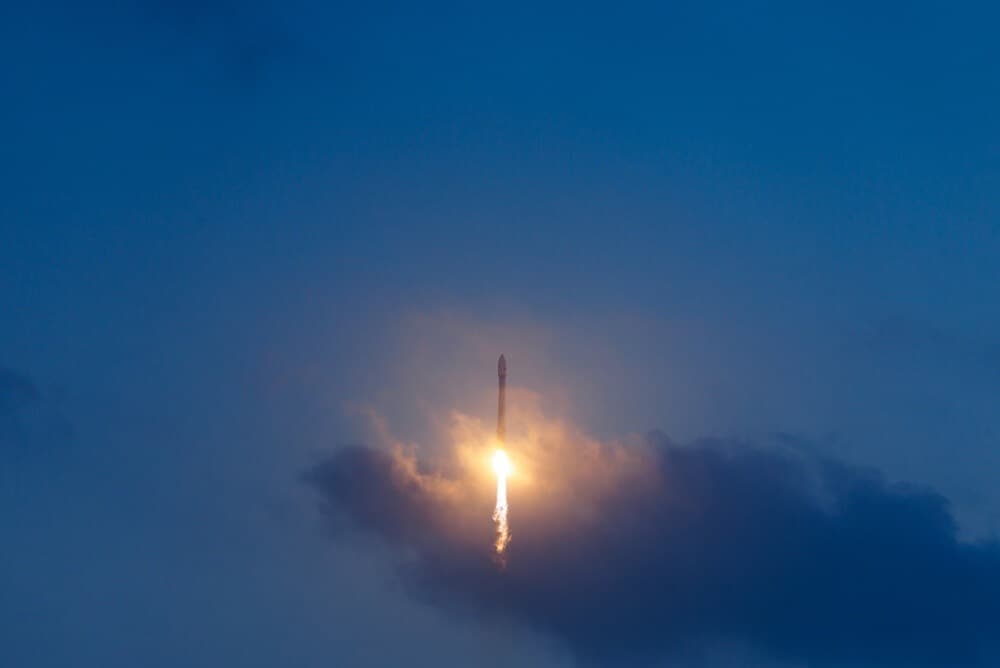
The rocket stage launched on February 1, 2025, carrying a batch of Starlink satellites to low-Earth orbit. It then failed to de-orbit over the Pacific as planned and stayed up for three weeks before coming down on its own.
That malfunction handed researchers at the Leibniz Institute of Atmospheric Physics in northern Germany something they had been waiting for: a known object, on a known path, at a known time. Here is what they measured, why it matters, and what it does and does not mean for the air in your house.
What exactly did the scientists detect?
In the early hours of February 19, 2025, the upper stage made an uncontrolled re-entry over Europe, producing a fireball visible across northern skies. Roughly 20 hours later, a resonance lidar at Kühlungsborn, Germany, recorded a tenfold enhancement of lithium atoms at 96 km altitude, in the upper mesosphere. Using wind modeling and backward trajectories, the team traced those air masses to the Falcon 9 re-entry path at 100 km altitude, west of Ireland.
Robin Wing, the study's lead author, and his colleagues describe it as the first measurement of upper-atmospheric pollution from a space debris re-entry and the first observational evidence that ablating debris can be picked up by ground-based lidar. The paper ran in Communications Earth & Environment in February 2026.
Lithium was the marker of choice for a reason: it turns up only in trace amounts naturally at that altitude, so a sudden spike is hard to explain any other way. Falcon 9 tank walls use an aluminum-lithium alloy, and at the hull thickness involved, lithium vaporization is exactly what you would expect during re-entry.
Is this a one-off, or part of something bigger?
It fits a pattern researchers spotted three years ago, much lower down. A 2023 NOAA-led study flew a custom instrument in the nose of a NASA WB-57 out of Alaska to sample the stratosphere, the layer roughly 11 to 50 km up where the ozone layer sits. The team, led by research chemist Daniel Murphy, found more than 20 elements from spacecraft re-entry in stratospheric particles, in ratios matching alloys used in rockets and satellites.
About 10% of stratospheric sulfuric acid particles larger than 120 nm carried aluminum and other re-entry elements, and the mass of lithium, aluminum, copper, and lead from spacecraft exceeded the natural cosmic dust supply of those same metals. Two of the odd finds, Murphy noted, were niobium and hafnium, rare elements nobody expected to see up there.
So the two studies cover different altitudes and different questions. The 2023 work established that spacecraft metals accumulate in the stratosphere. The 2026 work showed that a single re-entry can be caught in the act, far higher up, and traced back to its source. That second capability is what makes ongoing monitoring possible.
Why does the volume matter so much?
Because it is climbing. Astronomer Jonathan McDowell has tracked one to two Starlink satellites re-entering per day and projects roughly five per day once the planned constellations are fully deployed, based on about 30,000 low-Earth-orbit satellites on a five-year replacement cycle. SpaceX reported deorbiting 260 Starlink satellites to the FCC between December 2025 and May 2026, following nearly 500 in the comparable window a year earlier.
The concern is not any single re-entry. Murphy's team estimated the 10% figure could grow to 50% or more as launch rates rise and operators dispose of hardware by steering it into the atmosphere to burn up. Wing has also pointed to aluminum's role in catalyzing ozone destruction in the stratosphere, and the ozone layer is what blocks ultraviolet radiation from reaching the ground.
Does any of this reach the air I breathe?
Not in a way you would measure with a home monitor. The NOAA researchers were direct about this: direct health or environmental impacts at ground level are unlikely, though the measurements carry broad implications for the stratosphere and above. This is a story playing out miles above where weather happens, in layers that regulate radiation and climate rather than ones you inhale.
What it does illustrate is how short the list is of air quality variables that any household actually controls. Rocket alloys in the mesosphere are not on that list. The particles circulating through your living room are.
Take care of the air you can actually control
Outdoor and upper-atmosphere pollution mostly happens to you. Indoor air is different because your HVAC system cycles the air in your home repeatedly whenever it runs, and everything in that air passes through one filter on the way.
A few things worth doing this week:
- Check when your filter was last changed, and write the date on the new one when you swap it.
- Match the filter rating to your household: MERV 8 covers most homes, MERV 11 suits allergy and pet households, and MERV 13 is the step up for smoke and fine particles.
- Confirm the filter sits flush in the slot, since gaps let air to bypass the media entirely.
Sources: Communications Earth & Environment, Air Quality News, NOAA Chemical Sciences Laboratory, PNAS, EarthSky, Engadget, Sky & Telescope.