July 7, 2026

Usually, no. If your local AQI is over 100, keep your windows closed. Opening them lets fine particles, smoke, and smog move straight into your home. Below AQI 100, most people can open up when conditions feel comfortable; above it, keep windows shut and let your HVAC air filter capture fine particles indoors. Either way, check your local AQI first — air can look clear and still be unhealthy.
Not sure which filter fits your home? Answer a few quick questions and we'll match you to the right MERV rating.
Your home feels stuffy. The weather looks beautiful outside. Cracking a window seems like the absolute easiest way to bring in some fresh air. We have all been there.
But what if the air outside is actually dirtier than the air inside? If the outdoor Air Quality Index (AQI) is high, that "fresh air" might carry fine particles, smoke, smog, or allergens straight into your living room.
Indoor air and outdoor air are deeply connected. You cannot control the air outside your home. You can, however, control how much of it gets inside. That is why checking the outdoor AQI matters before you decide to open your windows.
If you are wondering, "Can you open windows when AQI is high?" we have you covered. Let's break down exactly how outdoor air affects your home and when you should keep your glass shut.
Outdoor air quality directly impacts the air inside your home.
Monitoring the AQI (Air Quality Index) is crucial for making informed decisions about opening your windows.
When the AQI is high, it is best to keep your windows closed to prevent harmful pollutants, allergens, and particles from entering your living space.
Taking steps to manage indoor air, such as using air purifiers, can help maintain a healthier home environment.
In most cases, no. If the AQI is high, it is much better to keep your windows and doors closed. Opening windows during periods of poor outdoor air quality lets polluted air easily enter your home. This raises your indoor pollutant levels and forces your HVAC system to work overtime.
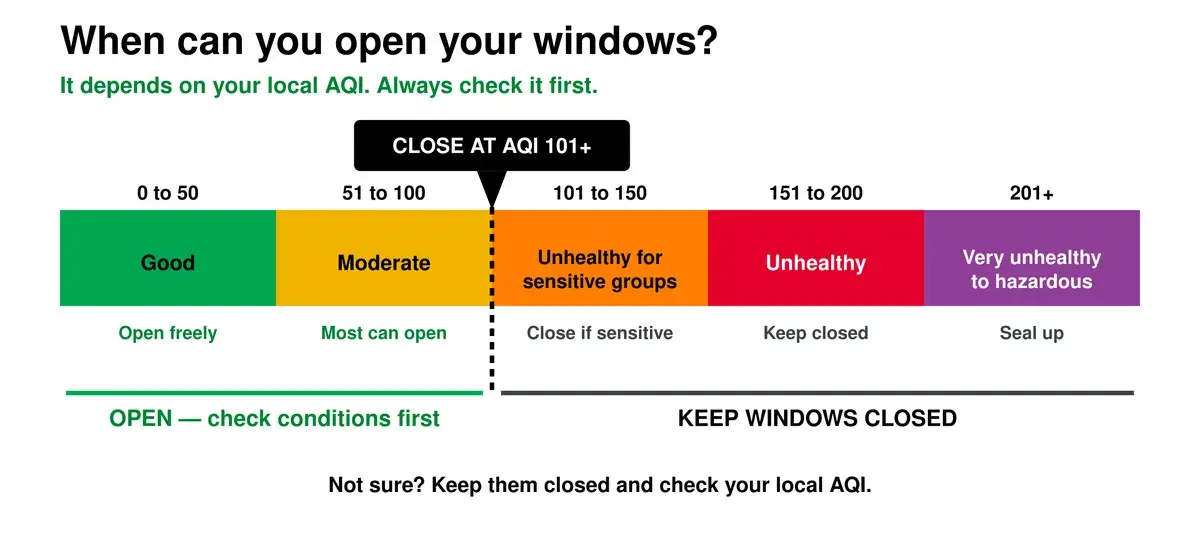
Here is a simple guide on when to close windows based on the AQI:
AQI 0–50 (Good): It is usually safe to open windows if outdoor conditions are comfortable.
AQI 51–100 (Moderate): Many people can still open windows. However, highly sensitive individuals may want to limit ventilation during peak pollution hours.
AQI 101–150 (Unhealthy for Sensitive Groups): Keep windows closed if anyone in the home has asthma, allergies, or sensitivities.
AQI 151–200 (Unhealthy): Keep windows closed. Limit the amount of outdoor air entering the building.
AQI 201+ (Very Unhealthy or Hazardous): Keep windows and doors tightly closed. Reduce outdoor exposure entirely and run indoor filtration.
When in doubt, check your local AQI first. Air can look clear and still contain harmful pollutants that are not visible to the naked eye. Before opening your windows, check Filterbuy’s Live AQI Map to see what outdoor air quality looks like in your area right now.
Indoor air is never fully separate from outdoor air. Even with your windows completely shut, outdoor pollutants still enter your home. They sneak in through ventilation systems, attic leaks, gaps in walls, and poorly sealed door frames.
High outdoor AQI naturally raises indoor pollution levels. This happens especially quickly during wildfire smoke events, heavy traffic pollution, or high-pollen days. Opening windows just speeds up that infiltration process.
This reinforces a larger rule of thumb. Checking the relationship between outdoor AQI and indoor air quality is one of the first things you should do when thinking about your home's air quality. For a deeper dive, check out our guide: Does Outdoor AQI Affect Indoor Air Quality?
Opening windows changes your home. It turns a controlled indoor environment into a direct extension of outdoor conditions. On clean-air days, that is helpful and refreshing. On high-AQI days, it actively harms your indoor air quality.
When you open windows on a bad air day, you:
Let fine particles enter the home directly.
Increase your family's exposure to wildfire smoke, smog, dust, and pollen.
Make indoor air much harder for your HVAC filters to clean.
Bring in ozone and other irritating outdoor pollutants.
Trigger symptoms for people with asthma, allergies, or heart conditions.
"Fresh air" is not always clean air. Here are the specific pollutants you invite in by leaving high-AQI windows open.
PM2.5 refers to fine inhalable particles. These particles are microscopic, so small that they stay airborne for a long time and can travel deep into your lungs. PM2.5 is commonly linked with wildfire smoke, vehicle emissions, and combustion-related pollution.
Wildfire smoke can travel thousands of miles. It often affects homes far from the actual fire itself. Even if the sky only looks slightly hazy, the AQI may still be dangerously elevated.
Ground-level ozone is a harmful gas that is often worse on hot, sunny days. Unlike particle pollution, ozone is not always visible. High ozone days can look bright and clear.
The standard AQI does not always capture every specific allergy trigger. However, outdoor air can still bring heavy pollen, dust, and other daily irritants into your home.
It is generally okay to open your windows when your local AQI is in the Good range (0-50). On Moderate AQI days (51-100), most healthy people can still open windows. Sensitive groups should monitor their symptoms and avoid peak pollution periods.
Here are some practical tips for natural ventilation:
Open windows when the AQI is Good.
Avoid opening windows near busy traffic times if you live close to a major road.
Keep windows shut when wildfire smoke, haze, or strong outdoor odors are present.
Keep windows closed during high pollen periods if seasonal allergies are a concern.
Check the AQI multiple times a day. Air quality can shift quickly with the wind.
Use Filterbuy’s Live AQI Map before opening windows. This is especially helpful during wildfire season or hot summer afternoons.
When outdoor AQI and indoor air quality clash, you have to play defense. Here is what you should do instead of letting bad air inside:
Keep all windows and exterior doors closed.
Use your HVAC system in recirculation mode if that setting is available.
Replace dirty air filters. Your system cannot properly clean the air if it is pushing through a clogged filter.
Use the highest MERV rating your HVAC system can safely support.
Reduce indoor pollution sources. Skip the heavy frying, blow out the candles, and put away harsh chemical sprays.
Seal obvious gaps around windows and doors if you notice outdoor smoke entering.
If you want better protection outdoors on high-AQI days, consider upgrading your filter. For many homes, MERV 13 offers stronger filtration for fine particles than lower-rated filters.
Have Filterbuy’s MERV 13 pleated air filters as your first line of defense against smoke, smog, and fine airborne particles. Note: Make sure to check your system manual to ensure it can handle a MERV 13 rating.
An AQI over 100 in a window-open scenario is risky. AQI above 100 means outdoor air may be unhealthy for sensitive groups.
At this point, opening windows brings in pollutants that trigger coughing, wheezing, eye irritation, or asthma flare-ups in vulnerable people. Once the AQI rises above 150, the air is considered unhealthy for everyone. At that level, your windows should stay closed as much as physically possible.
We know that keeping windows closed can make a house incredibly hot. Heat can also be dangerous. Do not ignore rising indoor temperatures just to avoid outdoor pollution.
If it is hot indoors and the AQI is high, cooling should still be your priority. Use your air conditioning if available. Keep your blinds or curtains closed during peak afternoon heat. You can use indoor ceiling or floor fans for air circulation, but avoid using window fans. Window fans actively pull polluted outdoor air inside.
If your home becomes dangerously hot and you have no cooling options, consider leaving. Go to a public cooling location, a library, or another indoor space with cleaner, conditioned air. People with health concerns should always follow local public health guidance or speak with a medical professional.
Not sure if today’s air is safe to let inside? Use Filterbuy’s Live AQI Map to check your local AQI first.
Before you ventilate your home, open the map and check:
The current AQI in your specific zip code.
Whether your location is in the Good, Moderate, Unhealthy, or Hazardous range.
Whether nearby areas are showing rapidly worsening conditions.
Whether smoke, ozone, or particle pollution is currently affecting your region.
This map helps you decide whether to keep windows closed and rely on your HVAC filtration instead.
Opening windows can be a wonderfully simple way to refresh your home. It only works, however, when the outdoor air is actually clean enough to bring inside. When the AQI is high, outdoor air carries fine particles, smoke, and smog directly into your living space.
The safest move is to check your local AQI first. Keep your windows closed during unhealthy conditions, and support your indoor air with the right HVAC filtration.
Before opening your windows today, check Filterbuy’s Live AQI Map and make sure the air outside is actually worth letting in.
It is usually better to keep windows closed when the AQI is over 100, especially if anyone in your home is sensitive to air pollution. AQI above 100 can affect people with asthma, allergies, heart conditions, respiratory issues, children, older adults, and pregnant individuals.
A practical rule is to start closing windows when the AQI reaches 101 or higher. If AQI is 151 or higher, windows should generally stay closed because the air is considered unhealthy for everyone.
Indoor air is usually more protected than outdoor air, but it is not completely separate. Outdoor pollutants can still enter through leaks, vents, doors, and windows. Keeping windows closed and using proper filtration can help reduce indoor exposure.
Opening windows can improve indoor air quality when outdoor air is clean. However, when AQI is high, opening windows can make indoor air worse by allowing outdoor pollutants to enter.
Yes. Wildfire smoke particles can still enter through small gaps, cracks, and ventilation pathways. Keeping windows closed helps, but HVAC filtration and sealing obvious leaks can provide added protection.
Indoor fans can help circulate air inside, but avoid window fans or exhaust setups that pull outdoor air into the home during periods of high AQI.
Yes, if your air conditioner recirculates indoor air rather than pulling in outdoor air. Make sure the system has a clean filter and that any fresh-air intake is closed if your system allows it.
MERV 13 is a strong option for many homes because it captures more fine airborne particles than lower-rated filters. Homeowners should confirm their HVAC system can safely handle the higher-rated filter.
Yes. Outdoor pollutants, pollen, dust, and smoke can enter the home and worsen allergy symptoms for some people. Keeping windows closed on days with poor air quality can help reduce exposure.
Check your local AQI before opening windows. Filterbuy’s Live AQI Map can help you see current outdoor air quality in your area and decide whether to ventilate naturally or keep windows closed.
It depends on the pollutant and local weather. Ozone often rises during hot, sunny afternoons, while particle pollution can vary based on traffic, smoke movement, wind, and local conditions. Check the real-time AQI rather than relying solely on the time of day.
Not always. Some fine particles are invisible, and the air can look clear even when the AQI remains elevated. Check your local AQI before opening windows after smoke, haze, or pollution events.
