September 4, 2026
Author: Michelle Wan, Brand Manager and Air Quality Writer, Filterbuy
Reviewed by: David Clark, CEO of Filterbuy HVAC Solutions and Licensed HVAC Technician
Published: September 4, 2026 | Updated: September 4, 2026
Purple on the U.S. Air Quality Index means an AQI of 201 to 300, the category the EPA calls Very Unhealthy. It is a health alert for everyone in the household, not only sensitive groups. Wildfire smoke drives nearly every purple day in the United States. Indoors, the response is to close the house up, switch the HVAC to recirculate, run the fan continuously through a MERV 13 filter, and add a HEPA air purifier in each room you occupy.
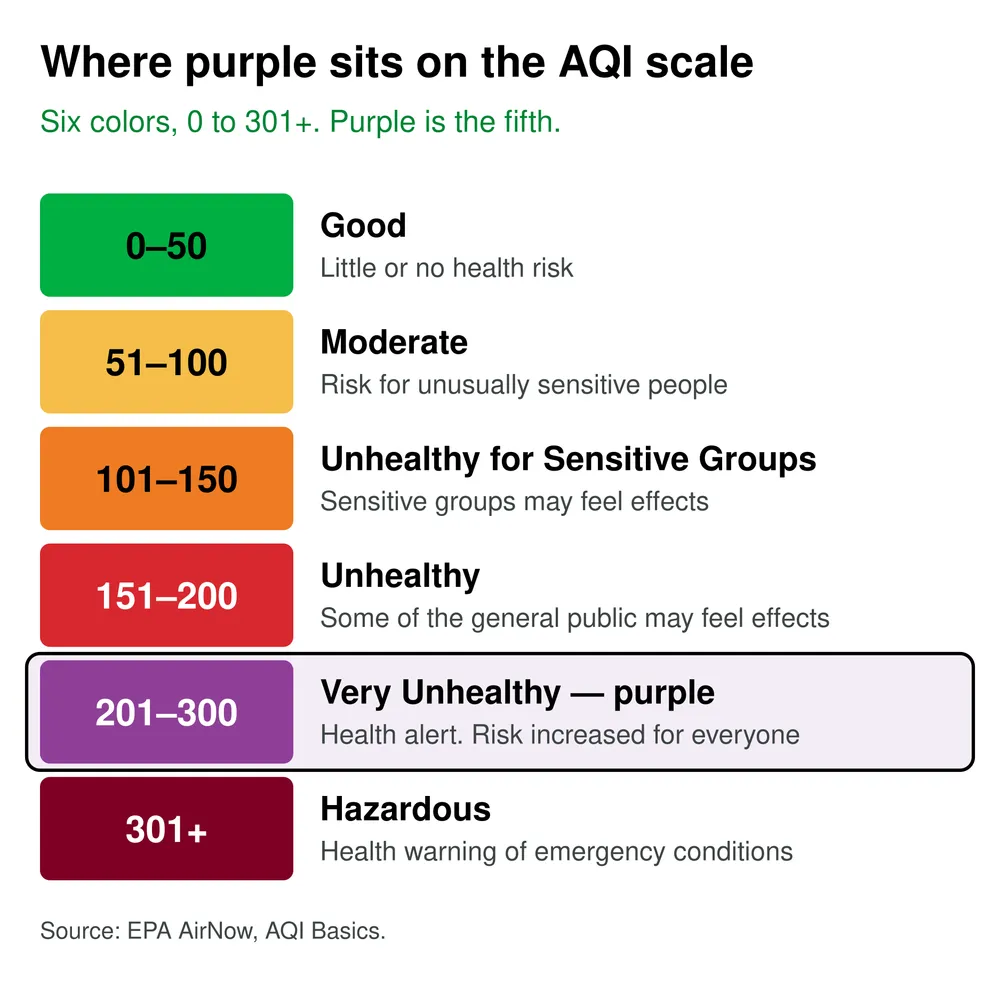
Purple is the fifth of six AQI bands, above red at 151–200 and below maroon at 301+.
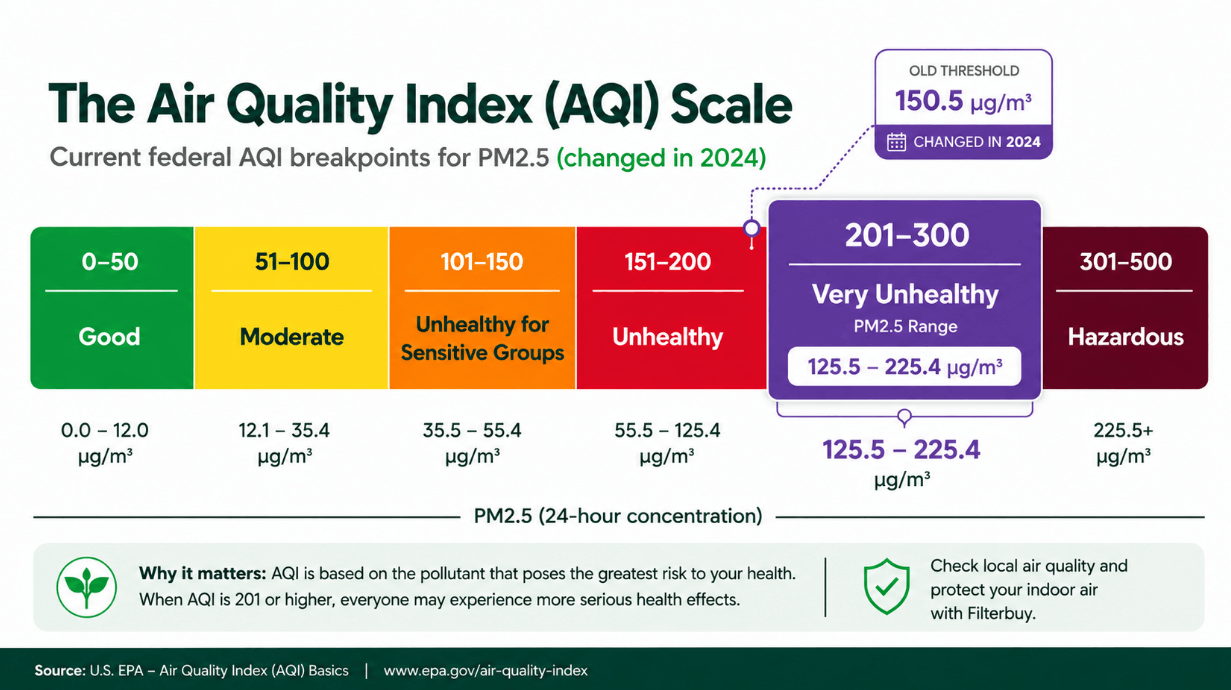
For fine particles, purple means a 24-hour PM2.5 average of 125.5 to 225.4 µg/m³.
The EPA lowered the purple threshold in 2024, so purple now arrives earlier in a smoke event.
The EPA advises MERV 13 or higher during smoky periods, and the practical trigger is an AQI above 100, not 200.
Not sure what your system takes? The quiz below matches you to the right filter in about 30 seconds.
Answer 3 quick questions and we will match you to your filter.
Know your size already? Shop air filters at Filterbuy.
Purple on the U.S. Air Quality Index means the AQI is between 201 and 300, the category the EPA labels Very Unhealthy. It is a health alert for everyone, not just sensitive groups, and it is rare outside major smoke events. Treat one as a stay-inside day: close the house up, run your HVAC on recirculate with an EPA-recommended MERV 13 filter, and put a HEPA air purifier in every room you occupy.
Purple is the fifth of six AQI categories, covering values 201 through 300, and its official EPA name is Very Unhealthy.
Purple is one color covering a wide range. An AQI of 299 carries roughly 80% more fine particle mass than an AQI of 201, and both display as purple.
The EPA lowered the PM2.5 purple threshold in 2024. Smoke that would have read red under the older breakpoints can read purple today.
The indoor response has two parts. If you have central HVAC, run a MERV 13 filter in it with the fan on continuously. Whether or not you do, run a HEPA air purifier in each occupied room. The upgrade trigger is an AQI above 100, not 200.
Purple air quality means the Air Quality Index has reached 201 to 300, which the U.S. Environmental Protection Agency classifies as Very Unhealthy. AirNow describes the category in one line: a health alert where the risk of health effects is increased for everyone. It is the second-worst of the six AQI colors, behind only maroon at 301 and above.
What changes at purple is that the warning stops being targeted. Orange is aimed at sensitive groups, red widens it to some of the general public, and purple drops the qualifiers. Everyone in the household is in the affected group.
Filterbuy maintains live air quality pages for cities across the country, so we watch these readings year-round, and the questions homeowners send us follow a pattern. Purple gets read as a weather curiosity when it is closer to an instruction. Red and purple look much the same through a window, which leaves the number doing work your eyes cannot.
Source: EPA AirNow, AQI Basics. Purple is the fifth of six categories on the U.S. Air Quality Index.
For a walkthrough of every band, see our complete AQI color chart. For the bands on either side of purple, see moderate air quality and hazardous air quality (AQI 301+).
For fine particle pollution, purple means a 24-hour PM2.5 average between 125.5 and 225.4 micrograms per cubic meter. The AQI is an index rather than a measurement, so the same band means a different concentration for each pollutant. PM2.5 matters most at home: it is what wildfire smoke is made of, and it drives nearly every purple day in the country.
Source: EPA Air Quality System, AQI Breakpoints. PM2.5 drives nearly every purple reading in the United States.
Most air quality explainers still have this piece wrong. When the EPA strengthened the PM2.5 standard in 2024, it also revised the AQI breakpoints sitting underneath it, effective May 6 of that year. The bottom of the purple band dropped from 150.5 µg/m³ to 125.5 µg/m³, according to the EPA’s own fact sheet on the change.
A smoke event producing 130 µg/m³ would have read red under the old breakpoints. The same air reads purple today, and the EPA notes the revision may shift some wildfire days from Unhealthy to Very Unhealthy. Nothing changed about the smoke; the scale got more protective, so purple arrives earlier in an event. If you carry a memory of purple from a past fire season, adjust it downward.
“People assume a color change means the smoke got worse. Usually it means the science did. We rewrote our own AQI pages against the 2024 numbers because half the charts still floating around the internet are running on the old math, and a homeowner comparing today’s reading to a 2022 chart will talk themselves out of acting.”
– Michelle Wan, Brand Manager and Air Quality Writer, Filterbuy
The purple band runs unusually wide, and the color coding hides it. Its floor, an AQI of 201, is 125.5 µg/m³ of PM2.5. Its ceiling, an AQI of 300, is 225.4. That is close to 80% more particle mass from one end to the other, and your phone shows the same purple at both.
So read the number, not just the color. An AQI of 290 sits closer in particle load to the bottom of the Hazardous range than to where purple began. Split the difference at 250 and you are looking at roughly 175 µg/m³, nearly twenty times the 9.0 µg/m³ ceiling for Good air.
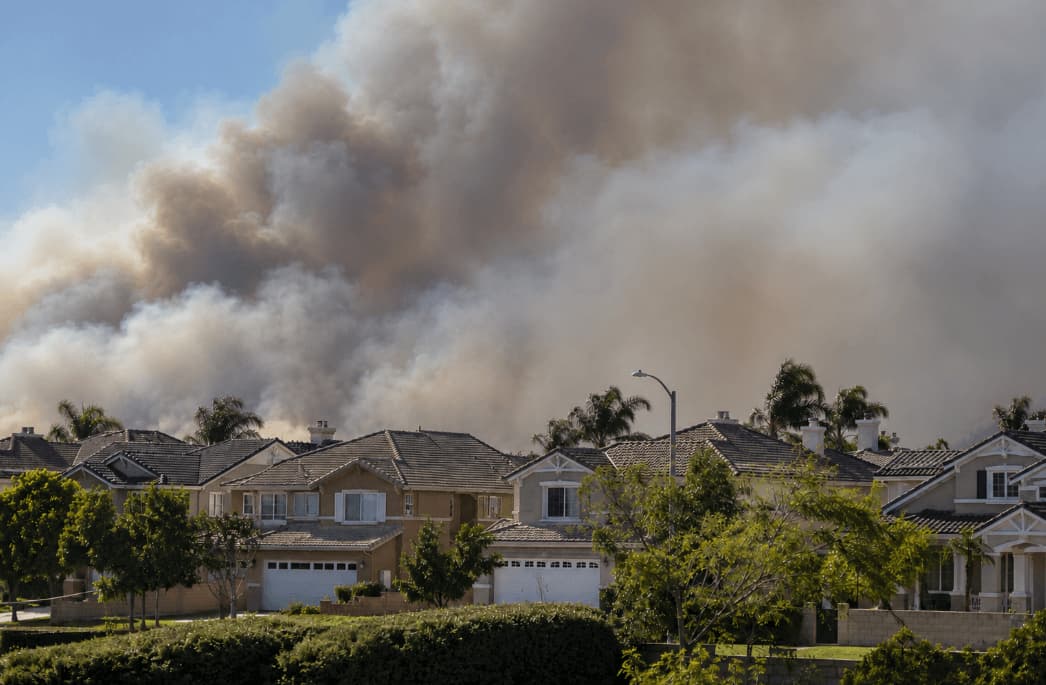
Wildfire smoke causes the overwhelming majority of purple days in the United States, and purple is uncommon otherwise. The EPA notes that AQI levels rarely exceed 200 here, which is why most AQI charts show only the 0 to 300 portion of the scale.
The realistic causes, in rough order of frequency:
Wildfire smoke, from a nearby fire or a plume that has traveled hundreds of miles downwind.
Prescribed and agricultural burning in stagnant conditions that trap smoke near the ground.
Severe winter inversions, which trap woodsmoke and exhaust in a valley, common along Utah’s Wasatch Front and in parts of Alaska.
Dust storms, which push PM10 into the purple range, mostly in the Southwest.
Ground-level ozone almost never reaches purple in a modern U.S. city, so if your area is purple, fine particles are behind it. That is also why this page sits on Filterbuy’s site instead of a weather site: particles are the one part of a smoke event a household can do something about from inside
At an AQI of 201 to 300, EPA guidance is that everyone should avoid physical activity outdoors and that sensitive groups should stay indoors with activity low. Sensitive groups means people with asthma, COPD, or heart disease, plus children, older adults, and people who are pregnant.
Size is why. At 2.5 micrometers or less, these particles slip past the defenses in your nose and throat and settle deep in lung tissue. Short-term exposure is associated with coughing, chest tightness, shortness of breath, eye and throat irritation, and worsening of asthma and heart conditions. Chest pain, breathlessness at rest, or asthma that does not respond to a rescue inhaler warrants a doctor.
Staying inside helps, but it is not a seal. EPA research puts indoor PM2.5 at roughly 55% to 60% of outdoor levels during smoke events with the windows shut and no air cleaner going. At 150 µg/m³ outside, a closed-up house still holds air that would read solidly red on its own.
Exertion, not simply being outdoors, is the variable every official recommendation turns on. A two-minute walk to the car is a different exposure than a forty-minute run. Most guidance stops at “stay inside,” which is little help when you have a school run and a dog that needs walking.
Guidance reflects U.S. EPA and state health department recommendations for the Very Unhealthy (purple) AQI category. Exertion, not time outdoors alone, is the variable these recommendations key on.
If you must be outside, a properly fitted N95 filters fine particles; a cloth or surgical mask does not. And plan past today: purple events commonly run several days, and heavy smoke loads a filter fast, so keep a spare on the shelf.
On a purple day, seal the house, switch the HVAC to recirculate, run the fan continuously through a MERV 13 filter, and put a HEPA air purifier in each room you use. Outdoor air at 201 or above gets in regardless, through gaps around doors and windows, through fresh-air intakes, and through the front door. Filtration is the part you control, so work through these in order.
Close the house. Shut every window and exterior door. Whole-house fans, window fans, and evaporative coolers pull outdoor air straight in.
Switch the HVAC to recirculate. Close any fresh-air intake so the system stops importing smoke.
Set the fan to ON, not AUTO. On AUTO it runs only during heating or cooling calls. On ON, indoor air cycles through your filter all day.
Put a MERV 13 filter in, if you have central HVAC. The step that decides whether the first three accomplish anything.
Run a HEPA air purifier in each room you occupy. Size each unit to its room and avoid models that generate ozone. If you can manage only one, EPA clean-room guidance says to seal a single interior room and put it there, for whoever is most sensitive.
Stop adding particles indoors. No candles, gas or wood stoves, fireplaces, smoking or vaping, aerosol sprays, frying, broiling, or vacuuming.
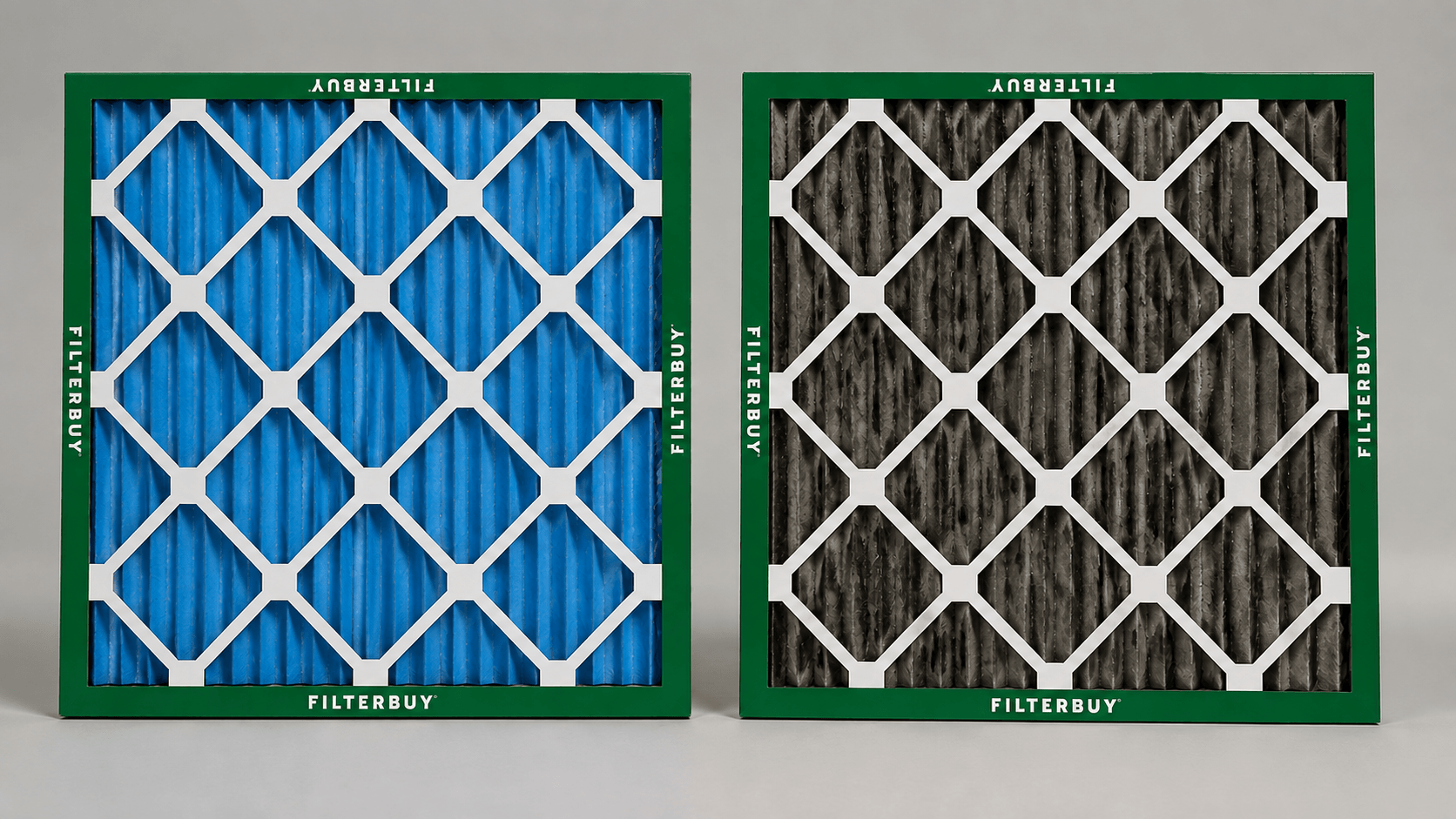
Check your filter daily, not monthly. The EPA advises replacing it once it looks dark brown or black, often well ahead of the manufacturer’s schedule.
Recheck the AQI a few times a day. Wind shifts rewrite the situation quickly.
Track it on the AirNow Fire and Smoke Map or the Filterbuy live USA AQI map. EPA also publishes clean room instructions.
Steps 3 and 4 are one move. The same EPA research cited above reports that a high-efficiency filter cuts indoor PM2.5 by about 50% with the fan running continuously, against roughly 24% for a low-efficiency filter.
MERV 13 is the filter to be running any time the AQI climbs past 100, not only at purple. By the time a reading hits 201, this should be an upgrade you made weeks ago. The reason is particle size. MERV, short for Minimum Efficiency Reporting Value, rates how well a filter captures particles by size range. The EPA’s MERV table puts MERV 13 at a minimum of 50% capture between 0.3 and 1.0 microns, the fraction of wildfire smoke that does the damage. A standard MERV 8 is built for lint, and fine smoke passes straight through it. Our full breakdown of MERV ratings covers the rest of the scale.
The recommendation has two parts, and they are not interchangeable. If your home has central HVAC, run an EPA-recommended MERV 13 filter in it. Whether or not it does, run a HEPA air purifier in each room you occupy. The filter cleans the air your system moves; the purifiers cover the rooms where people spend the hours, including bedrooms overnight when the system cycles less.
EPA wildfire guidance recommends MERV 13 or higher during smoky periods, provided the system can accommodate it. Most residential furnaces can; our guide to choosing a MERV rating for high AQI days walks through the check.
Two things quietly undo a good filter. A loose fit lets air bypass the media, and one left in too long restricts airflow. Because Filterbuy builds its own filters instead of reselling, fit is what we keep coming back to: the rating is on the box, but the fit is decided at your return. Measure before you buy. Filterbuy makes MERV 13 filters in more than 600 sizes, including custom dimensions for odd returns. Stock them before fire season, because that is when they sell out, or put a spare on auto-delivery so one is always on the shelf.
“Everyone asks which filter to buy. Almost nobody measures the return first. A MERV 13 sitting loose in an oversized track does less for you on a purple day than a snug MERV 11, because the air simply goes around it. Check the fit on a clear day, with the manufacturer’s specifications in front of you. Not at ten at night with the sky orange.”
– David Clark, CEO of Filterbuy HVAC Solutions and Licensed HVAC Technician
How rare purple is, how far it reaches, what it costs.
Unhealthy air days fell 64% since 2000.
U.S. days reaching Unhealthy for Sensitive Groups or worse dropped from 2,080 in 2000 to 757 in 2024. Purple is rare because the air got cleaner, not because the scale is generous.
Source: U.S. EPA, Our Nation’s Air: Trends Through 2024
182 purple days, across 26 states.
The American Lung Association counted 182 Very Unhealthy days for fine particle pollution in 2022–2024, with 55.1 million people across 26 states exposed to at least one purple or maroon day. Uncommon, but no longer a Western-states problem.
Source: American Lung Association, State of the Air 2026
Asthma emergencies rose 82% in one day.
When smoke drove New York air to its worst levels on June 7, 2023, asthma-related emergency visits rose 82% statewide and nearly tripled among older children and young adults.
Source: New York State Department of Health, in the CDC’s Morbidity and Mortality Weekly Report
Every claim on this page links to its source inline, and all of them are EPA, AirNow, CDC, or American Lung Association primary documents.
Wait until the AQI has been out of purple for several hours, then air the house out while conditions hold. Indoor particles lag the outdoor reading, so keep the fan running past the all-clear and check the filter. Our wildfire smoke recovery checklist covers the timeline.
Real-time AQI is a weighted average of recent hours rather than a live reading, so it lags the air in both directions, and consumer sensors estimate particle mass differently from regulatory monitors. During a fast-moving event, treat a climbing number as a floor. Our guide to hazardous air quality explains the calculation in full.
Real-time AQI averages recent hours rather than reading live, so it lags in both directions. Treat a climbing number as a floor. Our guide to hazardous air quality explains why.
MERV 13 or higher, and not only at purple. EPA advises at least MERV 13 on any filter upgrade, and the practical trigger is an AQI above 100. Pair it with a HEPA purifier in each occupied room. Our guide to choosing a MERV rating for high AQI days overs how to check compatibility.
Purple days are rare, which is what makes them easy to get caught out by. The households that ride one out comfortably bought the filter in April. Know your size before fire season and keep the spare where you can find it. You can check your local reading on the Filterbuy AQI map any time.
Purple (Very Unhealthy): AQI 201 through 300, where the EPA states the risk of health effects is increased for everyone.
PM2.5: Fine particulate matter 2.5 micrometers or smaller, the main pollutant in wildfire smoke and the usual driver of purple readings.
MERV: Minimum Efficiency Reporting Value, the 1-to-16 scale for how well an HVAC filter captures particles by size. MERV 13 is the EPA’s recommended upgrade.
HEPA: High-efficiency particulate air, the filter standard in portable purifiers, capturing at least 99.97% of particles at 0.3 microns. Separate from MERV and not interchangeable with it.
Exertion: The variable most air quality guidance keys on. Harder breathing pulls polluted air deeper into the lungs.
