August 11, 2026
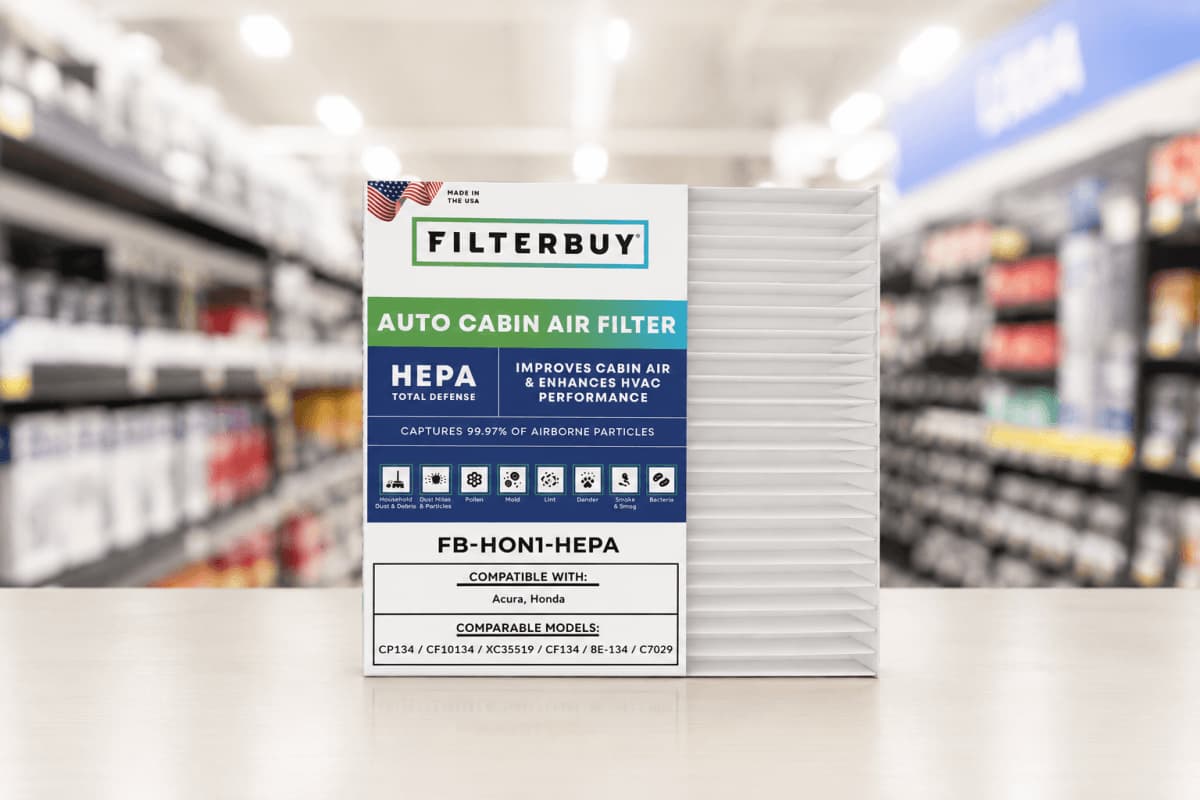
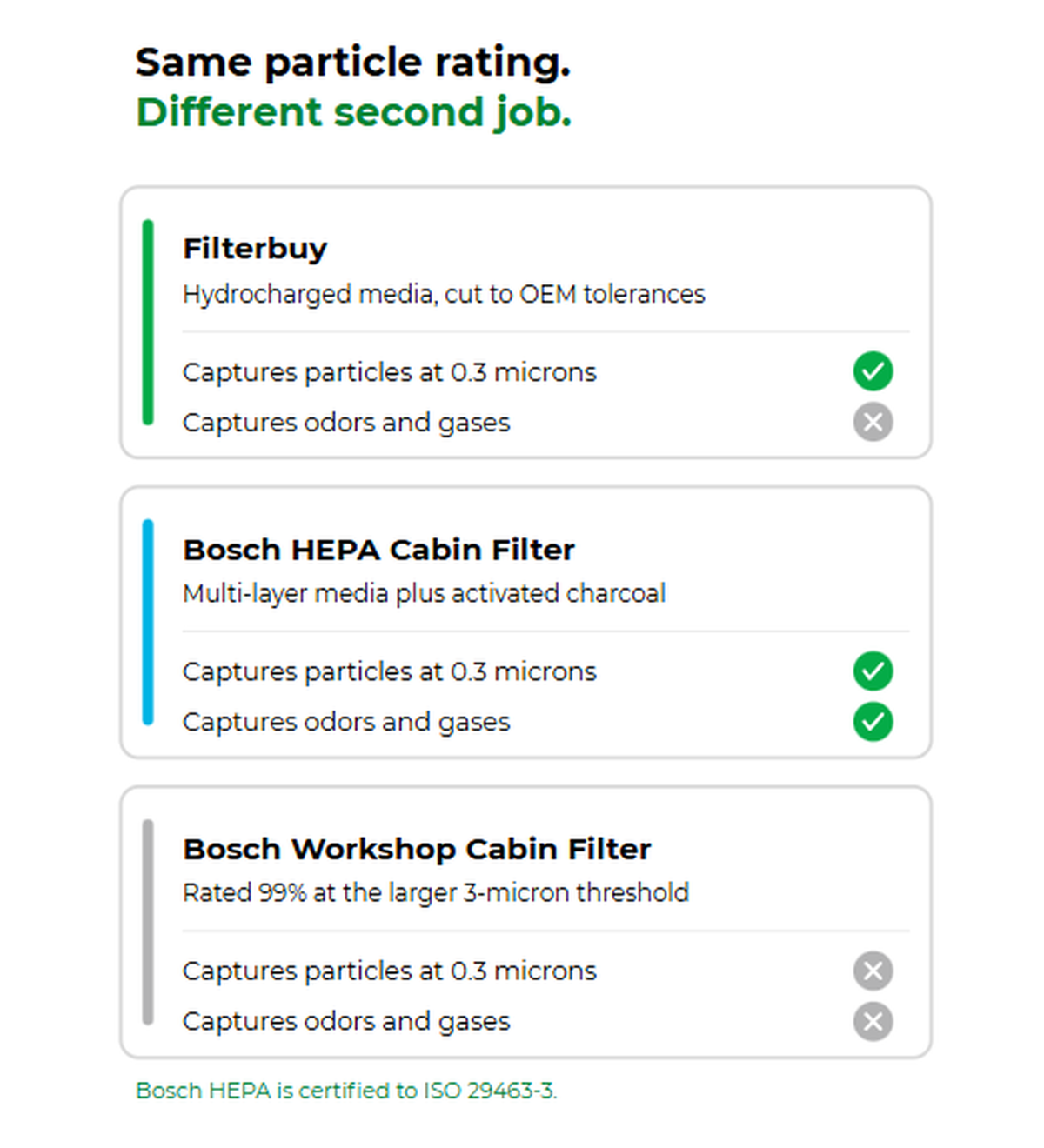
Filterbuy and Bosch HEPA both capture 99.97% of particles at 0.3 microns, so the real difference is what else each one handles. Bosch HEPA adds an activated charcoal layer that captures odors and gases. Filterbuy uses hydrocharged media cut to OEM tolerances, which limits the bypass gaps where unfiltered air slips around the filter instead of through it.
Filterbuy — captures particles at 0.3 microns. Hydrocharged media, cut to OEM tolerances.
Bosch HEPA Cabin Filter — captures particles at 0.3 microns, plus odors and gases from an activated charcoal layer.
Bosch Workshop Cabin Filter — rated 99% at 3 microns, a different tier from the two above.
Answer three quick questions below and we will match you to the filter that fits your vehicle.
Answer 3 quick questions and we will match you to your perfect filter.
Already know your vehicle? Shop Filterbuy auto cabin air filters.
You're shopping for a cabin air filter, and two names keep appearing: Filterbuy and Bosch.
Both claim HEPA-level performance. Both fit a wide range of vehicles. So why does the choice feel harder than it should?
The real question isn't which brand sounds more familiar.
It's whether you need a filter optimized for particle capture or one that also neutralizes odors. Those are different problems, and they have different answers.
Both Filterbuy and Bosch HEPA filters achieve 99.97% particle capture at 0.3 microns, but they get there through different technologies with different strengths.
Filterbuy uses hydrocharged synthetic media and OEM-precise fitment, making it the stronger choice for allergy sufferers and DIY replacements.
Bosch's HEPA Cabin Filter adds an activated charcoal layer for odor and gas control, which is a meaningful advantage for drivers in heavy traffic or industrial areas.
Bosch's Workshop Cabin Filter is rated at 3 microns, making it unsuitable for allergy or respiratory management.
A filter replaced on schedule consistently outperforms a technically superior filter that gets swapped out months late.
Most drivers assume all HEPA-rated filters are essentially the same. If the box says 99.97% efficiency, the job is done. It’s actually worth digging a little deeper here.
HEPA certification tells you how well a filter traps particles at a single size (0.3 microns), but understanding a few extra details, like fitment precision, how the media holds its charge over time, and whether the filter handles gaseous pollutants, can help you make an even better choice.
Two filters can carry the same efficiency rating, and knowing these differences means you can find the one that truly performs best in real driving conditions.
The most important variables in a cabin air filter comparison aren't brand recognition. They're media technology and fitment tolerance, and those two things do separate Filterbuy from Bosch's lineup.
Filterbuy uses HEPA-certified synthetic media with a hydrocharging process, an electrostatic treatment that gives the filter media a sustained charge.
That charge actively attracts particles rather than waiting for them to physically contact the fibers. The result is better capture of fine particles including pollen, mold spores, pet dander, and airborne bacteria, without requiring tighter fiber weaves that would restrict airflow.
Each filter is manufactured in the USA to exact OEM tolerances, which means the housing fit is precision-cut to eliminate bypass gaps, the spaces around the filter where unfiltered air can sneak through and go directly to your vents.
Certified to ISO 29463-3, the Bosch HEPA Cabin Filter achieves 99.97% particle capture at 0.3 microns.
Its differentiator is a dedicated activated charcoal layer that adsorbs gaseous pollutants: exhaust fumes, VOCs, and traffic-related odors that particle filters alone can't address.
If you drive primarily in stop-and-go traffic or near industrial areas and notice persistent odors through your vents, that charcoal layer is a meaningful feature, not a marketing add-on.
Bosch also offers a separate Workshop Cabin Filter rated at 99% efficiency at the larger 3-micron threshold.
That filter is engineered for professional installer volume, not for allergy or respiratory management.
For most drivers reading a comparison like this one, the Workshop line isn't the right choice.
| Spec | Filterbuy | Bosch HEPA | Bosch Workshop |
|---|---|---|---|
| Filtration efficiency | 99.97% | 99.97% | 99% |
| Particle size rating | 0.3 microns | 0.3 microns (ISO 29463-3) | 3 microns |
| Media technology | Hydrocharged synthetic | Multi-layer + activated charcoal | Standard media |
| Odor/gas control | No | Yes | No |
| Fitment tolerance | OEM-precise (USA-made) | Standard | Standard |
| Best use case | Allergies, DIY, air quality | Odor + particles, retail/pro install | General light-duty use |
A few additional details worth keeping in mind:
Particle capture floor: Filterbuy captures at 0.3 microns. Bosch Workshop captures at 3 microns. That 10x difference matters when pollen (10 to 100 microns), mold spores (1 to 30 microns), and diesel exhaust particulates (0.1 to 10 microns) are concerns for you or your passengers.
Gaseous pollutants: Activated charcoal, present in Bosch HEPA's design, adsorbs VOCs and odor-causing gases. Hydrocharged synthetic media, used by Filterbuy, does not. It's optimized for solid particles, not gases.
Fitment gap risk: A filter that doesn't seat flush against its housing creates bypass airflow. Filterbuy's OEM-tolerance manufacturing directly targets this. A poor fit can undermine an otherwise high-efficiency filter regardless of its spec sheet.
Older HVAC systems: Drivers with older vehicles or lower-powered blower motors should note that denser filtration media can increase static pressure. If your HVAC already runs weak, verify your vehicle's recommended filter spec before prioritizing maximum filtration density.
For the majority of drivers, especially those managing seasonal allergies, pet dander exposure, or urban air quality, particle capture is the primary job the cabin filter needs to do well.
On that measure, Filterbuy's hydrocharged HEPA media and precision fitment make it a strong, well-rounded choice.
The subscription model and free 2-day shipping also remove the common friction that causes drivers to delay replacement longer than they should. That matters more than most people realize. A filter replaced on schedule consistently outperforms a technically superior filter swapped out six months late.
For drivers who want both particle filtration and active odor reduction, Bosch HEPA is worth considering, as its charcoal layer adds odor control that serves a specific need.
But for most drivers focused on general air quality, allergy management, and hassle-free DIY replacement, Filterbuy is the stronger everyday choice.
The combination of hydrocharged HEPA media, precision fitment, and a subscription model that keeps replacements on schedule means Filterbuy delivers reliable, consistent performance where it counts most. For the majority of drivers, that's exactly what they need.
EPA guidance on vehicle cabin air quality and ASHRAE's filtration frameworks both recommend prioritizing particle capture efficiency and consistent filter maintenance intervals over any single product feature. Regular replacement, not maximum MERV or HEPA rating alone, is the biggest determinant of filter performance over time.
No cabin air filter is a perfect fit for every driver. If you live near industrial zones or spend significant time in heavy stop-and-go traffic, the odor control built into Bosch HEPA's charcoal layer is a real, functional advantage worth the tradeoff of buying through retail rather than direct.
For most other drivers, the practical starting point is this: use Filterbuy's vehicle selector to confirm your vehicle's correct size and filter housing type before ordering.
Getting the fitment right is the single highest-leverage step you can take, because the best-specced filter on the market still underperforms if it doesn't seat correctly in your vehicle.
Bosch's HEPA Cabin Filter, certified to ISO 29463-3, achieves 99.97% particle capture at 0.3 microns and adds an activated charcoal layer for odor reduction, making it a capable filter for drivers who want both particle and gaseous pollutant control.
It's best suited for buyers who prefer purchasing at a local retailer or through a professional installer. The Bosch Workshop Cabin Filter, rated at 99% efficiency at 3 microns, is better suited for general-use vehicles and is not recommended for allergy or respiratory management.
Filterbuy uses HEPA-certified synthetic media combined with a hydrocharging process that gives the filter an electrostatic charge, actively attracting particles as small as 0.3 microns, including pollen, mold spores, pet dander, and airborne bacteria.
The filters are manufactured in the USA to exact OEM tolerances, which minimizes fitment gaps that allow unfiltered air to bypass the media entirely. For allergy sufferers, that combination of certified efficiency and precision fit is what separates a filter that performs on paper from one that performs in the car.
Most vehicle manufacturers recommend replacement every 15,000 to 25,000 miles, or once per year. Drivers in high-pollen regions, wildfire-prone areas, or heavy urban traffic should replace closer to the 12,000 to 15,000 mile mark.
A clogged filter restricts airflow, increases strain on the blower motor, and allows more contaminants to circulate through the cabin. Checking filter condition at every oil change is a low-effort habit that prevents the most common cause of filter underperformance: simply forgetting to replace it.
Filterbuy cabin air filters are available at Filterbuy.com and through Amazon. Buying directly from Filterbuy.com provides access to multi-pack pricing, subscription plans with automatic delivery, and free 2-day shipping, which eliminates the most common reason drivers delay replacement past their recommended interval.
