
Furnace Filter Airflow Restriction in Cold Weather: Signs and Fixes
November 3, 2026
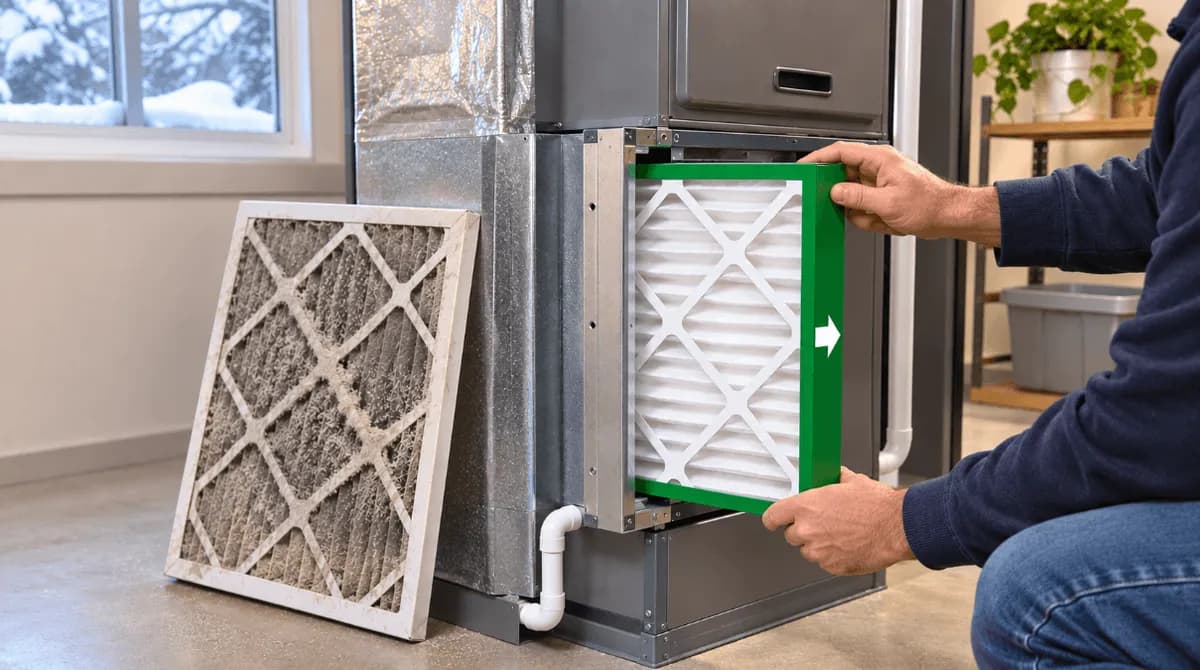
Turn the system off, slide out your furnace filter, and hold it up to a light. If little light passes through or the filter is bowed, replace it before the next cold night, because a filter that lasted 90 days in spring can fill in 30 to 45 days in January.
Depth decides how much room the new filter leaves your blower. With a 1-inch slot, Filterbuy usually recommends MERV 8 or 11. With a media cabinet, a 4-inch MERV 13 starts at about the same resistance as a 1-inch MERV 8, so check your furnace manual for its filter limits before you step up.
How Much Of The Filter Budget A Clean Filter Uses
Clean-filter resistance on 20x25 filters at 1,000 CFM, in inches of water column (in. w.c.). Most furnaces budget 0.10 in. w.c. for the filter.
Within the 0.10 filter budget
Over the filter budget
1-Inch Filters
MERV 8: 0.10 in. w.c.
Uses the full filter budget before any dust
MERV 11: 0.15 in. w.c.
0.05 over the filter budget
MERV 13: 0.22 in. w.c.
0.12 over the filter budget
4-Inch Filters
MERV 8: 0.05 in. w.c.
Half the filter budget
MERV 11: 0.08 in. w.c.
Within the filter budget
MERV 13: 0.11 in. w.c.
0.01 over, about the same as a 1-inch MERV 8
On a furnace rated for 0.50 in. w.c., a clean 1-inch MERV 13 uses about 44% of the total budget by itself. A 4-inch MERV 13 uses about 22%, leaving room for the dust it collects by January.
Source: Filterbuy testing lab, initial (clean) pressure drop. Filter budget per the National Comfort Institute. Values vary by manufacturer.
Shop Furnace Filters In Your Exact Size
Fast and free 2-day delivery to most US states. Auto-delivery saves 5% on every order.
Find The Right Filter Depth And MERV For Your Furnace
Every winter, the same calls reach Filterbuy: a furnace that shuts itself off after a few minutes, or a filter that went gray weeks early. Because we cut, pleat, and frame our filters in our own U.S. plants, we see both sides of that problem: how much resistance a filter starts with, and how quickly a cold snap loads it up.
TL;DR
Furnace filter airflow restriction happens when a filter is too dirty, too dense, or too small for the air your heating system needs to move. Cold weather makes it more likely, because long run times load filters faster. The result can be an overheated furnace that trips its high-limit switch and short cycles. Filterbuy's first recommendation is a fresh filter in the right size and MERV rating, checked monthly all winter.
Key Takeaways
Winter loads filters fast. Filterbuy's operations team sees a filter that lasted 90 days in spring fill in 30 to 45 days in January.
Low airflow overheats the heat exchanger, so the high-limit switch shuts off the burner and the furnace short cycles.
Most home furnaces are rated for about 0.50 in. w.c. of total external static pressure, and roughly 0.10 of that is budgeted for the filter.
In Filterbuy lab testing, a 4-inch filter starts with about half the resistance of a 1-inch filter at the same MERV rating.
Why Furnace Filters Restrict Airflow More in Cold Weather
Your furnace runs longer in cold weather, pushing more air and dust through the filter every day, and resistance climbs as the media fills. A closed-up house adds to the load, as pet dander and fireplace soot recirculate instead of escaping outdoors.
Technicians call a filter's resistance to airflow pressure drop, and it becomes a problem once the media loads up or the filter is too dense or too small for the blower. Moving air carries heat off the heat exchanger and into your rooms, so when it slows, heat builds up inside the cabinet. That is how a clogged filter makes a furnace overheat.
“After a decade of making filters and watching what happens when homeowners wait, the pattern is dependable: a $15 filter problem in November is a $500 service call by February.”
Filterbuy Operations Team
Related reading: why winter indoor air quality is worse and common winter airflow problems.
Signs of Furnace Filter Airflow Restriction in Winter
The clearest sign is short cycling. The burner lights, runs a few minutes, and shuts off while the blower keeps going, then it starts over. Why furnaces short cycle in cold weather covers the non-filter causes.
Winter Airflow Triage
| Sign | Could also be |
|---|---|
| Short cycling: burner stops after minutes, blower keeps running | Oversized furnace; dirty flame sensor (stops within seconds) |
| Weak airflow at vents | Closed registers, disconnected duct, failing blower motor |
| Cold rooms at the end of long duct runs | Leaky or unbalanced ductwork |
| Runs nonstop, never reaches setpoint | Normal on the coldest nights, or an undersized furnace |
| Whistling at the return or filter slot | Undersized return, filter not seated |
| Hot cabinet or scorched-dust smell | Dust burning off on the season's first cold days (normal, brief) |
| Flashing status light | Any stored fault code; match it to the chart on the furnace door |
Cold-weather lookalike: High-efficiency furnaces (90%+ AFUE) vent through white PVC pipes outdoors. Snow or ice can block them and trip a pressure switch, which looks like filter restriction from indoors. Reviewer David Clark notes that after a heavy snow, most no-heat calls he sees on high-efficiency furnaces trace back to a drift or an ice cap over the exhaust pipe. Filterbuy's frozen furnace vent pipe guide shows how to clear one safely.
Where Static Pressure Comes In
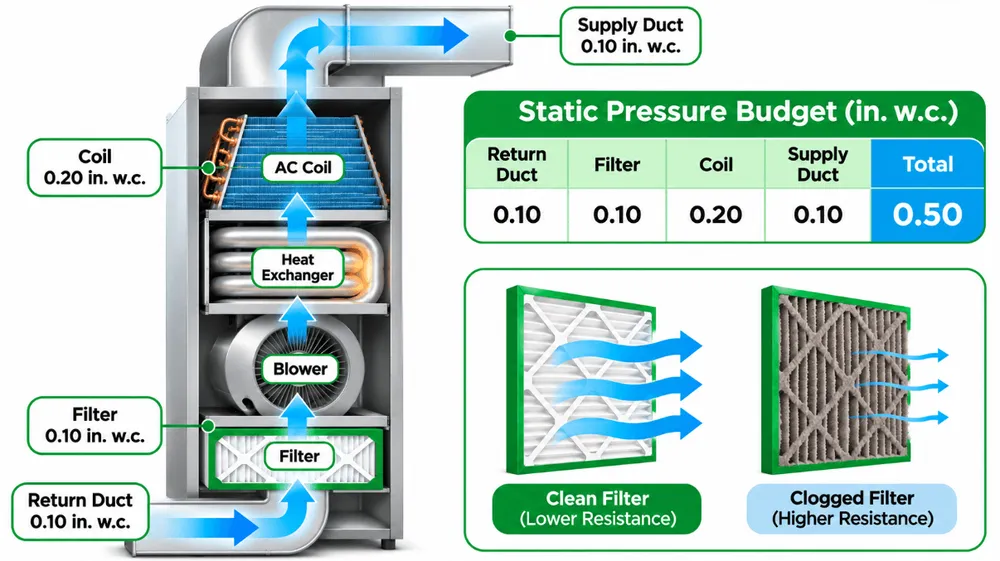
Static pressure is the resistance a furnace blower pushes against as it moves air through the filter, ducts, and coil, measured in inches of water column (in. w.c.). Most home furnaces are rated for about 0.50 in. w.c. in total. A dirty or overly dense filter eats into that limit.
The National Comfort Institute (NCI) splits that 0.50 in. w.c. budget like this (HVAC Today):
Static Pressure Budget on a 0.50 in. w.c. Furnace
| Component | Pressure (in. w.c.) |
|---|---|
| Evaporator (AC) coil | 0.20 |
| Air filter | 0.10 |
| Supply ductwork | 0.10 |
| Return ductwork | 0.10 |
| Total | 0.50 |
Source: National Comfort Institute static pressure budget, via HVAC Today.
Real homes rarely stay on budget. NCI reports that the average system it field-tests runs about 0.82 in. w.c., and diagnostic platform measureQuick finds that more than 70% of the systems in its database exceed 0.50. Older PSC blowers simply move less air as pressure rises, while variable-speed ECM blowers draw more power to hold airflow until they hit their limit.
Filterbuy Lab Data on Filter Depth
Filterbuy manufactures every filter it sells, so we test them. Our lab measured clean-filter resistance on 20x25 filters at 1,000 CFM:
| Filter rating | 1-inch (in. w.c.) | 4-inch (in. w.c.) |
|---|---|---|
| MERV 8 | 0.10 | 0.05 |
| MERV 11 | 0.15 | 0.08 |
| MERV 13 | 0.22 | 0.11 |
Source: Filterbuy testing lab, initial (clean) pressure drop on 20x25 filters at 1,000 CFM. Values vary by manufacturer.
Two results shape Filterbuy's advice. Every 1-inch MERV 11 and MERV 13 filter starts above the 0.10 in. w.c. filter budget before it catches any dust. And a 4-inch MERV 13 starts at about the same resistance as a 1-inch MERV 8, so depth buys finer filtration without the airflow penalty. See our full MERV ratings and pressure drop chart.
What that means for your furnace: On a furnace rated for 0.50 in. w.c., a clean 1-inch MERV 13 uses about 44% of the total budget by itself (0.22 ÷ 0.50), before the ducts and coil take their share. A 4-inch MERV 13 uses about 22%, leaving headroom for the dust it will collect by January.
How to Fix a Restricted Furnace Filter
Usually the fix is a clean filter in the correct size, plus a walk around the house to clear vents. The swap takes about five minutes.
Turn the system off at the thermostat before you open the filter slot.
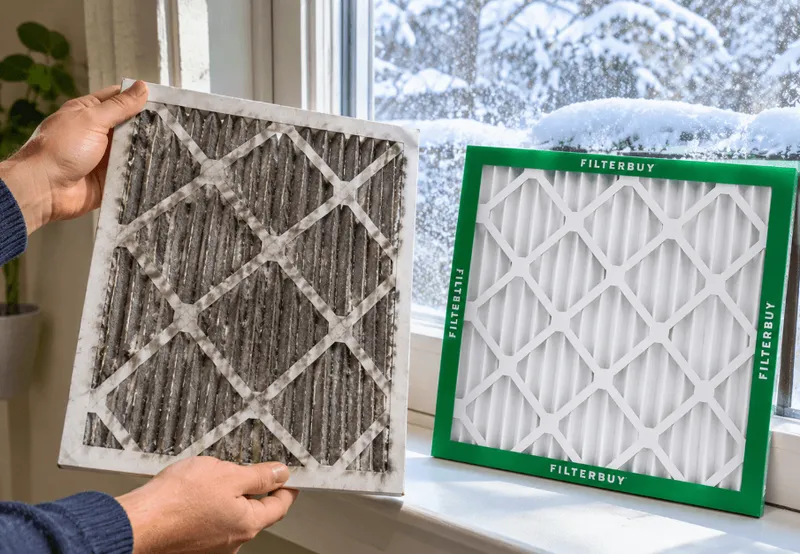
Inspect the filter. Hold it up to a light. If little light passes through or it is bowed, replace it.
Match all three dimensions. Order by the nominal size on the old frame (for example, 16x25x1), and double-check depth, the number Filterbuy's manufacturing team sees ordered wrong most often. If the label has worn off, see how to measure your air filter.
Point the arrow toward the furnace, the direction air flows. Filterbuy's guide to changing a furnace filter walks through each step.
Clear registers and returns. Move furniture and holiday decor off vents, and keep most registers open, because closing them raises static pressure.
Clear the outdoor PVC vent pipes on high-efficiency furnaces after any snow or ice.
Restart and watch a full cycle. If the furnace shuts down again, stop resetting it and call a technician.
“The question I get most is which MERV to buy. The one to ask first is whether the filter you are holding actually fills the slot.”
Michelle Wan, Brand Manager and Air Quality Writer, Filterbuy
Never run the furnace without a filter. Dust coats the blower and coil, turning a cheap fix into a costly one.
Choosing the Right MERV Rating and Winter Replacement Schedule
For most furnaces, a MERV 8 or MERV 11 pleated filter, replaced on a winter schedule, balances clean air with healthy airflow. MERV 13 captures finer particles but restricts more in a 1-inch size, so it works best in a 2- to 4-inch slot.
MERV (Minimum Efficiency Reporting Value) rates how well a filter captures particles under ASHRAE Standard 52.2. The EPA's guide to MERV ratings advises choosing MERV 13 or as high a rating as your system fan and filter slot can accommodate.
Pro Tip: Upgrade thickness before MERV. With a 1-inch slot, Filterbuy usually recommends MERV 8 or 11. If your furnace has a media cabinet, a 4-inch air filter lets you step up to MERV 13.
Winter Filter Check and Replacement Schedule
| Your setup | Winter check | Typical winter replacement |
|---|---|---|
| 1-inch pleated, no pets | Monthly | Every 60–90 days, sooner if gray |
| 1-inch pleated with pets, allergies, or a wood stove | Monthly | Every 30–60 days |
| 2-inch pleated | Monthly | Every 60–90 days |
| 4- or 5-inch media filter | Every 1–2 months | Every 3–6 months |
Filterbuy's recommended heating-season ranges. Follow your furnace manufacturer's manual if it differs.
These ranges tighten ENERGY STAR's filter guidance (check monthly, change at least every 3 months) for winter. Filterbuy auto-delivery ships your exact size, made in the USA, whenever you choose. See also how often to change your furnace filter in winter.
Plan your winter supply: November through March runs about 150 days. On Table 4's 30–60 day schedule, that means three to five 1-inch filters per return, while a 4-inch filter on a 3–6 month schedule needs one or two.
When to Call an HVAC Technician
Call a licensed HVAC technician if short cycling continues after a fresh filter or new filters clog within weeks, and ask for a static pressure test before you upgrade MERV. Note your filter size, install date, burner cycle length, and any blinking code to speed the visit. If you smell gas or a CO alarm sounds, leave the house and call your gas utility or 911. Repeated overheating stresses the heat exchanger, so follow CPSC guidance on CO alarms: one per level, tested monthly.
Supporting Statistics
47% of U.S. homes heat with natural gas, so furnace airflow matters in about half of homes. (U.S. Energy Information Administration)
More than 400 Americans die each year from unintentional, non-fire CO poisoning, and CDC lists furnaces among household sources. (CDC)
MERV 10–13 filters changed energy use by less than 1% in a year-long study of ten homes, while MERV 16 filters could raise it more than 5%. (Lawrence Berkeley National Laboratory)
Frequently Asked Questions
Can a dirty furnace filter make the furnace shut off?
Yes. Restricted airflow overheats the heat exchanger, the high-limit switch cuts the burner, and the furnace keeps cycling until airflow is restored.
Is a high-MERV filter bad for my furnace in winter?
Not by default. In Filterbuy's lab, a clean 1-inch MERV 13 starts at 0.22 in. w.c., more than double the filter budget, while a 4-inch MERV 13 starts at 0.11. Moving to a thicker filter usually solves the problem.
How often should I change my furnace filter in winter?
Check it monthly, and replace a 1-inch pleated filter every 30–90 days depending on pets and dust, or a 4-inch filter every 3–6 months.
Is a 4-inch filter better than a 1-inch filter in winter?
Usually, if your furnace has a media cabinet. In Filterbuy's lab, a 4-inch filter started with about half the resistance of a 1-inch filter at the same MERV rating.
How do I know if static pressure is too high?
Short cycling and weak airflow at the vents are clues, but only a technician's manometer reading can confirm it.
Glossary
Airflow restriction: Anything that reduces the volume of air an HVAC system moves, such as a clogged filter.
Pressure drop: The loss of air pressure across a filter or component; it rises as a filter loads.
Total external static pressure (TESP): The combined resistance of filter, coil, and ducts a furnace blower works against.
High-limit switch: A furnace safety sensor that shuts the burner off when the heat exchanger overheats.
Short cycling: A furnace turning on and off in short bursts instead of completing heating cycles.
MERV: Minimum Efficiency Reporting Value, the ASHRAE 52.2 rating (1–16) for particle capture.
AFUE: Annual Fuel Utilization Efficiency, the share of fuel a furnace turns into usable heat.
About the Author and Reviewer
Michelle Wan is Brand Manager and Air Quality Writer at Filterbuy and works directly with Filterbuy's manufacturing teams in Alabama, Florida, Pennsylvania, and Utah. David Clark is a licensed, EPA-certified HVAC technician and President of Filterbuy HVAC Solutions, with more than a decade in the field.