April 15, 2026
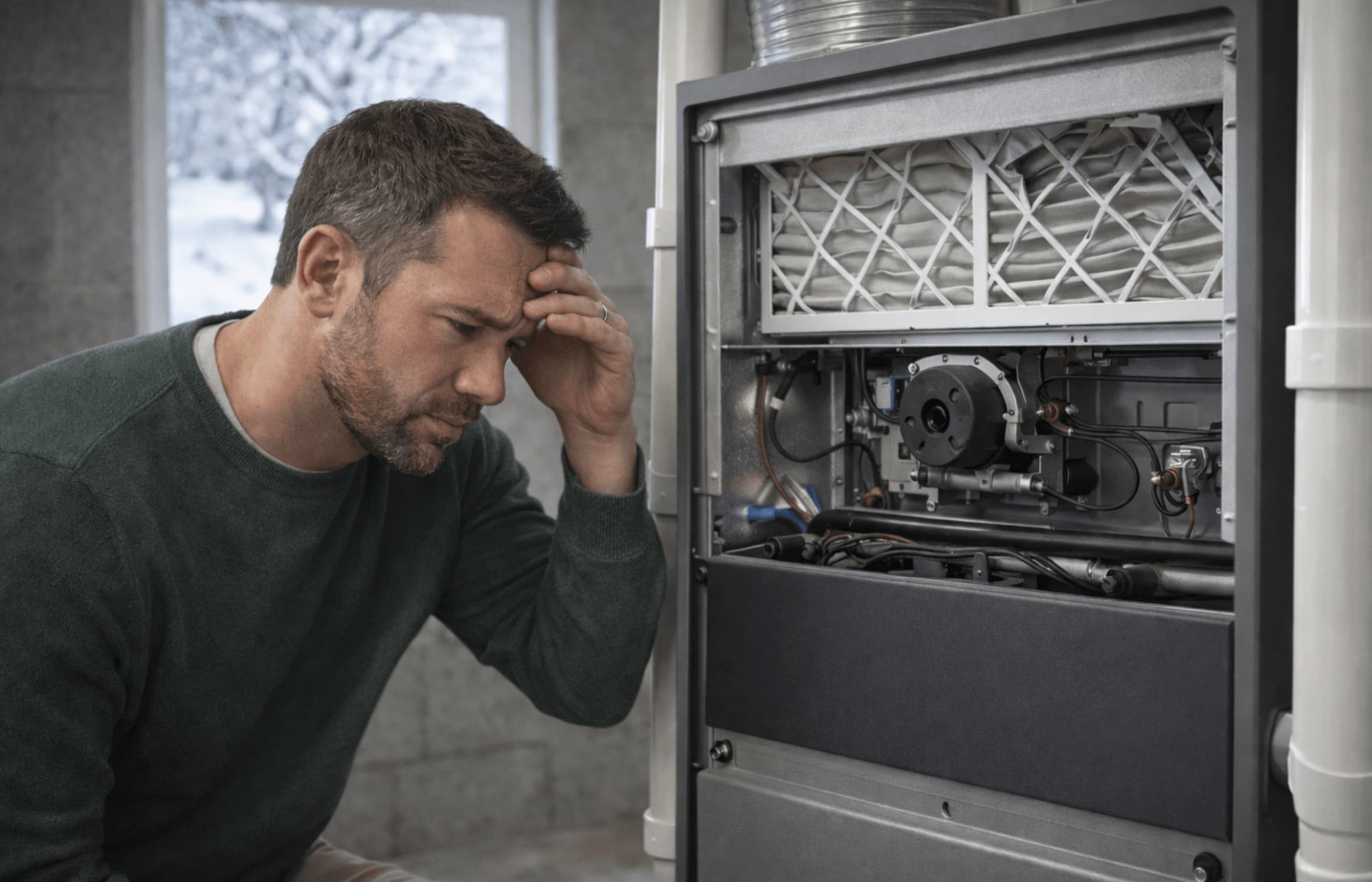
Thermostat set to 68. Your furnace kicks on, runs two minutes, shuts off. Kicks on again. Shuts off. The house stays cold while your system wears itself out on repeat. That pattern has a name: short cycling. And in most cases, your air filter is the reason.
The good news is that most causes are things you can check yourself, and the most common one costs under $25 to fix. Some of these take five minutes. A few need a licensed technician. We'll tell you which is which, walk you through each cause, and give you a clear fix for every one of them.
Your HVAC system short cycles in winter when it starts, runs less than five minutes, and shuts off before your home reaches the set temperature. In winter, it happens more often because cold weather adds specific stress that warmer months don't.
The most common causes:
• Dirty air filter — restricted airflow forces the heat exchanger to overheat and trip the safety shutoff
• Thermostat placement — a thermostat near a heat source reads a false temperature and cuts the cycle early
• Blocked vents — closed or obstructed registers build up pressure and cause the system to overheat
• Heat pump in extreme cold — heat pumps struggle to extract heat from outdoor air below 35 to 40°F, triggering safety cutoffs
• Frozen flue cap — ice blockage at the exhaust pipe forces a safety lockout
Start with the filter. Hold it up to a light source. If you can't see through it, replace it before doing anything else. That single fix resolves the majority of winter short cycling complaints.
• Short cycling means your system runs 2 to 5 minutes, shuts off, and restarts. A healthy cycle is 10 to 15 minutes.
• A dirty air filter is the most common cause by a wide margin. It chokes off airflow and forces the heat exchanger to overheat.
• Oversized systems, thermostat placement problems, blocked vents, and heat exchanger faults are the next most frequent culprits.
• Heat pumps short cycle differently in cold weather. Outdoor temperature and refrigerant pressure are factors that don't apply to gas systems.
• Ignoring short cycling speeds up component wear and drives up your energy bills.
• A suspected cracked heat exchanger is a safety issue, not just a repair issue. It's a potential carbon monoxide risk. Don't run the system until a technician has inspected it.
A normal heating cycle runs roughly 10 to 15 minutes. That's enough time to pull cold return air, heat it, push it through your ductwork, and bring your home up to the temperature you've set. Short cycling happens when that sequence cuts off in under five minutes and the system restarts almost immediately.
The result is a system that runs constantly but never does its job. Your home stays cold, your energy bill climbs, and every one of those short start-stop cycles puts strain on the compressor, the blower motor, and the heat exchanger. Those are the most expensive parts to replace. According to the U.S. Energy Information Administration, space heating and air conditioning together account for more than 52% of a typical household's annual energy use. A short cycling system pushes that figure up while delivering less comfort in return.
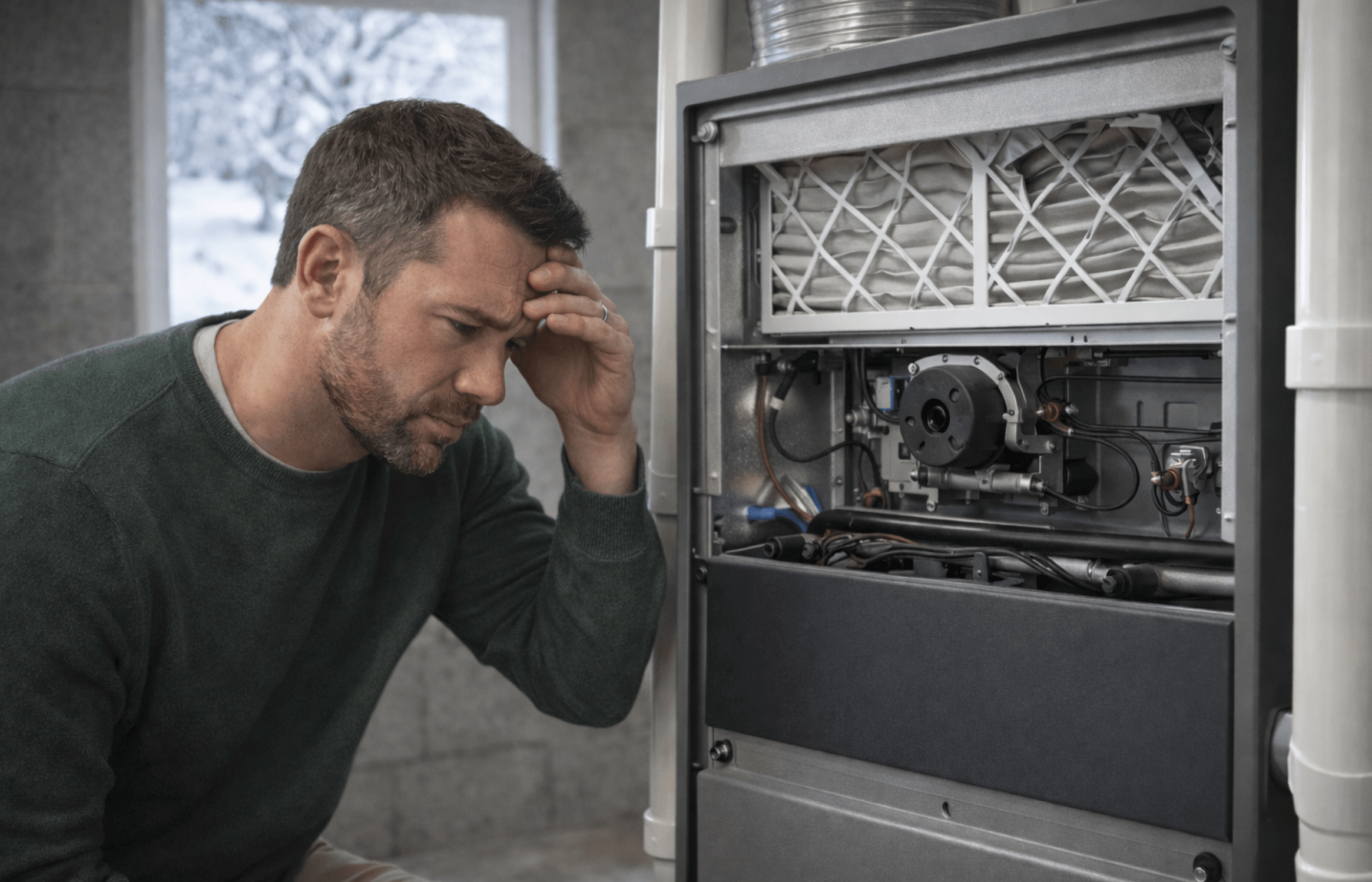
Start here, every time, no exceptions. When a filter clogs up with dust, pet dander, and debris, it chokes off the airflow your system needs to run safely. Without enough air moving across the heat exchanger, the temperature inside climbs too high. The high-limit safety switch detects this, shuts the system down, then resets. And the whole sequence starts again minutes later.
Fix: Pull the filter and hold it up to a light source. Can't see through it? Replace it. For most homes, a pleated MERV 8 to MERV 11 filter swapped every 60 to 90 days is the right call. If you have pets or allergy sufferers in the house, go MERV 11. Stay under MERV 13 unless your system is specifically rated for the added resistance.
Filterbuy Tip: The filter check takes about 60 seconds and costs nothing. It's the first thing our technicians look at on every short cycling call, and it solves the problem more often than anything else on this list.
An oversized system heats the space too fast for the ductwork to keep up. The thermostat hits its target temp before the rest of the house has caught up, signals the system to stop, and then temps drop again within minutes. The cycle keeps repeating. Those rapid, shallow runs wear out the heat exchanger, blower motor, and contactor switch faster than normal operation ever would.
Fix: If your system has always cycled this way since installation, a contractor's Manual J load calculation will tell you whether the unit is correctly sized for your home. This isn't a quick adjustment. It's a design problem that usually requires equipment replacement to fully resolve. If short cycling only recently started, sizing probably isn't the cause.
A thermostat mounted near a heat source reads the wrong temperature. Sunny window, lamp, kitchen appliance, even a TV nearby: all of them can fool it into thinking the room is warmer than it actually is. The thermostat cuts the heat cycle short, the room cools off, and the system restarts. Low or dying batteries cause the same erratic behavior.
Fix: Replace the battery first. Takes 30 seconds and occasionally that's the whole fix. If the battery's fine, check placement. The thermostat belongs on an interior wall, away from direct sunlight, drafts, and anything that generates heat. Most homeowners can handle a relocation themselves. A smart thermostat upgrade is also worth considering since modern units are far better at reading ambient conditions accurately.
The heat exchanger transfers heat from the combustion chamber into the air moving through your home, while keeping combustion gases completely separate from what your family breathes. When it cracks or develops a fault, the high-limit switch shuts the system down as a safety measure. The system cools, the switch resets, the system restarts, and the pattern keeps going.
Safety Notice: A cracked heat exchanger isn't a DIY repair. It's a potential source of carbon monoxide exposure, an odorless, colorless gas that poses a serious health risk. If you suspect this is the problem, turn the system off and call a certified HVAC technician immediately. Don't run it again until it's been professionally inspected.
Fix: A licensed HVAC technician needs to inspect, diagnose, and replace the component. Heat exchanger replacement typically runs $500 to $1,500 depending on the system and part. If the furnace is older than 15 years, full replacement may make more financial sense than repair. Your technician can help you weigh the options.
In heating mode, a heat pump pulls latent heat from outdoor air and moves it inside. That process depends on refrigerant cycling at the right pressure. When refrigerant leaks and pressure drops, the system can't move heat efficiently, safety cutoffs engage, and short cycling starts.
Fix: Low refrigerant always means there's a leak somewhere. Recharging without finding it is a temporary fix at best. A licensed technician needs to locate the leak, repair it, and recharge to the correct spec. Budget $150 to $500 depending on refrigerant type and where the leak is.
This one's easy to miss, especially after you've rearranged furniture or put down a new rug. When supply or return registers are blocked or shut, static pressure inside the duct system builds up. The blower works harder to push air through, the system overheats, and the safety limit switch trips. Same result as a dirty filter, different cause.
Fix: Walk the house and open every supply and return vent. Check walls, ceilings, and floors. Clear anything blocking airflow: furniture, rugs, curtains. This takes five minutes and costs nothing.
Your flue pipe is more vulnerable in winter than any other season. Ice can build up at the exterior cap during a cold snap. Bird nests from the previous season, debris, and small animals seeking warmth can all cause blockages too. When the flue is blocked, combustion gases back up inside the system and trigger a safety lockout.
Fix: Go outside and find the flue cap. Look for ice buildup, debris, or anything blocking the opening. Minor ice buildup you can usually clear yourself. If the blockage is deeper or unclear, call a pro. A blocked flue is a safety issue, not just a performance one.
"A dirty air filter accounts for more short cycling calls than anything else we see. It's the first thing we check before touching anything else on the system. If your HVAC is short cycling this winter, pull that filter before you pick up the phone."
— Filterbuy HVAC-Certified Technician, with over a decade of residential and commercial HVAC service experience
1. How Long Do Furnaces Last? Average Lifespan & Life Expectancy — Filterbuy Our guide to furnace longevity. If your system is older and short cycling frequently, this helps you figure out whether you're looking at a repair or a replacement. https://filterbuy.com/resources/furnaces/furnace-knowledge/how-long-do-furnaces-last-average-lifespan-and-life-expectancy-of-a-furnace/
2. Maintaining Your Air Conditioner — U.S. Department of Energy The DOE's official guidance on HVAC filter maintenance, including the 5% to 15% energy savings that come from replacing a dirty filter. The primary source for that statistic. https://www.energy.gov/energysaver/maintaining-your-air-conditioner
3. Heat Pump Systems — U.S. Department of Energy How heat pumps operate in both heating and cooling modes, including cold-weather performance thresholds. Worth reading if your heat pump specifically short cycles in winter. https://www.energy.gov/energysaver/heat-pump-systems
4. Use of Energy in U.S. Homes — U.S. Energy Information Administration The EIA's data on residential energy use by end use, including the 2020 finding that space heating and cooling account for more than half of what the average household spends on energy. https://www.eia.gov/energyexplained/use-of-energy/homes.php
5. Indoor Air Quality (IAQ) — U.S. Environmental Protection Agency The EPA's full resource on indoor air pollutants, ventilation, and the role of filtration in maintaining a healthy home. Useful context when you're choosing a MERV rating. https://www.epa.gov/indoor-air-quality-iaq
6. ENERGY STAR Certified Heating & Cooling — U.S. Environmental Protection Agency ENERGY STAR's guide to certified HVAC equipment and efficiency standards. Useful if you're comparing systems or evaluating whether a replacement makes financial sense. https://www.energystar.gov/products/heating_cooling
52% of a typical U.S. household's annual energy goes to space heating and air conditioning. Source: EIA, Residential Energy Consumption Survey 2020 — https://www.eia.gov/energyexplained/use-of-energy/homes.php
5–15% energy savings just from swapping a dirty HVAC filter for a clean one. Source: U.S. Dept. of Energy, Energy Saver — https://www.energy.gov/energysaver/maintaining-your-air-conditioner
15–20 years is the expected lifespan of a well-maintained furnace. Short cycling cuts into that. Source: Filterbuy, "How Long Do Furnaces Last" — https://filterbuy.com/resources/furnaces/furnace-knowledge/how-long-do-furnaces-last-average-lifespan-and-life-expectancy-of-a-furnace/
What those numbers mean for you: heating is already your biggest home energy cost. Short cycling drives it higher while wearing out your equipment faster. The fix for the most common cause costs less than $30.
Short cycling is usually fixable before it gets expensive. The homeowners who spend the least on HVAC repairs over the years aren't always the ones with the newest systems. They're the ones who change their filter on schedule, keep their vents clear, and call someone at the first sign of trouble instead of waiting. Those habits cost almost nothing. Skipping them can cost thousands.
One honest thing worth saying: not every short cycling problem has a DIY fix. A cracked heat exchanger and a refrigerant leak both need a licensed technician, full stop. Don't try to ride those out or diagnose them yourself. But the odds are genuinely good that you'll find the cause in your filter slot before any of that ever becomes relevant.
Pull the filter. Check the vents. Then check the thermostat. In our experience, that sequence clears up most short cycling issues before a service call ever enters the picture.
Work through these in order before calling anyone. Most of the time, you'll find the cause in the first three.
1. Check your air filter. Hold it up to a light source. Can't see through it? Replace it before you do anything else.
2. Open every supply and return vent. Walk the whole house, check every room, and clear anything blocking airflow: furniture, rugs, curtains.
3. Replace the thermostat battery. Then confirm it's on an interior wall away from sunlight and anything that generates heat.
4. Go outside and check the flue cap. Look for ice buildup, debris, or anything blocking the opening. Clear minor buildup carefully.
5. Check for error codes. Thermostats and furnace control boards often display fault codes. Write them down before you call anyone.
6. If the problem continues after all five checks, schedule a professional inspection. You've ruled out everything a homeowner can reasonably address at that point.
7. Set up filter auto-delivery. It's the most common short cycling cause, and auto-delivery means a fresh filter shows up before the old one ever becomes a problem.
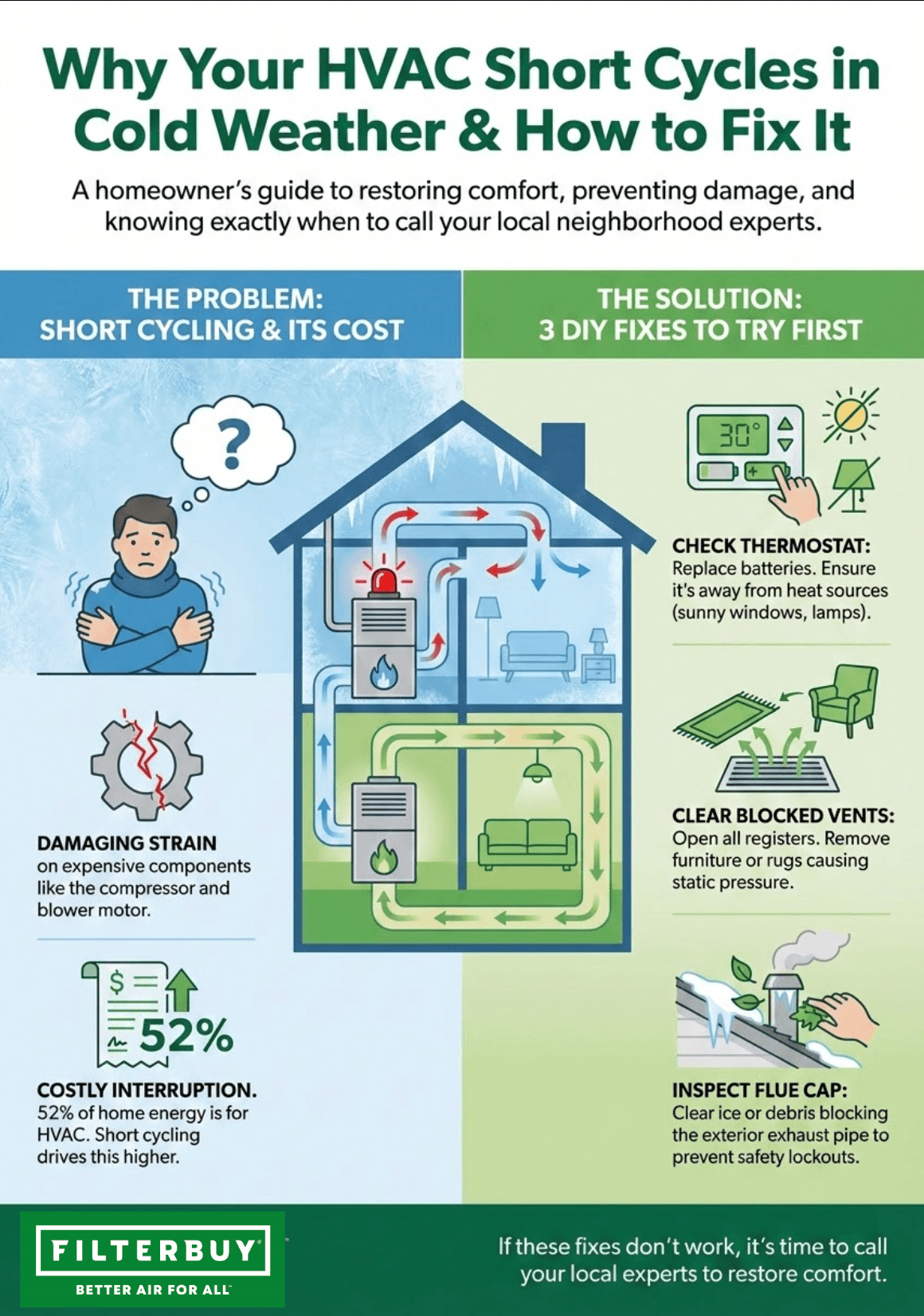
Cold weather puts stress on heating systems that warmer months don't. Heat pumps struggle to extract heat from outdoor air below 35 to 40°F. Flue vents can ice over at the exterior cap. And higher heating demand strains components that are already working hard. If your system only short cycles in winter, the cause is usually something outdoors: a refrigerant issue, a frozen flue, or a temperature sensor reacting to extreme cold.
Yes, and it's the most common cause. A clogged filter blocks the airflow the system needs to stay within its safe temperature range. Without it, the heat exchanger overheats and trips the high-limit safety switch. The system shuts down, cools off, restarts, and repeats. Replacing the filter is always the first step, no matter what else is going on.
If your furnace starts, runs less than five minutes, shuts off, and restarts within a few minutes, that's short cycling. A healthy cycle runs 10 to 15 minutes. You'll also notice the house never quite reaches the temperature you've set, even though the system seems to be running all the time.
Usually it isn't an immediate safety hazard. But it isn't harmless either. The constant start-stop cycles speed up wear on the compressor, blower motor, and heat exchanger, and they push your energy bill up in the process. The exception is a cracked heat exchanger, which can allow carbon monoxide into your home's air. If you notice a burning smell or symptoms like headaches and nausea while the system runs, treat it as a safety issue: turn the system off and call a technician immediately.
A normal cycle runs roughly 10 to 15 minutes under average winter conditions. In very cold weather or in larger homes, cycles may run longer. If yours consistently cuts off in under five minutes, that's short cycling and it's worth running through the diagnostic checklist starting with the filter.
If a clogged filter is the cause, yes. A fresh filter restores proper airflow and keeps the heat exchanger from overheating. If the short cycling continues after you've installed a new filter, work through the rest of the list: vents, thermostat, flue cap, then call a pro if none of that resolves it.
Many causes are DIY-friendly: a dirty filter, closed vents, a dead thermostat battery, a thermostat in the wrong spot, and a blocked flue cap are all things a homeowner can handle. Others require a licensed technician: refrigerant leaks, a cracked heat exchanger, and electrical control board failures should not be attempted as DIY repairs.
It depends entirely on the cause. A replacement filter is $10 to $30. Thermostat replacement with installation typically runs $100 to $250. A refrigerant recharge costs $150 to $500 depending on system size and refrigerant type. Heat exchanger repair or replacement runs $500 to $1,500 or more. A furnace that's been short cycling for years due to neglect may ultimately need full replacement, with costs starting around $2,500. The sooner you find the cause, the less expensive the fix.
The most common cause of HVAC short cycling costs under $30 to fix. We stock 600+ filter sizes, ship free, and offer auto-delivery so you're never caught with a clogged filter again. Find your exact size, set your schedule, and check this off your list today.
