June 18, 2026
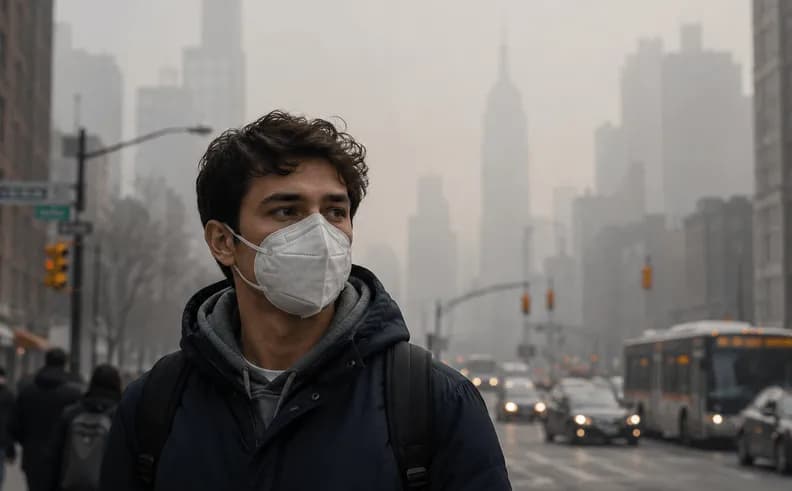
The smoke that turns the sky orange is built from particles so small that thirty of them could line up across a single one of your hairs, and a bandana lets nearly all of them through. A NIOSH-approved N95 mask for wildfire smoke stops at least 95% of them, which is the difference between a covering that only comforts you and one that actually protects you. We think about these invisible particles all day at Filterbuy, and wildfire smoke throws the smallest, most stubborn ones straight at your lungs. The encouraging part is that you hold more of this in your hands than the haze suggests, both outdoors in the mask you choose and indoors in the air your family breathes for most of the day.
Yes. A NIOSH-approved N95 that seals tightly to your face filters at least 95% of the fine PM2.5 in wildfire smoke and can cut your exposure roughly tenfold. Fit decides everything. When a mask gaps at the edges, smoke slips around the filter instead of passing through it.
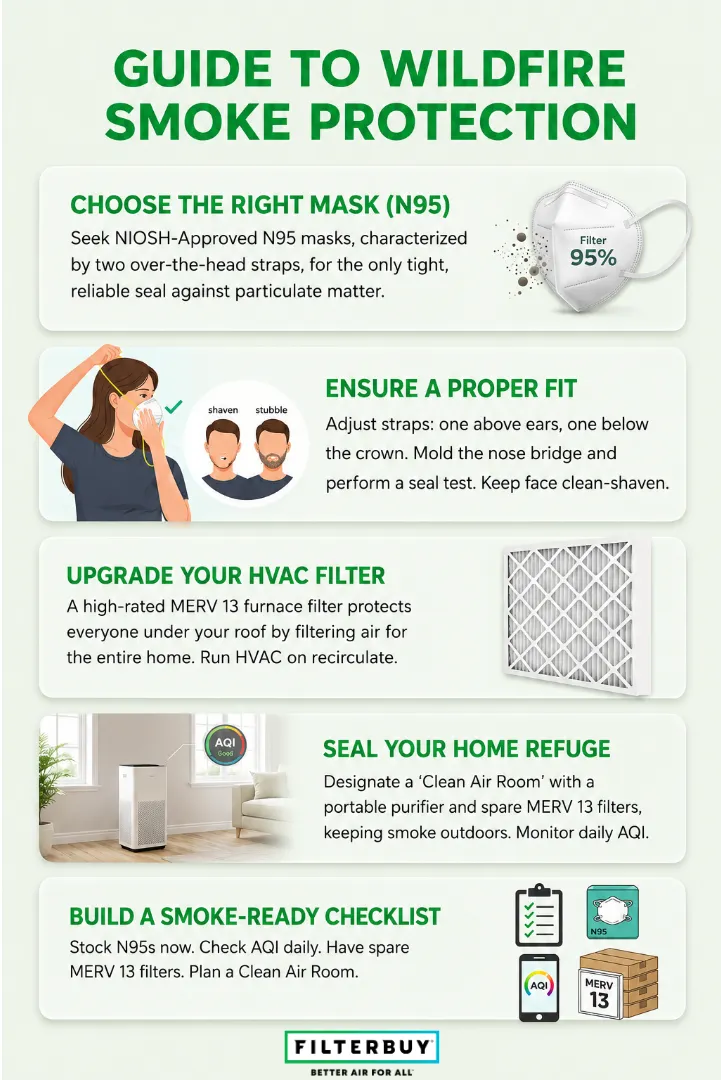
The best one is simply the one that seals on your face and carries a real NIOSH approval. Check for the NIOSH stamp and approval number, pick a model with two straps that cross over your head instead of looping around your ears, and find a metal nose clip you can pinch to your own shape. A valve changes only your comfort and what you breathe out, never how well the mask filters what you breathe in.
In a lab, a good KN95 filter filters about as well as an N95. The trouble shows up on a real face, where most KN95s rely on ear loops that seal loosely and protect a little less. Reach for one anyway when an N95 is sold out, because a snug KN95 still runs circles around a cloth mask.
A NIOSH-approved N95 mask traps at least 95% of the fine PM2.5 in wildfire smoke.
Fit beats brand every time, because a mask that does not seal cannot protect you.
KN95 masks filter well but seal loosely, thanks to those ear loops.
Cloth and surgical masks barely touch smoke particles.
Your strongest play is clean indoor air, with an N95 wildfire smoke mask for the trips you cannot skip.
Picture the fibers inside an N95 as a dense, charged thicket. Smoke particles that try to drift through get caught two ways: snagged by the tangle of fibers and pulled aside by a static charge baked into the material. That one-two catch is what lets a respirator meet the N95 respirator standard, which sets the bar at filtering 95% of test particles or better. The EPA puts a properly worn N95 above that mark for the PM2.5 in real wildfire smoke.
Notice the words properly worn. A finger-width gap at the cheek or chin hands the smoke a free pass around the filter, so the seal you get matters as much as the filter you bought.
Both masks can hold back wildfire smoke. What separates them is how dependably each one stays sealed to your face across a long, hazy day.
Nearly every KN95 hangs from ear loops, and ear loops tug the mask flat against your cheeks without ever pressing it tight along the edges. California's air regulators flag exactly this looser fit as the reason a KN95 struggles to hold the seal that keeps smoke out. KN95 is an international spec rather than a NIOSH approval, too, so quality swings from one box to the next. If you go this route, pick a model that has passed NIOSH testing at 95% or higher.
Real life intervenes. The N95s sell out, or one pinches your face after an hour, or you simply have a stack of KN95s left over from a few years back. A well-fitted KN95 is the right call in every one of those moments. It filters far more smoke than a cloth mask, a bandana, or bare skin, and the mask you will actually keep on always wins.
| Feature | N95 | KN95 |
|---|---|---|
| Certification | NIOSH-approved in the U.S. | International standard, quality varies |
| Straps | Two straps over the head | Usually ear loops |
| Typical Fit | Tight, sealing | Looser along the edges |
| Filtration | At least 95% of PM2.5 | 95% in lab tests, fit dependent |
| Best Use | Primary choice for smoke | Reliable backup |
A cloth mask was made to catch big droplets, not the microscopic grit in smoke, and its weave is riddled with gaps that PM2.5 floats straight through. A surgical mask does a bit better on the material itself, yet it sags loose along your cheeks and chin, so smoky air just slides around the sides. The American Lung Association says it without flinching. Ordinary dust masks and cloth coverings will not guard your lungs against the fine particles in wildfire smoke. When smoke is the enemy, only a sealed respirator gives you real N95 mask smoke protection.
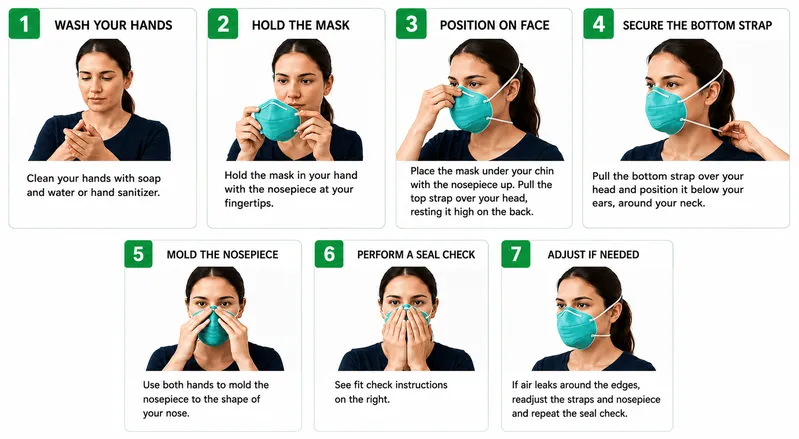
A respirator earns its keep only when it seals, and plenty of people wear one that leaks from the first breath. The routine below takes under a minute and decides whether you walk out genuinely protected or only feeling that way.
Settle both straps into place, one above your ears and one below. Pinch the metal strip across the bridge of your nose until it follows the line of your face. Shave any stubble where the mask meets skin, since even a day's growth pries the seal open. Now cup both hands over the mask and breathe in hard. Feel air sneaking in at the edges? Adjust and test again until the mask tugs slightly toward your face on every inhale.
Trade out your respirator the moment it gets harder to breathe through, or once it looks dirty or feels damp. A clogged, soggy mask quietly works against you, so stash a few spares where you will find them when the smoke shows up.
Children, older adults, pregnant family members, and anyone with a heart or lung condition feel smoke first and feel it worst. Respirators are not built for small faces, and a clean seal is hard to win on a child's or a bearded jaw, so for them the safest plan leans harder on staying indoors. Treat all of this as general guidance rather than medical advice. If someone in your home lives with a health condition, let their doctor steer the specifics.
Most smoke advice stops at the mask, and that is exactly where we lean in. Every serious health authority lands on the same conclusion, that your most powerful move during a smoke event is to stay indoors and keep the indoor air clean. The mask covers you for the sprint to the car or the trip to the mailbox. The home covers the long hours, and that is where filtration quietly does the real work.
Three steps turn a house into a refuge. Seal it up so less outdoor air wanders in. Flip your HVAC to recirculate so it quits drawing smoke from outside. Run a clean, high-rated filter that grabs a big share of the fine particles already adrift indoors. If you want the why behind those particles, it pays to know exactly what PM2.5 is and how far into your body it travels. Before anyone steps out, spend ten seconds to check your local outdoor air quality today, and the moment an alert lands, run our playbook for what to do at home during an air quality alert.
After manufacturing filters for over a decade and serving more than two million households, we keep watching the same scene repeat every smoke season. The calmest families are rarely the ones with the priciest gear. They are the ones who already know which mask to grab and already have a clean filter doing its quiet work at home.
— Filterbuy Team
When smoke rolls in, these are the sources we keep open. Each comes from a recognized public health or air quality authority, so the guidance underneath holds up.
The country's occupational health institute spells out how a NIOSH-approved respirator protects you and why the fit makes or breaks it.
Source: CDC / NIOSH, How to Protect Workers and the Public from Wildfire Smoke
The EPA's smoke course confirms that a properly worn N95 clears more than 95% of the PM2.5 in wildfire smoke.
Source: EPA, Strategies to Reduce Exposure Outdoors
A working checklist for smoky days, from masking up outside to setting up a clean-air room inside.
Source: AirNow, When Smoke Is in the Air
California's air board explains why KN95 ear loops seal loosely and how to choose a KN95 worth wearing.
Source: California Air Resources Board, Smoke Ready California
Guidance for workers and employers when the job simply cannot move indoors.
Source: OSHA, Protecting Workers from Wildfire Smoke
A federal prep guide for before, during, and after a wildfire, tailor-made for the family that likes a plan.
Source: Ready.gov, Wildfires
The American Lung Association walks through the health risks of fine particles and says plainly why cloth and dust masks fall short.
Source: American Lung Association, Wildfire Smoke and Lung Health
Wildfires burn an annual average of roughly seven million acres across the United States, and the bigger the burn, the farther the smoke drifts. Source: Congressional Research Service, Wildfire Statistics
In 2023, smoke from Canada's record wildfire season traveled thousands of miles and drove record-breaking poor air quality across the northeastern United States. Source: NASA Scientific Visualization Studio, 2023 Canadian Wildfire Smoke Transport
PM2.5 makes up most of wildfire smoke and is small enough to reach deep into the lungs and pass into the bloodstream, where it can damage the lungs and heart. Source: NIH National Library of Medicine, Wildfire PM2.5 and Cardiopulmonary Hospitalizations
Let us say the quiet part out loud, even though we sell filters and not masks. When smoke arrives, the respirator soaks up all the attention, and from where we stand as the people who make filters, it is the most overrated piece of the average family's smoke plan. The real workhorse is the filter already sitting in your furnace. A solid N95 earns its keep for the walk to the car or the school pickup line, and that is about where its shift ends. The hours that pile up, the evenings and overnights at home, ride on the air inside your walls.
Every smoke season, we field the same worried question about which mask to buy, and almost no one asks the one that matters more: whether the filter in the system is clean and rated to catch fine particles. We have watched households weather one orange sky after another, and the pattern reads clearly to us. The families who come through in the best shape set their home up as the first line of defense long before any smoke arrives, well ahead of the last-minute scramble for respirators.
Our honest stance is that the mask deserves about half the attention it gets, and the filter deserves twice as much. A mask looks after one person on a quick trip outside, while a clean, capable filter looks after everyone under your roof for as long as the smoke hangs around. In our experience, that quieter half of the story decides how a family actually feels when the air goes bad.
Get out ahead of smoke season with a few quick moves.
Check your local air quality today. Make it as routine as glancing at the forecast.
Stock NIOSH-approved N95s now. Grab a few per person while shelves are full, and look for the NIOSH stamp.
Practice the seal once. Mold the nose clip, set both straps, and run a seal check.
Check your filter. Make sure it is clean and rated for fine particles, and keep a spare.
Set up a clean-air room. Pick one room to seal off, and switch your HVAC to recirculate.
Plan for those who feel smoke first. Decide now how you will keep kids, older adults, and anyone with heart or lung trouble indoors.
Save your trusted sources. Bookmark the air quality tools and health guidance you will want on hand.
Do this once, and you become the calm, ready one when the next advisory lands.
Can I reuse an n95 for smoke?
You can wear the same N95 over several outings as long as it still seals, still breathes easily, and still looks clean. Retire it once it turns damp, grimy, or harder to pull air through.
Do N95 masks block the smell of smoke or toxic gases?
No. An N95 captures particles, not gases or odors. Still smell smoke through a well-sealed mask? That is the gas half of smoke, which a particle respirator cannot catch, and it is a clear signal to cut your time outside.
Are N95 masks safe for kids?
Respirators are sized for adult faces, not children, so a trustworthy seal is hard to come by. The stronger protection for kids is clean, filtered indoor air while the smoke lingers.
What if I have a beard?
Facial hair breaks the very seal an N95 relies on, even a day of stubble. If shaving is off the table, you will stay better protected indoors than behind a mask that leaks with every breath.
Is a KN95 okay when i cannot find an N95?
Absolutely. A well-fitted KN95, ideally one NIOSH-tested at 95% or higher, is a strong stand-in that beats a cloth or surgical mask by a wide margin.
Do N95 masks expire?
The filter media can break down and the straps can go slack over time, so check the maker's date and toss anything old or stretched. A mask that has lost its seal has lost its job.
Wildfire smoke is the kind of threat you cannot see and cannot wish away, and you are nowhere near powerless against it. A well-fitted, NIOSH-approved N95 carries you through the outdoor trips you cannot skip, while clean indoor air carries your family through the long, smoky stretches. Every filter you change, and every reading you check before opening the door, builds a household that breathes easier when the sky goes orange. That habit protects the people you love more than any single gadget ever will.
Ready to turn your home into the calm, clean-air refuge your family counts on? Browse our air quality guides and walk into the smoke season knowing exactly how to protect what matters most.
You know which N95 to reach for now, and you know why your home is the real refuge from wildfire smoke. Take the next step and equip your system with a filter built to catch fine particles, so your family keeps breathing easy long after the masks come off.
