June 18, 2026
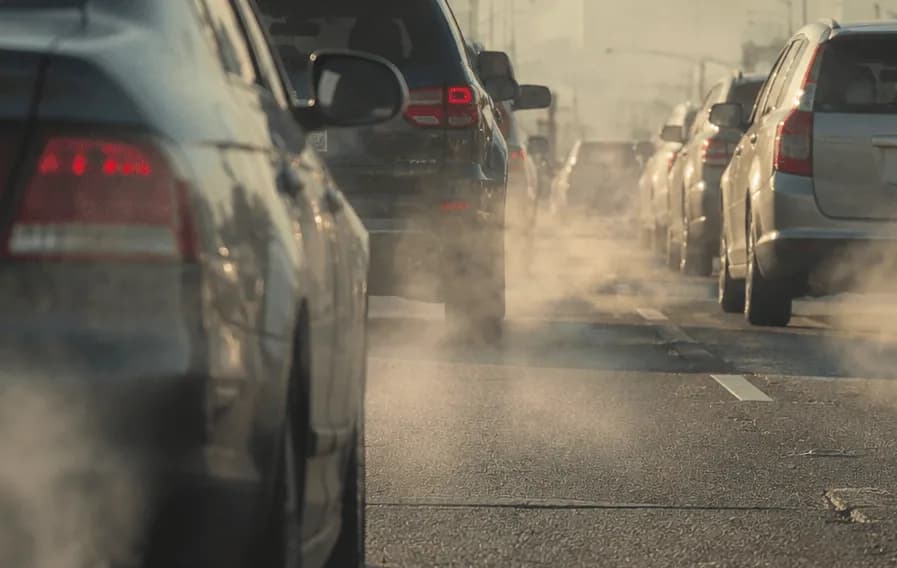
The worst air your family breathes this summer might show up on the prettiest day of the year. The sky is clear, the sun is bright, and the wind has gone still. Those are the exact conditions that cook up ground-level ozone, a gas you cannot see or smell at the point where it starts to sting your lungs. We have spent years obsessed with what floats through people's homes, and ozone bothers us more than almost anything, because the filter you count on for dust and pollen lets this one slip right past. Once you see why, protecting everyone under your roof gets a lot clearer.
Ground-level ozone is a reactive gas that irritates your airways, weakening lung function and worsening asthma, coughing, and chest tightness. It hits children, older adults, and people with lung disease the hardest. Because ozone is a gas and not a particle, standard furnace and HEPA filters do not remove it. Activated carbon media helps, and so does limiting outdoor air on high-ozone days.
Ozone is a gas, not a particle. Your dust filter barely touches it.
Standard filters cannot stop ozone. Only activated carbon adsorbs it.
Ozone harms the lungs. It cuts lung function and worsens asthma. Children, older adults, and people with lung disease face the most risk.
Avoid ozone generators and ionizers. They add the gas you want gone.
Daily habits matter most. On high-ozone days:
Check the air quality forecast.
Limit outdoor time.
Recirculate indoor air.
Use the right carbon media.
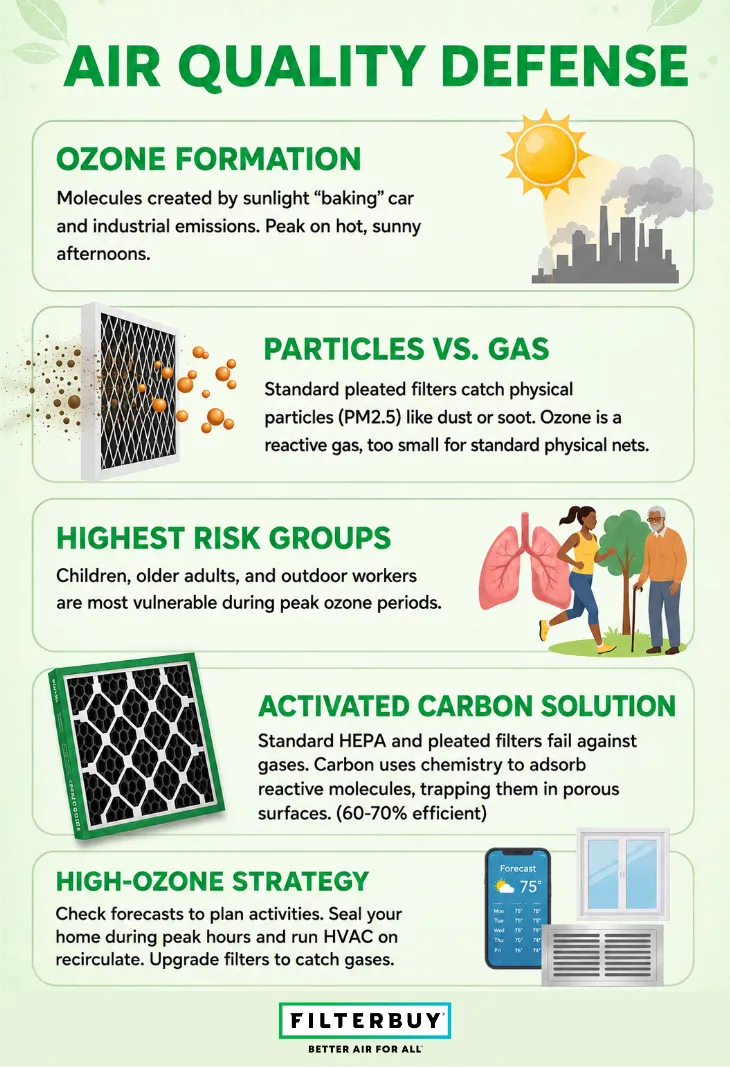
Ozone is one simple molecule with a split personality. It carries three oxygen atoms and does two very different jobs depending on where it sits. High in the sky, the ozone layer blocks the sun's ultraviolet rays and protects the whole planet. Down at street level, that same molecule becomes a lung irritant and the core ingredient in smog.
The confusing part is that ground-level ozone never arrives ready-made from a tailpipe. It forms when sunlight bakes two other pollutants together, nitrogen oxides and volatile organic compounds, the stuff that drifts off cars, power plants, and more household products than you would expect. The science behind how ozone forms in the lower atmosphere is well documented. Ozone climbs highest on hot, sunny, low-wind afternoons, right when your family wants to be outside.

This is where a lot of home air advice quietly goes wrong. People treat every kind of bad air as one problem with one fix, and ozone punishes that assumption. PM2.5 is particle pollution, the tiny bits of soot, smoke, and dust your filter was built to grab. A good pleated filter works like a fine net, catching those particles as air moves through it.
Ozone plays by different rules. It is a gas, and its molecules are far too small for that net to hold, so they pass through as though it were not there. That one fact shapes your whole defense, because anything that stops particles will do almost nothing to a gas. Work out which problem you actually have, and the right fix gets obvious fast.
Breathe ozone in, and it does more than pass through. It reacts with the lining of your airways the way a harsh chemical would, and the American Lung Association compares the feeling to a sunburn on the inside of your lungs. On a high-ozone day, you might catch yourself coughing, clearing a raw throat, or working harder for a full breath. For anyone in the house already living with asthma, those days can mean more inhaler use and a few rough nights.
One bad afternoon is one thing. Years of them are another. Researchers have tied repeated ozone exposure to worsening asthma, and they point to ozone as a likely cause of new asthma cases as well. Children worry us most, since their lungs are still growing and the harm can stack up quietly over time. That slow build is why these ozone exposure health effects deserve steady attention rather than a one-day scramble.
Ozone does not hit everyone the same way. Some people feel it while others notice nothing at all. The ones who feel it first usually fall into a handful of groups:
Children who breathe faster and log more hours playing outside
Older adults, especially those managing a heart or lung condition
People living with asthma, COPD, or another lung disease
Outdoor workers who cannot just step inside when the air turns
Anyone exercising outdoors during the afternoon ozone peak
Even a healthy, active adult can feel it after a hard outdoor workout on a smoggy day. If someone you love sits in one of these groups, ozone earns a spot on your radar every summer.
Ozone stays invisible, but your body keeps score. A scratchy throat, watering eyes, a cough that lingers, breathing that feels oddly shallow, any of it can point to ozone climbing outside. The catch is that these high ozone health symptoms read just like allergies or an ordinary tired afternoon, so they are easy to wave off. You do not have to guess. Pull up the forecast, check your local outdoor air quality today, and plan around it. When the reading slides into orange or red, push outdoor plans to the cooler morning and keep a closer watch on anyone in a sensitive group.
Plenty of brands dodge this question. We will answer it straight. A standard pleated furnace filter, even a premium one, exists to trap particles, so it does nothing to ozone, which sails right through the media as the gas it is. A HEPA filter, for all its muscle against fine particles, comes up just as empty against ozone. Some gadgets sold as air purifiers make things worse, because ozone generators and many ionizers pump even more ozone into your rooms. We would not run one in our own homes, and we tell our customers to keep them out of theirs.
There is one filtration approach that helps. Filters with a layer of activated carbon can adsorb ozone, grabbing it through chemistry instead of a physical net. A government-backed pilot study found that carbon-loaded filters pulled roughly 60 to 70 percent of the ozone out of the air moving through them, while filters without carbon barely touched it. Carbon pulls its weight as part of the plan, not as a miracle, and it works best paired with the habits below.
Check the forecast every morning during ozone season, and ease off on outdoor time when the numbers run high.
Keep the windows shut through the hot afternoon hours and run your system on recirculate so it stops pulling ozone-heavy air indoors.
Add an activated carbon stage if your system can take one, and swap it on schedule so it keeps doing its job.
Pass on the ozone-generating “purifiers,” ionizers, and UV gadgets that promise fresh air and deliver more ozone.
Trim the indoor sources that feed ozone, like harsh solvents, by reaching for low-VOC products instead.
Not one of these asks for a renovation or a big budget. Small moves, repeated, are what keep you ahead of the air.
After manufacturing filters for over a decade and serving more than two million households, we have learned that real protection starts with understanding your air, not just buying a filter. Ozone proves the point. The right media earns its keep, and so does knowing when to shut the windows and skip the afternoon run.
— Filterbuy Team
The Environmental Protection Agency spells out how ozone hurts the respiratory system and who carries the heaviest risk.
The American Lung Association walks through, in plain terms, how ozone attacks lung tissue and what long-term exposure does over time.
AirNow gives you a quick activity guide for adjusting your day when ozone turns unhealthy.
The Centers for Disease Control and Prevention puts the health effects of ozone and particle pollution side by side.
The National Institute of Environmental Health Sciences tracks the research on how ozone and other pollutants act on the body.
The National Oceanic and Atmospheric Administration explains how heat, sunlight, and emissions team up to form ground-level ozone.
The Texas Commission on Environmental Quality shows how local weather stretches the ozone season, which helps any warm-climate home.
Filters with activated carbon pulled roughly 60 to 70 percent of ozone in a pilot study, while filters without carbon barely touched it.
Ozone above 70 parts per billion can cause health problems even for healthy adults who are active outside.
More than 300 U.S. counties, clustered around the most populated areas, have been flagged as failing to meet national ozone standards.
Ozone rewrites the rulebook you use for dust, pollen, and wildfire smoke. It is a gas, so you hold it back with daily judgment and the right carbon media, not with a particle filter pulling solo duty. Nobody knows your home and the people in it better than you do. Add a little awareness of when ozone spikes and an honest read on what your filtration can and cannot do, and you become the one who keeps the whole house breathing easier from the first heat wave to the last.
You already know what ozone does and where a standard filter falls short. Turn that into a plan you can act on this week, working through these steps in order.
Check your air quality and make it a habit. Look up today's reading before you commit to outdoor plans, then check it each morning through the warm months. When ozone hits the orange or red range, treat it as your signal to move activity to the cooler early hours.
Map who you are protecting. Jot down who in your home sits in a sensitive group, whether that is a child, an older parent, or anyone with asthma or another lung condition. How cautious you get on bad days follows from their needs.
Audit what your filter really does. Find out which filter your system runs right now. A standard pleated filter handles dust and pollen but leaves ozone alone, so decide whether a carbon stage belongs in your setup. While you are in there, unplug any ozone generator or ionizer, adding the gas you want gone.
Build your high-ozone-day routine. Settle on a simple plan for peak afternoons. Close the windows, run the system on recirculate, and move workouts and yard work to the morning when ozone runs lower.
Set a maintenance reminder. Carbon media only pulls ozone while it stays fresh. Put a recurring note on your calendar to replace it on schedule so your protection does not fade between seasons.
Get a professional opinion before you upgrade. If you want to add a carbon stage, ask a trusted HVAC professional what your specific system can handle before you buy. A few minutes of expert input beats a filter that does not fit.
Each move is small on its own. Stack them together, and you stay firmly in charge of the air your family breathes, one ozone season at a time.
How does ground-level ozone affect your health?
Ozone reacts with the lining of your airways, which brings on coughing, throat irritation, chest tightness, and weaker lung function. It makes asthma and other lung conditions worse, and it lands hardest on children, older adults, and people who work outside.
Is ground-level ozone the same as PM2.5?
No. PM2.5 is fine particle pollution, the tiny solids and liquids that a regular filter can catch. Ozone is a gas that slips through those filters, so it needs a different kind of defense.
Do air filters remove ozone?
Standard pleated and HEPA filters do not, because ozone is a gas rather than a particle. Filters with an activated carbon layer can pull a meaningful share of it out of the air.
What are the symptoms of high ozone exposure?
Look for coughing, throat and eye irritation, chest tightness, shortness of breath, and asthma flare-ups. These tend to show up during or right after time outside on hot afternoons.
How can I reduce ozone exposure indoors?
Check the daily forecast, cut back outdoor time when ozone is high, keep windows closed, and recirculate the air through peak hours, run activated carbon media, and steer clear of anything that generates ozone.
You cannot out-engineer the weather, and you do not need to. When ozone season rolls in, lean on the habits above and think about adding activated carbon to catch the gases a standard filter leaves behind. Find the carbon option that fits your system, and give everyone under your roof easier air all year.
