June 18, 2026
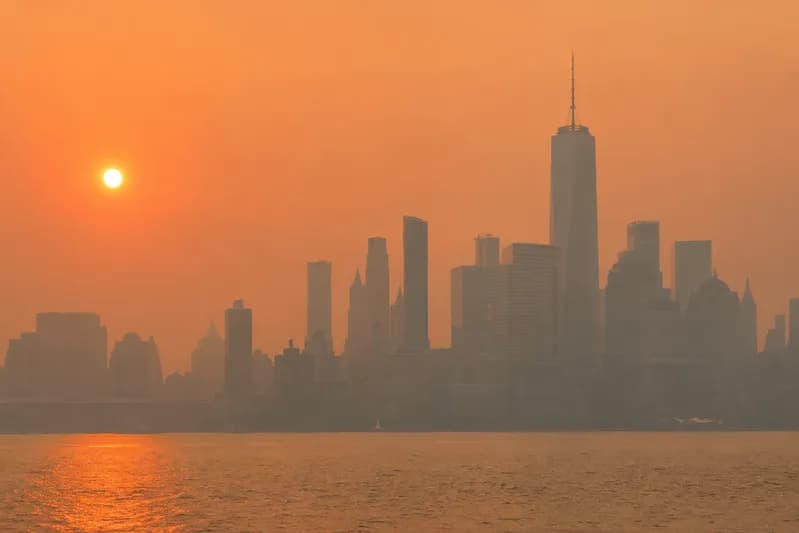
In June 2023, the midday sky over New York City glowed orange, and the smoke behind it had drifted from Canadian forests hundreds of miles to the north. Most of what makes wildfire smoke dangerous never shows up as color. It arrives as particles you cannot see, fine enough to slip through a cracked window or a worn-out filter and settle into the rooms where your family sleeps and breathes. You have more control over that air than the forecast suggests, and the filter in your system does most of the work.
Canadian wildfire smoke reaches the U.S. as fine particle pollution (PM2.5) carried south by upper-level winds. To protect your home, close your windows and doors, run your HVAC on recirculate with a MERV 13 filter, add a portable air cleaner for the room you use most, and check your local air quality reading before you head outside.
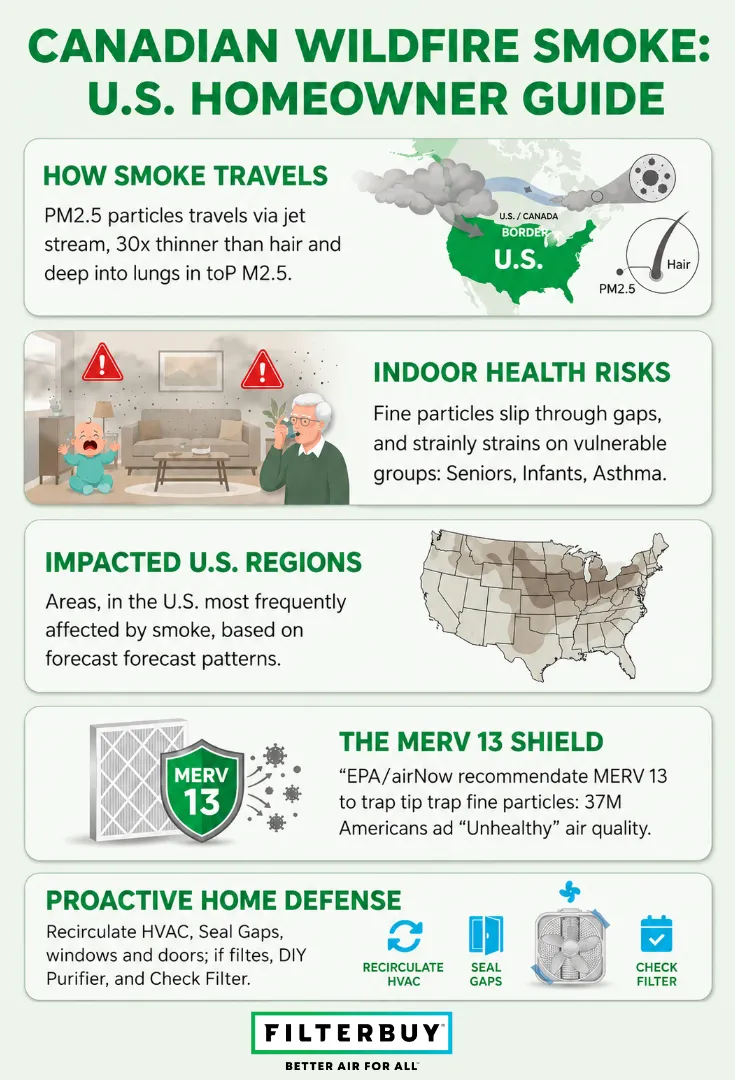
Canadian smoke reaches the U.S. as fine particles (PM2.5) and drifts thousands of miles.
The Midwest, Great Lakes, and Northeast get hit hardest, and big events reach Texas.
Smoke seeps indoors and lingers, raising risk for children, older adults, and people with heart or lung conditions.
A MERV 13 filter, recirculate mode, and a sealed home are your best defense.
Watch your local AQI, change filters often, and keep spares ready.
Wildfires across the Canadian boreal forest throw huge plumes of smoke high into the sky. Once it climbs, the jet stream and strong upper-level winds carry it for hundreds and sometimes thousands of miles. NASA satellites have tracked black carbon from Canadian fires crossing all of North America and reaching Europe within days. When that high smoke sinks back toward the ground, it raises the level of fine particle pollution, or PM2.5, in the air your family breathes.
These particles run smaller than 2.5 microns, far thinner than a strand of hair. That size is the problem. The particles travel deep into the lungs and cross into the bloodstream. NOAA forecasters watch the smoke move because it can cut visibility and push air quality into the unhealthy range hundreds of miles from any flame. When a temperature inversion traps it near the ground, a single event can hang over a city for days.
Canada now logs hundreds of wildfires in a busy season. You can scan the record of major Canadian wildfires to see how often these events strike. Once you picture how far the smoke travels, it makes sense that a home nowhere near the border still needs protection.
Canadian smoke does not stop at the border. The heaviest, earliest hits usually land across the Upper Midwest and the Great Lakes, where Minnesota, Wisconsin, and Michigan sit right in the path. As the plumes push east, the Northeast gets its turn, and cities from Chicago to New York have watched the air go gray and the readings climb.
The big events travel much farther. In 2025, smoke from fires in Saskatchewan and Manitoba drove air quality alerts as far south as Texas, and the U.S. Census Bureau mapped how many Americans sat under poor air across the lower 48. During one smoke wave, AirNow put locations from Montana to Maine in the unhealthy range.
The table below shows where cross-border smoke tends to land. Read it as a general pattern, not a forecast, because every event picks its own track.
| Region | States Frequently Affected | Typical Timing |
|---|---|---|
| Upper Midwest and Great Lakes | Minnesota, Wisconsin, Michigan, Iowa, Illinois, Indiana, Ohio, the Dakotas | Earliest and often heaviest, late May through August |
| Northeast | New York, Pennsylvania, New Jersey, Connecticut, Massachusetts, Vermont, New Hampshire, Maine | Follows the Midwest as plumes track east |
| Central and Southern Reach | Nebraska, Kansas, Missouri, Kentucky, Montana, and as far south as Texas | During large events like the 2025 season |
The Canadian fire season runs from spring into early fall, and the worst U.S. smoke tends to cluster from late May through August. That timing is your opening. In our experience, the homeowners who ride out these events best are the ones who set up filtration before the season, not during it. Buy a spare filter or two in spring, and you stay ready the day a plume drifts your way.
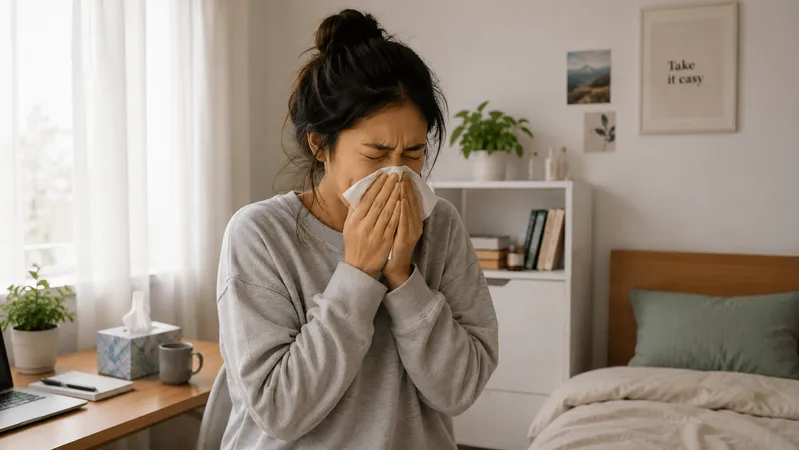
Plenty of homeowners figure that shutting the door keeps the danger outside. It does not. Fine particles work their way in through gaps around windows and doors, through fresh-air intakes, and on your clothes every time you step inside. Once they settle in, they can hang around long after the outdoor haze lifts.
The American Lung Association explains that the fine particles in wildfire smoke reach deep into the lungs and can cross into the bloodstream, where they strain the heart and the respiratory system. Symptoms can show up a day or two later, so people often feel a smoke event after it has already moved on.
Some people in your home carry more risk than others. The CDC names children, older adults, people who are pregnant women, and anyone living with asthma, COPD, or heart disease as the ones who need the most protection. If that describes someone you love, treat your indoor air as the priority the moment smoke moves in. Protection starts with keeping particles out and filtering whatever sneaks through.
This is where you take charge. The filter already in your HVAC system is the most useful tool you own during a smoke event, working every time the blower kicks on. Back it up with a few habits, and your whole house becomes a cleaner place to breathe.
When wildfire smoke rolls in, the federal agencies all point to one upgrade. The EPA and AirNow both recommend a MERV 13 filter, because that rating grabs the fine particles that lighter filters wave right through. We build MERV 13 filters in more than 600 sizes, custom dimensions included, so you can match the filter your system actually takes instead of settling for whatever the hardware store has on the shelf. If your system can run one, switching to Filterbuy MERV 13 air filters is the strongest first move you can make against cross-border smoke.
Keep the smoke out while your filter handles the rest. Shut your windows and doors, then set your HVAC system or window unit to recirculate so it stops drawing outside air in. Close the fresh-air intake if your system has one. Go easy on the bathroom and kitchen exhaust fans, too, since they pull smoky air in behind them. The EPA suggests building a clean room, one space you keep as free of particles as possible, for the hours when the smoke gets thick.
For the room your family lives in most, a portable air cleaner adds another layer of defense on top of your central system. If you cannot buy one during an event, the EPA has tested a do-it-yourself fix. Tape a MERV 13 filter to a newer box fan, built in 2012 or later for safety, and run it in a closed room. It pulls real particles out of the air for very little money when the store shelves go bare.
Heavy smoke loads a filter much faster than everyday dust. During an active event, check yours often and swap it the moment it looks dirty, even if that beats your normal schedule. Keep a few spares in the closet so you never have to pick between clean air and an empty slot. After the smoke clears, a fresh filter catches the particles that settled while the haze sat over your neighborhood.
Watching the air outside tells you when to seal up and when you can open the windows again. The U.S. Air Quality Index, or AQI, ranges from 0 to 500, with color codes that indicate how clean or dirty the air is right now. Once it climbs past 100, sensitive groups should cut back on time outdoors. Past 150, the air turns unhealthy for everyone.
Track it in real time on the AirNow Fire and Smoke Map, which pulls live data from monitors and sensors nationwide. To follow the source of the smoke directly, open the Filterbuy live Canada wildfire and smoke map for a current look at where the fires burn and where the plume heads next. One quick check before you plan your day tells you whether to run your errands now or wait for the air to clear.
Your filter is the quietest worker in the house during a smoke event, and it guards the people you care about most. We tell every homeowner what we built this company on. Put a real filter in your system, keep a spare on the shelf, and you will never feel helpless when the sky turns hazy.
— Filterbuy Team
Lean on these before, during, and after a smoke event. Each one helps you act with confidence.
1. See Your Local Smoke Level In Real Time. AirNow shows the particle pollution near you and the steps experts recommend during smoke, from a MERV 13 filter to recirculate mode.
2. Set Up A Clean Room At Home. The EPA walks you through a low-particle room and a portable or do-it-yourself air cleaner for the worst hours.
3. Know Your Family's Health Risk. The CDC spells out who faces the most risk from smoke and what to do before, during, and after.
4. Understand How Smoke Affects Your Lungs. The American Lung Association explains how fine particles reach the lungs and bloodstream and who feels it most.
5. See Where The Smoke Comes From. NASA Earth Observatory maps the cross-border path of Canadian smoke so you can picture the plume reaching your area.
6. Prepare Before Fire Season. The National Weather Service shares prep steps and the alert channels worth setting up early.
7. Build A Household Smoke Plan. FEMA Ready helps you prepare, stay safe, and recover, with guidance on alerts and evacuation if it comes to that.
We have watched a lot of smoke seasons from the manufacturing side of clean air. Three numbers stick with us.
1. The smoke reaches far past the fire lines. We have learned that the haze rarely stays near the flames. NOAA satellites show Canadian wildfire smoke fouling air quality and cutting visibility hundreds of miles from the source.
2. During the June 2025 Canadian smoke event, the U.S. Census Bureau paired National Weather Service PM2.5 forecasts with its population data and found that more than 37 million Americans were forecast to face air quality rated "Unhealthy for Sensitive Groups" or worse, including over 9 million in the "Unhealthy" range.
3. The health risk climbs with every microgram. In a peer-reviewed review, researchers found that each 10 microgram-per-cubic-meter rise in wildfire-specific fine particles lifted the risk of all-cause death by about 1.9 percent.
Smoke seasons are not going anywhere, and the families who stay comfortable are the ones who prepare before the first plume shows up. You cannot steer the wind, but you can own the air in your house. Put a filter built for fine particles in your system, keep a spare ready, and the next smoky forecast turns into a minor errand instead of an emergency. Take a few minutes today to match the right MERV 13 filter to your system, and breathe easier the next time Canadian smoke crosses the border.
Get ready before the season, then move fast when smoke arrives.
Before Smoke Season
Find the MERV 13 filter size your system takes.
Stock one or two spare filters.
Sign up for local air quality alerts.
When Smoke Moves In
Check your AQI on the AirNow Fire and Smoke Map.
Close your windows and doors.
Set your HVAC to recirculate and shut the fresh-air intake.
Run a portable air cleaner in the room you use most.
Change your filter as soon as it looks dirty.
After The Smoke Clears
Swap in a fresh filter.
Restock a spare for next time.
Does Canadian wildfire smoke really affect U.S. air quality?
Yes. Smoke from Canadian fires crosses into the United States on a regular basis as fine particle pollution. Upper-level winds carry it south, where it raises local readings and grays out the sky far from any active fire, often for days at a stretch.
Which U.S. states get the most smoke from Canadian wildfires?
The Upper Midwest and Great Lakes usually catch the heaviest, earliest smoke, with the Northeast next in line. During large events, alerts have reached as far south as Texas, so this is not only a border-state problem.
How far can wildfire smoke travel from Canada?
Hundreds and sometimes thousands of miles. NASA has tracked Canadian smoke crossing North America and reaching Europe within days, which is why homes deep inside the United States still see hazy skies and higher readings.
What MERV rating filters wildfire smoke?
Federal agencies recommend a MERV 13 filter for wildfire smoke because that rating captures the fine particles that lighter filters let pass. Run one only if your HVAC system can handle the higher rating, and replace it more often while the smoke lasts.
Is indoor air safe during a wildfire smoke event?
Not on its own. Fine particles seep in through gaps, intakes, and open doors, and they linger after the outdoor haze clears. Closing up your home, running a MERV 13 filter, and adding a portable air cleaner keep your indoor air far cleaner.
How often should I change my filter during heavy smoke?
More often than your usual schedule. Heavy smoke loads a filter fast, so check it regularly during an event and swap it as soon as it looks dirty. A few spares on hand keep you protected without a gap.
Where can I check cross-border smoke and the AQI near me?
Check your local reading on the AirNow Fire and Smoke Map, which uses the color-coded U.S. Air Quality Index. For a look at the fires and plumes themselves, the Filterbuy Canada smoke map shows where the smoke is heading.
Now that you know how Canadian wildfire smoke reaches your home, you can get ahead of the next plume instead of reacting to it. Set your system up with a MERV 13 filter built for fine particles, and protect the air your family breathes every day.
