September 1, 2026
By Michelle Wan | Reviewed by David Clark, Licensed HVAC Technician | Published September 02, 2026
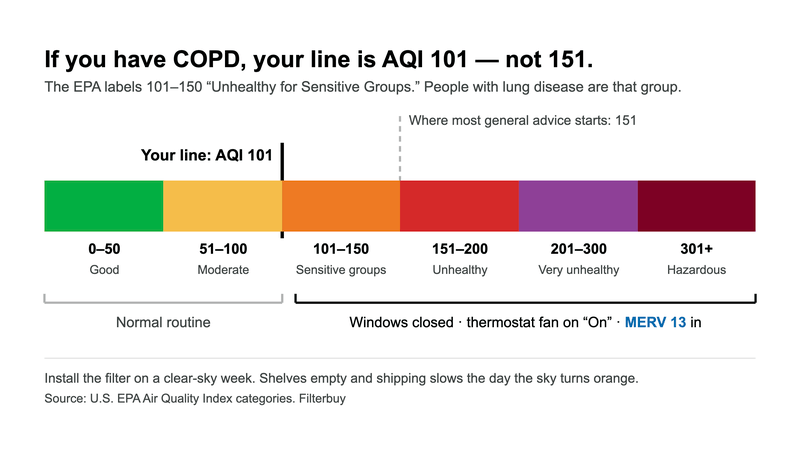
If you have COPD, act at AQI 101, not 151 — and have a MERV 13 filter installed before fire season, not during it. AQI 101 is where the EPA band “Unhealthy for Sensitive Groups” begins, and people with lung disease are the group it means.
The two moves that do the most work both happen before smoke arrives: a written COPD action plan completed with your doctor, and a MERV 13 filter running with the thermostat fan switched from “Auto” to “On.” The EPA estimates that a high-efficiency filter run continuously can cut indoor PM2.5 by roughly half, against about 24% for a typical low-efficiency filter.
Not sure which MERV 13 fits your system? Take the quick match quiz below.
Answer a few quick questions and we’ll match you to the right filter for your system.
Know your size already? Shop MERV 13 air filters at Filterbuy — built in the USA, 600+ sizes, with custom sizes for odd cabinets.
Filterbuy manufactures and sells air filters, including the MERV 13 filters described here. This page is educational and is not medical advice. Talk with your healthcare provider about managing your COPD.
Wildfire smoke is mostly PM2.5, the fine fraction that reaches deep into the lungs, and the EPA lists worsening COPD of chronic obstructive pulmonary disease as a documented effect. Your two highest-value moves happen before smoke arrives: a written COPD action plan built with your doctor, and a MERV 13 filter running with the fan set to “On.” The EPA estimates that pairing a high-efficiency filter with a continuously running fan can cut indoor PM2.5 by roughly half.
• Wildfire smoke exacerbates COPD. The CDC has advised clinicians that smoke exposure can worsen COPD, and that emergency visits rise in the days after exposure.
• AQI 101 is your line, not 151. People with lung disease are the EPA “sensitive group,” so the Orange band most people ignore is the one that should change your day.
• MERV 13 is the residential standard for smoke. The EPA recommends MERV 13 or higher during smoky periods, with the thermostat fan switched from "Auto" to "On."
• A clean-air room doubles your protection. In one wildfire study a MERV 13 filter held the indoor-to-outdoor PM2.5 ratio at 0.55; adding a portable air cleaner pushed it to 0.22.
• Ask your doctor before you wear an N95. The American Lung Association advises people with lung disease to ask a physician first, because respirators make breathing harder.
Wildfire smoke is a mix of gases and fine particles, and the fraction that matters most for COPD is PM2.5: particulate matter 2.5 microns and smaller. Particles that small slip past the upper airway and settle deep in lung tissue, where they inflame airways that are already narrowed.
For someone living with emphysema or chronic bronchitis, that inflammation is what turns a smoky week into a flare. In its 2023 advisory, the CDC told clinicians that smoke may worsen chronic respiratory conditions including COPD, and that emergency visits climb in the days after exposure.
The delay is the part most people miss. The American Lung Association notes that first symptoms can appear 24 to 48 hours after exposure, which is why you can get through a smoky Tuesday feeling more or less normal and find that Thursday is the hard day. A plan written in advance beats judgment made in the moment.
Most people with COPD are holding two documents during fire season: a written COPD action plan with green, yellow, and red zones that a clinician filled out with them, and a phone showing a color-coded AQI. Nothing connects the two. The table below is the bridge.
The color zones on a COPD action plan are set by your symptoms, not by the AQI. Print this table and mark it up with your provider.
One caution about reading it. Advanced COPD often means daily breathlessness that is simply your normal, so what the yellow zone looks for is a change from that baseline rather than any particular symptom. Your clinician decides where those lines fall for you, which is why this belongs at your next appointment rather than on the fridge alone.
Every fire season we watch people try to solve a maintenance problem in an emergency. For most homes that is inconvenient. For a household with COPD, a week spent waiting on a filter is a week of exposure you cannot take back.
Michelle Wan, Filterbuy
The window that matters is a clear-sky week in spring, not the afternoon the sky turns orange. Filterbuy has manufactured air filters in the United States since 2013, through every Western fire season since, and the same pattern repeats every year: orders spike within hours of a nearby ignition, which is exactly when local shelves empty and shipping slows. The households that ride out a bad week most easily are rarely the ones who bought the highest-rated filter. They are the ones who had it installed before the smoke arrived.
1. Get or update your written COPD action plan. The American Lung Association publishes a free template to complete with your provider.
2. Check your prescription supply. The CDC advisory tells patients to keep prescriptions current and stocked ahead of an event.
3. Confirm your system takes MERV 13, then buy spares. Two or three will cover most seasons. Filterbuy stocks 600+ sizes plus made-to-order for odd cabinets, and auto-delivery keeps a spare on the shelf.
4. Set up your clean-air room. Pick the bedroom if you can, or whichever room has the fewest windows. The EPA has a setup guide.
5. Bookmark a live map. The AirNow Fire and Smoke Map and Filterbuy's live smoke and AQI map give ZIP-level readings.
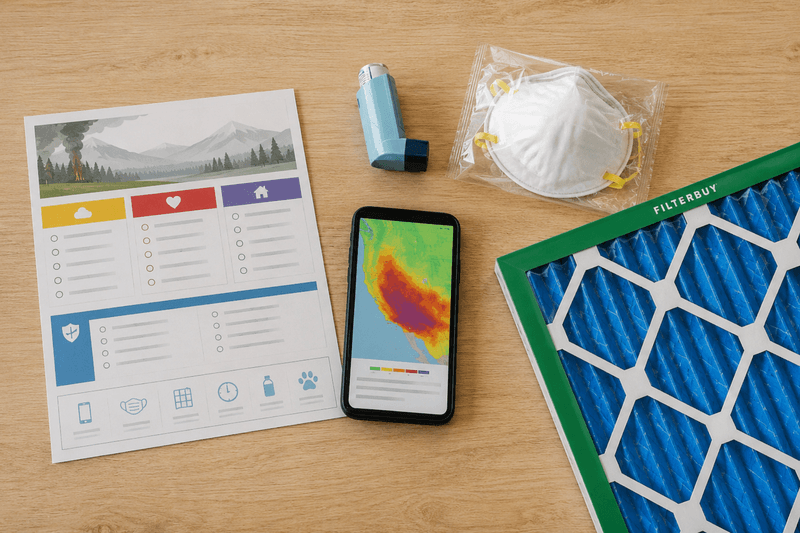
Your central HVAC system is the most powerful air cleaner you own, because it pulls your home’s entire air volume through one filter, over and over. That only pays off if the filter catches fine particles and the fan is actually moving air.
Install a MERV 13 filter. The EPA recommends MERV 13 or higher during smoky periods, because it captures a meaningful share of PM2.5 without choking most home blowers. MERV 8 will not. Our MERV 13 vs. HEPA comparison for wildfire smoke explains why true HEPA rarely fits residential ductwork. Filterbuy builds MERV 13 in 1-, 2-, and 4-inch depths, and the deeper filter holds more media, so it captures the same fine particles at lower airflow resistance.
Switch the thermostat fan from "Auto" to "On." This is the free half of the upgrade, and the step most people skip. The EPA estimates that a high-efficiency filter run continuously may cut indoor PM2.5 by about 50%, against roughly 24% for a typical low-efficiency filter.
Close the fresh-air intake so the system recirculates instead of pulling smoke in on purpose.
Add a portable air cleaner in your clean-air room. Choose an ozone-free unit sized for the space. In a peer-reviewed study of a home during a wildfire, a MERV 13 held the indoor-to-outdoor ratio at 0.55; a portable cleaner brought it to 0.22.
Change the filter far more often. A filter that would normally last 90 days can load up within a week of heavy smoke, so replace it as soon as it looks dark brown or black. If a purifier is out of reach, the EPA has researched box-fan DIY air cleaners built around a MERV 13 filter.
Stop adding smoke of your own. The EPA advises against candles, gas or wood stoves, aerosols, frying, and vacuuming without a HEPA vacuum. For the smell that lingers, Filterbuy’s Odor Eliminator, an activated carbon filter, catches what a fiber-only filter cannot.
Every wildfire guide, this one included, tells you to seal the house and run the filter. Twice a season we hear from a household where that plan ran into something else.
Your filter runs on electricity, and fire weather is when utilities cut it. The American Lung Association notes that utilities run planned outages during high-risk conditions, meaning fire season. An outage stops your HVAC filtration, and if you use a concentrator it stops your oxygen. Ask your supplier about stand-alone tanks that need no power, keep batteries charged, and register with your utility for notice of shutoffs.
Sealing up collides with staying cool. The EPA is blunt about the trade: if you have no air conditioner and it is too warm to stay inside with the windows closed, shelter somewhere else, because heat is the more immediate danger. An evaporative cooler is its own problem, since it pulls outdoor air in by design, so cover its intakes with 4-inch MERV 13 filters or use it sparingly.
The question landing in the Filterbuy inbox every fire season is which mask to buy. Most wildfire articles say N95, and for most people that is right. If you have COPD, check with your doctor first. The American Lung Association advises people with lung disease to ask a physician before using an N95, because respirators make breathing harder, and to wear one only if you must go outside. A cloth mask is no substitute for either, so for many COPD households the real question is not which mask to wear but whether to make the trip at all.
On medication, no article should be giving you dosing advice. What this one can pass along is what the CDC tells clinicians: keep your prescriptions current and stocked, and know before smoke season which medications your plan says to lean on.
If you use supplemental oxygen, do not adjust your own flow rate. The American Lung Association is explicit: call your doctor before changing anything.
On a smoke day it gets hard to judge what counts as normal for you, so use the table below rather than guess.
These zones follow the American Lung Association's COPD action plan. Build your own version with your provider, and do not wait to see whether the air clears.
Filterbuy makes filters, so we should be straight about the limits. We see loaded filters come back from smoke-hit homes every year, and they show what a filter caught rather than what it missed. A MERV 13 reduces the fine particles moving through your system. It will not treat COPD or strip the gases out of smoke, and it cannot make a heavy smoke day safe for exertion. Managing the disease itself belongs to your action plan, your medications and your doctor.
6.7 million Americans with COPD live in a county with a failing air-quality grade. Close to 1.3 million live in counties failing all three graded measures. Source: American Lung Association, State of the Air 2026.
Asthma ER visits ran 17% above expected across 19 smoke days in 2023. The CDC defined a smoke day as AQI 101 or higher, the same Orange threshold used in the crosswalk above. That study tracked asthma, not COPD, but the exposure line is identical. Source: CDC, Morbidity and Mortality Weekly Report.
COPD prevalence climbs from 0.4% of adults aged 18–24 to 10.5% of those 75 and older. The age group most likely to have COPD is the group the EPA flags as most vulnerable to smoke. Source: CDC National Center for Health Statistics, 2023.
Treat AQI 101 as your threshold. The 101–150 Orange band is labelled "Unhealthy for Sensitive Groups," and people with lung disease are the group it means.
MERV 13 or higher per EPA guidance, as long as your system can handle it. See our guide to choosing a MERV rating for high AQI days.
Watch the numbers rather than the sky, because haze clears before fine particles do. Keep the AirNow Fire and Smoke Map open until your ZIP code holds below AQI 100 for a full day, keep filtering through the tail of the event, and change the loaded filter once it is over.
Check it weekly during an active smoke event; replace it when it looks dark or matted. Our guide to reading a wildfire smoke map helps you time it.
AQI (Air Quality Index): The EPA 0–500 scale for outdoor air pollution; 101–150 is Unhealthy for Sensitive Groups.
COPD (chronic obstructive pulmonary disease): A progressive lung disease, most often emphysema and chronic bronchitis, obstructing airflow out of the lungs.
COPD action plan: A document a patient and provider complete together, sorting symptoms into green, yellow, and red zones with actions.
Exacerbation (flare): A worsening of COPD symptoms beyond a person’s normal baseline, often needing a treatment change.
Clean-air room: A room sealed against smoke and filtered with a portable air cleaner, as the EPA recommends.
MERV (Minimum Efficiency Reporting Value): The 1–16 scale rating how well a filter captures particles; MERV 13 is the residential standard for smoke.
PM2.5: Fine particulate matter 2.5 microns or smaller, the main health hazard in wildfire smoke.
Portable air cleaner: A standalone room purifier, rated by Clean Air Delivery Rate (CADR).
Disclosure: Filterbuy manufactures and sells air filters, including the MERV 13 filters discussed here. This article is educational and is not medical advice. Talk to your healthcare provider about your COPD management.
• CDC Health Advisory CDCHAN-00495: Wildfire Smoke Exposure Poses Threat to At-Risk Populations
• US EPA: Strategies to Reduce Exposure Indoors
• US EPA: Who is at Increased Risk of Health Effects from Wildfire Smoke Exposure
• US EPA: Create a Clean Room to Protect Indoor Air Quality During a Wildfire
• US EPA: Research on DIY Air Cleaners to Reduce Wildfire Smoke Indoors
• American Lung Association: Wildfire Smoke and Lung Health
• American Lung Association: My COPD Action Plan (PDF)
• American Lung Association: State of the Air 2026, Populations at Risk
• CDC MMWR: Asthma-Associated ED Visits During the Canadian Wildfire Smoke Episodes
• CDC NCHS Data Brief 529: COPD in Adults Age 18 and Older, United States, 2023
Related reading: MERV 13 vs. HEPA for wildfire smoke · How to read a wildfire smoke map · What MERV rating for a high AQI day · Check your local air quality
