September 1, 2026
By Michelle Wan | Reviewed by David Clark, Licensed HVAC Technician | Published September 02, 2026
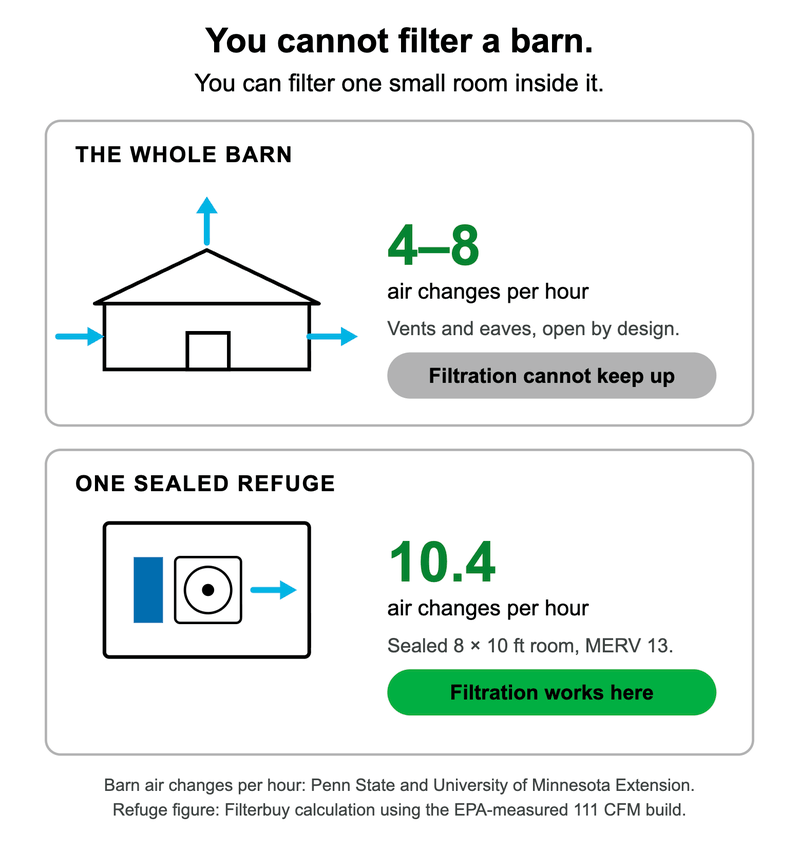
You cannot filter a barn, so filter one small room inside it instead. A working barn is built to exchange its air 4 to 8 times an hour, roughly 8 to 16 times faster than a house, so the air you clean is replaced before the filter finishes the job. Keep the barn ventilated, build one sealed refuge for the animals most at risk, and manage water, feed, and rest for everyone else.
The barn: ventilate, do not seal. Sealing it trades smoke for ammonia, humidity, and mold.
The refuge: one small sealed room you can filter. A tack room, feed room, brooder, or single stall, under about 150 square feet.
The animal: manage the load. No work, water beside the feeder, dust-free feed, and close watching.
The EPA names MERV 13 as its filtration benchmark for wildfire smoke, in both HVAC systems and DIY box-fan cleaners. MERV 13 captures microscopic particles, including the fine PM2.5 that makes up most of wildfire smoke. Barn fans and window units rarely take a catalog size, so measure the slot before you order.
Running a mini split in the tack room, feed room, or barn office? Answer a few quick questions and we will match you to the right filter.
Or skip the quiz and start from your size. Filterbuy makes over 600 standard sizes plus custom-cut filters in the USA.
You cannot filter a whole barn, and every smoke season a lot of rural homeowners lose money finding that out. A barn is built for 4 to 8 air changes an hour, roughly 8 to 16 times what a house does, so the air you clean is gone before the filter finishes the job. The approach that actually works is triage. Keep the barn ventilated, build one small filtered refuge for the animals that need it most, and manage workload, water, and dust for everyone else.
Roughly 90% of wildfire particle mass is PM2.5, small enough to reach the deepest airways of the lung, per Oregon State University Extension.
A horse's normal resting respiratory rate is 12 to 24 breaths per minute. UC Davis School of Veterinary Medicine advises calling a vet if a resting horse consistently exceeds 30.
Chickens are the most vulnerable animals in your barnyard. Birds breathe with one-directional airflow and cross-current gas exchange, which OSU Extension notes makes them more susceptible to smoke than mammals.
Airway damage from wildfire smoke takes 4 to 6 weeks to heal, and UC Davis recommends no return to exercise sooner than two weeks after the air clears.
MERV 13 is the EPA's filtration benchmark for smoke, in both HVAC systems and DIY box-fan air cleaners.
I pull AQI readings for U.S. cities every morning, and the questions that come in from barn owners are different from the ones homeowners ask. A homeowner wants to know which filter to buy. A barn owner wants to know which animal to move first. That is the honest answer here: on a smoke day you are not cleaning the barn, you are choosing where the clean air goes.
Michelle Wan, Brand Manager and Air Quality Writer, Filterbuy
A barn cannot be filtered, because a barn is built to leak on purpose. Filterbuy has been building air filters in the United States since 2013, which is exactly why we can tell you what ours will not do here. Extension guidance from Penn State and the University of Minnesota puts a working stable at 4 to 8 air changes an hour, all of it aimed at flushing ammonia, moisture, and mold before they settle. A typical house turns its air over about half a time an hour. So your barn is not a bigger house. It is a building with the opposite assignment.
Source: Penn State and UMN Extension.
A barn replaces its entire air volume 8 to 16 times faster than a house does. Smoke you filter out is replaced within minutes. This is also why sealing the barn is the wrong instinct: close it up and you trade PM2.5 for ammonia, humidity, and mold, the drivers of equine asthma the rest of the year.
So stop aiming for clean air everywhere. Aim for clean air somewhere.
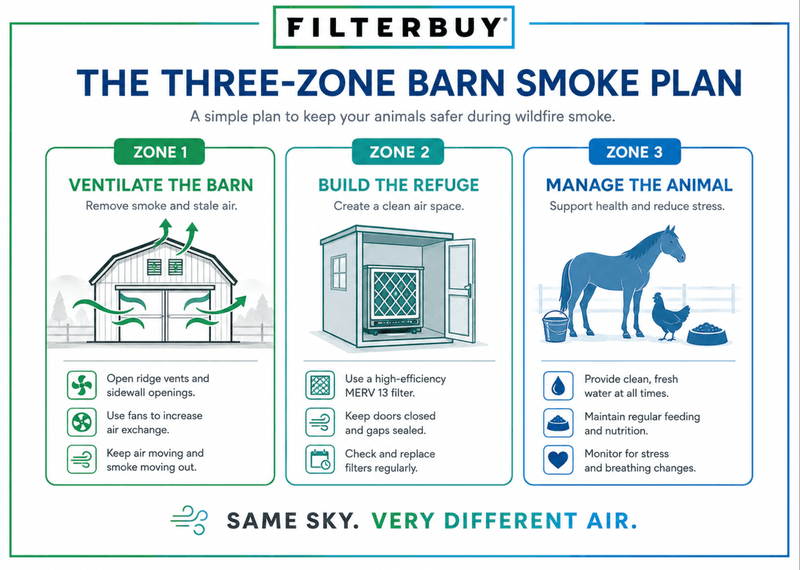
Once you stop trying to fix the whole property at once, the problem splits into three smaller ones, each with a fix that actually fits it.
Zone 1. The barn: ventilate, don’t seal. Leave ridge vents and eave inlets open and keep air moving. You manage dust and ammonia here, not smoke, which cannot be controlled in this space.
Zone 2. The refuge: one small sealed room you can filter. A tack room, feed room, brooder, or single enclosed stall. Filtration works here, and this is where your highest-risk animals go: chicks, foals, a horse with heaves, a sick calf.
Zone 3. The animal: manage the load. Water placement, dust-free feed, no exercise, and close watching. This zone costs nothing, and for every animal that cannot fit inside Zone 2, it is doing most of the work. Only Zone 2 requires buying anything.
Smoke does not treat every animal in the barnyard the same way. Lung anatomy, body size, and how much a vet can realistically do for the species all shift the risk.
Sources: UC Davis Center for Equine Health; Oregon State University Extension EM 9897; Texas A&M AgriLife.
Two findings put numbers on this. After the 2018 Calgary wildfires, lung washes on polo horses found airway inflammation in every horse studied, with performance recovering only after roughly two and a half weeks of clearer air, per Oregon State University Extension. A Beef Quality Assurance review of the California fires, cited by Texas A&M AgriLife, linked cattle smoke exposure to pneumonia and reproductive losses: reduced conception, low birthweights, and lower milk production.
Goats, sheep, and pigs sit between these three cases. They are mammals, so the horse guidance on water, dust-free feed, and rest transfers directly, but like cattle they are usually housed outdoors with few individual treatment options.
Poultry come with one extra complication. Texas A&M AgriLife specialists point out that the respiratory signs smoke causes in chickens are also the signs of avian influenza, so a coughing flock in smoke season is worth testing rather than assuming.
No official AQI standard exists for livestock, which leaves most owners guessing at exactly the moment they need a number. UC Davis suggests the human athlete thresholds are a reasonable place to start for horses, so the table below adapts the NCAA and USEF guidance they cite into a barnyard version. Treat it as a starting point and Confirm it with your own veterinarian.
Adapted from NCAA and USEF guidance cited by UC Davis. Confirm with your vet.
Check before you decide: see live air quality in your area, track plumes on our live wildfire and smoke map or the AirNow Fire and Smoke Map, and if it passes 301, read what hazardous air quality means.
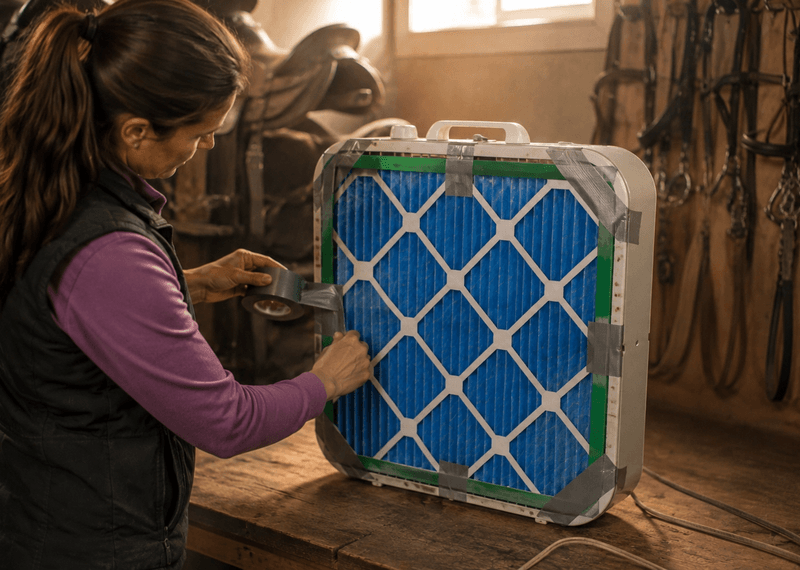
A clean-air refuge is one small, sealable room where filtration finally has a fair fight: the barn version of the clean room the EPA recommends for houses. The whole thing takes an afternoon, and the afternoon needs to happen before smoke season rather than during it.
1. Pick the smallest usable room. Tack room, feed room, brooder, or one enclosed stall. Less volume means more turnovers an hour, so aim under about 150 square feet if you are running a single air cleaner. Above roughly 150 square feet a single box-fan cleaner drops below 4 air changes an hour, which is the point where the refuge stops earning its keep.
2. Seal it, then plan for air. Weather-strip the door, close the gaps, and cover any window. A sealed room still needs a fresh air path, so keep occupancy low and open the door periodically rather than shutting animals in.
3. Add filtration. Either buy a portable air cleaner sized to the room or build the EPA-researched DIY air cleaner, which is a box fan with a MERV 13 filter taped over the intake. EPA testing clocked that basic build at roughly 111 CFM of clean air, and found that a 4-inch filter, extra filters, or a cardboard shroud each pushed it higher. Take the 4-inch if the fan will accept it, because a 1-inch filter loads fast in smoke and barn air is dustier than house air before a fire ever starts. Fire safety matters more here than it would at home: use a box fan built in 2012 or later carrying a UL or ETL mark, never leave it running unattended near hay or bedding, skip the extension cord, and put a working smoke alarm in that room. A barn is not a spare bedroom.
4. Match the filter to the fan. Barn equipment rarely takes a catalog size, so measure the slot rather than the old filter and order to those numbers. Filterbuy stocks over 600 standard sizes and cuts custom-cut air filters to order in the USA. Because custom filters are cut rather than pulled off a shelf, this is the step that punishes waiting: order in spring, not when the sky turns orange.
5. Stock spares now. Smoke loads a filter fast, and a loaded filter moves less air, so the check matters more than the calendar. Hold it up to a light, and if light no longer passes through the pleats, it is finished. Keep two or three Filterbuy spares per unit on the shelf, or put them on auto-delivery so the shelf refills itself.
6. Dry-run it on a clear day. Check that the fan runs, the door seals, and the animals will actually walk in. Finding out that a mare will not enter the feed room is a problem worth having in June rather than August.
There is one detail here that we notice because we run the cutting floor. Tack-room window units, wall fans, and old exhaust boxes were built to whatever dimension the installer had on the truck that day, and a filter that does not seal does not filter at all: the air simply routes around the edge instead of through the media. Filterbuy cuts custom sizes to the exact numbers you give us rather than rounding to the nearest stock size, and in a barn that is the difference between a refuge that works and a box that just hums.
The mistake I see on service calls during smoke events is people forcing a high-MERV filter into a system that cannot pull through it. In a barn refuge you are not fighting that problem, because a box fan and a filter is an open loop, not a duct system. What you are fighting is loading. That filter will be grey in days, not months, and a grey filter moves almost no air.
David Clark, Licensed HVAC Technician and President of Filterbuy HVAC Solutions
If the barn has an office or wash rack running on real HVAC, put a MERV 13 in that system as well, and our guide to which MERV rating to run at a high AQI covers the trade-offs. Ask your technician before you do, though, because older equipment can struggle against the added pressure drop.
The arithmetic that rules out filtering a barn is the same arithmetic that tells you how big a refuge can be, so it is worth running once. Air changes per hour equal the clean air delivery rate times 60, divided by the room volume. EPA measured roughly 111 CFM from the basic box-fan build, which sets the ceiling for what one of them can do. We have not seen anyone work this out for barn spaces, so here it is.
Filterbuy calculation. Air changes per hour = (CADR x 60) / room volume, using the 111 CFM clean air delivery rate EPA measured for the basic box-fan-plus-MERV-13 build. Idealized: it assumes full CADR and ignores fresh smoke leaking in, so treat these as ceilings, not guarantees. EPA found a 4-inch filter, extra filters, or a cardboard shroud all raise CADR above this baseline.
Refuge sizing is blunt in practice. A tack room works, a wash bay is borderline, and half a barn aisle is a waste of a good filter. When in doubt, pick the smaller room.
Once the refuge is running, the rest of the herd still needs managing, and the guidance from UC Davis and the AVMA costs nothing to follow.
Cancel all work. Exercise drives far more air, and far more particulate, into the lungs and can trigger bronchoconstriction. If smoke is visible, the horse doesn’t work.
Move water beside the feeder. Horses drink most water within two hours of eating hay. Moist airways clear particles; dry ones trap them.
Soak the hay or feed dust-free. Every particle you remove is one the lungs don’t have to clear on top of smoke.
Mist pens and aisles. A light watering keeps kicked-up dust from stacking on top of the smoke already in the air.
Watch appetite. An animal going off feed or water is usually the first honest signal that something is wrong.
Protect yourself too. The chores still have to get done, so wear a properly fitted N95 while you do them.
Call a veterinarian if a horse shows any of these, per UC Davis School of Veterinary Medicine:
Resting respiratory rate consistently above 30 breaths per minute (normal is 12–24)
Obvious nostril flaring
Increased breathing effort visible in the abdomen and rib cage
Repetitive or deep coughing, or abnormal nasal discharge
For all species, AVMA guidance compiled by OSU Extension flags coughing or gagging, open-mouth breathing, watering eyes, fatigue, disorientation, and reduced appetite or thirst. Animals with heart or respiratory disease need the closest watching.
Recovery outlasts the smoke by weeks, which is the part most owners underestimate. UC Davis states that airway damage from wildfire smoke requires 4 to 6 weeks to heal, and advises no return to exercise sooner than two weeks after the air fully clears. Pushing early aggravates the injury. OSU Extension likewise advises that handling or transporting livestock too soon delays healing.
Monitor feed and water intake for weeks, and test forage and water before reuse if ash fell on your pasture. Then reset every filter in the refuge and the house, Filterbuy or otherwise.
Barn air filtration addresses smoke without fire, which is by far the more common situation. If fire itself is moving toward your property, none of the filtration advice applies. Filtration stops being the priority and evacuation becomes the only one.
Arrange trailer capacity before the season rather than during a warning. AVMA guidance compiled by OSU Extension is explicit that if you cannot haul every animal in one trip, you should build a network of neighbors, haulers, and producers in advance. Large animals are the single hardest thing to move quickly, and horses will refuse a trailer they have never been asked to load onto.
The same guidance points back to year-round maintenance: keep structures sound, take out dead trees, clear brush, and hold defensible space around the buildings. Nothing in this guide is a substitute for leaving when you are told to leave.
If an afternoon of barn prep feels like an overreaction, three figures from federal and national sources put it in proportion.
Averages calculated by Filterbuy from NIFC year-end totals. Sources verified August 20, 2026.
The primary data is worth reading yourself: NIFC wildfires and acres, 1983–2025; EPA wildland fire research; American Lung Association State of the Air 2026.
Filterbuy has manufactured air filters in the United States since 2013, in our own plants in Alabama, Florida, Pennsylvania, and Utah, and we ship factory-direct to more than two million households, including the rural counties that absorb most of this country’s smoke days. That vantage point is why this guide argues against something the rest of the internet recommends.
Most wildfire advice is written for houses and then pointed at barns. It does not transfer. Filterbuy builds the filters, so we know what they can and cannot do: a pleated filter is rated against an airflow path, and a barn has no airflow path to speak of. What Filterbuy can do is cut a filter to fit a tack-room window unit or an odd barn fan, which is the part of this problem filtration actually solves.
No. A barn exchanges its air 4 to 8 times per hour by design, so no filter keeps pace. Filtration works only in a small, sealable room where a portable cleaner can turn the air over repeatedly.
No. Sealing a barn traps ammonia, humidity, and mold spores, the drivers of chronic equine respiratory disease. Keep vents open and build a separate refuge.
MERV 13. The EPA recommends MERV 13 or higher for the fine PM2.5 in wildfire smoke, in both central HVAC and DIY box-fan cleaners. Our guide to the best MERV filter for wildfire smoke covers the trade-offs.
Yes. Birds breathe with unidirectional airflow and cross-current gas exchange rather than the tidal breathing of mammals, which OSU Extension identifies as making them more susceptible. They also have fewer treatment options.
Ask your local extension office. University of California researchers have studied contamination risk in backyard eggs after urban wildfires; guidance depends on what burned nearby.
Check a live map, not your nose: PM2.5 travels hundreds of miles unseen. Start with our wildfire smoke and AQI guide, then the live smoke map.
AQI (Air Quality Index). The EPA's 0–500 daily air pollution scale. Above 100 is unhealthy for sensitive groups.
PM2.5. Fine particulate matter 2.5 microns or smaller. Roughly 90% of wildfire particle mass, small enough to reach the deepest airways.
MERV. Minimum Efficiency Reporting Value, the 1–16 ASHRAE scale for particle capture. MERV 13 is the EPA's smoke benchmark.
ACH (Air Changes Per Hour). How many times a building's air volume is replaced hourly. Barns target 4–8 ACH; a house runs near 0.5.
CADR (Clean Air Delivery Rate). Filtered air delivered, in cubic feet per minute. Higher CADR cleans a room faster.
Heaves (Recurrent Airway Obstruction). A chronic equine asthma-like condition triggered by dust, mold, and irritants. Affected horses are at far higher risk in smoke.
Clean-air refuge. A small, sealable filtered room where at-risk animals shelter. The barnyard version of the EPA’s "clean room."
Bronchoconstriction. Narrowing of the small airways, which exercise during a smoke event can trigger in horses.
AirNow Fire and Smoke Map. The EPA and U.S. Forest Service map of live smoke plumes and PM2.5 readings.
Filterbuy. A U.S. air filter manufacturer producing over 600 standard sizes plus custom-cut MERV 8, MERV 11, and MERV 13 pleated filters, factory-direct.
is Filterbuy’s Brand Manager and Air Quality Writer. She translates the technical side of indoor air quality (MERV ratings, filtration, HVAC efficiency, pressure drop) into plain-English advice for homeowners, and works directly with Filterbuy’s manufacturing teams across its Alabama, Florida, Pennsylvania, and Utah plants. Michelle earned her B.A. in Sociology from the University of California, Santa Cruz, in 2021, and appears in Filterbuy’s educational social and video content. Learn more on her author page.
David Clark is President of Filterbuy HVAC Solutions, an EPA-certified technician and a graduate of the South Florida Academy of Air Conditioning, with more than a decade in HVAC across installation, maintenance, dispatch, and service. He reviewed the filtration, ventilation, and airflow guidance on this page.
1. UC Davis School of Veterinary Medicine, Center for Equine Health: Wildfire Smoke and Horses
3. U.S. EPA: Create a Clean Room to Protect Indoor Air Quality During a Wildfire
4. U.S. EPA: Research on DIY Air Cleaners to Reduce Wildfire Smoke Indoors
5. Texas A&M AgriLife: Livestock Respiratory Issues Expected Following Panhandle Wildfires
6. Penn State Extension: Horse Stable Ventilation
7. University of Minnesota Extension: Ventilation Systems for Horse Barns
8. UC Agriculture and Natural Resources: Poultry Wildfire Resources
