September 1, 2026
By Michelle Wan | Reviewed by David Clark, Licensed HVAC Technician | Published September 02, 2026
A cough that outlasts the smoke by days or even weeks is common, and on its own it is rarely dangerous. Clinicians call anything under three weeks an acute cough. Three to eight weeks is subacute, and past eight weeks it is chronic and warrants medical evaluation.
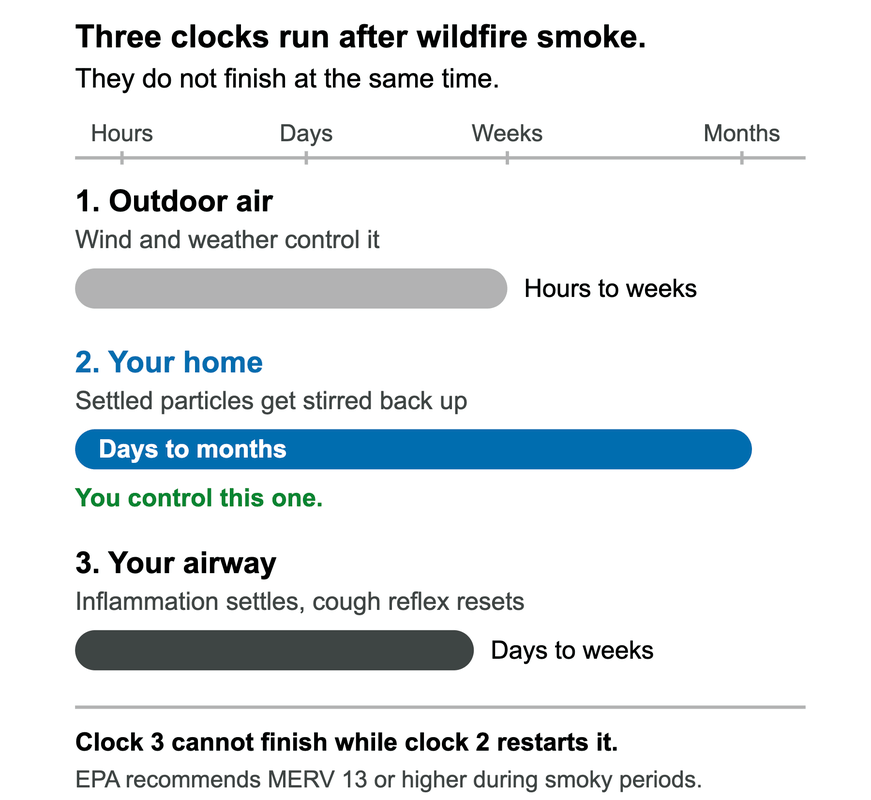
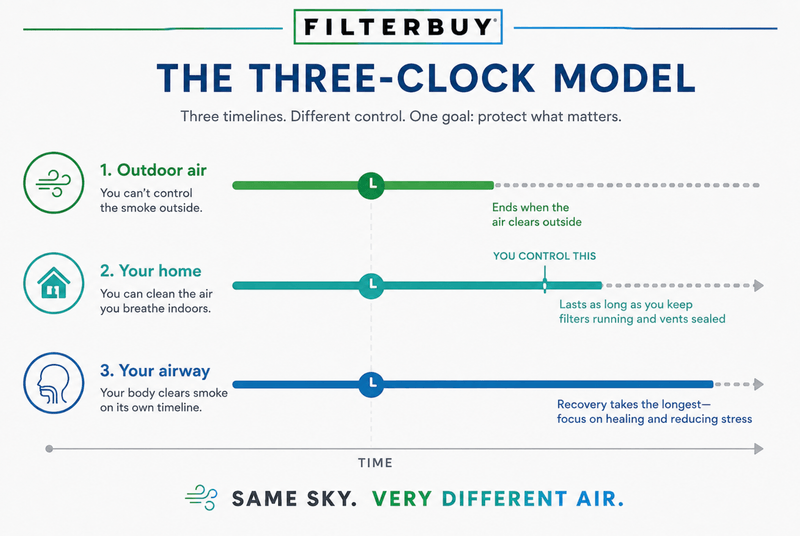
The reason yours keeps going after the sky cleared is that three separate clocks are running, and they do not finish together.
Outdoor air clears first, in hours to weeks. Wind and weather control it.
Your home clears second, in days to months. Fine particles that got inside settle into carpet, bedding, and ductwork, then get stirred back into the air.
Your airway clears last, in days to weeks, and it cannot reset while your home keeps re-exposing it.
Your home is the only clock you control. The EPA recommends upgrading to a MERV 13 or higher HVAC filter during smoky periods to capture the fine particles in wildfire smoke. Filtration does not treat a cough, and that part belongs to your doctor. What it does is capture the particles that keep setting it off.
Seek medical care now for chest pain or tightness, shortness of breath at rest, or coughing up blood.
Call your doctor within a day or two if the cough is getting worse, wheezing is new for you, or it is still there at three weeks. This page is educational and is not medical advice.
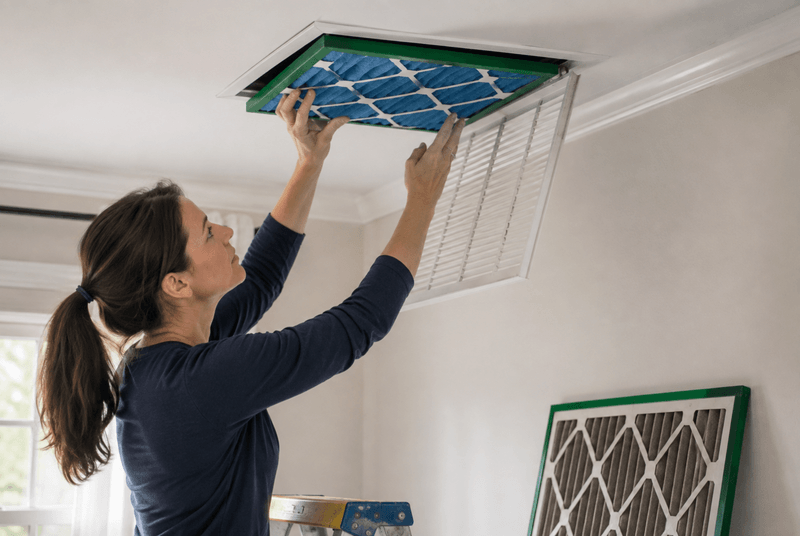
Start with the clock you control. Pull the filter that ran during the smoke and look at it, then put a MERV 13 in its place.
Not sure which filter fits your system? Answer a few quick questions and we will match you to your size and rating.
It is common for a cough to outlast the smoke by days or even weeks, and on its own that is rarely dangerous. Smoke inflames the airway and leaves the cough reflex easily provoked, so the coughing carries on after the outdoor air has cleared, while the particles that worked their way into your home keep setting it off again. Clinicians call anything under three weeks an acute cough. Once you pass eight weeks, or if any of the red flags below appear, it is time to see a doctor.
A cough lasting under three weeks falls in the category clinicians call acute cough, per the classification published by CHEST (the American College of Chest Physicians).
Three separate clocks run after a fire: the outdoor air, your house, and your airway. They do not finish at the same time, which is why the AQI can read green while you are still coughing.
Cough lasting 3 to 8 weeks is subacute; past 8 weeks it is chronic and warrants medical evaluation rather than waiting it out.
The EPA recommends upgrading to a MERV 13 or higher HVAC filter during smoky periods to capture the fine particles in wildfire smoke.
Dry sweeping and non-HEPA vacuuming put settled ash back into the air. California public health guidance is to dampen surfaces and use a wet cloth or mop instead.
The smoke event ends on three different schedules, not one. The outdoor air clears first, and that is the only clock most people are watching. Your home’s air clears second, on a timeline you have real control over, while your airway clears last on a timeline nobody controls at all. So a cough that seems to make no sense, with clear skies overhead and a green reading on your phone, is almost always the second and third clocks still running. Since we manufacture filters rather than treat patients, the middle one is where we can be genuinely useful, and it is what this guide is built around.
Clock 2 is the only one you control, and it is the one that decides how long Clock 3 takes.
Clock two is the one homeowners tend to underestimate. Particles small enough to reach the deep lung are also small enough to slip past weatherstripping, and once they are inside they do not simply disappear when the fire goes out. They settle instead, and then almost any ordinary movement puts them back up again: walking across the room, running the furnace fan, vacuuming with a standard machine. Each of those is a fresh dose delivered to an airway that has not finished healing from the last one.
A post-smoke cough stalls for exactly this reason. Clock three cannot finish while clock two keeps restarting it. For the fuller picture of how smoke gets into a house in the first place, and what to do while it is still outside, see our guide to wildfire smoke and the air quality index.
The question we get most after a fire isn’t ‘is the air bad.’ It’s ‘why am I still coughing when my app says the air is fine.’ The app is answering a different question than the one people are asking. An AQI reading is a measurement of the air outside your house. It was never built to describe the air in your bedroom, and after a fire those two numbers can point in opposite directions for weeks.
Michelle Wan, Brand Manager and Air Quality Writer, Filterbuy
The filter is the part of this we actually know. Filterbuy has manufactured pleated air filters in the United States since 2013, in our own plants in Alabama, Florida, Pennsylvania, and Utah, and we ship them factory-direct to more than two million households, many of them in the western counties that absorb most of the country’s smoke days. It is a narrow vantage point, and worth being honest about its edges. We cannot tell you why your cough has not stopped, and a clinician can. What we can tell you is what a filter looks like when it comes out of a house after a smoke event, why a MERV 8 pad lets the dangerous fraction sail straight through, and why the return grille in an older home so often refuses the rating the EPA recommends. That last problem is the reason we build custom sizes at all, alongside the 600-plus standard ones: a large share of American homes were never framed to a standard filter dimension, and during smoke season a filter that does not fit is a filter that does not work.
Duration is the most useful signal you have. Clinicians sort coughs by how long they have been running, because duration narrows the likely causes faster than any other single detail you could offer them. The categories below come from the cough classification guideline published by CHEST, applied here to a smoke exposure.
Cough duration categories follow the classification published by CHEST (the American College of Chest Physicians). This page is educational and is not medical advice.
Milder symptoms often settle much faster. UCLA Health notes that in people without an existing lung condition, mild symptoms generally settle within 24 to 48 hours of the exposure ending. The American Lung Association points out the other side of that same window: symptoms can take 24 to 48 hours to show up in the first place, so a cough that begins two days after a smoky weekend is still plausibly the smoke. If yours was mild and short-lived, our guide to mild smoke inhalation symptoms covers the shorter end of this range.
Two groups run longer clocks than the table allows for. People with asthma or COPD flare hardest and settle slowest, and after the January 2025 Los Angeles fires, UCLA Health pulmonologist Dr. May-Lin Wilgus reported patients who were still describing flare-related symptoms at six-month follow-ups. Separately, and far less commonly, some people develop persistent asthma-like symptoms after a single intense exposure, a pattern first documented in 1985 as reactive airways dysfunction syndrome. That is uncommon, and it is a physician’s diagnosis to make, not a self-assessment.
Stop monitoring and seek care if any of the following are present. Duration is the routine signal; these are the urgent ones, and they override the timeline above.
Children, older adults, pregnant people, and anyone with heart or lung disease should have a lower threshold on every item above.
The California Department of Public Health advises anyone with chest pain, chest tightness, or shortness of breath after a fire to seek medical care, and flags children and young adults for closer monitoring.
Cleaning up your indoor air is the part of recovery you control, and it is the part that lets clock three finish. The steps below come from EPA and state public-health guidance, though we have ordered them the way we would actually work through a house rather than the way an agency lists them. That sequence matters more than most people expect. Wiping down surfaces before you have a fresh filter in and the fan running does little more than move the problem into the air.
Put a MERV 13 filter in your HVAC system. The EPA recommends upgrading to MERV 13 or higher during smoky periods to remove fine smoke particles, and notes most residential systems accommodate it as long as the filter is changed often. See our breakdown of which MERV rating actually helps against smoke, then shop Filterbuy MERV 13 filters [LINK: supply MERV 13 category URL] in your size.
Replace the filter that ran during the event, regardless of the calendar. EPA guidance is to change a filter once it looks dirty, meaning dark brown or black, and under heavy smoke that point can arrive well ahead of schedule. The failure we run into most often is not ignorance but supply: the loaded filter stays in because the replacement has not turned up yet. Keep two or three spares in your size on a shelf, or put them on Filterbuy Auto Delivery so the next one is already in the house by the time you need it.
Run the blower on "On," not "Auto," for a day or two afterward. The EPA advises setting the fan to On rather than Auto to get the most out of the filter. Running it continuously pulls the lingering airborne particles through the new media instead of leaving them to settle out and get stirred up again later.
Clean settled ash wet, never dry. California public health guidance is to avoid dry sweeping and leaf blowers, dampen surfaces, and use a wet cloth or mop. Standard and shop vacuums exhaust fine particles back into the room; use a HEPA vacuum or skip vacuuming.
Wash the soft surfaces that hold particles. Bedding first, since you spend eight hours a night breathing whatever is in it, then curtains and throws.
Add a portable HEPA air cleaner in the bedroom. A portable HEPA cleaner works alongside your HVAC filter rather than replacing it, and Filterbuy does not make them, so this is not a recommendation we stand to gain from. The bedroom is where it earns its keep, because that is where a lingering cough costs you the most sleep. Eight uninterrupted hours in the cleanest room in the house does more for recovery than anything else on this list.
Stop adding indoor smoke. Candles, fireplaces, incense, and pan-frying all add fine particles to an inflamed airway.
If MERV 13 does not come in your return grille’s size, you have hit one of the more common post-fire dead ends. Taping a smaller filter in place will not rescue it either, because air takes the path of least resistance, and a half-inch gap is a far easier path than pleated media. Filterbuy builds custom air filters to any size, so an odd-sized return is not a reason to run a lower rating through smoke season.
A pleated filter does not remove smoke odor. Pleated media captures particles; odor is gas-phase. A lingering smell is a cue to clean surfaces and soft goods, not a sign your filter failed. Our guide to choosing an AC filter for wildfire smoke covers the carbon options that do target odor.
Opening the windows is only sometimes right. Once outdoor air is genuinely clear, ventilation flushes indoor pollutants. While smoke is still around, it undoes everything else on this list. Check your local AQI on the live map before you open anything, and if there is still fire activity nearby, track it on the live wildfire and smoke map.
An N95 does nothing for you at your desk. Masks earn their keep outdoors and during ash cleanup, not in a filtered room. See which mask rating actually works for smoke.
An air cleaner that makes ozone can cause the symptom you are trying to fix. We sell filters, so take this as a warning against a category we do not compete in rather than a pitch. The EPA advises choosing an air cleaner that does not produce ozone, and names coughing, breathing difficulty, and lung damage among the harms. Devices marketed as ozone generators, ionizers, or "activated oxygen" purifiers are the ones to check. The California Air Resources Board maintains a list of air cleaners tested to emit little or no ozone; if a unit is not on it, that is worth knowing before it runs all night in a bedroom.
A cough that starts during a fire is not automatically caused by the fire. This is the question most people are actually turning over by week two, and it is the one thing the timeline above cannot settle on its own. Smoke irritation, a virus picked up while sheltering indoors with other people, and an asthma flare all produce a cough, and after a fire they overlap constantly. The distinctions below are the ones clinicians work from. CHEST notes that respiratory infections are the most common cause of acute cough in general, and that subacute cough is most often post-infectious. A fire in the background does not make an infection any less likely, then. If anything, it makes one easier to miss.
This table describes what clinicians distinguish between. It is not a diagnosis, and the categories overlap, because a smoke-irritated airway is easier to infect. Only a clinician can tell you which one you have.
Write down the exposure history before you go. A cough on its own is a thin clue. Put a date on it, set it beside the smoke event and a few details about the house, and it becomes a much better one. That is information nobody else in the room has. Five things worth writing down before the appointment:
When the smoke arrived and when the cough started. The gap between the two matters. Symptoms can surface as late as 24 to 48 hours after exposure, so a two-day lag still points at the smoke, while a two-week lag points somewhere else entirely.
Whether you were home, evacuated, or came back to a closed-up house. Coming back to a house that sat through the fire is a very different exposure from riding it out indoors with the windows shut.
What the cough is doing now, whether better, worse, or flat. Which direction it is heading tells a clinician more than how bad it happened to be on any single day.
What you have already changed indoors. Filter rating and when you last replaced it, whether the fan has been running, whether there is an air cleaner in the house. If the cough has not shifted despite all of that, the absence of improvement is itself worth reporting.
Whether you cleaned with a standard vacuum or swept dry. This one gets left out almost every time, and it explains a good number of second-week relapses.
Three findings explain why a post-smoke cough behaves the way it does. Each maps onto one of the three clocks: how long a cough normally runs, how long particles hang around in a house, and how much of the outdoor smoke actually reaches the air you breathe indoors. Two caveats are worth stating up front rather than burying. The cough-duration figure comes from studies of ordinary acute cough illness rather than smoke exposure specifically, so read it as a benchmark for how long coughs run in general. And the 2.99 ratio describes PM10, the coarser fraction that includes settled ash, while the finer PM2.5 in those same homes averaged 1.08, lower but still above the normal residential range.
The cough-duration figure is for acute cough illness generally, not smoke exposure specifically. The 2.99 ratio is PM10; PM2.5 in the same homes averaged 1.08. Full citations link beneath this table.
1. Ebell MH, Lundgren J, Youngpairoj S. How Long Does a Cough Last? Comparing Patients’ Expectations With Data From a Systematic Review of the Literature. Annals of Family Medicine. 2013;11(1):5–13.
2. Goftari E, Rivera Carias J, Fulford L, Li H. Post-Wildfire Indoor Pollution in WUI Areas following the 2025 Los Angeles Fires, Part I. ACS ES&T Air. 2026;3(1):142–155.
3. Liang Y, Sengupta D, Campmier MJ, Lunderberg DM, Apte JS, Goldstein AH. Wildfire smoke impacts on indoor air quality assessed using crowdsourced data in California. PNAS. 2021;118(36):e2106478118.
There is no published figure for the share of smoke-related coughs that clear by a given week, so use the clinical categories instead. Under three weeks is acute cough, three to eight weeks is subacute, and beyond eight weeks is chronic cough that warrants medical evaluation. UCLA Health notes that milder irritation in people without lung conditions often clears within 24 to 48 hours after the smoke ends.
The outdoor AQI measures outdoor air only. Fine particles that entered your home during the smoke event stay in carpet, upholstery, and ductwork and get stirred back into the air, and your cough reflex stays extra sensitive for a while after the irritant is gone. Both continue after the AQI returns to green.
Wildfire smoke can trigger a cough that becomes chronic by duration, meaning more than eight weeks. In a small number of people, an intense single irritant exposure is followed by persistent asthma-like symptoms and airway hyperreactivity, described in the literature as reactive airways dysfunction syndrome. A cough at eight weeks is a reason to see a clinician, not to keep waiting.
Filtration does not treat a cough, but it removes the particles that keep re-triggering it. The EPA recommends MERV 13 or higher HVAC filtration during smoky periods, and a portable HEPA cleaner adds a second layer in the room where you sleep. Filterbuy makes the first and not the second, and both are worth having during smoke recovery.
Ash from burned structures can contain metals, chemicals, and in older buildings asbestos, unlike relatively benign wood ash. Handle it wet, wear gloves and an N95, and keep children away from cleanup.
If you do one thing after reading this, pull the filter. Take it out and look at it. If it is dark brown or black, it stopped doing its job some time ago and has been sitting in the airstream ever since. That one check will tell you more about the air in your house than any number on a screen, and it costs nothing.
Then, in order: check what the outdoor air is doing on the live AQI map to see whether it is safe to open the windows. Put a MERV 13 in, and if your return grille is an odd size, Filterbuy builds more than 600 standard sizes plus custom dimensions to fit it. Then set the thermostat fan to On for a day or two. If the cough is still there at three weeks, stop troubleshooting the house and book an appointment, because filtration is the part of this we can help with and the cough itself belongs to your doctor.
PM2.5: Fine particulate matter 2.5 micrometers and smaller. The fraction of wildfire smoke that reaches the deep lung and drives most smoke-related symptoms.
PM10: Particulate matter 10 micrometers and smaller, the coarser fraction that includes settled ash and soot. It is heavier than PM2.5 and lifts back into the air more readily when disturbed.
Indoor-to-outdoor (I/O) ratio: Indoor pollutant concentration divided by outdoor concentration. Below 1 means the air inside is cleaner than the air outside; above 1 means the house itself is the source.
AQI (Air Quality Index): The U.S. Environmental Protection Agency’s 0 to 500 daily scale for outdoor air quality. It reports outdoor conditions only and says nothing about the air inside your home.
MERV: Minimum Efficiency Reporting Value, the ASHRAE scale rating how well an air filter captures particles. The full scale runs to 20; residential filters run 1 to 16. Higher numbers capture smaller particles. MERV 13 is the rating the EPA recommends for wildfire smoke.
HEPA: High-Efficiency Particulate Air, a standard used in portable air cleaners and specialized vacuums, not in residential furnace slots.
Acute, subacute, and chronic cough: The CHEST duration categories: under three weeks, three to eight weeks, and more than eight weeks. Chronic cough warrants medical evaluation.
Resuspension: Settled particles lifted back into the air by walking, vacuuming, or air movement.
RADS (reactive airways dysfunction syndrome): Persistent asthma-like symptoms and airway hyperreactivity following a single high-level irritant exposure, first described in the journal Chest in 1985.
CHEST: The American College of Chest Physicians, the professional body whose guidelines define the cough duration categories used here.
Michelle Wan is Filterbuy’s Brand Manager and Air Quality Writer, covering AQI trends, wildfire smoke, and indoor air quality across Filterbuy’s health and wellness resource library. She works directly with Filterbuy’s manufacturing teams in Alabama, Florida, Pennsylvania, and Utah. Filterbuy has manufactured HVAC air filters in the United States since 2013 and serves more than two million households.
The filtration guidance here was reviewed by David Clark, a licensed HVAC technician. The medical information is summarized from the sources below and is not a substitute for care from your own clinician.
Irwin RS, French CL, Chang AB, Altman KW; CHEST Expert Cough Panel. Classification of Cough as a Symptom in Adults and Management Algorithms. Chest. 2018;153(1):196–209. (PMID 29080708)
U.S. Environmental Protection Agency. Preparing for Smoke and Heat. MERV 13 and filter-replacement guidance.
U.S. Environmental Protection Agency. Create a Clean Room to Protect Indoor Air Quality During a Wildfire. Fan setting, damp cleaning, and indoor particle sources.
American Lung Association. Wildfires and lung health. Delayed symptom onset and when to call a physician.
American Lung Association. Returning home after a disaster.
UCLA Health. The effects of wildfire smoke on your lung health. Reza Ronaghi, MD, on symptom timelines.
University of California. On first anniversary of L.A. wildfires, health effects linger. May-Lin Wilgus, MD, on six-month follow-ups.
California Department of Public Health. State Health Officer urges caution during wildfire cleanup. Ash handling and when to seek care.
Brooks SM, Weiss MA, Bernstein IL. Reactive airways dysfunction syndrome. Chest. 1985;88(3):376–384. (PMID 4028848)
Ebell MH, Lundgren J, Youngpairoj S. How Long Does a Cough Last? Annals of Family Medicine. 2013;11(1):5–13. (PMID 23319500)
Goftari E, et al. Post-Wildfire Indoor Pollution in WUI Areas following the 2025 Los Angeles Fires, Part I. ACS ES&T Air. 2026;3(1):142–155. (PMID 41536327)
Liang Y, et al. Wildfire smoke impacts on indoor air quality assessed using crowdsourced data in California. PNAS. 2021;118(36):e2106478118. (PMID 34465624)
Centers for Disease Control and Prevention. Wildfires.
U.S. EPA and U.S. Forest Service. AirNow Fire and Smoke Map.
