Hyper-Heat Mini Splits Explained: Do You Actually Need One?
October 6, 2026
Do You Need A Hyper-Heat Mini Split?
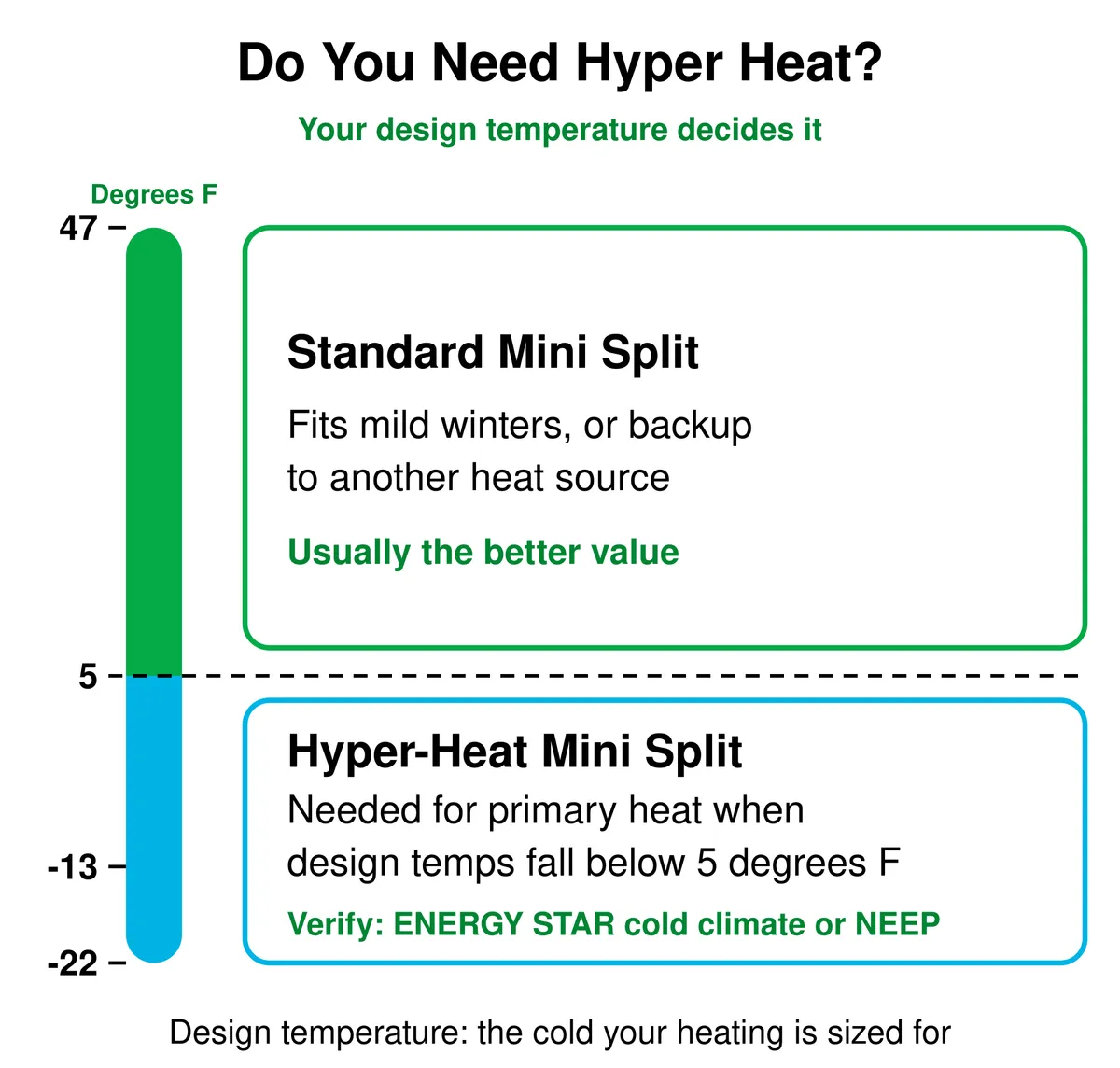
You need a hyper-heat mini split if it will be your main heat source and your local design temperature falls below 5°F. If your winters stay milder, or the mini split backs up another heat source, a standard inverter model usually handles the load at a better value. Hyper heat is a marketing term, not a certification, so look for an ENERGY STAR cold climate or NEEP listing before you buy.
Hyper-heat: holds full rated heating output at 5°F and keeps running down to -13°F or -22°F, depending on the model.
Standard: heating output drops as it gets colder, so it fits mild winters and backup heat.
Heating a garage, sunroom, or addition in a milder climate? Filterbuy mini splits start at $749 with fast and free 2-day delivery to most US states, plus a 7-year compressor and 3-year parts warranty. They heat reliably down to 5°F, and professional installation is required.
Not sure which size or setup fits your space? Take the quick quiz below and get matched to a mini split.
A hyper-heat mini split is a ductless heat pump built to keep most or all of its heating output in deep cold. Most models hold full rated capacity at 5°F and keep running down to -13°F or -22°F. A standard mini split loses output as the air gets colder. You only need hyper-heat if the mini split will be your main heat source and your winter design temperature falls near or below 5°F.
TL;DR
Hyper-heat is a manufacturer label for cold-climate ductless heat pumps. When the Filterbuy team compared manufacturer spec sheets for this guide, the number that mattered most was how much heat a unit still delivers at 5°F. If your design temperature stays above about 17°F, or the mini split backs up another heat source, a standard model is usually the better value. If it will be your primary heat and design temperatures dip near or below 5°F, choose a hyper-heat or ENERGY STAR cold climate model.
Key Takeaways
Filterbuy's analysis of Mitsubishi Electric submittal data shows a standard 12,000 BTU M-Series system delivers about 68% of its rated heat at 5°F, while the comparable H2i system delivers about 119%.
Because brands use "hyper heat" loosely, the reliable proof is an ENERGY STAR cold climate designation or a NEEP cold climate list entry.
Your local design temperature, and whether the mini split is primary or supplemental heat, decide whether the hyper-heat premium pays off.
What Is A Hyper-Heat Mini Split?
A hyper-heat mini split is a ductless air-source heat pump designed to keep producing strong heat when outdoor temperatures fall well below freezing. Mitsubishi Electric sells the technology as Hyper-Heating INVERTER, or H2i, and MRCOOL sells a product line called Hyper Heat. No industry body certifies the term.
Every heat pump pulls heat from outdoor air, and colder air has less of it to give. Hyper-heat systems make up the difference with compressors that run faster in cold weather and, on many models, refrigerant injection. Most also add a base pan heater so defrost water drains instead of refreezing inside the outdoor unit.
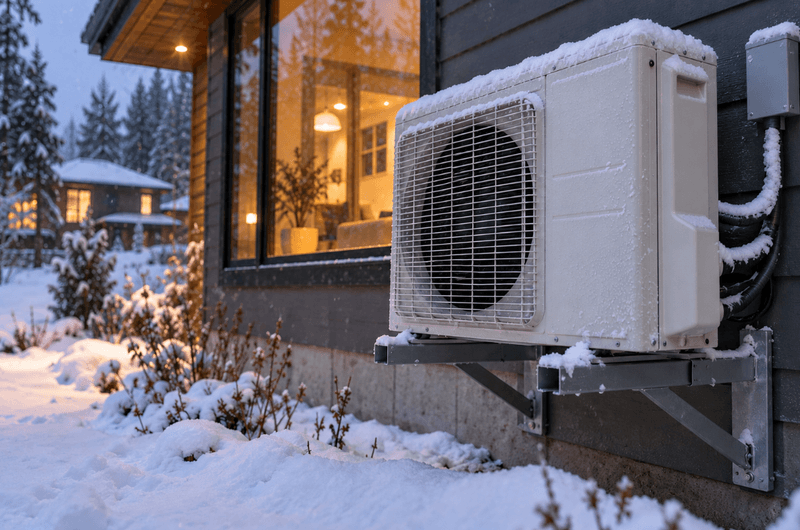
Read more about how mini splits perform in cold weather.
Hyper-Heat Vs. Regular Mini Split: What Changes Below Freezing
The real difference between a hyper-heat and a regular mini split is how much heat each one can still make in cold air. Below about 17°F, a standard model's maximum output starts to slide. A hyper-heat model holds its rated output down to 5°F and keeps running in colder air.
Mitsubishi Hyper-Heat Vs. Standard M-Series
Product listings rarely print heating output at 5°F, so the Filterbuy team pulled Mitsubishi Electric's submittal sheets for two 12,000 BTU wall systems and ran the numbers.
Source: Mitsubishi Electric submittal data for MSZ-GL12NA/MUZ-GL12NA and MSZ-FS12NA/MUZ-FS12NA. Percentages calculated by Filterbuy.
On a 5°F night, the hyper-heat system puts out about 4,900 more BTU per hour than the standard one, even though the standard system has the bigger heating rating on the box. To see which M-Series models carry H2i, read our Mitsubishi mini split review.
What MRCOOL Means By Hyper Heat
MRCOOL rates its Hyper Heat models to keep heating down to -22°F. When we lined up MRCOOL's published operating ranges, several lines sold without the Hyper Heat name already reached -13°F, the same floor as Mitsubishi's H2i systems.
Source: MRCOOL operating temperature ranges, MRCOOL support documentation, accessed October 2026.
An operating floor only tells you where a unit shuts off, so ask for maximum heating capacity at 5°F before you compare prices.
Do I Need A Hyper-Heat Mini Split? A Design-Temperature Decision Guide
You need a hyper-heat mini split when it will be your primary heat and your winter design temperature falls near or below 5°F. Design temperature is the outdoor reading your heating system is sized for, covering all but the coldest hours of a typical year. Your contractor uses it in a Manual J load calculation to size the equipment.
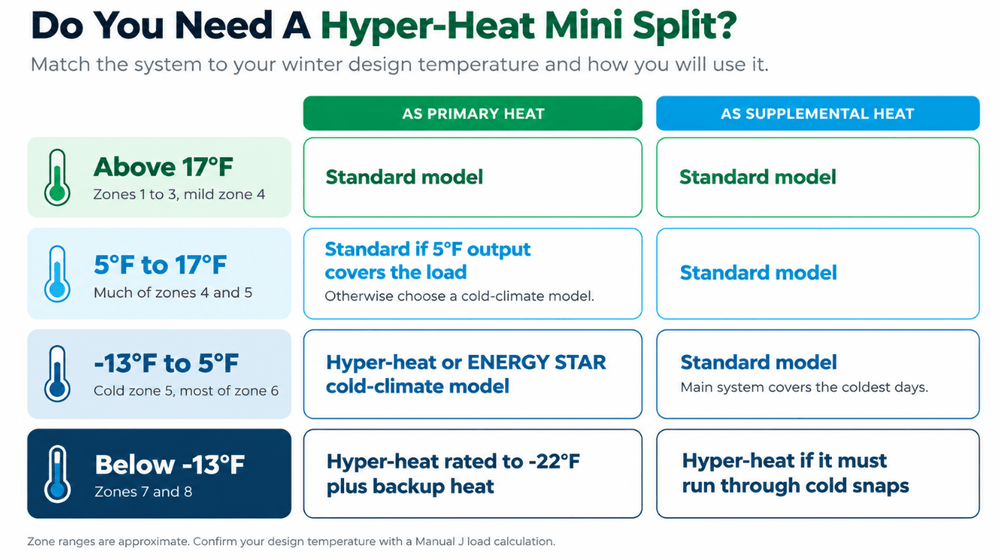
Filterbuy built this framework around the 5°F test point that ENERGY STAR and NEEP use. Before you pay for hyper-heat, answer these questions:
Will the mini split be your main heat, or will a furnace or boiler cover the coldest days?
What is your local design temperature? Find your county on the Building America climate zone map, then ask your installer for the Manual J figure.
Can the unit's maximum output at 5°F cover the room's heat loss at design temperature? If not, step up to a cold-climate model or a larger size.
Filterbuy worked example: Picture a room that loses 11,000 BTU per hour at a 5°F design temperature. The standard GL12 in the table tops out at 9,790 BTU per hour, so it falls about 1,200 short. The H2i FS12 covers the same room with roughly 3,700 BTU per hour to spare.
Start with our mini split BTU sizing guide, then add the 5°F check from question three. If you live somewhere with hard winters, our guides to adding a mini split in Colorado and mini split costs and rebates in Connecticut cover local pricing and incentives.
How To Confirm A Mini Split Is Cold-Climate Ready
Third-party verification is the most reliable way to check a cold-climate claim. For ductless heat pumps, two programs do that job: the ENERGY STAR cold climate designation and the NEEP cold climate air-source heat pump list. A model on either list has tested, published performance at 5°F.
Under the ENERGY STAR Version 6.2 heat pump specification, a cold climate ductless heat pump must keep at least 70% of its 47°F heating capacity at 5°F, reach a COP of at least 1.75 at 5°F, and meet an HSPF2 of at least 8.5. The program's ENERGY STAR ductless heating and cooling guidance adds that these systems keep working below 5°F but perform best alongside backup heat in extreme cold.
The Northeast Energy Efficiency Partnerships (NEEP) maintains the cold climate air-source heat pump specification and product list, which publishes tested low-temperature data for every qualifying model.
When A Standard Mini Split Is The Smarter Buy
A standard mini split is the better value when winters stay mild or when the unit heats one room next to another heat source. In those homes, a correctly sized standard inverter model handles the load, and the hyper-heat premium buys capacity the system will rarely use.
$749 buys a 12,000 BTU Filterbuy ductless mini split system with fast and free 2-day delivery to most US states and a 7-year compressor and 3-year parts warranty. The price is published, so there is no quote to request. Each system delivers reliable heating down to 5°F at 17 SEER2, which clears the federal efficiency minimum and is built for value. If this unit would be your primary heat where design temperatures fall below 5°F, choose a hyper-heat or ENERGY STAR cold climate system instead. We would rather you buy the right system, even when it is not ours.
Professional installation is required, and the warranty is void if the system is self-installed.
Because Filterbuy also makes air filters, a quick maintenance note for any mini split: the washable pre-filter protects the indoor coil, so rinse it on schedule through the heating season. Your whole-home HVAC filter does the heavy lifting for air quality. Compare track records across brands in our ranking of the most reliable mini split brands.
"Every spec sheet we compared for this guide pointed the same way. A standard unit can carry the bigger rating on the box and still come up short at 5°F. Find your design temperature first, then hold the 5°F output up against it."
— Michelle Wan, Brand Manager and Air Quality Writer, Filterbuy
Supporting Statistics
42% of U.S. households used electricity as their main space heating fuel in 2024. EIA credits better heat pump technology for part of that growth, especially in colder climates. Source: EIA residential heating analysis.
Every prototype in the DOE cold climate heat pump field trials delivered at least 100% of its rated heating capacity at 5°F. The 19 units were installed in northern U.S. homes for the Residential Cold Climate Heat Pump Technology Challenge, and their measured COPs ran from 1.8 at -15°F to 3.5 at 45 to 55°F. Source: ACEEE cold climate field study.
A cold-climate heat pump met over 90% of a Minneapolis home's annual heating load and cut heating energy use by more than 50%. The load was measured at -11°F, with a booster heater covering the rest. Source: Center for Energy and Environment Minnesota field test.
Frequently Asked Questions
What Temperature Does A Hyper-Heat Mini Split Work Down To?
Most hyper-heat mini splits keep heating down to -13°F, and some, including MRCOOL Olympus Hyper Heat units, are rated to -22°F. Full rated output usually holds to about 5°F and tapers off below that.
Do Hyper-Heat Mini Splits Need Backup Heat?
In the coldest regions, yes. If you live in IECC climate zone 7 or 8, or your area sees stretches below the unit's operating floor, keep backup heat.
Is MRCOOL Hyper Heat The Same As Mitsubishi Hyper-Heat?
No. MRCOOL Hyper Heat and Mitsubishi Hyper-Heating INVERTER are separate product lines from different manufacturers, with different ratings. Compare them on maximum heating capacity at 5°F and on ENERGY STAR cold climate or NEEP listing.
Are There Tax Credits Or Rebates For Hyper-Heat Mini Splits?
The federal Section 25C tax credit was terminated for heat pumps placed in service after December 31, 2025, so confirm eligibility with a tax professional. Many state and utility programs still pay rebates, and some require an ENERGY STAR cold climate or NEEP-listed model. Filterbuy's guide to mini split tax credits and rebates in 2026 tracks what is available now.
Disclosure: Filterbuy sells ductless mini splits and discusses its own line below. Filterbuy is not affiliated with or endorsed by Mitsubishi Electric or MRCOOL.
Glossary
Hyper-heat mini split: A ductless heat pump built to deliver full or near-full heating capacity at 5°F and to operate down to -13°F or -22°F.
Hyper-Heating INVERTER (H2i): Mitsubishi Electric's trademarked cold-climate technology, rated for 100% capacity at 5°F and operation to -13°F.
Design temperature: The outdoor temperature a heating system is sized to handle on all but the coldest hours of a typical year.
Manual J: The ACCA load calculation contractors use to size HVAC equipment.
IECC climate zone: A county-level International Energy Conservation Code classification, from 1 (hottest) to 8 (coldest).
COP (coefficient of performance): The ratio of heat delivered to electricity used. A COP of 2 means two units of heat per unit of electricity.
HSPF2: Heating Seasonal Performance Factor 2, the federal seasonal heating efficiency rating.
NEEP: Northeast Energy Efficiency Partnerships, the nonprofit behind the cold climate heat pump specification and product list.