
Cold Weather Alerts Today: What Each NWS Alert Means and How to Protect Your Home
October 26, 2026
Most cold weather alerts go up a day or two before the cold arrives, and fast and free 2-day delivery takes about as long. Keep a spare air filter next to your furnace before alert season starts, so a Freeze Watch never catches you without one.
As a filter manufacturer, we've found that filters load up faster in winter, when closed windows and long furnace runtimes pull more dust through them. A clogged filter can leave rooms cold or trip your furnace's overheating shutdown mid-cold snap. Check yours every 30 days, and change it every 30 to 45 days if you have pets or allergies.
Get a Spare Filter Before the Freeze
Fast and free 2-day delivery to most US states.
How Much Notice A Cold Alert Gives You
Typical lead time before the cold arrives, next to standard delivery
Order your spare before the first watch
Then the alert is your cue to swap it in.
Alert lead times: National Weather Service. Delivery times vary by location.
Answer a few quick questions and we'll match you with the right filter for winter.
A forecast tells you how cold it will get. It doesn't tell you what that cold will do inside your home. We've made air filters in the U.S. for more than a decade at Filterbuy, and we read every cold weather alert the same way: as a countdown to the hours when your heating system works hardest.
TL;DR
To check cold weather alerts today, enter your ZIP code at weather.gov, the National Weather Service (NWS) website. Four alerts matter most for homeowners: the Frost Advisory, Freeze Warning, Cold Weather Advisory, and Extreme Cold Warning. The Filterbuy Cold Alert Action Ladder below explains what each one means for your home.
Key Takeaways
Cold Weather Advisories and Extreme Cold Warnings replaced the old wind chill alerts on October 1, 2024.
Thresholds vary by NWS office, so a Florida advisory starts far warmer than a Minnesota one.
Filterbuy's advice: when the first Freeze Watch of the season goes up, check your air filter.
How Do I Check Cold Weather Alerts Today?
Type your city or ZIP code into weather.gov, and any active alert appears in a colored banner on your forecast. Other ways to check:
Weather.gov by ZIP code. Read the full alert, including its timing and the counties it covers.
Weather.gov alert map. The color-coded map on the weather.gov homepage shows alerts nationwide, including watches for tomorrow, and the NWS Active Alerts page lists them.
Wireless Emergency Alerts (WEA). Your phone only buzzes for the NWS's most dangerous warnings, like tornadoes and flash floods. Cold alerts aren't on that list, so a deep freeze can arrive without a notification. That gap is why Filterbuy tells customers to check the forecast themselves.
NOAA Weather Radio. It broadcasts NWS warnings around the clock, even when power and cell service go out.
Local news and school district sites. Best for school closings and delays.
Make the most of the watch window. A Freeze Watch or Extreme Cold Watch usually comes 24 to 48 hours before the cold. Use that time to buy a replacement filter, find your water shut-off valve, and book HVAC service early.
What Do the Different Cold Weather Alerts Mean?
NWS cold alerts fall into two groups: frost and freeze alerts for plants and outdoor water lines, and cold alerts for people and pets. A watch means the hazard could develop in the next day or two; a warning means it's expected or already here.
| NWS alert | What it means | Typical trigger | What it replaced |
|---|---|---|---|
| Frost Advisory | Frost is likely on calm, clear nights while the air stays above freezing | Lows of about 33–36°F | No earlier name |
| Freeze Watch | A freeze is possible, usually 24–48 hours out | 32°F or lower possible | Hard Freeze Watch |
| Freeze Warning | A freeze is expected, usually within about 24 hours | 32°F or lower expected | Hard Freeze Warning |
| Cold Weather Advisory | Cold is dangerous to anyone unprepared but below warning level | Set by each NWS office | Wind Chill Advisory |
| Extreme Cold Watch | Dangerously cold air, with or without wind, is possible | Set by each NWS office | Wind Chill Watch |
| Extreme Cold Warning | Dangerously cold air, with or without wind, is expected | Set by each NWS office | Wind Chill Warning |
Sources: National Weather Service (NWS) cold hazard simplification, effective October 1, 2024; NWS offices in Tallahassee, FL and Charleston, WV.
We cover the Cold Weather Advisory, Extreme Cold Warning, and Freeze Warning in separate guides, plus a Freeze Warning vs. Frost Advisory comparison.
Why Don't I See Wind Chill Warnings Anymore?
On October 1, 2024, the National Weather Service renamed its wind chill alerts through its Hazard Simplification initiative. The Wind Chill Advisory is now the Cold Weather Advisory, and Wind Chill Watches and Warnings are now Extreme Cold Watches and Warnings, because cold is dangerous with or without wind.
Wind chill still counts: alerts trigger on air temperature or wind chill, whichever is colder. Read more in Did the NWS Get Rid of Wind Chill Warnings?
Why Does the Same Alert Mean Different Temperatures in Different Places?
Each local NWS office decides what counts as dangerous cold for its climate. In the Twin Cities metro, a Cold Weather Advisory starts below -25°F, according to Minneapolis-St. Paul TV station KSTP; in the Florida Big Bend, NWS Tallahassee issues it at 15–24°F.
We take a mild-sounding alert as seriously as a severe one. Warm-climate homes often have less pipe insulation, and their furnaces may sit idle until a cold snap demands hours of runtime.
What Should I Do at Home When a Cold Weather Alert Is Issued?
When a cold weather alert is issued, protect your plants, pipes, pets, and heating system, adding steps as alerts grow more severe. The Filterbuy Cold Alert Action Ladder below spells out each level.
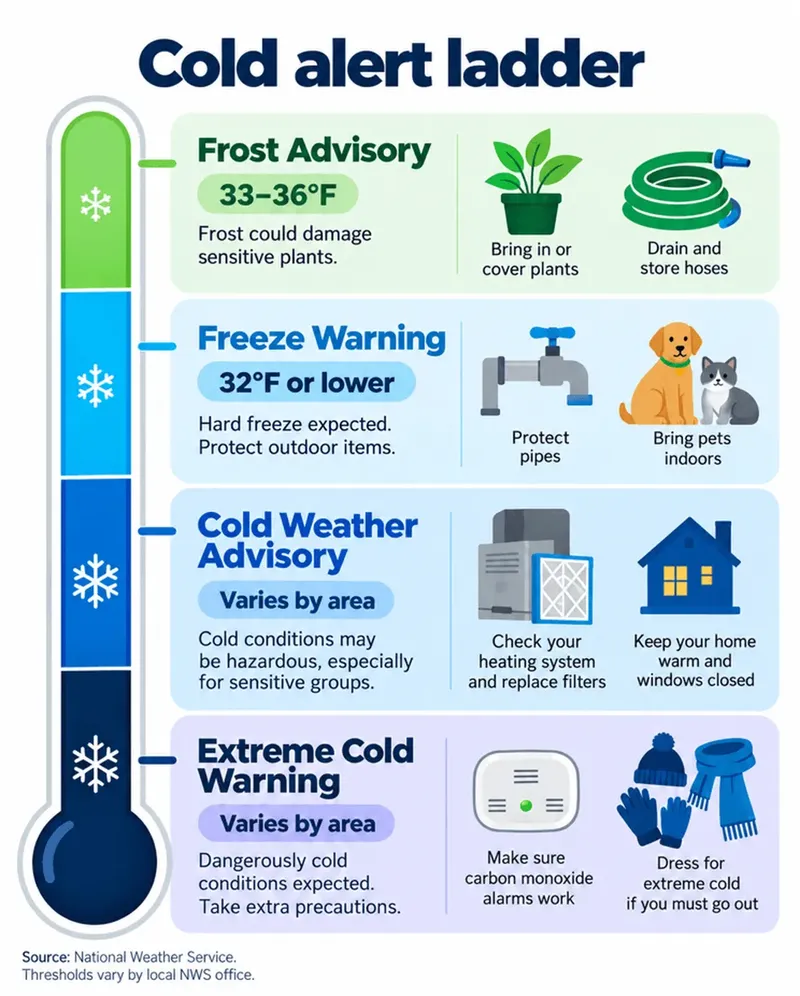
| Alert level | Outdoors | Plumbing | Heating and indoor air |
|---|---|---|---|
| Frost Advisory | Cover tender plants; bring potted plants inside | No action needed for most homes | Confirm the heat turns on and runs normally |
| Freeze Watch or Warning | Bring pets inside; disconnect and drain garden hoses | Cover outdoor spigots; open sink cabinets on exterior walls | Check the air filter and replace it if it looks gray or clogged |
| Cold Weather Advisory | Limit time outside; cover exposed skin | Let a faucet on an exterior wall drip | Keep the thermostat steady day and night; clear snow from outdoor vents |
| Extreme Cold Watch or Warning | Avoid going outside; keep a car kit and at least half a tank of gas | Know where your main water shut-off valve is | Test carbon monoxide alarms; have a backup heat plan; call an HVAC pro at the first sign of trouble |
Filterbuy Cold Alert Action Ladder. Plumbing guidance follows American Red Cross recommendations; HVAC steps reviewed by David Clark, Licensed HVAC Technician.
Protect Your Pipes
Keep your thermostat at the same setting day and night during severe cold, and never below 55°F if you'll be away. If a pipe bursts, shut off the water at the main valve and call a licensed plumber. See the American Red Cross guide to preventing and thawing frozen pipes for more.
Get Your Heating System Ready
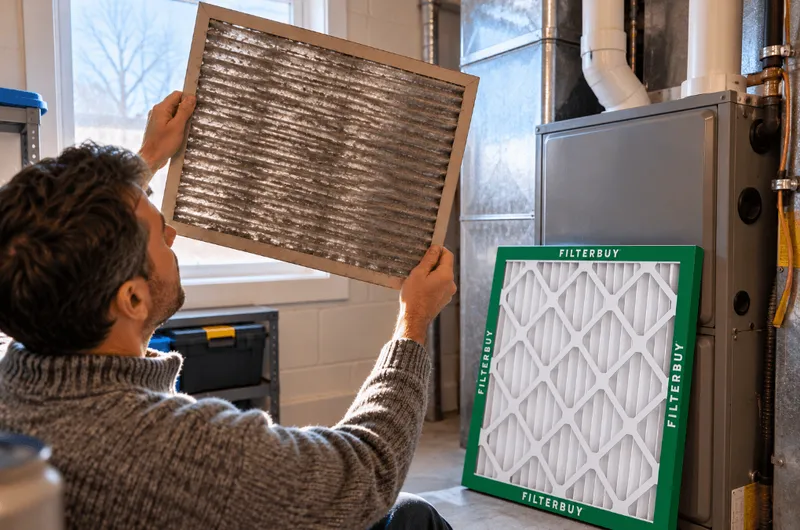
A clogged filter makes your furnace or heat pump work even harder during a cold alert. Restricted airflow can leave rooms cold or trigger a furnace's overheating shutdown. As a filter manufacturer, Filterbuy has found that filters load up faster in winter: with the windows shut, dust and dander stay inside, and hours of furnace runtime pull it all through the filter.
"A cold weather alert is the best filter reminder you'll ever get. It tells you a day or two ahead exactly when your furnace will work its hardest. I would much rather see a family spend two minutes checking a filter the night a Freeze Watch goes up than spend a cold night waiting on a repair."
- Michelle Wan, Brand Manager and Air Quality Writer at Filterbuy.
Before temperatures drop, walk through this quick checklist:
Hold your filter up to a light. If light barely gets through, replace it. Find your filter size with our air filter size chart.
Clear snow and ice from the outdoor heat pump and from the vent pipes on a high-efficiency furnace. A blocked exhaust pipe can shut the furnace down or push carbon monoxide indoors.
Move furniture and rugs off vents and return grilles.
Test your carbon monoxide alarms. The CDC recommends one near every sleeping area, plus a yearly furnace service.
Keep space heaters well away from bedding, curtains, and furniture.
What If Your Heat Stops Working During a Cold Alert?
Try these quick checks before calling for emergency service:
Thermostat. Make sure it's set to Heat and above room temperature; a blank screen usually means dead batteries.
Air filter. A badly clogged filter can make a furnace overheat and shut itself off. Put in a clean one and restart the system.
Vent pipes. On a high-efficiency furnace, clear any snow covering the outdoor intake and exhaust pipes.
Power. Check the breaker and the furnace's service switch, which looks like a light switch near the unit.
Heat pump behavior. In deep cold, a heat pump may run auxiliary heat or pause to defrost, sending steam off the outdoor unit. Both are normal.
Still no heat? Call a licensed HVAC technician. While you wait, close doors to unused rooms to hold in warmth, and never heat your home with a gas oven or grill.
Watch Your Indoor Air During Long Cold Spells
Multi-day cold snaps keep windows shut, so the HVAC filter does most of the work of cleaning indoor air. If a replacement is due, see which MERV rating works best in winter.
Winter air is dry, but don't crank up the humidifier in a deep freeze. Guidance cited by the U.S. Environmental Protection Agency caps indoor humidity at about 35% when it's 20°F outside and 25% at 0°F; above that, moisture condenses on cold windows. See our guide to ideal winter humidity levels.
Filterbuy's winter rule of thumb: check your filter every 30 days, and expect to change it every 30 to 45 days if you have pets or allergies. Learn how often to change your furnace filter in winter and how a clean filter can lower your winter heating bill. Filterbuy makes over 600 sizes plus custom sizes, so an odd-sized return is never a reason to skip a change.
Supporting Statistics
About 1 in 60 insured homes files a water damage or freezing claim each year, and the average claim is $15,400 (Insurance Information Institute).
In Southern states, pipes can start freezing at around 20°F (U.S. Department of Energy).
Carbon monoxide kills more than 400 Americans a year and sends more than 100,000 to the emergency room (CDC).
Frequently Asked Questions
Is there a cold weather alert near me today?
To see alerts in your area, check weather.gov by ZIP code or the NWS Active Alerts page. Alerts can change during the day.
What temperature triggers a cold weather advisory?
There is no national number. Each NWS office sets the threshold for its area, from below -25°F in the Twin Cities metro to 15–24°F in the Florida Big Bend.
Should I let my faucets drip during a cold weather alert?
Yes, on the coldest nights. The American Red Cross says running water through a pipe, even at a trickle, helps keep it from freezing.
Do schools close for cold weather alerts?
School districts decide for themselves, often weighing NWS alerts. Check your district's website or local news for closings and delays.
Should I change my air filter before a cold snap?
Yes, if it's dirty or nearly due. Filterbuy recommends checking it as soon as a Freeze Watch or Cold Weather Advisory is posted. More tips are in our winter air quality resources.
Glossary
National Weather Service (NWS): The federal agency that issues official U.S. weather alerts.
Cold Weather Advisory: Dangerous cold below warning level; replaced the Wind Chill Advisory in 2024.
Extreme Cold Warning: Dangerous cold is expected; replaced the Wind Chill Warning in 2024.
Wind chill: How cold it feels on skin when wind and temperature combine.
Auxiliary (aux) heat: Backup heat a heat pump uses in deep cold or while defrosting.
MERV: Minimum Efficiency Reporting Value, a scale rating how well a filter captures particles.
Carbon monoxide (CO): An odorless gas produced when fuel burns, including in furnaces.
Safety note: Call 911 if someone shows signs of frostbite or hypothermia. The NWS cold weather safety page lists the warning signs.