September 1, 2026
By Michelle Wan · Technically reviewed by David Clark, Licensed HVAC Technician · Published September 1, 2026
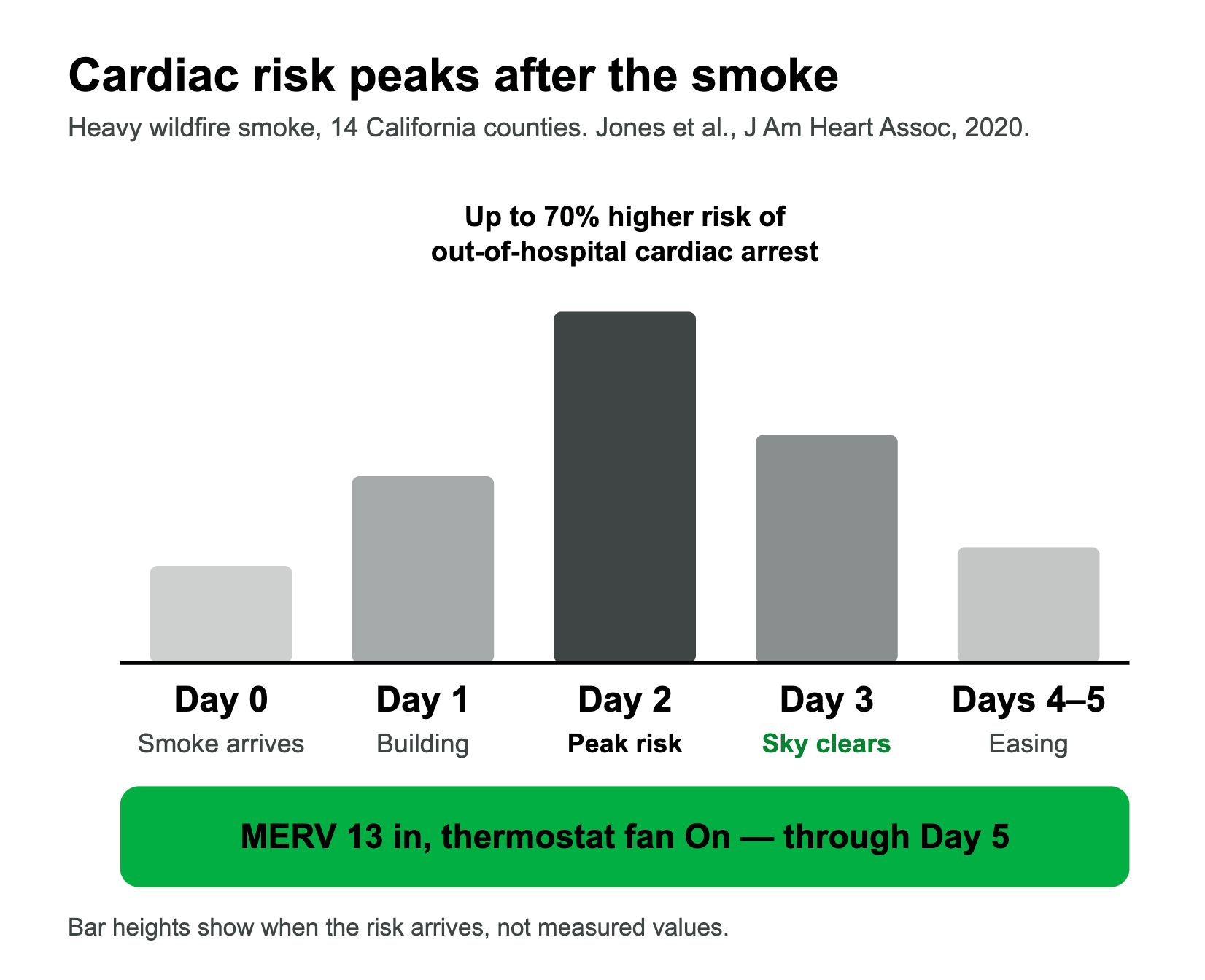
Wildfire smoke is a cardiovascular risk, not only a respiratory one. PM2.5, the fine particles in smoke, pass from the lungs into the bloodstream, where research links them to inflammation, stiffer blood vessels, and blood that clots more readily. Across 14 California counties, out-of-hospital cardiac arrest risk rose by as much as 70% on heavy smoke days, and it peaked two days after the exposure rather than during it.
That timing is the part most smoke advice leaves out. For indoor air, the EPA recommends a MERV 13 filter with the thermostat fan set to On instead of Auto, and keeping it running for 48 to 72 hours after the air reads normal.
What each setup does to indoor PM2.5:
Standard filter, fan on Auto — baseline only.
Standard filter, fan running continuously — reduces indoor PM2.5 by about 24%.
MERV 13, fan running continuously — about 50%. The EPA-recommended whole-home baseline.
MERV 13 plus a bedroom portable air cleaner — brings the indoor/outdoor PM2.5 ratio to about 0.22.
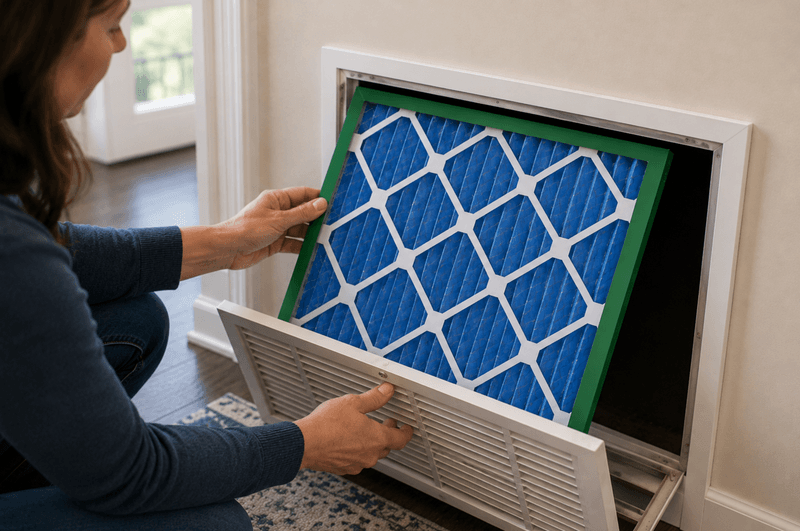
MERV 13 air filters capture microscopic particles and are the highest rating most residential systems can run without straining the blower. Filterbuy builds them in over 600 sizes, because a filter that leaks around the frame is not filtering.
Not sure which filter fits your system? Answer a few quick questions and we will match you to the right size and rating.
Prefer to skip the quiz? Shop MERV 13 air filters by size.
Wildfire smoke is a cardiovascular risk factor, not just a respiratory one. The fine particles in smoke, known as PM2.5, pass from your lungs into your bloodstream, where they trigger inflammation, stiffen blood vessels, and make blood more likely to clot. During heavy smoke days in California, out-of-hospital cardiac arrest risk rose by up to 70%, and the peak came two days after the exposure. Running a MERV 13 filter with your HVAC fan on continuously is the single most practical way to cut that exposure at home.
Filterbuy is a U.S. air filtration manufacturer that has built HVAC filters in its own American plants since 2013, and it maintains live air quality and wildfire smoke tracking pages for cities nationwide. Two things on this page come out of that vantage point. One is which piece of the research we lead with. The other is a gap we think most smoke advice leaves open for people with heart conditions.
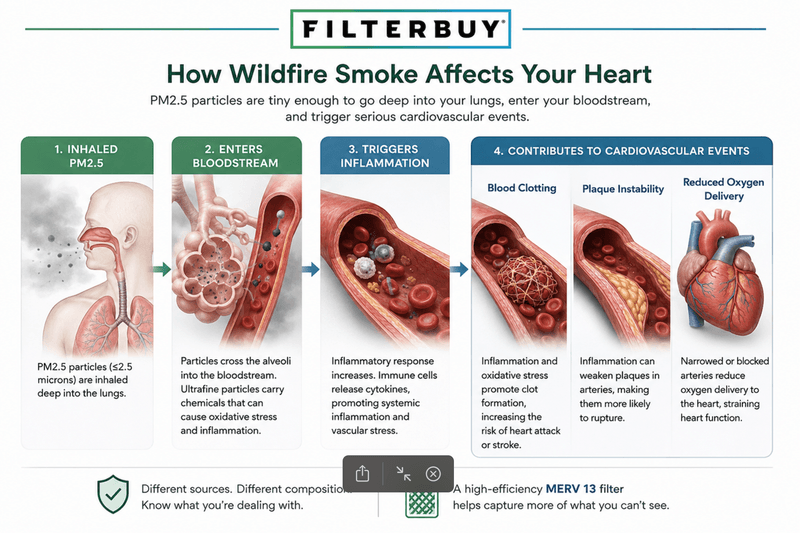
Wildfire smoke PM2.5 crosses into the bloodstream and triggers inflammation, clotting, and plaque instability. It is a cardiac risk, not just a lung risk.
Out-of-hospital cardiac arrest risk rose up to 70% during heavy California smoke, peaking two days after exposure.
Adults 65 and older, people with existing heart disease, and lower-income households face the highest risk.
A MERV 13 filter with the HVAC fan running continuously cuts indoor PM2.5 roughly in half, about double what a standard filter achieves.
Keep filtration running for 48 to 72 hours after the smoke clears.
Where this page comes from: every cardiovascular claim here comes from published research by the American Heart Association, the EPA, and the CDC, and each figure links to its source. The filtration guidance comes from Filterbuy's own manufacturing and from what homeowners tell us through each fire season. We kept the two apart on purpose. Filterbuy makes air filters and is not a clinical authority, and you deserve to know which half of this page is which.
This article is for general education and is not medical advice. If you have heart disease or symptoms such as chest pain, shortness of breath, palpitations, or lightheadedness, contact your physician or call 911. Talk with your cardiologist about a personal smoke-season plan before fire season begins.
Wildfire smoke affects the heart because PM2.5 particles are small enough to cross from your lungs into your bloodstream. At 2.5 microns and below, roughly one-thirtieth the width of a human hair, these particles slip past the airway defenses that catch dust and pollen. The American Heart Association covers this pathway in its overview of air pollution and heart disease. Once circulating, the particles set off a chain reaction cardiologists have mapped in detail.
Researchers have documented five overlapping mechanisms linking particulate exposure to cardiac events: systemic inflammation, oxidative stress, endothelial dysfunction (the lining of your blood vessels stops relaxing normally), autonomic dysfunction (your heart rate variability and rhythm control degrade), and hypercoagulability, or blood that clots more readily. Working together, they can destabilize arterial plaque that is already there, encourage clots to form in the coronary arteries, and set off dangerous rhythm disturbances. The AHA review Protecting Cardiovascular Health From Wildfire Smoke traces each of these pathways in full.
That last part is what most people miss. Smoke does not need to give you heart disease to put you in an ambulance. It only needs to unsettle the disease you already have.
Measurably, and by more than most people expect. Three studies give the clearest picture:
Relative risk (RR) and odds ratio (OR) compare smoke-day rates against non-smoke baseline days. A value of 1.00 means no increase. Sources: Jones et al. 2020; Haikerwal et al. 2015; American Heart Association, Protecting Cardiovascular Health From Wildfire Smoke.
The American Heart Association put the California finding plainly when it announced the results: heavy wildfire smoke raised the risk of out-of-hospital cardiac arrest by as much as 70%. The peak landed on the second day after exposure, and lower-income communities were hit hardest. Nor was this only a problem for seniors. The effect showed up in adults as young as 35.
How many people does that reach? The 2026 Heart Disease and Stroke Statistics Update counts 125.9 million U.S. adults, or 47.3%, living with high blood pressure. Heart disease is still the leading cause of death in this country, and stroke has climbed to fourth, which the AHA walks through in its plain-language summary of the numbers.
Yes, and the same California study that tracked heart visits tracked brain ones. Wettstein and colleagues examined emergency department visits across eight California air basins through the 2015 fire season. On dense smoke days, cerebrovascular visits among adults 65 and older rose by 22% (relative risk 1.22, 95% CI 1.00 to 1.49). Broken out by diagnosis, the elevated conditions included ischemic stroke and transient ischemic attack, the warning stroke that often precedes a larger one.
One detail in that study is worth knowing, because it speaks to whether any of this is real. The researchers ran a control condition: acute appendicitis, a diagnosis smoke has no plausible reason to affect. Appendicitis visits showed no association with smoke at all, while heart and stroke visits did. That is the kind of check that separates a genuine signal from a statistical artifact.
The stroke findings also peaked a day earlier than the cardiac arrest findings, on lag day 1 rather than lag day 2. Both point the same direction: the danger window opens after the exposure, not during it.
The inflammatory response lags the exposure by roughly 24 to 48 hours. Of everything in the wildfire smoke literature, this is the finding you can act on most directly, and the one almost nobody has heard.
In the Jones et al. California cardiac arrest study, the association between heavy smoke and out-of-hospital cardiac arrest was strongest on lag day 2, two days after the exposure rather than during it. The Australian wildfire season data show the same delayed shape, with a 48-hour lag across several outcomes.
In practice, the day the sky turns blue is not the day the risk ends. If you have heart disease, keep the filtration running and the activity moderate for at least 48 to 72 hours after the air reads normal on the live AQI and wildfire smoke map.
This is the part of the smoke conversation Filterbuy gets wrong along with everyone else. Nearly every advisory out there, including the fire season pages we published in earlier years, is written for the days the sky is orange. Hardly any of it covers the week after, which is exactly where the cardiac data concentrates. Reading that research changed how we write about fire season.
People come looking for a filter the day the sky turns orange. Almost nobody comes back the week after, once the air looks fine again. That is the exact window the cardiac research points to, and it is the one nobody is talking about. If you have a heart condition, the smart move is to leave the system running after you stop thinking about it.
Michelle Wan, Brand Manager and Air Quality Writer, Filterbuy
Filterbuy could not find this published anywhere, so we built it. The table lays the California lag structure over the EPA exposure-reduction steps, so what you do lines up with when the risk actually arrives. Watch Day 3. That is the row where everything looks fine and the data says otherwise.
Timing is based on the lag structure observed in Jones et al. 2020, where out-of-hospital cardiac arrest risk peaked on the second day after heavy smoke exposure, combined with U.S. EPA exposure-reduction guidance. This is general guidance, not a treatment plan. Anyone with diagnosed heart disease should agree a personal plan with their own physician before fire season.
Know the warning signs of a heart attack before a smoke event, not during one. About 1 in 5 heart attacks are silent, meaning the damage happens without the person recognizing it.
Three figures from federal and national health sources put the rest of this page in proportion. Each answers a different question. How much of the particle problem is smoke? How many Americans breathe it? And how large is the cardiac population it lands on?
Figures reflect the most recent published data from each agency as of August 2026. EPA emissions share covers primary PM2.5 nationwide. American Lung Association grades are based on 2022–2024 monitoring data. CDC heart attack figures are drawn from National Vital Statistics System and American Heart Association source tables.
Cited sources for the figures above
U.S. Environmental Protection Agency. Wildland Fire, Air Quality and Public Health Considerations (PM NAAQS reconsideration fact sheet, 2023). The EPA states that wildland fires account for over 30 percent of the nation's primary PM2.5 emissions.
American Lung Association. State of the Air 2026 Key Findings and Short-Term Particle Pollution Trends. 61.5 million people live in counties graded F for particle pollution spikes; 152.3 million, or 44 percent of Americans, live where the air failed at least one measure.
Centers for Disease Control and Prevention. Heart Disease Facts. About 805,000 heart attacks occur annually in the U.S., including 200,000 recurrent events, and one person dies of cardiovascular disease every 34 seconds.
Together they say something no single study does. Smoke is a leading national source of the exact particle that damages arteries. Tens of millions of Americans sit in its path. And the country already carries a cardiac population big enough that even a modest bump in relative risk turns into a real number of people. Which is why we would file filtration alongside taking your blood pressure medication rather than alongside an air freshener. Of everything on this page, it is the variable you fully control. You can check what your own air is doing right now.
The research keeps pointing at the same groups. Your risk is highest if you:
Have diagnosed coronary artery disease, heart failure, or a prior heart attack or stroke
Are 65 or older, the age group with the strongest associations across nearly every study. The EPA maintains a fuller list of who is at increased risk from wildfire smoke
Have high blood pressure or diabetes, both of which compound particulate risk
Are pregnant, or are caring for young children
Live in a lower-income household or an older, leakier home. The California data found lower socioeconomic status significantly increased risk, largely because sheltering and filtration are less available
Across the wildfire and smoke map pages Filterbuy maintains for cities nationwide, one misunderstanding comes up more than any other: people assume a fire icon has to sit near their town for the smoke to matter. It does not. Fine particles routinely cross state lines, and wildfire smoke can travel hundreds or thousands of miles downwind of the burn. Your exposure comes down to the concentration where you are standing, not the mileage to the flames. So if you belong to any of the groups above, treat a smoke advisory the way you would treat a heat advisory. It calls for a plan, not just awareness.
Long-term particulate exposure is associated with accelerated atherosclerosis, the gradual buildup of plaque that narrows and stiffens arteries. Large epidemiologic studies have found that PM2.5 exposure, even at levels below current national guidelines, tracks with higher rates of cardiovascular hospitalization. Atherosclerosis is the disease underneath most heart attacks and ischemic strokes, which is why a slow acceleration of it matters as much as any single smoke event.
EPA researchers, summarizing findings in the agency's Healthy Heart research program, observed that long-term PM2.5 exposure increased small, dense cholesterol particles in the bloodstream of cardiac catheterization patients. For the broader mechanistic picture, see Impact of Wildfires on Cardiovascular Health in Circulation Research.
One smoky week will not damage your arteries. The worry is that fire seasons now stack year on year, which makes the exposure that counts cumulative rather than episodic. Handle your indoor air as something you manage year-round, not something you react to when the sky changes color.
The EPA recommends a MERV 13 or higher filter with the HVAC fan set to run continuously. That sits at the top of the list below, which follows the agency guidance for reducing smoke exposure indoors and runs in order of impact:
Close windows and doors, and set any fresh-air intake or window AC unit to recirculate.
Install a MERV 13 filter and switch your thermostat fan from Auto to On. This is the difference-maker. Upgrading to a high-efficiency filter and running the fan continuously may reduce indoor PM2.5 by about 50%. A typical low-efficiency filter running continuously only reduces particles by about 24%.
Add a portable air cleaner in the bedroom, or set up a cleaner air room. In one residential field study, a central system with a MERV 13 filter brought the indoor/outdoor PM2.5 ratio to 0.55; adding a portable air cleaner dropped it to 0.22. If a commercial unit is out of reach, the EPA has tested DIY box fan air cleaners.
Check the filter daily. During heavy smoke, filters load up fast. If it looks dark brown or gray, or smells like smoke, replace it. A clogged filter restricts airflow and stops protecting you.
Skip the workout. Avoid vigorous indoor or outdoor exertion during and for 48 hours after heavy smoke.
Keep taking your medications as prescribed, and call your cardiologist if you notice new or worsening symptoms.
Without any filtration, indoor PM2.5 typically runs at 55% to 60% of outdoor levels during a smoke event even with the house closed up. Filtration is what closes that remaining gap.
On smoke calls, the problem is almost never the MERV rating. It is the MERV 13 that went in during the first fire of the season and never came out. Smoke loads a filter in weeks, not the ninety days people plan around. Once it is loaded it chokes airflow and stops protecting you at the same time, so you lose twice. Buy the spares before fire season, not during it..
David Clark, Licensed HVAC Technician, Technical Reviewer
I/O ratio = indoor PM2.5 divided by outdoor PM2.5; lower is better. CADR = clean air delivery rate, measured against a bare box fan. Sources: U.S. EPA, Strategies to Reduce Exposure Indoors; U.S. EPA, Research on DIY Air Cleaners; Fisk & Chan 2017.
MERV 13 hits the sweet spot for most homes. It is fine enough to catch smoke-sized particles and still loose enough that a residential blower can push air through it. True HEPA is a different matter. It creates far more static pressure than a home system is built for, which is why it belongs in a portable unit rather than your return vent. Our comparison of MERV 13 versus true HEPA for wildfire smoke works through that airflow trade-off in detail. One practical note from the manufacturing side: Filterbuy builds MERV 13 in over 600 sizes because the right rating in the wrong size lets air slip around the media entirely, and a filter that leaks is not filtering.
We sell filters, so you should know exactly where this evidence stops. The chain running from smoke to your heart to the filter in your wall has three links, and they are not equally strong.
Smoke exposure and cardiac events. Strong and consistent, but observational. Studies compare event rates on smoke days against non-smoke days. They establish association at population scale, not causation in any one person.
Filtration and indoor particle levels. Directly measured and well established. A MERV 13 with the fan running roughly halves indoor PM2.5. This part is not in dispute.
Filtration and actual cardiac outcomes. Here is the weak link, and it is where most filter marketing quietly overclaims.
The best evidence on that third link comes from a 2025 randomized crossover trial in the Journal of the American College of Cardiology. Researchers gave 154 adults living near highways either real HEPA filtration or a sham unit with the filter quietly removed. Among those with elevated systolic blood pressure, the real units produced a clinically meaningful drop of roughly 3 mmHg. Diastolic pressure did not move, and neither did readings for participants who started out normal. An earlier and much smaller trial from the same group found no blood pressure difference at all.
Two caveats matter here, and we would rather say them out loud than let you infer them. The trial tested traffic pollution, not wildfire smoke. And it measured blood pressure, not heart attacks. Nobody has run a trial showing that a filter running during a wildfire prevents a cardiac event. Such a study would be difficult and expensive, and it may never happen.
SO WHAT SHOULD YOU ACTUALLY CONCLUDE
That the case for filtration during smoke is strong but indirect, and that this is still reason enough to act. Weigh the two sides. Acting costs you a filter and a thermostat setting, and if the research turns out to be wrong you are out a slightly higher power bill. Doing nothing, if the research is right, costs something measured in cardiac events. Filterbuy thinks that trade is obvious. Just make it knowing you are placing a reasoned bet, not buying a proven cure. Anyone who tells you a filter is clinically proven to prevent heart attacks, this brand included, is selling past the evidence.
This matters more than it might look. The California research found that lower socioeconomic status raised cardiac risk during smoke events, largely because sheltering and filtration were harder to come by. So here is the version of this advice that costs nothing and requires buying nothing from Filterbuy.
Run whatever filter you already have, with the fan set to On rather than Auto. Even a low-efficiency filter running continuously cuts particles by about 24 percent. That setting is free.
Build a box fan cleaner. The EPA has tested these designs and found a single 4-inch MERV 13 on a box fan raised clean air delivery by 123 percent. One filter, one fan.
Pick one room and seal it rather than trying to treat the whole house. Fewest windows, no fireplace, door closed.
Use a cleaner air shelter. Libraries, malls, community centers, and senior centers have commercial filtration and cost nothing. Several hours of clean air is a real reduction in exposure, not a consolation prize.
If you do one thing on this list, switch the thermostat fan from Auto to On. Nothing else on this page returns as much for as little.
Raise these at a routine appointment. Waiting until a smoke event means calling when the office is at its busiest:
Given my specific condition, what symptoms during a smoke event should send me to the emergency room rather than to the phone?
Should anything about my medications change during or after a smoke event?
Is there an activity threshold you want me to stay under on smoke days and for the two to three days after?
If I monitor blood pressure at home, what reading should prompt me to call you?
Does my condition put me in a group that should leave the area during a prolonged smoke event rather than shelter in place?
Wildfire smoke does not cause heart disease on its own, but it can trigger acute cardiac events in people who already have it. Emergency department analyses found a relative risk of 1.42 for myocardial infarction on dense smoke days, with the strongest effect in adults 65 and older.
Cardiac risk peaked on lag day 2 in the California data, so the risk does not end when the sky clears. If you have diagnosed heart disease, keep filtration running and activity moderate for 48 to 72 hours after air quality returns to normal. See also: how long wildfire smoke stays in the air.
For whole-home protection, yes. It is the rating the EPA recommends and the highest most residential HVAC systems can safely run. Pair it with a portable air cleaner in the bedroom if someone in the household has heart or lung disease.
Particulate exposure is associated with hypertension and endothelial dysfunction, among other cardiovascular effects. If you monitor your blood pressure at home, keep logging it through a smoke event and share the readings with your doctor.
Filtration is the better indoor strategy. If you must go outside during heavy smoke, a properly fitted N95 filters fine particles; cloth and surgical masks do not. Our guide to choosing a mask for air pollution compares the ratings.
Not sure how to read the number on your air quality app? Start with what the AQI scale from 0 to 500 actually means, or open the national wildfire and smoke map to see current plume movement.
Jones CG, Rappold AG, Vargo J, et al. Out-of-Hospital Cardiac Arrests and Wildfire-Related Particulate Matter During 2015-2017 California Wildfires. J Am Heart Assoc. 2020;9:e014125.
Haikerwal A, Akram M, Del Monaco A, et al. Impact of Fine Particulate Matter (PM2.5) Exposure During Wildfires on Cardiovascular Health Outcomes. J Am Heart Assoc. 2015;4:e001653.
American Heart Association. 2026 Heart Disease and Stroke Statistics Update. Circulation, January 21, 2026.
American Heart Association. Protecting Cardiovascular Health From Wildfire Smoke. Circulation.
American Heart Association. Impact of Wildfires on Cardiovascular Health. Circulation Research.
American Heart Association. Air Pollution and Heart Disease, Stroke. Consumer health topics.
Wettstein ZS, Hoshiko S, Fahimi J, et al. Cardiovascular and Cerebrovascular Emergency Department Visits Associated With Wildfire Smoke Exposure in California in 2015. J Am Heart Assoc. 2018;7:e007492.
U.S. EPA. Strategies to Reduce Exposure Indoors. Wildfire Smoke and Your Patients' Health course.
U.S. EPA. Research on DIY Air Cleaners to Reduce Wildfire Smoke Indoors.
U.S. EPA. Healthy Heart Toolkit and Research: Results.
U.S. EPA. Who Is at Increased Risk of Health Effects From Wildfire Smoke Exposure.
Fisk WJ, Chan WR. Health benefits and costs of filtration interventions. Indoor Air, 2017. Cited within the EPA guidance above.
NCCEH. Indoor Air Filtration During Wildfires: Impacts on Air Quality and Health.
AirNow. Fire and Smoke Map. U.S. EPA and USFS.
U.S. EPA. Wildland Fire, Air Quality and Public Health Considerations. PM NAAQS reconsideration fact sheet, 2023.
American Lung Association. State of the Air 2026: Key Findings.
Centers for Disease Control and Prevention. Heart Disease Facts.
Brugge D, Eliasziw M, Thanikachalam M, et al. Effect of HEPA Filtration Air Purifiers on Blood Pressure: A Pragmatic Randomized Crossover Trial. J Am Coll Cardiol. 2025;86(8):577-589.
Brugge D, et al. A Randomized Cross-over Air Filtration Intervention Trial for Reducing Cardiovascular Health Risks in Residents of Public Housing near a Highway. Int J Environ Res Public Health, 2015.
Michelle holds a B.A. from the University of California, Santa Cruz, and works directly with Filterbuy's U.S. manufacturing teams across its factories in Alabama, Florida, Pennsylvania, and Utah, so her guidance is grounded in how filters are actually built and used in real homes rather than in spec sheets alone. She also fronts much of the brand's educational video and social content, and is based in the San Francisco Bay Area. Learn more on her author page.
David reviewed the MERV rating, static pressure, airflow, and filter-maintenance guidance in this article for real-world system compatibility.
