July 8, 2026
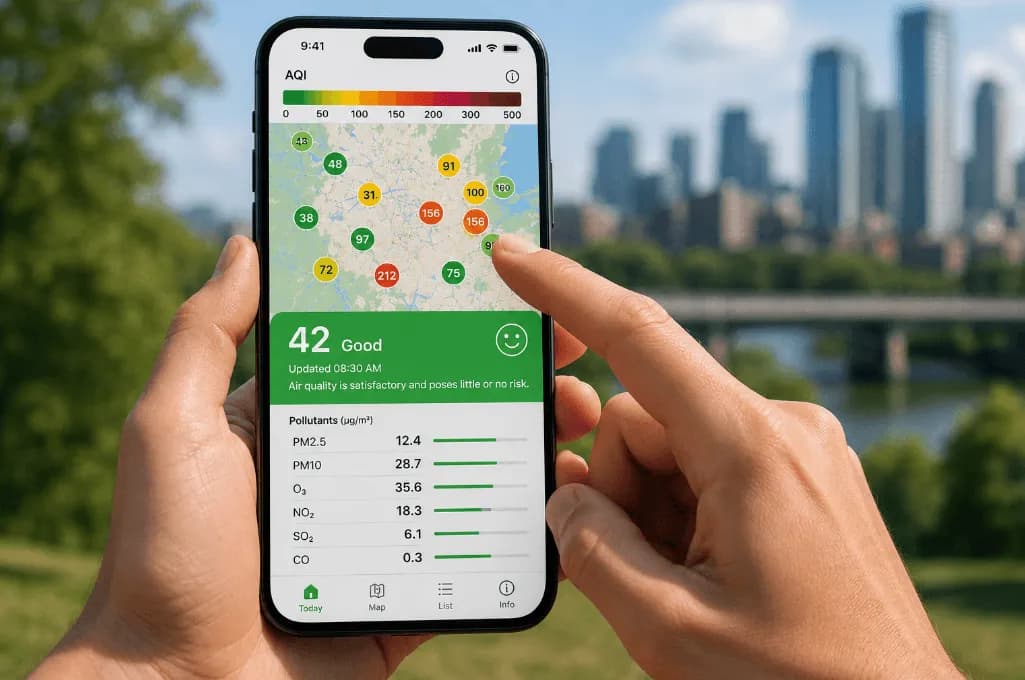
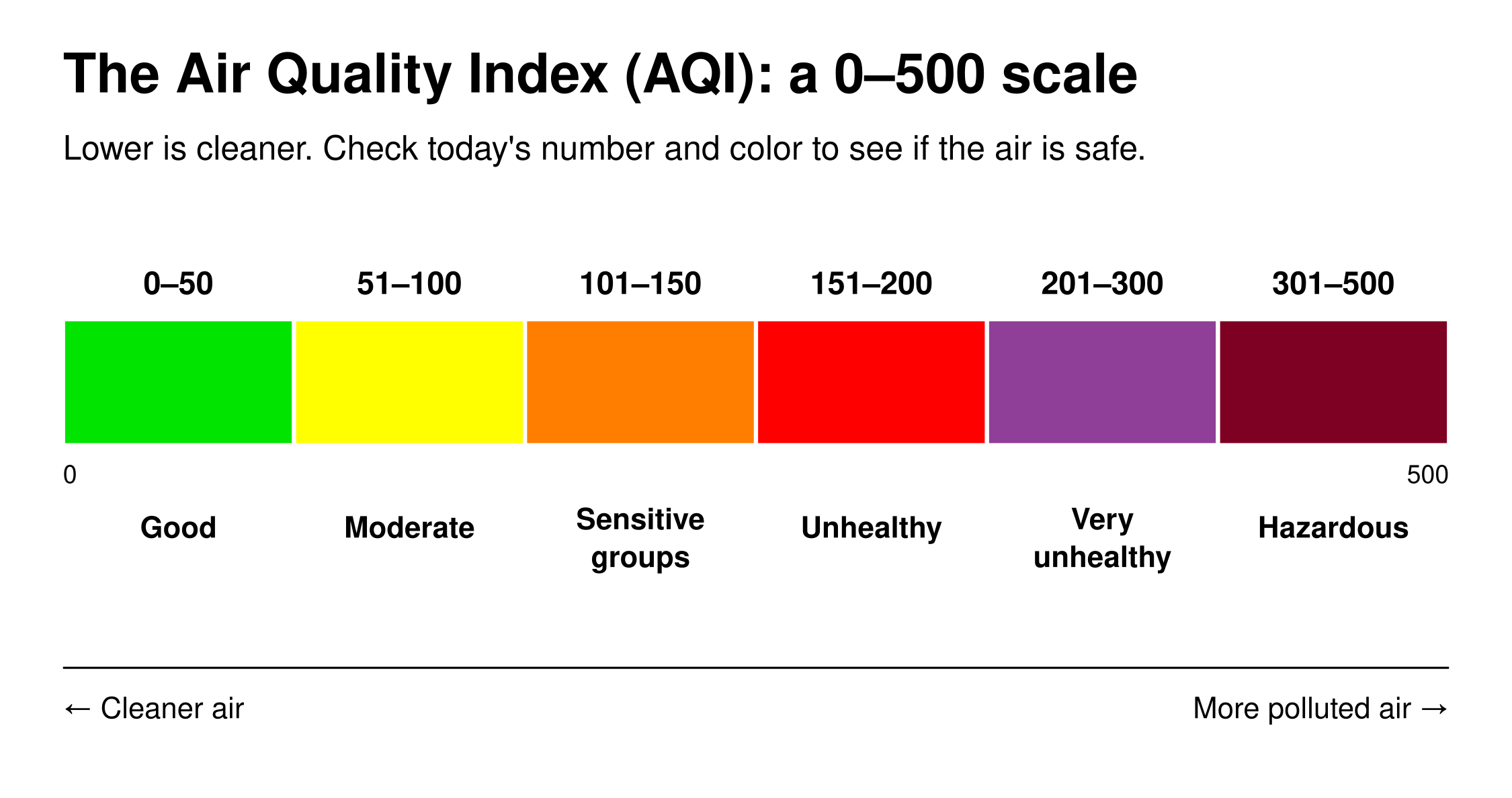
To find out if today's air is safe, check your local Air Quality Index (AQI) — a 0-to-500 scale where a lower number means cleaner air. Readings of 0–50 (green) are Good; as the number climbs through yellow, orange, and red, pollution rises and sensitive groups feel it first.
The color and number together give you an at-a-glance read on whether to open the windows or keep them closed and let your HVAC filter do the work. Not sure which filter fits your home? Take the quick match quiz below.
Answer 3 quick questions and we'll match you to the right air filter for your home.
Prefer to browse first? Shop air filters at Filterbuy →
Checking the AQI today? Start with the live number on the map. Look at the color, the main pollutant, and whether the reading is rising or falling. If the AQI is orange or worse, limit outdoor exposure and think about your indoor air, too.
Air quality changes fast. You might be checking your phone before a run, deciding whether to send the kids outside, or wondering if it's safe to open a window. You need a fast, accurate reading before making those calls.
Before reading further, check your current air quality using the Filterbuy Live AQI Map. Search by ZIP code, then come back to understand what the number means and what to do next.
Air quality shapes daily decisions: knowing your local AQI helps you plan outdoor activity, exercise, and ventilation safely
Conditions change quickly: weather, pollution, and wildfire smoke can shift readings within hours
Live tools give better data: the Filterbuy Live AQI Map gives fast, location-specific readings
AQI numbers require action: each color level comes with clear steps to protect your health
The EPA's Air Quality Index runs from 0 to 500. Higher numbers mean more pollution and greater health risk. The number and color are the fastest ways to judge current outdoor conditions.
Here is how the AQI color chart breaks down:
| AQI Range | Air Quality Level | Outdoor Activity Guidance |
|---|---|---|
| 0–50 (Green) | Good | Normal outdoor activity is safe. |
| 51–100 (Yellow) | Moderate | Usually fine; sensitive individuals should pay attention to symptoms. |
| 101–150 (Orange) | Unhealthy for Sensitive Groups | Kids, older adults, and those with asthma or lung conditions should reduce outdoor exertion. |
| 151–200 (Red) | Unhealthy | Everyone should limit long or intense outdoor activity. |
| 201–300 (Purple) | Very Unhealthy | Avoid outdoor exertion when possible. |
| 301+ (Maroon) | Hazardous | Stay indoors and keep outdoor air out of your home. |
You do not need to be a scientist to read real-time air quality data. Just follow these four steps.
Enter your ZIP code, city, or current location into a live air quality map. Air quality can vary widely from one neighborhood to the next. A local reading is always more useful than a regional average.
Look at the color assigned to your number. Green and yellow mean you can likely stick to your normal plans. Orange, red, purple, and maroon mean it is time to adjust those plans.
The AQI is usually driven by one specific pollutant. The EPA tracks five major ones: ozone, particle pollution (PM2.5 and PM10), carbon monoxide, sulfur dioxide, and nitrogen dioxide. Check which pollutant is causing the elevated reading today.
Do not just look at a single number — look at the direction it is moving. A rising AQI means pollution or smoke is moving in. A falling AQI means conditions may improve later in the day.
You may notice that the "Current AQI" on an app looks different from the "Daily AQI." The live reading often uses NowCast, which draws on recent hourly data and responds faster when conditions shift quickly — like when wildfire smoke moves in.
Think of the daily AQI like a box score from yesterday's game. Think of the live AQI like the game happening right now. NowCast helps you answer the real question: "Can I go outside right now?"
PM2.5 refers to fine particle pollution — particles small enough to reach deep into your lungs. It is usually the main driver of elevated AQI during wildfire smoke events and winter inversions.
The EPA updated its PM2.5 breakpoints in 2024. The "Good" category now tops out at 9.0 µg/m³ instead of 12.0 µg/m³, effective May 6, 2024. As a result, some days that previously showed as green may now appear yellow on your AQI map.
The CDC frames the AQI as a planning tool. A Code Orange day does not mean you cancel everything — it means you adjust the time, place, or intensity of your plans.
Enjoy normal outdoor activity. Open your windows and let fresh air in.
Most people can continue their usual routine. If you are sensitive to air pollution, watch for symptoms like coughing or shortness of breath.
Sensitive groups should shorten outdoor time. If you normally run for an hour, cut it to 30 minutes and take more breaks.
Move long or intense workouts indoors. Close your windows and run your HVAC system to filter indoor air.
Stay indoors as much as possible. Keep windows and doors tightly closed and use cleaner-air strategies to protect your household.
Your live AQI number tells you when outdoor air is a problem. Your HVAC filter determines how well your home responds.
When outdoor air is bad, close windows and doors and switch your HVAC to recirculation mode if available. This prevents the system from drawing in dirty air.
Check your HVAC filter. A dirty or poorly fitted filter cannot protect your equipment or your lungs. During heavy wildfire smoke, the EPA recommends a MERV 13 or higher filter to capture fine PM2.5 particles, but check your HVAC manual first to confirm your system can handle the increased resistance.
Filterbuy HVAC expert tip: "The AQI map tells you when outdoor air is changing. A clean, properly fitted HVAC filter helps your home respond when you need to keep windows closed and recirculate indoor air."
It is common for two apps to show different air quality readings. They may pull from different sensor networks, update at different intervals, or use different averaging methods.
AirNow's map typically updates in the second half of each hour. Government monitors are the most reliable source, though low-cost home sensors can add useful local detail. When two apps disagree, focus on the overall trend and color category rather than the exact number.
Air quality shifts by the hour. Build a habit of checking at these key moments:
Before your morning commute, school drop-off, or exercise
Midday and afternoon during the summer ozone season
Any time you see visible smoke or smell a campfire odor
Before opening your home's windows
After a sudden weather change or major wind shift
Air quality can vary block by block. Use Filterbuy's live AQI map to check the reading near your ZIP code, then choose the right filter to keep your home ready for whatever the air brings.
A good AQI is between 0 and 50, shown in green on official air quality maps. It means the air is satisfactory and most people can enjoy normal outdoor activities without concern.
An AQI above 100 is considered unsafe for sensitive groups (Code Orange). As it rises to Code Red (151+) and Code Purple (201+), it poses a risk to the general public.
Outdoor conditions shift constantly. Wind, sunlight, traffic, wildfire smoke, and weather patterns all affect pollution levels. NowCast updates the live AQI quickly as these factors change.
Yes. Close your windows whenever the AQI is orange or higher. During heavy smoke events, the EPA recommends closing windows and using your HVAC system's recirculation mode with effective filtration.
The EPA recommends considering a MERV 13 or higher filter during smoky periods to capture fine PM2.5 particles. Always verify that your specific HVAC system can handle the thicker filter material without restricting airflow.
