
What Is a Good AQI? Healthy Air Quality Ranges Explained
July 8, 2026

A good AQI is any number from 0 to 50. That's the "Good" range on the U.S. EPA / AirNow scale, where outdoor air is considered healthy for most people, including children, older adults, and people with asthma or heart conditions.
Above 50, air quality moves into Moderate and then higher-concern categories. Lower is always cleaner, and your local AQI can change quickly with smoke, ozone, traffic, and weather.
See where every range falls below, then match yourself to the right air filter for your home.
Answer 3 quick questions and we'll match you to the right filter for your home.
A good AQI is any number from 0 to 50. The air outside is considered healthy for most people, including children, older adults, and people with asthma or heart conditions. But once AQI rises above 50, it helps to know what each range means and when to check your local air quality before heading outside.
This article uses the U.S. EPA and AirNow AQI scale throughout. If you've seen a number on your weather app or phone and want to know what it means, you're in the right place.
Want to see your current AQI? Check your local AQI on Filterbuy's Live Air Quality Map by city or ZIP code.
Key Takeaways
The Air Quality Index (AQI) is a standardized scale used to measure and communicate air pollution levels.
An AQI value of 0 to 50 represents good air quality with little or no risk, while higher values indicate increasing levels of pollution and associated health risks.
Sensitive groups, including children, older adults, and individuals with preexisting health conditions, may experience effects at lower AQI thresholds.
Checking your local AQI before outdoor activities is crucial, especially on days with elevated pollution levels.
Tools like Filterbuy's Live Air Quality Map make it easy to stay informed about current air quality by city or ZIP code.
What Is a Good AQI Number?
A good AQI number is 0 to 50. On the standard AQI color scale, this is the green category. It means air pollution levels are low enough that most people can go outside, exercise, and carry on with their normal day without any health concerns.
A few things worth knowing about the Good range:
Lower is better. AQI 15 is cleaner than AQI 45, but both still fall in the Good category.
AQI changes throughout the day. Morning air near a highway is different from afternoon air on a summer ozone day. Today's AQI can change quickly due to smoke, ozone, traffic, and weather.
Location matters. Your AQI and your neighbor's ZIP code AQI may differ, especially near industrial areas or busy roads.
AQI Chart: What Each Air Quality Range Means
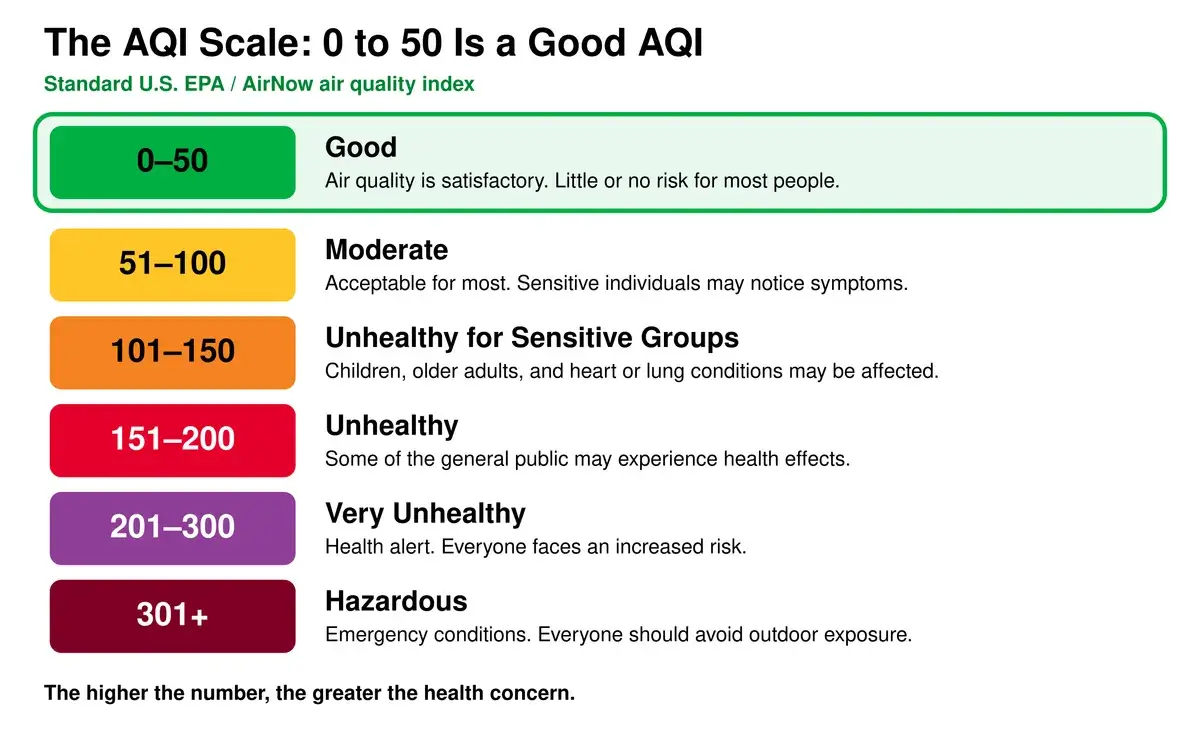
AirNow divides the U.S. AQI scale into six categories. Here's what each one means for your health:
| AQI Range | Color | Category | What It Means |
|---|---|---|---|
| 0–50 | Green | Good | Air quality is satisfactory. Little or no risk for most people. |
| 51–100 | Yellow | Moderate | Acceptable for most people. Unusually sensitive individuals may notice symptoms. |
| 101–150 | Orange | Unhealthy for Sensitive Groups | Children, older adults, and those with heart or lung conditions may be affected. |
| 151–200 | Red | Unhealthy | Some members of the general public may experience health effects. |
| 201–300 | Purple | Very Unhealthy | Health alert. Everyone faces an increased risk. |
| 301+ | Maroon | Hazardous | Emergency conditions. Everyone should avoid outdoor exposure. |
The higher the number, the greater the health concern. AQI values above 100 are unhealthy for sensitive groups first, then everyone as levels rise.
Is Moderate AQI Still Safe?
Generally, yes. AQI 51–100 is considered acceptable for most healthy adults. Most people can still go outside and exercise without issue.
That said, "moderate" is not the same as "clean." If you have asthma, COPD, heart disease, or a respiratory condition, pay closer attention at this level. Children, older adults, and pregnant people also tend to be more sensitive to air pollution than healthy adults.
If you or someone in your household falls into one of those groups, it's worth checking before any long outdoor workout or school activity.
What Makes AQI Go Up?
AQI measures a mix of pollutants. The two most common drivers of high AQI readings in the U.S. are fine particles and ground-level ozone.
Fine Particles (PM2.5)
PM2.5 refers to tiny particles — 2.5 micrometers or smaller in diameter. That's about 30 times smaller than a human hair. Because they're so small, they can travel deep into your lungs and even enter your bloodstream.
PM2.5 comes from:
Wildfire smoke
Vehicle exhaust
Power plants and industrial facilities
Wood burning
According to the U.S. EPA, particle pollution is linked to aggravated asthma, decreased lung function, irregular heartbeat, nonfatal heart attacks, and premature death in people with heart or lung disease.
Ground-Level Ozone
Ozone is a common summer pollutant. It forms when emissions from cars, factories, and other sources react in the heat and sunlight. Unlike the ozone layer high in the atmosphere, ground-level ozone is harmful to breathe.
Ozone can irritate your lungs, cause coughing and throat irritation, and make it harder to breathe — especially during outdoor exercise. Hot, sunny afternoons tend to have the highest ozone readings.
Wildfire Smoke
Wildfire smoke is one of the fastest ways AQI can jump from Good to Unhealthy. And here's the thing: smoke travels. A wildfire burning hundreds of miles away can push your local AQI into dangerous territory, even on a clear-sky day.
If smoke is your concern, use Filterbuy's live U.S. Wildfire Smoke Map to track active fires and smoke spread near you.
Why the "Good" AQI Range Changed for PM2.5
The EPA updated its PM2.5 standard in 2024. The annual health-based PM2.5 limit was tightened from 12.0 µg/m³ to 9.0 µg/m³.
What does that mean practically? The Good PM2.5 range is now 0.0–9.0 µg/m³. Moderate begins at 9.1 µg/m³. The old threshold was 12.1 µg/m³.
The EPA projected that the stronger standard could prevent up to 4,500 premature deaths, avoid 290,000 lost workdays, and deliver up to $46 billion in net health benefits by 2032 (according to the EPA PM2.5 NAAQS update).
You don't need to memorize the numbers. The key takeaway: the standards have gotten stricter because cleaner air has measurable health benefits.
How to Check Your Local AQI
AQI can vary from one neighborhood to the next. A reading near downtown during rush hour will likely look different from one in a quieter suburb — and both can shift quickly when smoke or ozone moves through.
The easiest way to know what the air is like right now is to check your local AQI using a live map. Enter your city or ZIP code, and you'll get a real-time color-coded reading based on PM2.5, ozone, and other pollutants.
Not sure whether today's air quality is safe for a walk, a workout, or a school activity? Check before you head out.
Filterbuy note: Outdoor AQI tells you what's happening outside, but those particles can still make their way indoors. During smoke or high-pollution days, the right HVAC filter can help reduce the particles circulating through your home.
What to Do When AQI Is Not Good
Knowing your AQI number is useful. Knowing what to do with it is even better.
AQI 51–100: Keep an Eye on It
Most people can continue normal outdoor activity at this level. If you're in a high-risk group, watch for symptoms such as coughing, wheezing, or shortness of breath. Dial back intensity if you notice anything.
AQI 101–150: Sensitive Groups Should Adjust Plans
At this range, children, older adults, and people with asthma or heart conditions should reduce long or intense outdoor activity. Moving workouts indoors is a smart call. Keep windows closed if the outdoor air quality is worsening.
AQI 151+: Protect Your Indoor Air
When AQI climbs into the red zone, everyone should limit prolonged or heavy outdoor activity. Inside the house, close windows and doors. Run your HVAC fan to keep air circulating through your filter.
According to EPA wildfire smoke guidance, high-efficiency HVAC filters rated MERV 13 or higher — in systems designed to accommodate them — can help reduce indoor particle concentrations on high-AQI days.
Here's a quick guide to Filterbuy MERV ratings:
MERV 8: Good everyday protection for dust and pollen when AQI is typically in the Good range.
MERV 11: A stronger everyday option for homes with pets, heavy pollen, or moderate outdoor pollution.
MERV 13: The right choice for smoke events, high particle pollution days, and households with respiratory concerns — provided your HVAC system supports it.
Always choose the highest MERV rating your HVAC system can safely handle. Need help deciding? Choose the right MERV rating with Filterbuy's comparison guide.
If your AQI is rising due to smoke or particle pollution, your indoor air filter matters. Find the right air filter size and upgrade before the next high-AQI day.
Frequently Asked Questions
What is considered a good AQI?
A good AQI is 0–50. According to AirNow and the U.S. EPA, this means outdoor air quality is satisfactory, and air pollution poses little or no health risk for most people.
Is AQI 50 good?
Yes. AQI 50 is still in the Good range, though it sits at the upper end of that category. Air quality at AQI 50 is still considered satisfactory for most people.
Is AQI 100 safe?
AQI 100 is the top of the Moderate range. It is generally acceptable for healthy adults, but people who are unusually sensitive to air pollution — including those with asthma or COPD — may want to limit prolonged or intense outdoor activity.
At what AQI should I stay inside?
Sensitive groups (children, older adults, and people with heart or lung conditions) should start adjusting outdoor activity when AQI is at or above 101. Everyone should reduce prolonged or heavy outdoor exertion when the AQI reaches 151 or higher.
Why is my AQI high when the sky looks clear?
Fine particles (PM2.5) and ground-level ozone are not always visible. AQI can rise due to particle pollution, ozone, smoke from distant wildfires, traffic emissions, or weather patterns that trap pollution near the ground.
How do I check AQI near me?
Use a live AQI map and search by city or ZIP code. Check your local AQI on Filterbuy's live air quality map to see current conditions before heading outside.
What filter should I use when the AQI is bad?
Use the highest MERV-rated filter your HVAC system can safely accommodate. MERV 13 filters offer stronger protection against fine particles on high-AQI and smoke days. If you're unsure what your system supports, choose the right MERV rating using Filterbuy's guide before upgrading.