Adding a Mini Split AC System in Hawaii
Costs, Rebates & 2026 Guide
A mini split in Hawaii runs about $3,500 to $7,500 for a single zone, or $8,000 to $20,000+ for a multi-zone whole-home system in 2026. Hawaii Energy takes up to $550 off per qualifying unit as an instant credit on your contractor's invoice, available through June 30, 2026. The federal 25C tax credit ended December 31, 2025, so it no longer applies to installs in 2026.
- Single zone (1 room): $3,500 to $7,500 installed
- Multi-zone (3–5 rooms): $8,000 to $20,000+ installed
- Hawaii Energy rebate: up to $550 off per qualifying unit, applied instantly on the invoice
- Federal 25C credit: ended December 31, 2025 — not available in 2026
Your exact cost depends on how many rooms you cool and your home's setup. Take the quick match below to see what fits.

Answer a few quick questions and we'll point you to the right mini split system for your home.
Prefer to browse on your own?
Browse mini split systemsA four-zone ductless mini split for a three-bedroom Honolulu home runs about $13,000 installed in 2026. The Hawaii Energy rebate, applied at the contractor's invoice, can take up to $550 off the total per qualifying mini split unit. Federal Section 25C, the heat pump tax credit homeowners counted on through 2025, ended December 31. The 2026 financial picture looks different from anything written even six months ago, and most cost guides haven't caught up yet.
TL;DR: Quick Answers
Adding a Mini Split AC System in Hawaii
A 2026 mini split installation in Hawaii typically runs $3,500 to $7,500 for a single zone or $8,000 to $20,000 for a multi-zone whole-home system, with Hawaii Energy offering an instant rebate of up to $550 per qualifying unit through June 30, 2026. The federal 25C tax credit ended December 31, 2025, so the financial picture for 2026 is now driven by Hawaii Energy rebates and the state's high electricity rates rather than federal incentives.
Here's what most Hawaii homeowners need to know:
Cost (single-zone): $3,500 to $7,500 installed, depending on BTU and labor.
Cost (multi-zone, 3 to 5 heads): $8,000 to $20,000+ for a whole-home setup.
Hawaii Energy rebate: Up to $550 per qualifying unit, applied as an instant credit on the contractor's invoice. Available through June 30, 2026, while funding lasts.
Federal 25C tax credit: Expired December 31, 2025. Not available for installations placed in service in 2026.
Best fit for Hawaii: A variable-speed inverter heat pump rated SEER2 18 or higher, with a salt-resistant outdoor coating if you live within roughly half a mile of the coast.
Permit required: Yes, in every Hawaii county, for any 240V install. The contractor pulls it.
Contractor requirement: Hire a Hawaii Energy Clean Energy Ally to qualify for the rebate.
Filter to plan for: A washable mesh pre-filter rinsed every two weeks, plus a MERV 11 or MERV 13 filter on any central HVAC equipment the home still runs.
The single most common 2026 mistake is being upsold under urgency. The right contractor will run a Manual J load calculation, recommend the right number of zones for the rooms you actually use, and sometimes quote less work than you came in expecting to buy.
Top Takeaways
A 2026 Hawaii mini split install runs $3,500 to $7,500 single-zone or $8,000 to $20,000+ multi-zone.
The Hawaii Energy rebate is the primary 2026 incentive, worth up to $550 per qualifying unit.
Hire a Hawaii Energy Clean Energy Ally — there is no workaround for the rebate.
The most expensive 2026 mistake isn't waiting too long. It's being upsold under urgency.
Mini splits handle temperature and humidity, not air quality.
Why a Mini Split Makes Sense for Hawaii Homes
Most homes in Hawaii were built without ductwork. That's the biggest reason mini splits dominate the islands' AC retrofit market. Adding ducts to an existing home runs $5,000 to $15,000 before any equipment shows up on a truck, and mini splits skip that step entirely.
The case for mini splits goes beyond the ductwork math. Trade-wind cooling has gotten less reliable, summers feel longer than they used to, and Hawaiian Electric's residential cooling load keeps climbing. If you've been running fans twelve hours a day to sleep through the night, that's the data showing up in your house.
Why mini splits work especially well in Hawaii:
They install fast. A single-zone install usually wraps up in a day. A four-zone retrofit takes two or three days. Compare that to four-plus weeks for a ducted retrofit, especially in older homes where wall and ceiling cavities aren't friendly to new ductwork.
They zone naturally. Cool the bedrooms at night and the living area during the day, so you stop paying to condition rooms nobody is using. That matters when residential power can run forty cents per kilowatt-hour or more on Oahu.
They handle humidity. A properly sized inverter mini split dehumidifies as it cools, which cuts mold growth and keeps dust mite populations down. The windward side of every island sits in 70 to 80 percent humidity most of the year, and that has health consequences before it has comfort consequences.
They are heat pumps now. Most modern units do both heating and cooling. You probably won't need heat often in Hawaii, but homes mauka of 2,000 feet do, and a mini split heat pump covers both ends without a second piece of equipment.
If you are starting with a single bedroom, our guide on how to choose the right BTU rating for a bedroom walks through the sizing logic in detail.
How Mini Splits Work, and Why a Tropical Climate Changes the Math
A ductless mini split is two pieces of equipment connected by a thin refrigerant line set: one outdoor condenser, plus one or more indoor air handlers mounted on the wall, ceiling, or floor of each room you want to cool. There's no ductwork involved, no closet-mounted air handler, and no register grilles. The refrigerant cycle moves heat the same way your refrigerator does, pulling it out of the room and pushing it outside.
The compressor is what matters most for Hawaii performance. Modern mini splits use inverter compressors that ramp speed up and down based on the actual cooling load, instead of slamming on and off the way older AC units do. That difference shows up on the power bill. An inverter mini split holds the target temperature more steadily and pulls more humidity out of the air at part load. The U.S. Department of Energy reports that ductless systems also avoid the duct losses that account for more than 30 percent of energy use in central forced-air systems, and modern ductless equipment can reach SEER2 ratings up to 35 (compared with 15.2 to 25 for typical ducted heat pumps).
A few things about Hawaii change the equipment calculus.
SEER2 ratings
SEER2 is the efficiency rating that replaced SEER in 2023. Think of it as miles-per-gallon for an air conditioner. The federal regional minimum for split systems in Hawaii is SEER2 14.3, and most decent equipment beats that easily. Aim for SEER2 18 or higher if you want the upgrade to show up on your HECO bill. The premium between SEER2 16 and SEER2 22 typically pays itself back in three to five years at Hawaii's electricity rates.
Refrigerant transition
Manufacturers are phasing R-410A out of new equipment through 2025 and 2026. Most new mini splits ship with lower-GWP refrigerants such as R-32 or R-454B, which are rated A2L (mildly flammable) and require updated installer training. Ask your contractor whether the technicians on the crew have current A2L handling certifications before signing the quote.
Salt air
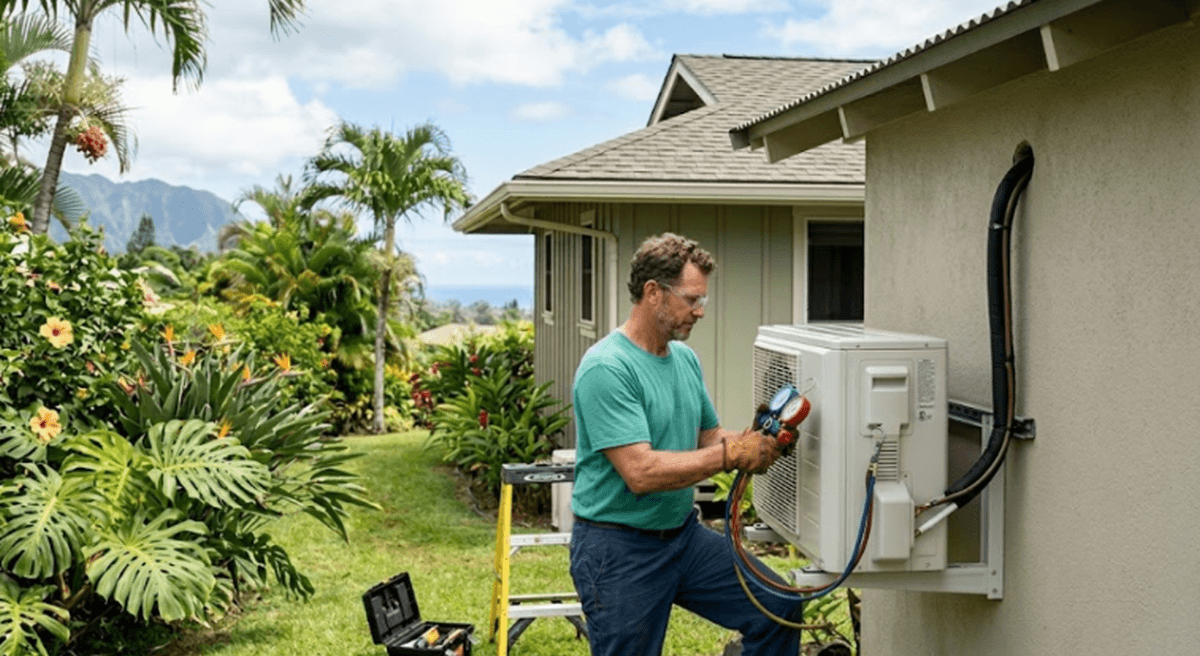
Mainland guides skip this one, and Hawaii homeowners pay for the omission. A standard outdoor condenser installed within half a mile of the ocean shows visible degradation inside 18 months. The fins corrode, the compressor wears, and the unit fails years ahead of schedule. Specifying a "Blue Fin" or equivalent anti-corrosion coating costs $100 to $300 per outdoor unit and roughly doubles practical service life in salt-spray conditions.
For a deeper look at the refrigerant cycle itself, the air conditioning entry on Wikipedia covers the thermodynamics in plain English.
How Much Does a Mini Split Cost in Hawaii in 2026?
In 2026, a single-zone mini split installed in Hawaii typically runs $3,500 to $7,500 all-in, including equipment, labor, permit, and disposal. Multi-zone systems with three to five indoor heads usually land between $8,000 and $20,000. Hawaii's labor rates plus barge-shipped equipment add roughly 10 to 20 percent on top of mainland averages.
Here are the configurations most homeowners compare:
| System | Hawaii installed range (2026) | Typical use case |
|---|---|---|
| Single-zone, 9k–12k BTU | $3,500 to $5,500 | One bedroom, home office, or small living room |
| Single-zone, 18k–24k BTU | $5,000 to $7,500 | Larger living rooms, open-plan spaces |
| Multi-zone, 2 heads | $7,000 to $11,000 | Bedroom plus living |
| Multi-zone, 3–4 heads | $10,000 to $15,000 | Most three-bedroom Hawaii homes |
| Multi-zone, 5+ heads | $15,000 to $22,000+ | Whole-home retrofits |
A few line items show up on Hawaii quotes that don't show up on national cost calculators:
Permits. Any install drawing a dedicated 240V circuit needs an electrical permit in every Hawaii county. The contractor pulls the permit. Honolulu County permits run $150 to $400, with two to four weeks of processing.
Outdoor unit mounting. Concrete pad, wall bracket, or roof bracket. In some hurricane-prone neighborhoods, county code may require a wall or roof bracket rather than a pad. Ask the installer to confirm what your jurisdiction requires.
Salt-resistant coating. Adds $100 to $300 per outdoor condenser, and is worth the spend within half a mile of the coast.
Electrical panel upgrade. Older Hawaii homes still on 100A service often need a panel upgrade to handle a multi-zone system. Budget $1,500 to $3,500 if so.
Long line sets. Standard quotes assume a 25-foot refrigerant line. Older two-story homes or split lots may need 50 feet or more, which adds $200 to $500.
Get three quotes and read them line by line, not just at the bottom. The cheapest bid often skips the salt coating, the surge protector, or the condensate pump that an older Hawaii home actually needs to run reliably. That's how a $9,000 install turns into a $12,000 repair in year three.
Hawaii Energy Rebates: What You Can Get in 2026
For homeowners on Oahu, Maui, the Big Island, Lanai, or Molokai, Hawaii Energy is the main rebate path on a new mini split. Hawaii Energy is the state's ratepayer-funded efficiency program. It is not the utility itself. Hawaiian Electric (HECO, plus its MECO and HELCO subsidiaries) delivers the electricity. Hawaii Energy administers the rebates, which appear as a credit on your contractor's invoice.
Mini split AC rebate
Hawaii Energy applies an instant rebate (deducted directly from your invoice rather than mailed later) on qualifying ductless mini split installations. Recent program tiers have offered up to $550 per qualifying unit. The current 2025-2026 program runs through June 30, 2026, on a first-come, first-served basis while funding holds out.
How to claim it:
Hire a Hawaii Energy Clean Energy Ally. Clean Energy Allies are contractors in the program's participating network, and the current directory lives on hawaiienergy.com.
Confirm the equipment meets the program's BTU and SEER thresholds before you sign the quote.
Your Clean Energy Ally files the rebate paperwork and applies the credit straight to your invoice.
A qualifying mini split unit must include its own outdoor condenser. Homes installing two separate single-zone systems may qualify for two rebates. A multi-zone system that shares one outdoor condenser counts as a single qualifying unit, regardless of how many indoor heads it feeds.
Tune-up rebate
Hawaii Energy also pays an instant rebate on annual tune-ups performed by a Clean Energy Ally on existing systems. The program is worth using because Hawaii's salt-and-humidity environment is rougher on outdoor equipment than most mainland service intervals assume.
Window AC instant rebate
If a window unit fits the room better than a mini split, Hawaii Energy still helps. Participating retailers including Home Depot and Lowes apply an instant rebate of about $25 at checkout on qualifying ENERGY STAR window models.
If you live on Kauai
Kauai sits outside Hawaii Energy's service territory. The Kauai Island Utility Cooperative (KIUC) administers rebates for Kauai homeowners directly, with its own program menu covering washers, refrigerators, ceiling fans, solar water heaters, heat pump water heaters, and window AC units. The application portal is at kiuc.coop.
Verify the current rebate amounts and equipment thresholds on the Hawaii Energy site before you sign a quote. The numbers do shift between program years.
Choosing a Hawaii Mini Split Installer
Picking the right installer in Hawaii comes down to a small number of non-negotiables, plus a handful of softer questions worth asking up front.
Confirm Clean Energy Ally status
If your contractor doesn't appear in Hawaii Energy's Clean Energy Ally directory, the rebate doesn't apply, and there is no workaround. Verify the contractor's company name on hawaiienergy.com before you put anything in writing.
Make sure they pull the permit
A mini split installation drawing 240V requires an electrical permit in every Hawaii county. Some installers offer to skip the permit to save you the $150 to $400 cost, but unpermitted work creates problems at resale, voids most manufacturer warranties, and can give your homeowners insurance grounds to deny coverage if the system damages something later. The contractor pulls the permit. You don't.
Ask for a Manual J load calculation
A Manual J calculation matches the room's actual cooling load to the right BTU capacity, and skipping it is the most common Hawaii install mistake. An oversized mini split short-cycles, which cools the room fast but doesn't run long enough to dehumidify the air. The result is a chilly, clammy room that the homeowner blames on the equipment, when the equipment was correctly built and just incorrectly sized. A good installer spends twenty minutes measuring rooms and asking about insulation, ceiling height, and window orientation before producing a number.
Beyond those non-negotiables, ask about warranty terms before signing. Most major brands (Mitsubishi, Daikin, Fujitsu, LG) offer 10 to 12 years of compressor coverage but only one to five years of labor coverage, and the gap matters because compressor work in year six rarely runs cheap. If you live outside Honolulu metro, in Hana, North Kohala, or upcountry Maui, ask about trip charges before the bid arrives so you don't get a surprise after the work starts. Get three quotes regardless of how confident you feel about the first contractor. Honolulu, Kahului, Kona, and Hilo labor rates differ enough that a third bid will usually tell you which of the first two is the outlier.
Federal 25C Tax Credit: What Changed for 2026
Through December 31, 2025, the federal Energy Efficient Home Improvement Credit (Section 25C) covered 30 percent of the cost of a qualifying heat pump installation, including ductless mini splits, up to a $2,000 annual cap. The One Big Beautiful Bill Act (Public Law 119-21), signed into law July 4, 2025, ended the credit.
Per IRS guidance FS-2025-05, Section 25C does not apply to any property placed in service after December 31, 2025. For mini splits installed in 2026, the federal credit is gone.
A few follow-on details matter for 2026 planning:
2025 installations, 2026 filing. If you installed a qualifying mini split in 2025, with the system fully operational and "placed in service" by December 31, you can still claim the credit on your 2025 federal return when you file in spring 2026. The IRS uses the placed-in-service date, not the contract date or the deposit date.
Section 25D ended on the same date. The Residential Clean Energy Credit, which covered rooftop solar PV and geothermal at 30 percent with no annual cap, also expired for property placed in service after December 31, 2025. Anyone planning a paired solar-and-mini-split project lost both credits at once.
State and utility programs are now the only meaningful incentive. Hawaii Energy rebates remain active through at least June 30, 2026, and they stack with manufacturer financing or cash purchases.
Financing the Project: GEM$ On-Bill, Manufacturer Loans & Cash
Four practical financing paths exist for a 2026 mini split project. The first is the most-publicized, and also the most-misunderstood.
Hawaii Green Infrastructure Authority (GEM$ on-bill loans)
GEM$ lets eligible Hawaiian Electric customers finance approved clean-energy improvements through a charge that appears on their monthly utility bill. Terms run up to 25 years at a fixed 5.5 percent APR, and the obligation is tied to the meter rather than the homeowner, so the balance transfers with the property at sale. There is one important limit. GEM$ residential financing currently covers solar PV, solar water heaters, heat pump water heaters, and battery storage. Ductless mini-splits aren't on the residential eligible-improvements list as of this writing. If you are pairing a mini split with a heat pump water heater, which does qualify, GEM$ can cover the water heater portion of the project.
Manufacturer financing
Mitsubishi, Daikin, Fujitsu, and the major distributors all run promotional financing through Wells Fargo, Synchrony, and similar lenders. Typical promos run 0 percent interest for 12 to 24 months on the equipment, or 7.99 to 9.99 percent APR for 60-month or 120-month terms on the full project. Read the deferred-interest fine print carefully. If the balance isn't paid off by the end of the promo window, the lender charges back-interest on the entire original balance, not just the unpaid portion.
Home equity / HELOC
For larger multi-zone projects, a home equity line is often the cheapest path. Interest may be deductible if the project counts as a substantial home improvement under IRS rules. Talk to a tax professional before assuming the deduction applies.
Cash
Cash still wins on total cost. The Hawaii Energy rebate applies directly to the invoice, and there are no financing fees or promotional windows to track.
After the Install: Filters, Salt Air, and Hawaii-Specific Maintenance
The project doesn't end when the installer drives away. Maintenance is what decides whether your mini split lasts eight years or eighteen, and Hawaii's climate makes maintenance more demanding than the manufacturer manuals suggest.
Why a mini split alone doesn't cover air quality
Every mini split indoor head ships with a washable mesh pre-filter that catches lint, hair, and large dust. The mesh works fine for what it does, but it isn't a MERV-rated HVAC filter, and that distinction matters in Hawaii. Mesh pre-filters don't capture the smaller particles such as PM2.5, smoke, mold spores, and dust mite allergens that drive respiratory symptoms.
If your home still runs any central HVAC equipment, even something as basic as a whole-house ventilation system, that's where a MERV 11 or MERV 13 filter does the small-particle work. A mini split handles temperature and humidity, and a MERV-rated filter handles the small-particle air quality your lungs actually feel. Most Hawaii homes need both pieces of the system.
Mesh pre-filter cleaning cadence
Vacuum or rinse the mesh pre-filter every two weeks if you live in Hawaii. Mainland guides recommend monthly cleaning, but Hawaii's higher dust load, salt aerosol, and year-round operation eat through that schedule fast. In our experience, skipping the two-week cadence is one of the more common reasons mini splits start underperforming inside the first eighteen months.
Coil cleaning
Have a professional clean the indoor evaporator coil every 12 to 18 months along the coast, and sooner if you can hear surf from your driveway. The outdoor condenser fins need a gentle hose-down every quarter to flush salt buildup. Skip the pressure washer. It bends fins and shortens the life of the unit.
Drain line
Hawaii's humidity keeps mini split drain lines wet most of the year. Pour about a cup of diluted vinegar (one part vinegar to one part water) down the indoor unit's condensate drain every quarter. That habit prevents algae clogs, which is the kind of small problem that turns into a $300 emergency service call when ignored long enough.
Annual professional service
An annual professional tune-up is worth scheduling, and Hawaii Energy pays an instant rebate when a Clean Energy Ally performs the service. Schedule the appointment for fall or winter, when contractor calendars are open and the summer cooling rush is over.
Don't forget the rest of the home
Most Hawaii homes still run at least one ducted system somewhere, even if it's just a whole-house ventilation fan or an older central AC. The single most cost-effective air-quality upgrade for that equipment is keeping a clean MERV 11 or MERV 13 filter in it. The filter is the part of the system actually doing the air-quality work.
Filterbuy custom-builds filters in over 600 sizes, all made in the USA. We ship factory-direct and free, and our auto-delivery option puts a fresh filter at your door on the schedule you set, so the change happens before you remember it needed to.
"Nine out of ten 'broken' mini splits I'm called out to in Hawaii aren't broken — they're oversized. The unit cools the room in twelve minutes, shuts off, and never runs long enough to pull the humidity out. That's why the room feels cold and clammy at the same time, and it's why a Manual J calculation matters more here than almost anywhere else in the country."
-Filterbuy Team
Essential Resources for Hawaii Homeowners
Every claim on this page is sourced. The seven links below are the official references homeowners and contractors lean on most when planning a mini split project in Hawaii. Verify rebate amounts and program deadlines on the original site before signing any quote, as the figures do shift between program years.
Hawaii Energy — Residential HVAC Rebates
Official rebate page covering ductless mini splits, AC tune-ups, window AC instant rebates, and program eligibility. The current Hawaii Energy program runs through June 30, 2026.
hawaiienergy.com/for-homes/rebates/hvac/
Hawaii Energy Clean Energy Ally Directory
The vetted contractor directory for Oahu, Maui, Big Island, Lanai, and Molokai. The rebate only applies when work is performed by a Clean Energy Ally, so confirm the contractor's name appears here before signing.
hawaiienergy.com/clean-energy-allies/residential-hvac-participating-contractors
Kauai Island Utility Cooperative (KIUC) — Rebates
Kauai is served by KIUC, not Hawaii Energy. KIUC runs its own rebate menu covering washers, refrigerators, ceiling fans, solar water heaters, heat pump water heaters, and window AC units.
IRS — One Big Beautiful Bill FAQ (Sections 25C and 25D)
The official IRS guidance (FS-2025-05) on the OBBBA termination of the federal heat pump and solar tax credits, including the placed-in-service rules for 2025 installations claimed on 2025 returns.
irs.gov — OBBB Sections 25C/25D FAQ
U.S. Department of Energy — Ductless Minisplit Heat Pumps
The federal Energy Saver page covering how ductless systems work, why they avoid the 30-percent-plus duct losses common in central forced-air systems, and what to look for in SEER2 ratings.
energy.gov/energysaver/ductless-minisplit-heat-pumps
ENERGY STAR — Certified Mini Split Heat Pumps
The product finder for ENERGY STAR-certified mini split units, with searchable specs by SEER2, HSPF2, capacity, and brand. Use this to verify any unit a contractor proposes meets current efficiency standards.
energystar.gov/products/ductless_heating_cooling
Hawaii Green Infrastructure Authority — GEM$ On-Bill Program
The official GEM$ program page covering on-bill financing for solar PV, solar water heaters, heat pump water heaters, and battery storage. Useful for homeowners pairing a mini split project with a qualifying water heater upgrade.
Supporting Statistics:
Three more federal and public-health-organization statistics that support the Hawaii mini split page from angles the first set didn't cover.
1. 90% Share of their time the average American spends indoors, where pollutant concentrations are often 2 to 5 times higher than outdoors
• Time Americans spend indoors: approximately 90%
• Indoor pollutant concentrations: often 2 to 5 times higher than outdoor levels
• Higher-risk groups (children, older adults, anyone with respiratory or cardiovascular disease) spend even more time indoors
• Indoor pollutant levels have risen as building envelopes have tightened without ventilation upgrades
SOURCE: U.S. Environmental Protection Agency (EPA)
Indoor Air Quality, EPA Report on the Environment (current EPA data)
www.epa.gov/report-environment/indoor-air-quality
2. 100% Hawaii's binding state mandate to reach 100% renewable electricity generation by 2045 — the nation's first such commitment
• Statewide target: 100% renewable electricity by 2045 (Act 97, 2015)
• Accelerated targets per Executive Order 25-01 (Jan 2025): 100% renewable in Hawaii County, Kauai, and Maui by 2035
• Current renewable share: 33.3% of Hawaiian Electric generation (2023)
• Funding source for the transition: ratepayer bills
SOURCE: Hawaii State Energy Office
Clean Energy Vision: Hawai'i Clean Energy Initiative (current state policy)
energy.hawaii.gov/renewable-energy
3. 4 of 5 U.S. homes with dust mite allergens in at least one bed, per the American Lung Association — the single most common indoor allergen in American bedrooms
• U.S. homes with dust mite allergens in a bed: roughly 4 of 5
• ALA-recommended indoor humidity: below 50% to control dust mites
• ALA-named control method: air conditioning and dehumidifiers
• Health stakes: dust mites are one of the major indoor triggers for people with asthma
SOURCE: American Lung Association
Dust Mites: Sources, Health Effects, and Protection (American Lung Association)
www.lung.org/clean-air/indoor-air/indoor-air-pollutants/dust-mites
Final Thought and Opinion
After fifteen years installing and servicing HVAC systems in Hawaii, here's the part of the conversation we think most cost guides get wrong.
The 25C tax credit ending is not the disaster the industry made it out to be.
Through the back half of 2025, every contractor in the state was running "act now before the credit ends" promotions. The implication was that 2026 would be a bad year to install a mini split.
We don't see it that way. The homeowners we’re quoting in 2026 are quietly proving the point.
The math still works. Here's the actual stack on a typical four-zone Honolulu install:
1. Federal 25C credit (gone in 2026): was worth $2,000 at the cap, claimed twelve months later on a tax return.
2. Hawaii Energy rebate (still here): up to $550 per qualifying unit, applied as an instant credit on the invoice.
3. Three qualifying units on a four-zone install: $1,650 off the price the day the work is done.
Stack that against Hawaii's 42-cent-per-kWh electricity rate, and the upgrade pays back fast. Hawaii electricity rates have climbed faster than the credit was worth.
The mistake homeowners are making in 2026 isn't waiting too long. It's being upsold under urgency.
A four-zone install for a home that only uses three rooms is a $4,000 mistake no rebate can undo. Oversizing a single zone to "make sure it's enough" shows up as clammy bedrooms for the next decade.
The contractors we trust most in this state right-size the project. Even when that means quoting less work than the homeowner came in expecting to buy.
The mini split itself is a great piece of equipment. The variable-speed inverter, the dehumidification at part load, the zone-by-zone control all earn the price tag in this climate.
The install is the part that decides whether the equipment performs, and the install is only as good as the load calculation behind it. That sequence is what separates a system you forget about for fifteen years from a system you complain about for fifteen years.
Your Next Steps: From Research to Installed System
Reading the guide is the easy part. The next four weeks are the actual project. Here's the order most Hawaii homeowners follow when they get this right.
Size the project
• Walk your home. Count the rooms you actually use.
• Most Hawaii households cool two or three zones, not the whole house.
• A bedroom plus the living area is the typical starting point — $7,000 to $11,000 before the rebate.
• Not sure on BTU? Check our bedroom BTU sizing guide.
Pull three quotes
• Open the Hawaii Energy Clean Energy Ally directory.
• Pick three contractors who serve your island.
• Request itemized quotes. Equipment, labor, permit, salt-resistant coating, and electrical work should each be a separate line.
• Ask for a Manual J load calculation as part of the bid. A contractor who refuses tells you something.
Compare line by line
• Lay all three bids side by side.
• Compare line items, not bottom-line totals.
• The cheapest bid usually skips the salt coating, surge protector, or condensate pump.
• A quote $1,500 cheaper than the others usually has $2,000 of stuff missing.
Confirm the rebate paperwork
Before signing, get three things in writing from your Clean Energy Ally:
Equipment meets Hawaii Energy's BTU and SEER thresholds for the current rebate tier.
The contractor will file the rebate application on your behalf.
The rebate amount appears as an instant credit on your final invoice, not a check mailed weeks later.
Schedule the install and the permit
• Sign the contract and pay the deposit.
• Let the contractor pull the electrical permit. Honolulu County: two to four weeks.
• Install timing: one day for single-zone, two to three days for multi-zone.
• Block your calendar accordingly.
Set up maintenance from day one
Two recurring reminders go on the calendar before the installer drives away:
• Every two weeks: rinse or vacuum the mesh pre-filter.
• Every quarter: flush the condensate drain with diluted vinegar, hose down the outdoor condenser.
Cover the air-quality side
• Mini splits handle temperature and humidity. They don't capture fine particles.
Frequently Asked Questions
Ready to Add a Mini Split to Your Hawaii Home?
You've worked out the 2026 cost ranges, the Hawaii Energy rebate window, and the contractor questions to ask before signing a quote. Browse Filterbuy mini split systems and HVAC filters, shipped fast and free from our factory, for equipment built to handle Hawaii's salt air, humidity, and high HECO rates.