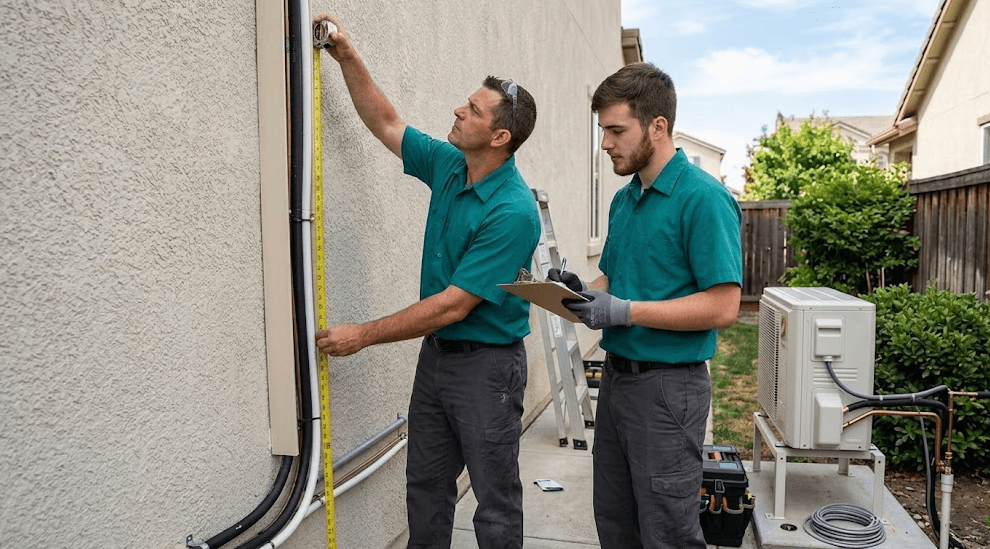
Mini Split Line Set Length: Maximum Distances & What Affects Performance
How Long Can a Mini Split Line Set Be?
There is no single maximum — three separate limits cap your line set at once: total run (up to about 230 feet on premium multi-zone systems, around 50 feet single-zone), per indoor unit (about 65 to 100 feet), and vertical rise (25 to 50 feet). Whichever you reach first is your ceiling, and bends count as added length.
Most mini splits that fail early fail from a line-set shortcut, not a faulty unit. A Filterbuy mini split system ships with the line set and full install kit matched to the air handler and condenser in one box, so the run is sized to the system instead of pieced together on site.

Tell us about your space and we'll match you to a Filterbuy mini split system sized for your room and run.
The line set is what makes a ductless system ductless. Two copper tubes and an insulation jacket carry refrigerant between the indoor air handler and the outdoor condenser, and that one piece of plumbing decides whether your mini split runs for fifteen years or struggles through its first cooling season.
Length is the variable that catches most homeowners off guard. Some pre-charged DIY kits cap at 25 feet. Premium multi-zone systems from Mitsubishi, Daikin, Fujitsu, and LG support over 200 feet of total piping across the indoor units they connect. The right number for your home depends on the brand, the model, the number of zones, and how much vertical distance the refrigerant has to climb.
Push past the manufacturer's maximum and you pay for it twice. The system runs less efficiently than its SEER2 rating promised, and the warranty stops covering what should have been a covered failure.
TL;DR: Quick Answers
Mini Split Line Set Length
Mini split line set length is brand-specific and capped by the manufacturer's installation manual, not by a universal standard. Single-zone budget systems usually max out at 50 feet of total run. Premium multi-zone setups from Filterbuy, Mitsubishi, Daikin, and Fujitsu allow about 230 feet of combined piping across all indoor units, and LG extends to 246 feet on certain configurations.
Two limits apply at the same time on every system. Total length across all indoor units is one ceiling. Per-indoor-unit length is a separate ceiling, typically 65 to 100 feet depending on air handler size. Vertical rise between the indoor and outdoor units is a third ceiling, usually capped at 25 to 50 feet, and bends count as added equivalent length on most brands. After manufacturing filters for over a decade and serving more than two million households, we've seen far more mini splits fail from line set shortcuts than from equipment defects. Pull the installation manual for your exact model, measure the actual run including bends and lift, and add a 10% buffer before you decide between pre-charged and standard line set.
Top Takeaways
Maximum line set length is brand-specific. Filterbuy, Mitsubishi, Daikin, and Fujitsu support around 230 feet of total piping in multi-zone setups. LG goes to 246. Pre-charged DIY kits cap at 25 to 75 feet.
Line set diameter is determined by the indoor unit, not the outdoor condenser, in multi-zone systems.
Most systems are factory-charged for 25 feet of run. Every foot beyond that needs roughly 0.2 to 0.3 ounces of additional refrigerant.
Vertical rise is capped separately from total length, usually 25 to 50 feet on residential systems.
Pre-charged kits ship in 16, 25, 35, and 50 foot lengths. Length can't be cut without voiding the factory charge.
Pushing past the manufacturer max voids the warranty and pulls efficiency down 5 to 15%, even when the refrigerant charge is correct.
Filtration condition matters as much as line set integrity for compressor longevity. Clean the air handler filter every 2 to 4 weeks during peak season.
How Long Can a Mini Split Line Set Be?
Single-zone budget systems usually cap at 50 feet of total line set. Premium multi-zone setups from Filterbuy, Mitsubishi, Daikin, Fujitsu, and LG go all the way to 230 or 246 feet of combined piping. Pre-charged DIY kits sit in the middle, between 25 and 75 feet.
What is the maximum line set length for a mini split?
Maximum total line set length depends on the brand. Filterbuy, Mitsubishi, Daikin, and Fujitsu each allow about 230 feet of total piping in multi-zone configurations. LG extends to 246 feet. Single-zone budget brands often cap at 50 feet. Push past the manufacturer maximum and the warranty stops covering you.
Does line set length affect mini split efficiency?
Yes. Every additional foot beyond the factory pre-charge length asks more of the compressor and chips away at real-world efficiency. Most manufacturers require additional refrigerant above 25 to 30 feet of total run. Real-world losses of 5 to 15% are common at the upper limit of manufacturer specs, even when the system is charged correctly.
What Is a Mini Split Line Set?
A mini split line set is the copper plumbing that connects the indoor air handler to the outdoor condenser. Refrigerant moves through it in both directions, which is how the system pulls heat out of your house in summer and pushes it back in during winter.
Three components make up the line set:
The liquid line, a smaller-diameter copper tube that carries high-pressure liquid refrigerant from the outdoor condenser to the indoor evaporator coil.
The suction line, a larger-diameter copper tube that returns low-pressure refrigerant gas from the indoor unit back to the outdoor compressor.
The insulation jacket, usually closed-cell foam, that wraps the suction line to prevent condensation, energy loss, and refrigerant temperature drift.
Most installs also run an electrical control wire and a condensate drain alongside the copper tubing through one three-inch wall penetration. The wire and drain aren't technically part of the line set, but they share the same conduit path. The whole assembly is what makes ductless air conditioning systems work without ductwork. Refrigerant moves the heat instead of conditioned air, so the only path between indoor and outdoor units is the line set itself.
Two separate variables decide line set sizing. Diameter is set by the indoor unit's BTU rating. Length is bounded by the manufacturer's installation manual for the specific model. Mix those up and the system either runs starved for refrigerant or chokes on what it has.
Maximum Line Set Length by Brand
Every manufacturer publishes its own line set limits in the installation manual for each system. The numbers shift between model generations, between single-zone and multi-zone configurations, and between air handler sizes. The table below summarizes typical maximums for current residential systems. Always check the installation manual for your specific model before purchase.
Mini Split Line Set Sizing Chart by BTU and Tonnage
Line set diameter is determined by the indoor unit, not the outdoor condenser, in multi-zone systems. That detail trips up DIY installs more than any other. A 36,000 BTU outdoor condenser running three 12,000 BTU indoor heads needs three sets of 12K-rated line set, not one 36K-rated set.
The chart below covers diameter pairings for the most common residential mini split capacities. The first dimension is the liquid line outside diameter. The second is the suction line outside diameter.
| BTU Capacity | Tonnage | Liquid Line OD | Suction Line OD |
|---|---|---|---|
| 9,000 BTU | 0.75 ton | 1/4 inch | 3/8 inch |
| 12,000 BTU | 1 ton | 1/4 inch | 1/2 inch |
| 18,000 BTU | 1.5 ton | 1/4 inch | 1/2 inch |
| 24,000 BTU | 2 ton | 3/8 inch | 5/8 inch |
| 30,000 BTU | 2.5 ton | 3/8 inch | 5/8 inch |
| 36,000 BTU | 3 ton | 3/8 inch | 5/8 or 3/4 inch |
Line set size for 12,000 BTU mini split
A 12,000 BTU (1 ton) mini split typically uses 1/4 inch liquid x 1/2 inch suction line set. Some inverter-driven 12K units run on 1/4 x 3/8. Confirm with the indoor unit installation manual.
Line set size for 18,000 BTU mini split
An 18,000 BTU mini split also uses 1/4 inch x 1/2 inch on most modern inverter systems. Older non-inverter 18K units sometimes spec 3/8 x 5/8. The model-specific manual is the only reliable source.
Line set size for 24,000 BTU mini split (2 ton)
A 24,000 BTU (2 ton) mini split needs 3/8 inch liquid x 5/8 inch suction. Running smaller line set than this is the most common DIY sizing mistake we see, and the performance hit shows up before the first cooling season ends.
Pre-Charged vs Standard Line Sets
Pre-charged line sets ship factory-charged with refrigerant for the rated length. They have flared ends, lineset couplings already in place, and require no vacuum pump or refrigerant handling at install. They're the standard for DIY ductless systems.
Standard line sets are bulk copper, flared on site, vacuumed, and charged by an EPA Section 608 certified technician. They're the standard for professional installation and allow custom-length runs that pre-charged kits can't match.
Pre-charged kits can't be cut shorter or extended past their rated length without voiding the charge accuracy. If your run is 12 feet, a 16-foot kit is the right pick, and the excess coils horizontally near the condenser. If your run is 18 feet, you size up to a 25-foot kit. Trying to thread the gap by cutting line set is what triggers most DIY warranty denials.
How Line Set Length Affects Mini Split Performance
Refrigerant charge math drives almost everything. Most systems are factory-charged for a standard run, usually 25 feet. Every foot beyond that needs additional refrigerant, typically 0.2 to 0.3 ounces per foot, depending on the brand. Below the standard length, refrigerant removal usually isn't required unless the manual specifies it.
Efficiency drops with length. Longer runs increase compressor work, refrigerant pressure drop, and heat gain through the line set insulation. Real-world losses of 5 to 15% are common at the upper limit of manufacturer specs, even when the system is charged correctly.
Vertical rise is capped separately from total length. When the indoor unit sits significantly above the outdoor condenser, oil return becomes the constraint. The compressor relies on refrigerant flow to circulate compressor oil, and excessive vertical lift starves the compressor over time. Most residential brands cap vertical rise between 25 and 50 feet.
Bend allowance matters on tight runs. Several manufacturers, Daikin most notably, require adding equivalent length per 90-degree bend in their long-line application charts. A run that measures 60 feet straight may count as 80 feet once you factor in bends.
Insulation matters more than people realize. A line set in direct sun without UV-rated covers loses insulation integrity year over year, which raises thermal loss and condensation risk. Cover the run.
Other Factors That Impact Mini Split Performance
Line set length is one variable. Several others matter just as much, and most get overlooked because the line set conversation dominates the install discussion.
BTU sizing accuracy matters first. An oversized system short-cycles, fails to dehumidify, and burns through its compressor faster. An undersized system runs constantly without ever reaching set point. A Manual J load calculation is the only correct way to size for your specific home.
Indoor air handler placement can quietly cost you 10 to 20% of capacity. Mounting above a heat source like a fireplace or oven causes the temperature sensor to misread the room. Direct sun exposure does the same. Aim the airflow across the longest dimension of the room and keep the unit out of corners where air doesn't circulate.
Outdoor unit clearance gets neglected almost as often. Most manufacturers require at least 12 inches of clearance on all sides of the outdoor condenser. When the coil recirculates its own exhaust air, capacity drops fast.
Refrigerant charge level matters in both directions. Undercharged systems lose efficiency before they fail to cool. Overcharged systems risk compressor damage. Both get corrected by an EPA Section 608 technician with a manifold gauge set.
Filtration condition matters as much as line set integrity. Mini split air handlers ship with thin washable mesh filters that catch debris, but they capture very few particles below 10 microns. Clean them every 2 to 4 weeks during peak season, and pair the system with proper whole-home filtration if indoor air quality is a priority. After manufacturing filters for over a decade and serving more than two million households, we've seen what happens when a mini split runs through a cooling season with a filter that hasn't been touched.
Building envelope quality is the silent multiplier on every other factor. Insulation, window quality, and air sealing decide how hard your mini split has to work to hold set point. This shows up most in older homes without ductwork, where single-pane windows, uninsulated wall cavities, and drafty building envelopes can push thermal load 30 to 50% above what square footage alone would suggest.
"After years of diagnosing mini split failures, we've found that line set length almost never kills a system on its own. What kills it is length combined with vertical rise the installer didn't factor in, or bends that pushed equivalent length past what the manufacturer's long-line chart actually allows."
-Filterbuy Team
Essential Resources
Seven authoritative sources for further reading on mini split installation, line set sizing, refrigerant handling, and the standards that govern all of it.
DOE guidance on ductless mini split heat pumps
Source: U.S. Department of Energy — Ductless, Mini-Split Heat Pumps
The DOE's foundational page on how mini splits work, where they make sense, and why they outperform ducted central systems on efficiency.
ENERGY STAR ductless heating and cooling certification
Source: ENERGY STAR — Ductless Heating & Cooling
ENERGY STAR's certification page covers what to look for in a qualifying system and how cold-climate certification works for low-temperature performance.
EPA refrigerant certification rules for mini split installation
Source: EPA — Section 608 Technician Certification Requirements
Federal law requires Section 608 certification for anyone adding or removing refrigerant from a mini split as part of installation. That includes connecting or disconnecting pre-charged line sets in some applications.
ACCA Manual J load calculation standard
Source: ACCA — Manual J Residential Load Calculation
The ANSI-recognized standard for sizing residential HVAC equipment. Required by most building codes and the only correct way to size a mini split for your specific home.
ASHRAE refrigeration safety standards
Source: ASHRAE — Refrigeration Resources (Standards 15 and 34)
ASHRAE Standards 15 and 34 govern refrigerant safety classification and refrigeration system installation. Standard 15.2 specifically addresses residential applications, including ductless systems.
AHRI air conditioning and heat pump efficiency reference
Source: AHRI — Air Conditioning and Heat Pump Efficiency 101
AHRI explains how 17 SEER2 and HSPF2 ratings get tested and certified, and why matched indoor-outdoor unit pairings matter for the efficiency claim on your invoice.
NIST refrigerant properties database
Source: NIST — REFPROP Reference Fluid Thermodynamic and Transport Properties Database
REFPROP is the U.S. government reference for refrigerant thermodynamic properties. It's the underlying data source for the long-line refrigerant charge math published in manufacturer installation manuals.
Supporting Statistics
Three current statistics that anchor the case for ductless mini split adoption and the efficiency math behind line set length decisions.
1. Duct losses can account for more than 30% of energy consumption for space conditioning, especially when ducts run through unconditioned spaces like attics. Ductless mini splits avoid this loss entirely.
Source: U.S. Department of Energy — Ductless Mini-Split Air Conditioners
2. ENERGY STAR certified mini splits use up to 60% less energy than standard home electric resistance heating, and avoid more than 4,500 pounds of greenhouse gas emissions per system over their lifespan.
Source: ENERGY STAR — Ductless Heating & Cooling
3. In 2025, U.S. manufacturers shipped 12% more heat pumps than gas furnaces, 3.6 million units versus 3.2 million. Heat pumps reached 47% of monthly residential cooling equipment market share, up from 33% a decade earlier.
Source: RMI — Tracking the Heat Pump and Water Heater Market in the United States
Final Thoughts
Line set length is brand-specific, model-specific, and shaped by vertical rise and bend count in ways that the headline maximum number doesn't capture. Pull the installation manual for your exact system, measure your actual run including bends and lift, and add a 10% buffer before you decide between pre-charged and standard line set. Most mini splits that fail prematurely fail because of an installation shortcut, not an equipment defect. The line set is where most of those shortcuts hide.
Next Steps
Pull the installation manual for your exact model. Manufacturer maximums shift between model generations.
Skip generic charts and forum posts.
Use only the number published for the system you're buying.
Measure your actual run. Walk the path before you order.
Count every bend.
Measure the full vertical rise between units.
Add a 10% buffer for routing changes.
Match diameter to the indoor unit's BTU, not the outdoor condenser. This is the most common DIY mistake.
12,000 to 18,000 BTU: 1/4 inch x 1/2 inch
24,000 to 36,000 BTU: 3/8 inch x 5/8 inch
Decide pre-charged or standard.
Under 75 feet, single indoor head: pre-charged DIY works.
Over 75 feet or multi-zone: licensed HVAC pro, vacuum pump, EPA Section 608 certification.
Pick the right system for your run. The Filterbuy 12,000 BTU 17 SEER2 ductless mini split.
115V and 230V variants
Rooms up to 300 square feet
Indoor air handler, outdoor condenser, line set, and full install kit in one box
Frequently Asked Questions
Pair Your Run With a Mini Split Built to Match
Now that you know how line set length, vertical rise, and bend count shape real-world performance, the next step is choosing a system engineered to hit its rated efficiency from day one. The Filterbuy 12,000 BTU 17 SEER2 ductless mini split ships in 115V and 230V variants with the indoor air handler, outdoor condenser, line set, and full install kit in a single box free 2-day shipping included.