
Chandler Real-Time AQI Tracker

Get Alerts For Unhealthy AQI In Your Area
When air quality in your area reaches unhealthy levels, we'll send you a quick alert, along with expert tips on how to reduce your exposure.
What's Actually In Chandler Air Today?
What High AQI Means for Your Lungs in Chandler
How to Read AQI
The Air Quality Index (AQI) measures how polluted the air is and how it may affect your health.
0–50 (Good): Air quality is satisfactory.
51–100 (Moderate): Acceptable, but some pollutants may pose minor concerns.
101–150 (Unhealthy for Sensitive Groups)
151–200 (Unhealthy)
201–300 (Very Unhealthy)
301+ (Hazardous)
Moderate
Still okay for most, but if you have asthma or allergies, take it easy and avoid long outdoor workouts.
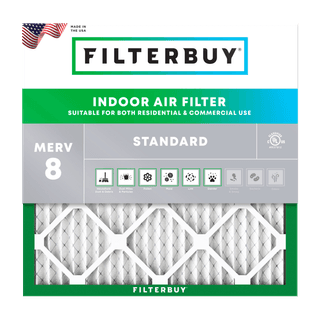
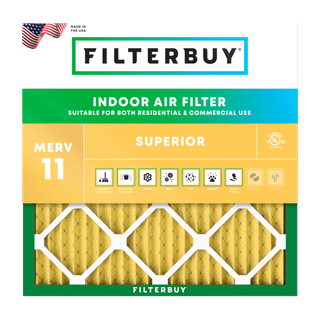
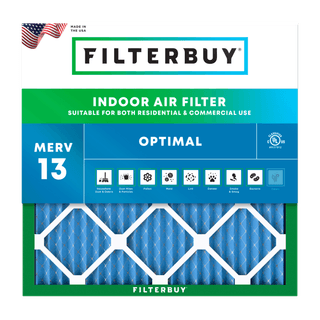
Shop MERV 11 filters→What's the Right Filter for Your AQI Level?


Check Today's Live Real Time Air Quality Index AQI Map in Chandler, AZ Now
TL;DR
The live AQI map on this Filterbuy page reads from EPA-referenced monitors and refreshes through the day. Under 50 is Good. Above 100, sensitive groups ease off outdoors and the four indoor steps below apply. Three pollutants drive Chandler's number: summer ozone, monsoon dust, and winter smoke under an inversion.
Reading Chandler's Live AQI Map
The color tells you what to do before the number does. Green and yellow mean carry on, while orange and above mean sensitive groups pull back. The map also names the dominant pollutant, usually ozone, PM10 dust, or PM2.5, the fine soot off anything burning. Which one it is decides what works indoors.
Key Takeaways
Chandler sits inside Maricopa County's serious PM10 nonattainment area and the Phoenix-Mesa moderate ozone area.
The county lists one monitoring station inside Chandler city limits, West Chandler at Ellis and Frye, so your street can differ from the map.
Air pollution here comes in three seasonal forms: ozone on hot afternoons, dust on monsoon evenings, fine particulate on still winter mornings.
Ozone breaks down indoors once the windows are shut. Dust and smoke do not, so those have to be filtered out.
What Each AQI Level Means for a Day in Chandler
Match the color the live map shows to a row. These are the EPA's six categories.
Per EPA AirNow guidance. Follow the category shown on the live map above.
At AQI 100 and above, Filterbuy recommends the same four steps every time.
1. Put MERV 13 in the HVAC if the system is on a lower tier. This is the whole-home layer, since the central system moves far more air than any portable unit.
2. Set the thermostat fan to On rather than Auto, so it filters continuously instead of only while heating or cooling.
3. Add a portable HEPA cleaner in each occupied room, bedrooms first. Choose a smoke CADR at least two-thirds of the room's square footage, so a 300 square foot bedroom wants about 200.
4. Close the house up and add no indoor smoke of your own: no candles, no frying, no vacuuming without a sealed unit.
Steps one and three are two layers, not a choice. The EPA recommends MERV 13 or higher in a central system during smoke events; acting at AQI 100 and running a cleaner in every room is Filterbuy's line, not the EPA's.
Dusty Outside, but Your App Says Moderate? Here's Why
Your app is probably reading PM2.5 while the storm outside is PM10. AQI is calculated separately for each pollutant and the highest wins, and Sonoran Desert dust is the coarse kind, whose sensors are far less common in consumer networks. The EPA says as much, noting that private apps may calculate AQI differently from the official index.
Two things widen the gap. Current AQI is a NowCast averaging recent hours, so it trails a fast-moving front by design. And Chandler has one county station, its nearest neighbors in Gilbert and Tempe.
ASU's Phoenix Dust Storm (PHX-DUST) Scale, published in the Bulletin of the American Meteorological Society, rates storms from Category 1 to 5 on peak PM10. An hour outside in a Category 1 means inhaling roughly 250,000 dust particles, rising past 1.3 million in a Category 5. Every category counts as a hazardous concentration.
In a dust event, trust your eyes before the index.
Is It Safe to Breathe Outside in Chandler Today?
Chandler's air is fine for most people under 50, and only gets bad enough to change plans above 100. That is where asthma, COPD and heart patients, children and over-65s count as sensitive groups under EPA guidance. Above 150, everyone eases off.
Where Chandler's Air Quality Forecast Comes From
Two agencies cover Chandler. ADEQ issues the daily Phoenix-area forecast, a Maricopa dust risk forecast and any High Pollution Advisories. The Maricopa County Air Quality Department runs the monitors and declares No Burn Days and dust alerts. Both send free alerts, and AirNow covers it nationally.
Why Air Quality Differs Across Chandler ZIP Codes
Where you sit relative to the freeways, open desert and construction changes what you breathe, so check AQI by ZIP code rather than the citywide figure.
Local influences, not live readings. For current numbers, use the AQI map above.
What Chandler Is Actually Breathing, Season by Season
Three pollutants set the number, each on its own clock.
Ozone timing per ADEQ; dust and inversion timing follow monsoon outflow and winter stagnation documented by Maricopa County.
Ozone timing per [ADEQ].
Ozone forms when tailpipe and industrial emissions cook in sunlight, which is why ADEQ advises residents to exercise outdoors before noon. In March 2026 the EPA declined to reclassify Phoenix-Mesa as "serious", finding it would have met the standard but for emissions from abroad.
Coarse dust lifts off the desert and farmland south of the city on thunderstorm outflow. Maricopa County has carried a serious PM10 designation since 1996.
Fine particulate collects under winter inversions, mostly from fireplaces, fire pits and fireworks, which is why the county aims Burn Cleaner, Burn Better at December and January. Across all three, the American Lung Association's State of the Air 2026 ranks Phoenix-Mesa 4th worst nationally for unhealthy ozone days and 15th for year-round particle pollution. Compare the Arizona, Phoenix and Mesa maps.
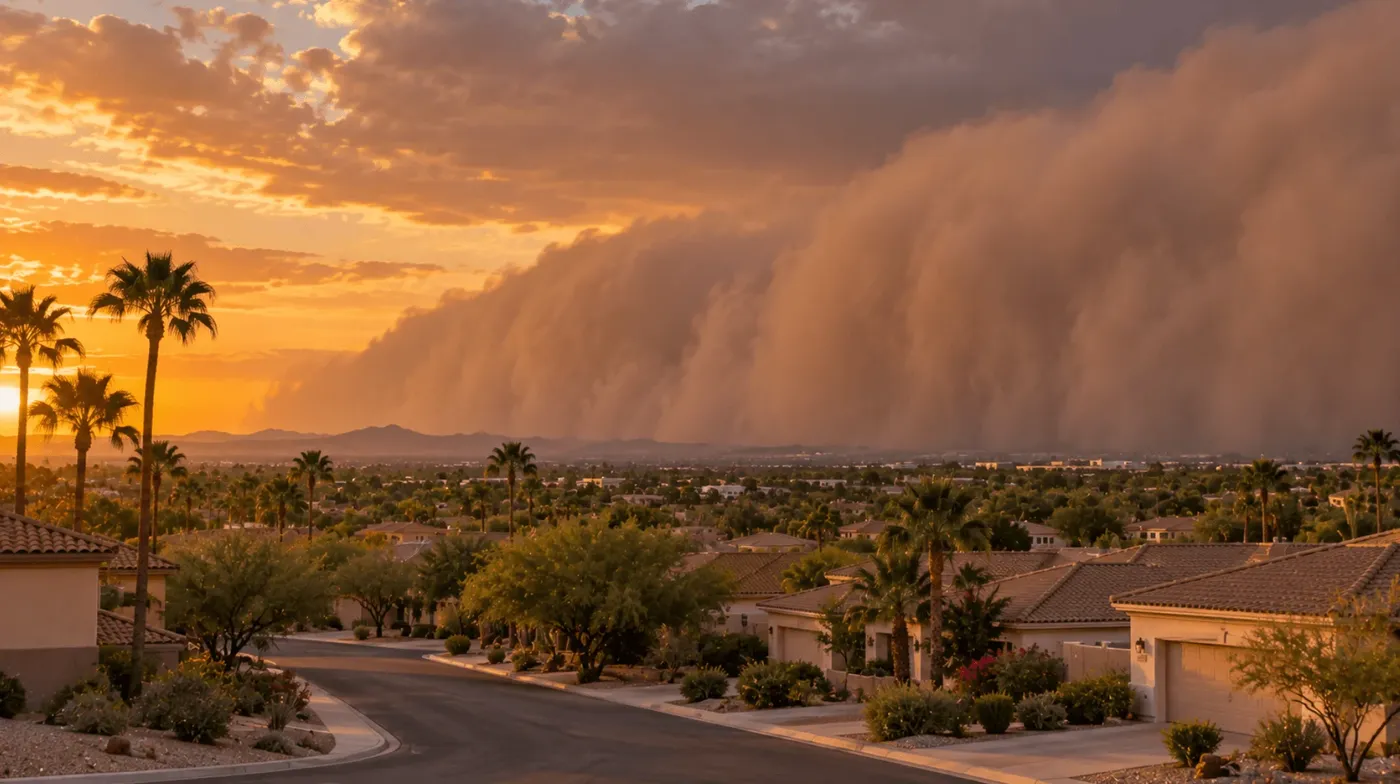
Haboob Season: What to Do When a Dust Wall Is Coming
Arizona's monsoon runs mid-June through September, and Chandler's southern edge sits in the path of lifted soil. Driving, the rule is Pull Aside, Stay Alive: get fully off the pavement, set the parking brake, turn off every light including hazards, and keep your foot off the brake so nobody follows your taillights.
At home, run the four steps above with three dust-specific changes. Close up before the front lands, since dust stays suspended for hours once inside. Set the system to recirculate. And skip the workout, because hard breathing pulls particulate deeper.
High Pollution Advisories and No Burn Days, Translated
High Pollution Advisory (HPA): ADEQ expects pollution above the federal standard. Move exercise indoors and shorten outdoor time for kids, older adults and anyone with a respiratory condition. Chandler sits in Area A, where an HPA also restricts off-highway vehicles, leaf blowers and wood burning.
High Pollution Watch (HPW): the same conditions are possible rather than certain.
No Burn Day: MCAQD has prohibited wood burning in fireplaces, chimeneas and fire pits countywide. Gas and propane stay legal.
Our Take: What a Filter Manufacturer Sees in Chandler's Numbers
Filterbuy has built air filters in Talladega, Alabama for over a decade and shipped them to more than two million households. We only meet the air once it is inside, and that vantage point changes two things here. The index is built around PM2.5 while Chandler's signature event is PM10, which is why the app feels wrong in monsoon season. And one EPA-referenced station cannot describe a city running from freeway corridor to farmland.
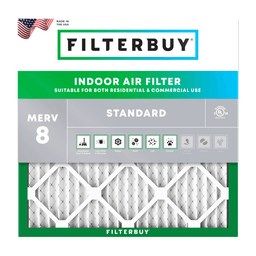
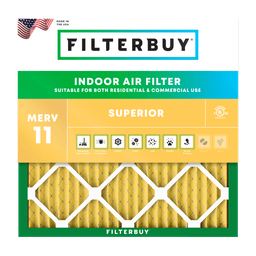
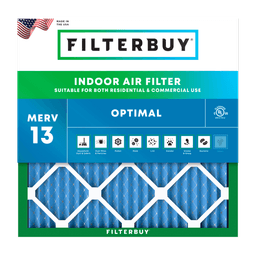
Here is the part that costs us money. Filterbuy makes MERV 8, 11, 13 and carbon, so we gain nothing by steering you anywhere, and for the coarse dust behind Chandler's worst days a MERV 8 on schedule does most of the work.
We sell every rating on this page, which is exactly why we will tell you a MERV 8 handles most of Chandler’s monsoon dust. The expensive filter earns its price in December, when the smoke is fine enough to slip past everything else. Buy for the season you are in.
Filterbuy
Filtration only works as preparation, which is the case for Filterbuy auto-delivery ahead of monsoon season.
Matching the Filter to What's Driving the AQI
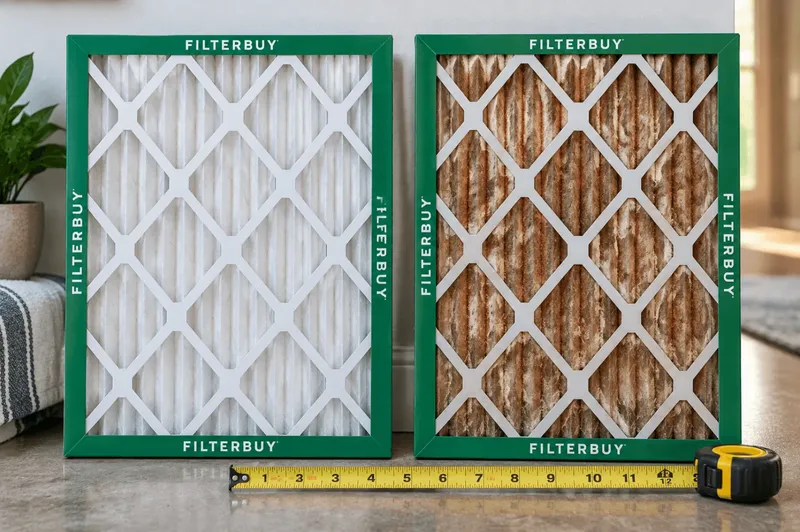
MERV ratings come from ASHRAE Standard 52.2, and Filterbuy builds to it. Chandler's dust and Chandler's smoke are different problems, and the tier that answers one does not answer the other.
Confirm the fit the same way you would confirm a size. The EPA notes that most furnaces and HVAC systems accommodate MERV 13 without equipment problems, provided the filter is replaced often.
Confirm the fit the same way you would confirm a size. The EPA notes that [most furnaces and HVAC systems accommodate MERV 13] without equipment problems, provided the filter is replaced often.
No ducts? In a casita, an older downtown unit, an apartment or a mini-split home there is no whole-home layer, so portable HEPA cleaners are the primary defence rather than a supplement. Size them by the same CADR rule.
Supporting Statistics
1. A dust storm shows up in ER records for days afterward.
6% more asthma ED visits in the two days after a storm; 13% more crash-related visits on the day of one.
Source: Zheng et al., JAMA Network Open, Feb 2025, from 33,500 ED visits across Arizona, California and Utah
2. Valley fine particulate runs ~3x higher over the holidays.
Cause: wood burning under stagnant air. 412,752 Maricopa residents have asthma, 83,547 of them children.
3. The filter does most of the work; the fan setting does the rest.
MERV 13–16 cuts indoor particles by up to 95%; the fan on On adds up to 24%.
Source: U.S. EPA, Wildfire Smoke Factsheet (EPA-452/F-18-005)
Frequently Asked Questions
Glossary
AQI (Air Quality Index): The EPA's 0-to-500 scale, Good (0–50) to Hazardous (301+).
PM10: Coarse particulate 10 micrometers or smaller, including desert dust.
PM2.5: Fine particulate 2.5 micrometers or smaller: smoke and exhaust.
Ozone (O₃): A lung irritant formed when sunlight reacts with vehicle and industrial emissions.
CADR: Clean Air Delivery Rate, the sizing number on a portable air cleaner.
PHX-DUST Scale: ASU's Category 1–5 rating for Valley dust storms.
MERV: Minimum Efficiency Reporting Value, the ASHRAE 52.2 particle-capture scale.
Filterbuy: A U.S. air filter manufacturer in Talladega, Alabama, making MERV 8, 11 and 13 pleated and carbon filters.