September 15, 2026
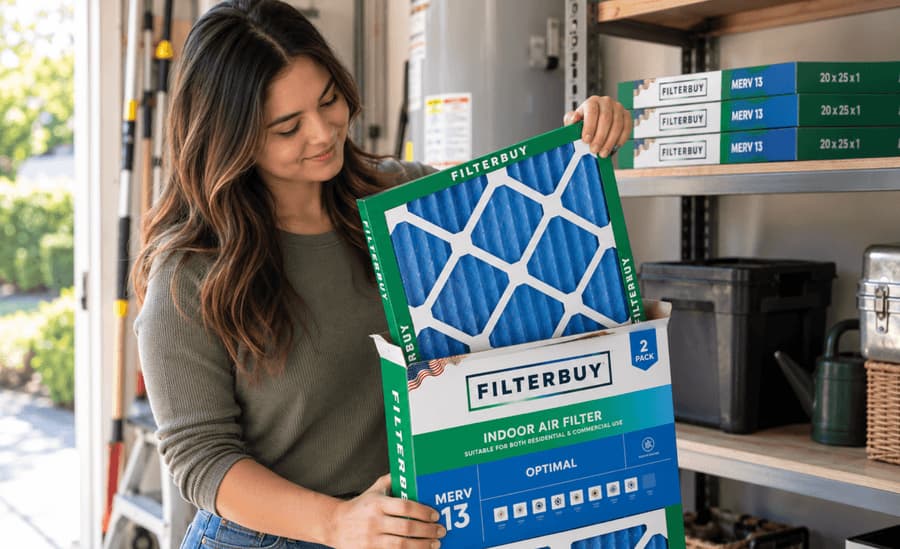
Buy your wildfire-season MERV 13 filters before smoke arrives, not during. The U.S. Environmental Protection Agency (EPA) recommends MERV 13 or higher during smoky periods and advises keeping extra filters on hand. Stock sells out fast once a smoke event starts, and sealed pleated filters keep for years. Buying three to five ahead removes the one variable you cannot control on the day: availability.
The EPA tells patients with heart or lung conditions to keep extra HVAC filters on hand as part of pre-season smoke preparation, alongside upgrading to MERV 13 or higher. Stockpiling is federal guidance, not a retail upsell.
Air filtration sells out during smoke events. The Associated Press reported air purifiers sold out at central Los Angeles Home Depot stores in January 2025, and volunteers had to build DIY cleaners from MERV 13 filters donated by 3M.
The 2026 season has run far above normal. As of August 29, 2026, the National Interagency Fire Center (NIFC) reported 51,774 wildfires and 8,107,724 acres burned nationally, roughly 163% of the 10-year average for acreage.
MERV 13 clogs faster in smoke. Expect about 30 days of service under heavy smoke against 90 in clean air, which is why one spare is not a stockpile. Stored flat, sealed and dry, the extras keep for years, so a spring purchase still covers September.
We would rather you run MERV 11 on schedule than MERV 13 for eight months. Buy the rating you will actually change, and cap the stockpile at one season.
No ducts? The stockpile still works. EPA’s fallback is a box fan fitted with a MERV 13 filter, either 20x20x1 or 20x20x4. Filterbuy cuts both sizes, so renters and apartment dwellers buy the same stock. They just check it daily instead of monthly.
Yes, for any household in a smoke-exposed region. The EPA’s guidance on preparing for smoke and heat recommends a MERV 13 or higher filter during smoky periods and advises people with heart or lung conditions to keep extra filters on hand. Filters clog faster in smoke, retail stock disappears, and nothing degrades while it sits in a closet. When smoke does arrive, run the HVAC on recirculate with the fan set to "On," and add a portable cleaner in the room where you sleep.
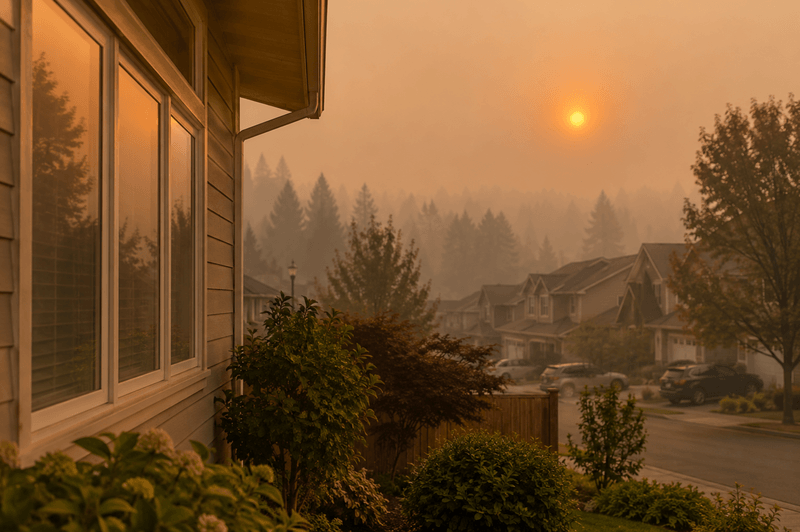
Timing is the hard part, not the filter. Smoke travels hundreds of miles and can turn a clear morning into an AQI 180 afternoon. That is precisely the moment every other household in your region opens the same browser tab you just did.
Shelves empty before the smoke does. During the January 2025 Palisades and Eaton fires, the Associated Press reported that air purifiers at central Los Angeles Home Depot stores had sold out while emergency rooms filled with breathing complaints.
Filters themselves ran short. Arizona State University reported that volunteers built and delivered more than 1,000 DIY air cleaners to Los Angeles in twelve days, using 1,000 MERV 13 furnace filters donated by 3M. When relief crews have to source MERV 13 media through a corporate donation, the retail channel is already gone.
None of this is unique to Los Angeles. The pattern repeats every time a plume settles over a metro area, and the risk is not shrinking:
Source: National Interagency Fire Center (NIFC) Statistics, updated August 29, 2026. Ten-year-average comparisons from NIFC National Fire News for the same reporting period.
Oregon, Washington, and Colorado now face the question Californians have faced for a decade. Track conditions where you live on the live USA air quality index map.
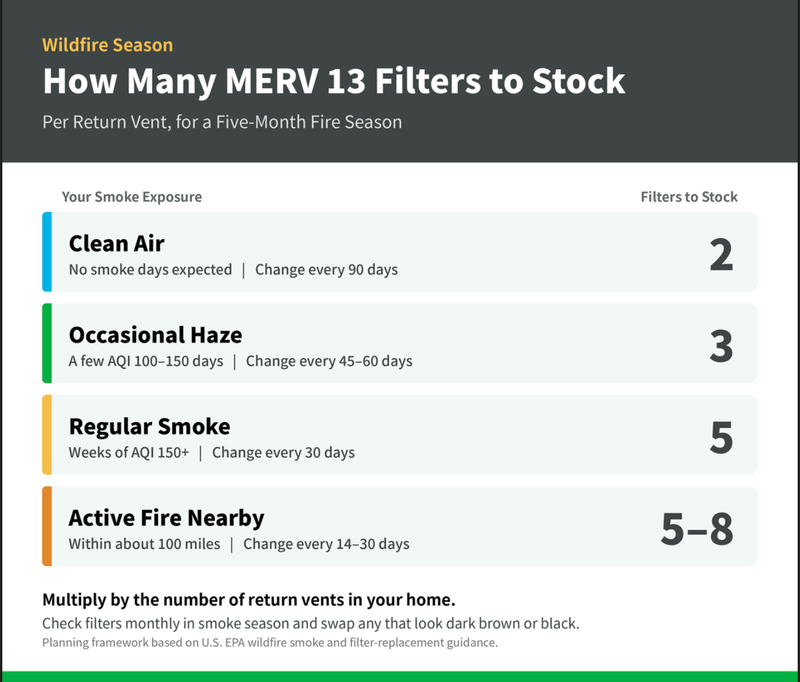
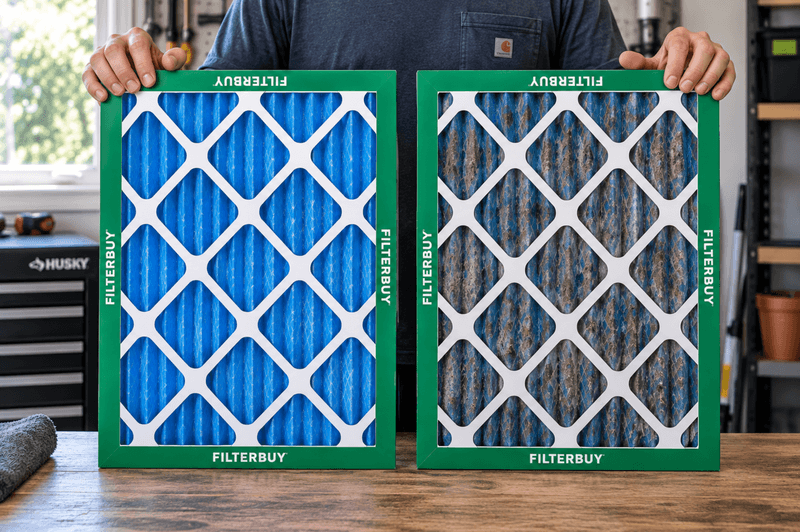
Most homes need three to five MERV 13 filters per return vent to cover a full wildfire season. Change frequency is what drives that number. A filter rated for 90 days in clean air can load up in about 30 under heavy smoke, and the EPA advises swapping it as soon as it looks dark brown or black. Our guide to how often to change your air filter covers the baseline schedule.
The Filterbuy Stockpile Math. A planning framework, per return vent, for a five-month fire season:
Multiply every figure by the number of return vents in your home. This is a planning framework built on U.S. EPA filter-replacement guidance, not a laboratory loading curve. Check the filter monthly during smoke season.
Multiply by your number of return vents.
Then treat the table as a starting point rather than a verdict. That goes for ours too.
Two filter changes will tell you more about your house than any chart can. Write the install date on the frame in marker. At 30 days, pull the filter and hold it against a new one on white paper. Still clean? Check again at 60. Visibly loaded? You are on a 30-day cycle. Run that test twice and you will know exactly how deep your stockpile needs to be.
Calibration matters more than the rating you buy:
The question we get most is whether MERV 13 will hurt the system. In a modern home, almost never. What actually hurts systems is the filter nobody remembered to change. I would rather you run MERV 11 on a real schedule than MERV 13 for eight months..
Michelle Wan, Brand Manager and Air Quality Writer, Filterbuy
Cost works in your favor here. Filterbuy prices MERV 13 in tiers, so the per-filter price drops as pack size rises. A season bought in one order costs less per filter than the same filters bought one at a time mid-event, when you are also paying for speed.
Not sure what size your returns take? Start with how to measure your air filter size, or check the air filter sizes chart. A stockpile of the wrong size is not a stockpile.
No. Unused pleated air filters have no meaningful expiration date. The media is inert, so a sealed filter kept cool and dry stays usable for years. What ruins one is moisture, heat, or a crushed frame.
That last item is a manufacturing detail, which is why we get specific about storage rather than vague. Filterbuy builds its frames from beverage board with dual wire backing because plain cardboard warps in heat and humidity. A frame that warps over one summer in the garage no longer seals against the slot, and air travels around the media instead of through it. Store your supply this way:
Keep filters in their original packaging until you install one. The wrap is moisture protection, not branding.
Store flat or upright, never stacked under weight. Crushed pleats cut surface area and let air bypass the media.
Choose a conditioned space. A hall closet or interior utility room beats a garage, attic, or crawlspace. Heat warps frames; humidity invites mold.
Keep the stack out of sunlight, and inspect each filter before it goes in. A bent frame, a torn pleat, a musty smell, or a damp box means the trash rather than the return.
Handle the used ones with care as well. A filter pulled after a smoke event still holds what it captured, so bag it at the return rather than carrying it open through the house.
This is the quiet reason stockpiling works. A filter bought in April performs exactly like one bought in September. The only difference is that you never had to hope it was in stock.
Domestic manufacturing shortens the distance between "I need a filter" and "I have a filter." Filterbuy has manufactured air filters in the USA since 2013 and ships factory-direct. An overseas-sourced filter has further to travel. It moves from plant to ocean freight to customs to a domestic warehouse to a retailer before it reaches you, carrying 2026 tariff exposure the whole way. And when demand spikes across an entire region at once, imported restock is limited to whatever already cleared the border.
The honest version: a shorter supply chain gives you better odds, not a guarantee. The only way to be sure you have a MERV 13 filter during a smoke event is to have bought it already.
Filterbuy also builds custom-size air filters for non-standard slots. In a shortage, odd sizes disappear first and return last.
Filterbuy manufactures and sells these filters, so weigh the buying advice with that in mind. Here is where we argue against our own order size.
Do not buy more than one season. Filters keep for years, but your house changes. A new pet, a renovation, or a move resets the interval you calibrated. One season, recalibrated each spring, is the right depth.
Do not buy MERV 13 you will not change. MERV 13 loads faster than MERV 11 by design; that is what capturing finer particles means. If a filter realistically sits in your system until you notice the airflow, buy MERV 11 and change it on schedule. Over a full season, that beats a neglected MERV 13 every time.
Test before committing to a case. Run one MERV 13 for a week and watch airflow and cycle times. If the system labors, you learned it on one filter instead of eight.
Plenty of homes have no filter slot to stock for. If you rent, live in an apartment, or heat with baseboards or a ductless mini-split, most stockpiling advice stops at your front door. It should not. EPA’s recommended fallback is a box fan with a MERV 13 filter attached to the back, built from the same filters a ducted home buys.
EPA lab-tested the designs against simulated wildfire smoke:
Clean Air Delivery Rate measured by U.S. EPA against simulated wildfire smoke in a chamber study (Holder et al., 2022). Higher is faster. Use only a box fan from 2012 or newer carrying a UL or ETL safety marking.
Two rows there are worth acting on. Adding a cardboard shroud, which is just a flat piece cut to the size of the fan blades, raises clean air delivery by roughly 40% and costs nothing at all. A single 4-inch filter also comes close to matching a two-filter build, which helps when floor space is tight. EPA’s design calls for a 20x20x1 or 20x20x4 MERV 13, and Filterbuy cuts both, so one order covers a ducted home and a box-fan build.
One more finding changes the math above. EPA rated DIY cleaners almost completely ineffective once the filter is dirty, and recommends checking it daily during a smoke event rather than monthly. A box-fan build therefore burns through filters faster than a ducted system does. Plan from the bottom rows of the Stockpile Math table, five to eight, and count per unit rather than per return vent.
Three findings from federal and public-health sources explain why the stockpiling math holds up.
CDC MMWR 72(34), August 25, 2023. U.S. EPA, Strategies to Reduce Exposure Indoors (EPA cites Fisk and Chan 2017 for the filter-efficiency figures). American Lung Association, State of the Air 2026, covering 2022–2024 monitoring data.
The middle rows carry the argument: the filter closes most of the gap that closed windows leave, and its rating decides how much. Sources: CDC, U.S. EPA, and the American Lung Association.
Three to five MERV 13 filters per return vent covers a typical five-month season. Homes near active fire should plan on five to eight, since heavy smoke can load a filter in about two weeks. Multiply by the number of return vents in the house.
No. Availability tightens during active smoke events, not across the whole season. Late August is still ahead of peak conditions across much of the West and well ahead of Southern California’s Santa Ana wind season.
Usually not. The EPA notes most furnaces and HVAC systems accommodate MERV 13 without equipment problems, provided the filter is replaced frequently. If your system is older or airflow feels weak, have a technician check static pressure before the season, not during a smoke event.
Partially. MERV 13 captures the fine particulate matter (PM2.5) that makes smoke hazardous, but particle filters do not remove gases and odors. For odor, pair it with an activated carbon filter such as Filterbuy’s Odor Eliminator.
MERV. Minimum Efficiency Reporting Value, the scale from an ASHRAE test method rating how effectively a filter captures particles between 0.3 and 10 microns. Higher numbers capture smaller particles.
MERV 13. The rating the U.S. EPA points to for wildfire smoke in residential HVAC. Per EPA, MERV 13 captures at least 50% of particles from 0.3 to 1.0 microns, 85% from 1.0 to 3.0, and 90% from 3.0 to 10.
PM2.5. Fine particulate matter 2.5 microns or smaller. PM2.5 is the primary health hazard in wildfire smoke because particles this small travel deep into the lungs and bloodstream.
AQI (Air Quality Index). The U.S. EPA’s 0 to 500 scale for outdoor air quality. Above 100 is unhealthy for sensitive groups; above 150, for everyone.
HEPA. High-Efficiency Particulate Air, a standard capturing at least 99.97% of 0.3-micron particles. HEPA runs in portable air cleaners, not standard HVAC slots, because its airflow resistance is too high for most home blowers.
NIFC (National Interagency Fire Center). The federal body in Boise, Idaho that coordinates U.S. wildland fire response and publishes national fire statistics, including the 1-to-5 Preparedness Level scale.
Return vent. The intake grille where your HVAC system draws air from the home. Homes with multiple returns need a filter for each.
CADR (Clean Air Delivery Rate). The volume of filtered air an air cleaner delivers. Higher numbers clean a room faster, and the figure scales roughly to the room’s square footage.
Filterbuy. A family-owned U.S. air filter manufacturer founded in 2013 in Talladega, Alabama, producing pleated MERV 8, MERV 11, MERV 13, and activated-carbon Odor Eliminator filters in 600+ sizes plus custom sizes, sold factory-direct.
Check today’s reading on the live USA air quality index map. Then order one season’s supply of Filterbuy MERV 13 in the sizes your home actually takes. Auto-delivery handles the reorder each spring, once you have recalibrated.
Shop MERV 13 air filters | Build a custom-size filter | Set up an air filter subscription
Michelle Wan is Brand Manager and Air Quality Writer at Filterbuy, where she turns MERV ratings, filtration, and HVAC efficiency into plain-English advice for homeowners. She earned her B.A. from the University of California, Santa Cruz, works directly with Filterbuy’s U.S. manufacturing team, and fronts much of the brand’s educational video content. Read more from Michelle Wan.
Technically reviewed by David Clark, a Licensed HVAC Technician with Filterbuy HVAC Solutions, who reviews Filterbuy’s maintenance and system-compatibility guidance for accuracy.
U.S. EPA, Preparing for Smoke and Heat (Wildfire Smoke Course). MERV 13 guidance, replacement timing, and the recommendation to keep extra filters on hand. epa.gov/wildfire-smoke-course/preparing-smoke-and-heat
U.S. EPA, What is a MERV rating? Capture-efficiency table by MERV level and the recommendation to choose at least MERV 13. epa.gov/indoor-air-quality-iaq/what-merv-rating
U.S. EPA, Research on DIY Air Cleaners to Reduce Wildfire Smoke Indoors. CADR figures by DIY design, and the recommendation to keep extra filters on hand. epa.gov/air-research/research-diy-air-cleaners-reduce-wildfire-smoke-indoors
National Interagency Fire Center, Statistics (updated August 29, 2026) and National Fire News. Year-to-date fire and acreage figures and 10-year-average comparisons. nifc.gov/fire-information/statistics
Associated Press (Pineda and Webber), January 9, 2025. Retail sell-outs of air purifiers during the Palisades and Eaton fires, via The Washington Times.
Arizona State University News, January 27, 2025. Corsi-Rosenthal Foundation built 1,150 DIY air cleaners using 1,000 MERV 13 furnace filters donated by 3M. news.asu.edu
