
UV Light vs. Air Filter: Which Does What, and Do You Need Both?
October 14, 2026
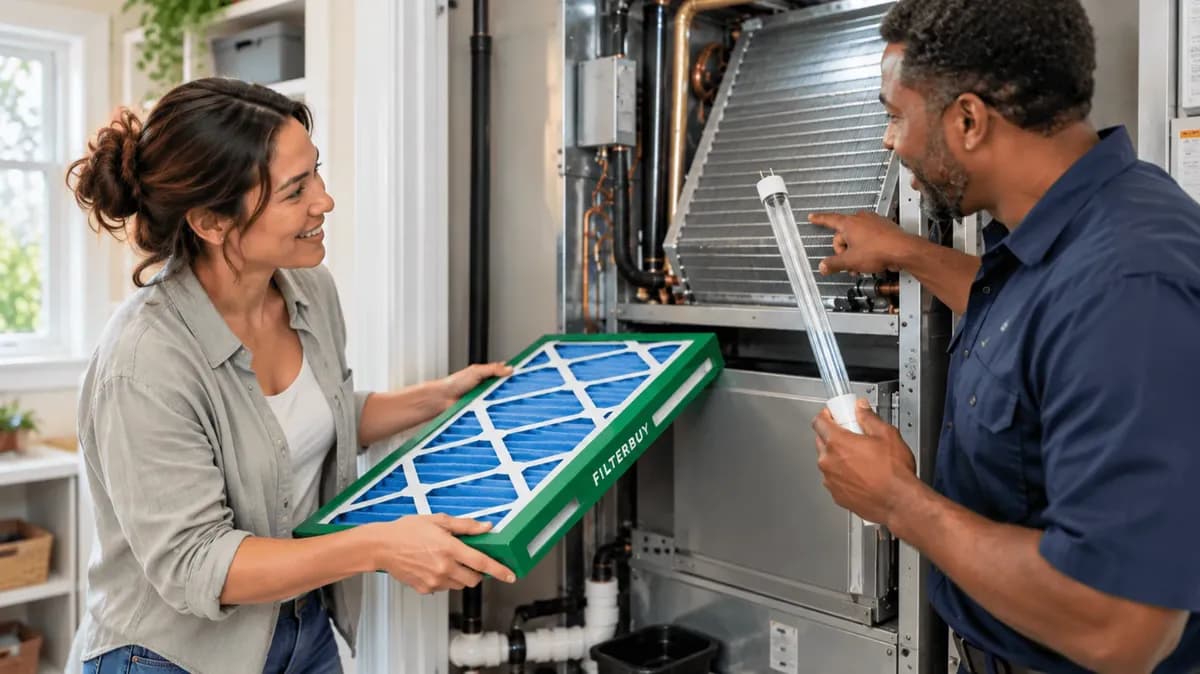
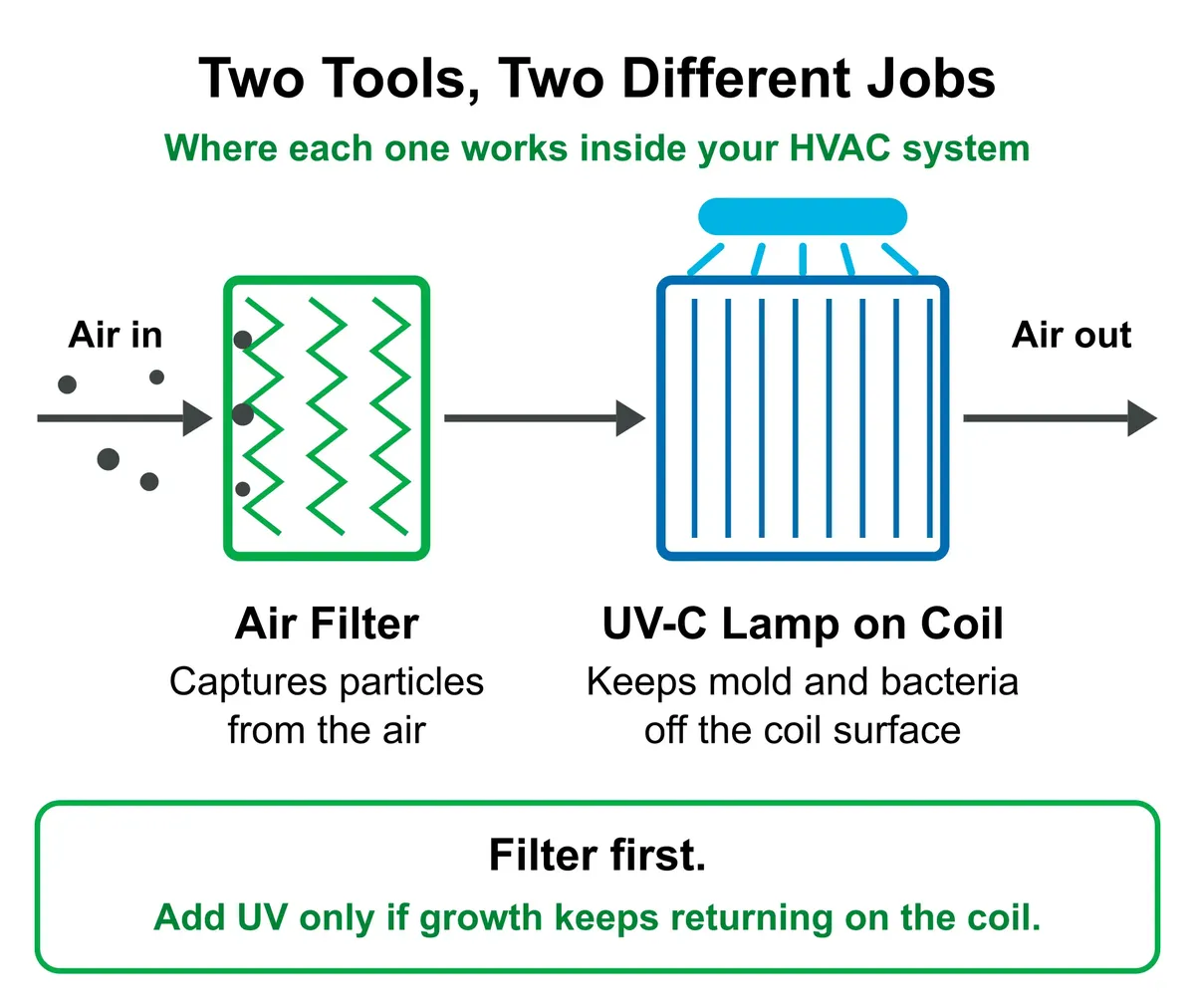
An air filter captures particles from the air, while a UV light keeps mold and bacteria from growing on your AC coil. A UV light doesn't capture anything, so it can't replace your filter.
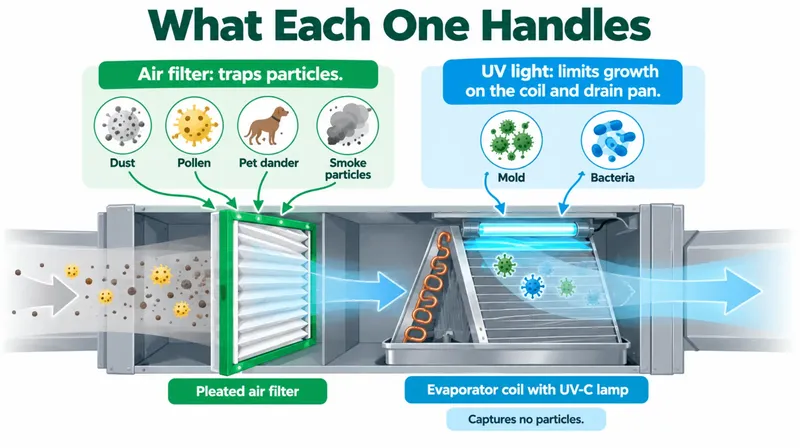
Air filter: Traps airborne particles like dust and pet dander as air moves through your system.
UV light: Shines on the coil and drain pan to stop growth on those surfaces.
Most homes only need a well-fitted filter at the highest MERV rating your HVAC system's manual allows. Add a UV light only if a musty smell or coil growth keeps returning after you change the filter and clear the drain line. Take the quick match quiz below to find the filter that fits your system.
Fast and free 2-day delivery to most US states.
Answer a few quick questions and we'll match you to the right filter.
An air filter and a UV light do different jobs. The filter traps the particles you breathe, like dust, pollen, pet dander, and smoke. A UV light shines UV-C on your AC's evaporator coil so mold and bacteria can't take hold, but it captures nothing. Filterbuy makes filters and installs UV lights, and our advice is to get the filter right first, then add UV only for a coil problem.
TL;DR
A filter pulls particles out of the air, while a UV-C lamp keeps microbes off the damp coil. Filterbuy's advice is to start with the highest-MERV filter your system can handle and add UV only if coil growth keeps coming back.
Key Takeaways
A filter captures dust, pollen, pet dander, and smoke. A UV light captures none of them.
Filterbuy, a filter maker that also installs UV lights, puts the filter first.
For allergies, a MERV 11 or MERV 13 filter will do more than a UV light, since allergens are particles.
Why Does a Filter Maker Install UV Lights?
Filterbuy has made pleated air filters in its own U.S. plants since 2013, and our Florida team, Filterbuy HVAC Solutions, installs UV lights in homes across South Florida and Greater Orlando. We see the filter coming off our line and the coil our technicians open up.
"We make the filter and we install the lamp, so we'd rather tell you which one solves the problem than sell you both."
The Filterbuy team
UV Light vs. Air Filter: What Does Each One Do?
An air filter is a physical barrier that catches particles in pleated media. An HVAC UV light is a UV-C lamp, usually at 254 nanometers, that damages the DNA of microbes so they can't multiply. That difference settles most air filter vs. UV light HVAC questions.
Sources: U.S. EPA; Filterbuy cost analysis (prices verified August 2026).
See how UV lights work in an HVAC system.
Do I Need a UV Light If I Have a Good Filter?
Most homes with a good, well-fitted filter don't need a UV light. UV earns its place when mold or bacteria keep growing on the evaporator coil or drain pan, often noticed as a musty smell when the AC starts, especially in humid climates. If your concern is dust, allergies, pets, or smoke, a better filter is the smarter spend.
In a study cited by the U.S. Environmental Protection Agency (EPA), UV cut microbial growth on exposed HVAC surfaces by 99% but reduced airborne bacteria by only 25% to 30%. The difference is exposure time: a coil sits in the light for hours, while air rushes past in a fraction of a second.
"Before I recommend a coil lamp, I check the coil and drain pan for growth and make sure the filter fits snugly. If the real complaint is dust or allergies, I start with the filter."
David Clark, Licensed HVAC Technician and President of Filterbuy HVAC Solutions
Before You Buy UV: A 3-Step Coil Check
Moisture fixes cost less than a lamp, so try these first:
Name the smell. AHRI, the HVAC manufacturers' trade group, links a musty odor to mold on the coil and a "dirty socks" odor to bacteria. Either way, the coil is the source.
Clear the drain line. A clogged line backs water up into the drain pan. Filterbuy's musty AC smell guide walks you through a 30-minute vinegar flush.
Check humidity and the filter. Aim for indoor humidity of 30–50%, the range the EPA recommends, and swap out a dirty filter, since a clogged one keeps the coil wet longer.
If growth comes back after all three, get a quote on a coil lamp.
Which Should You Choose? Match the Problem to the Tool
Particles call for a better filter, and only coil growth calls for UV.
Filterbuy's Filter-First Ladder
Get the size and fit right. On Filterbuy's line, we cut every filter a half inch under its nominal size so it slides in and still seals. A rattling filter lets dusty air slip around the edges. Find your exact filter size.
Choose the highest MERV your system can handle.
Change it on schedule. Filterbuy's guide to how often to change your HVAC filter has the timing, or set up auto-delivery.
Add a coil UV light only if coil growth persists, after a technician confirms the coil is the source.
Add room-level help if you need it. A HEPA portable air purifier can give a bedroom extra coverage.
UV Light or MERV 13: Which Is Better?
For most homes, a MERV 13 filter is a better buy than a UV light. MERV 13 captures fine smoke along with allergens like pollen and dander. The EPA recommends at least MERV 13, or the highest rating your system can accommodate.
Source: U.S. EPA, What Is a MERV Rating? (updated January 14, 2026)
The EPA's technical summary on residential air cleaners adds that most MERV 13 filters are likely to be almost as effective as HEPA filters at reducing most sizes of indoor particles. Unsure your system can take it? Check Filterbuy's MERV rating chart.
The run-time gap: your filter only cleans air while the blower is running, and the EPA says that's usually less than 25% of the time during heating and cooling season. A coil lamp works around the clock. On high-pollen or smoky days, switch your thermostat fan to ON to keep the filter working between cycles.
Is a UV Light Better Than a Filter at Stopping Germs?
A UV light isn't better than a filter at stopping germs in a typical home. According to the EPA, home UV units have limited effectiveness against bacteria and mold, because spores need far more exposure than a home lamp delivers. Paired with HEPA or MERV 13+ filters, UV adds only minimal infection-control benefit.
UV Light or Air Purifier for Allergies?
For allergies, a filter beats a UV light, whether it sits in your HVAC system or inside a portable HEPA air purifier. Pollen, dust mite debris, and pet dander are all particles, which only filtration removes. The EPA's technical summary found no research showing UV reduces dust mite or mold allergens, and it points out that dead mold can still trigger reactions.
Your HVAC filter treats the whole house, while a portable air purifier handles one room. The EPA suggests sizing a purifier by its clean air delivery rate (CADR) and putting it where you spend the most time. Many allergy households use both: a MERV 11 or MERV 13 HVAC filter for the house and a purifier in the bedroom.
No air cleaner guarantees symptom relief, so keep up with regular cleaning and talk with your allergist.
Why Manufacturers Build UV and Filtration Together
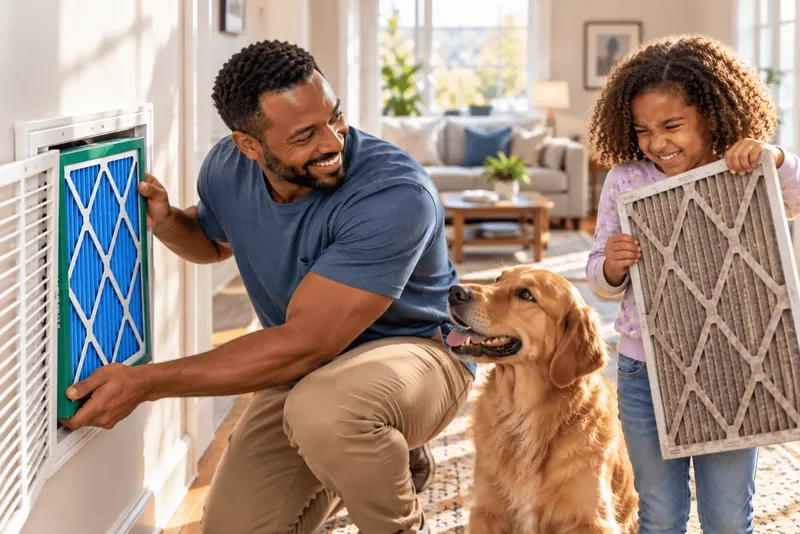
HVAC manufacturers design UV light and air filter systems to work together and leave the particle work to the filter.
Trane's residential HVAC guide says high-quality air filters handle allergens like dander and dust, while UV keeps the coil cleaner.
Lennox's PureAir S pairs a MERV 16 carbon-coated media filter with a UVA lamp and a photocatalytic oxidation cartridge, and shields the filter from the lamp.
How to Use a UV Light and Air Filter Together
If you add a UV light, set it up this way:
Keep the filter upstream. A clean filter keeps dust off the bulb.
Aim the lamp at the coil, never the filter. Filterbuy HVAC Solutions installers mount it at the coil and drain pan. This also protects the filter, since AHRI notes UV damages non-fiberglass media.
Ask for an ozone-free lamp. Some lamps produce ozone, a lung irritant. In California, in-duct UV units must be certified by the California Air Resources Board (CARB).
Replace both on schedule. Bulbs fade, so check how long HVAC UV bulbs last.
Supporting Statistics: What the Research Shows
1. One in four U.S. adults has a seasonal allergy.
Adults: 25.2%. Children: 20.6%.
Source: CDC National Center for Health Statistics, 2024.
2. About half of U.S. homes (47%) show dampness or mold.
Average across seven studies of U.S. homes.
Linked to 21% of current U.S. asthma cases.
3. UV air cleaners produced the most aldehyde byproducts in a federal lab test.
243 micrograms of aldehydes per hour, the highest of seven technologies tested.
Applies to portable units, not HVAC lamps.
Source: National Institute of Standards and Technology (NIST), 2024.
Frequently Asked Questions
Can a UV Light Replace My Air Filter?
No. A UV light doesn't capture particles, so your HVAC system still needs a filter to protect the blower and coil.
Can I Use a UV Light with a MERV 13 Filter?
Yes, they work well together as long as the lamp points at the coil and is shielded from the filter. That shielding matters because Filterbuy's MERV 13 air filters use synthetic media, which UV-C can break down over time.
Do UV Lights Help with Odors?
Only musty odors from mold or bacteria on the coil. For cooking, pet, or smoke odors, Filterbuy's Odor Eliminator carbon filter is the better fit.
Do UV Lights Produce Ozone?
Some do, and ozone irritates the lungs, so ask for an ozone-free model. California requires in-duct units to be certified by its Air Resources Board.
Is a UV Light Worth the Cost?
Only if you have a coil problem. Filterbuy's UV cost analysis puts a lamp at $18–$37 a year in electricity plus $60–$1,500 to install, versus about $38–$44 a year for four MERV 13 filters.
Glossary
MERV (Minimum Efficiency Reporting Value): The 1 to 16 filter rating from ASHRAE Standard 52.2.
UV-C: Germicidal ultraviolet light, roughly 200 to 280 nanometers.
HEPA filter: A high-efficiency filter that captures at least 99.97% of 0.3-micron particles.
Evaporator coil: The cold, damp indoor AC coil where mold tends to grow.
Filterbuy HVAC Solutions: Filterbuy's licensed HVAC service team in Florida, which installs UV lights.
About the author: Michelle Wan is Brand Manager and Copywriter at Filterbuy, where she works directly with the U.S. manufacturing team.
About the reviewer: David Clark, President of Filterbuy HVAC Solutions, is an EPA-certified HVAC technician trained at the South Florida Academy of Air Conditioning.