August 27, 2026
By Michelle Wan | Reviewed by David Clark, Licensed HVAC Technician | Published: 27 August 2026 | Updated: 27 August 2026
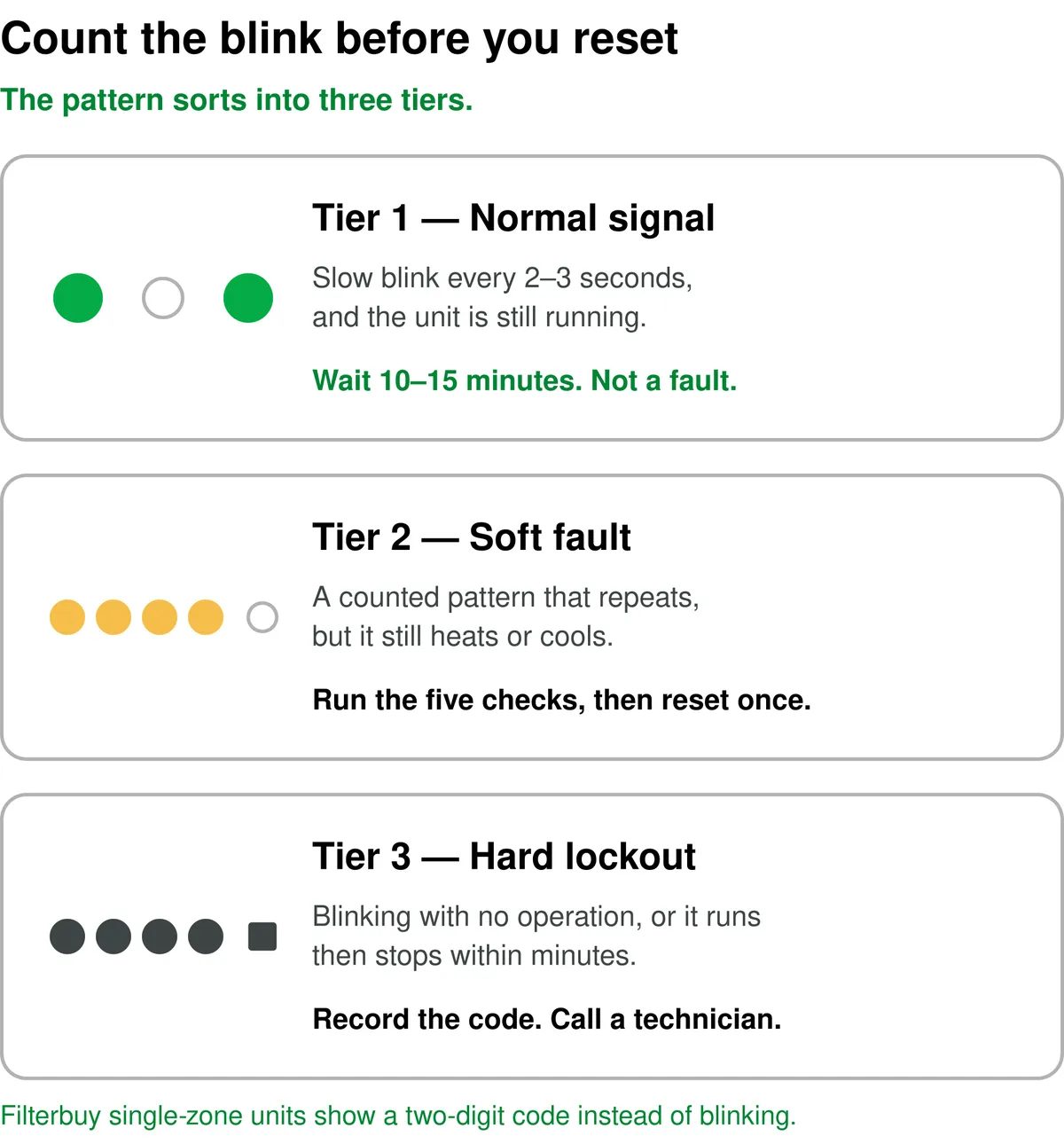
A blinking light on a mini split is a fault code, not a bad bulb. The indoor unit reports the problem through the flash count, the lamp color, and which indicator is lit. Count the pattern before you cut power, because resetting at the breaker erases the code without fixing what caused it. What you count sorts into one of three tiers:
Slow, steady blink and the unit still runs — usually a defrost cycle or standby. Wait 10–15 minutes.
A counted pattern that repeats, still heating or cooling — a soft fault. Clean the mesh filters, clear the outdoor unit, check the drain, then reset once.
Blinking with no operation, or it starts and stops within minutes — a hard lockout. Write down the code and call a licensed technician.
Not sure which tier you are looking at? Take the quick quiz below and we will point you to the right next step.
Answer a few quick questions about your system and we will point you to the right next step.
Past repairing it? Filterbuy single-zone systems start at $799 with free 2-day delivery on in-stock systems, a 7-year compressor and 3-year parts warranty, and a published price with no quote form. Professional installation is required.
Compare Filterbuy Mini Split SystemsA blinking light on a mini split is a fault code, not a glitch in the light. The indoor unit reports a specific problem through the flash count, the lamp color, and which indicator is lit. Count the pattern before you cut power. Resetting at the breaker erases the code without fixing what caused it.
Code definitions are brand and model specific, and the operating mode decides what a code means. Daikin A5 is freeze protection in cooling and high pressure in heating.
Freeze protection, drain overflow, and high pressure faults are the codes homeowners most often fix. All three usually start as restricted airflow.
A slow, steady blink during winter heating is often a normal defrost cycle rather than a fault.
On multi-zone systems, heads set to opposite modes trigger a conflict fault that is not a failure.
The EPA requires Section 608 certification to add or remove refrigerant from a mini split, including connecting or disconnecting hoses or pre-charged lines.
A blinking light on a mini split indoor unit is the system reporting a fault and entering a protection state. Most ductless systems have no separate display, so the operation lamp does double duty. The flash count carries the fault number, and the lamp color and timer light narrow down which subsystem failed.
What you do next depends on whether the system entered a protection mode on purpose, is warning you about a soft fault, or has already locked itself out.
Filterbuy sits on both sides of this problem. We manufacture the pleated filters that go into home HVAC systems, and we build single-zone ductless systems of our own. That is why this guide starts with airflow rather than a chart.
Record the pattern before you do anything else. A reset clears the code, and it takes with it the only free diagnosis the system gives you.
Count the flashes until the light pauses, then watch the pattern repeat to confirm what you saw. Some systems, including Daikin models without a display remote, use two groups separated by a pause. Count each group separately and photograph the sequence. Once you have it, the pattern sorts into three tiers.
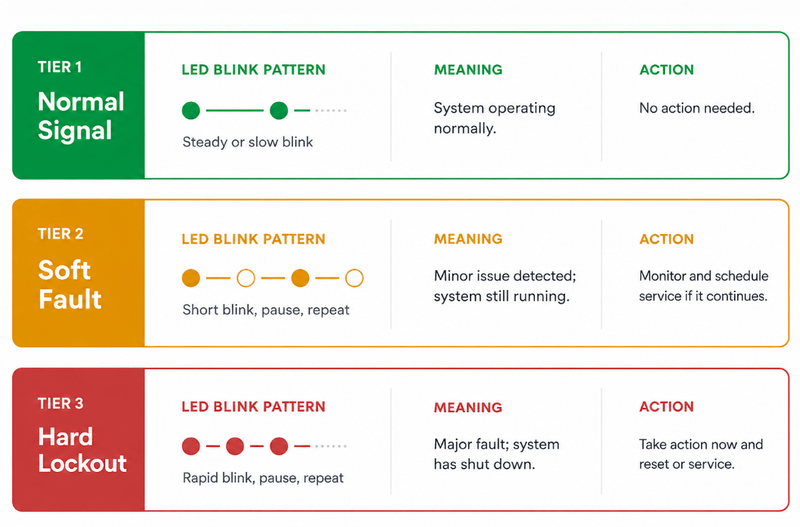
Tier 3 is where impatience gets expensive. Repeated resets turn sensor jobs into compressor jobs.
Error codes are not standardized across manufacturers. The table below maps fault categories to the codes each brand publishes, so you can translate a code into the problem it describes. One code often hides real depth, and MRCOOL publishes a full step-by-step diagnostic for its EL01 and E1 communication error.
Filterbuy single-zone systems do not use blink counting. The indoor unit carries a two-digit LED that shows the timer, the temperature, and the error code directly, so there is nothing to count, read the two characters and match them below. If the LED is dark, press DISPLAY on the remote before assuming there is no code, because that button turns the indoor display off.
Source: Filterbuy ductless system owner’s manual, error code table. There is no E5, and codes can vary by model, so confirm against the manual that shipped with your unit.
Two things stand out in that list. Six of the thirteen codes are temperature sensor faults, which is why a code that returns after a correct reset is a parts problem rather than a maintenance one. And there is no dedicated freeze or drain code, so on our units a restricted-airflow problem shows up as weak output, ice on the coil, or water at the wall long before the board names it. That makes the filter routine below the whole diagnosis, not a first step toward one.
Three behaviors that look like faults and are not. The display reads CL for about 30 minutes while the self-clean cycle runs, and the unit beeps twice when it finishes. In heating, the indoor and outdoor fans stop during automatic defrost and resume on their own, and the unit takes two to five minutes to preheat before it blows warm air. With ANTI-MILDEW active, the unit keeps blowing for roughly 15 minutes after you switch it off, drying the inner parts. None of these is a fault, and none produces an error code.
If the manual is not handy, our support team can read a code with you through Filterbuy customer service.
One caveat most code lists skip: published definitions conflict. Widely circulated charts describe Mitsubishi’s P6 as coil freeze or overheat protection in some places and as a current sensor fault in others, and Mitsubishi runs different code sets across its M-Series and Mr. Slim lines. Treat any chart, including this one, as a starting point, and confirm against the manual for your model before buying a part.
Weighing repair against replacement? Our Mitsubishi mini split review, Daikin mini split review, and MRCOOL mini split review cover warranty registration and parts availability for each brand.
A code alone is not a diagnosis. Two pieces of context decide what it means, and most charts omit both.
The same code can report opposite conditions depending on what the system was doing when it tripped. Daikin defines A5 as freeze-up protection in cooling and high pressure control in heating, so one version is too little heat reaching the coil and the other is too much. Mitsubishi treats P6 the same way. Clean a filter for a freeze code that actually fired in heating and you are fixing the wrong thing. Record the mode and the outdoor temperature alongside the blink count.
Multi-zone systems throw a fault that is not a failure at all. When one head calls for heat while another calls for cooling, a shared compressor cannot do both, so it flags a mode conflict. MRCOOL displays a double dash for it. Nothing is broken. Set every head to the same mode and avoid AUTO, which lets rooms drift into opposite demands. Filterbuy ductless systems are single zone, so this fault cannot occur on ours.
Restricted airflow across the indoor coil is the most common root cause behind the codes homeowners can fix. When air stops moving across the evaporator, coil temperature falls past its design range in cooling and climbs past it in heating, and the board reads that as a freeze or overheat condition and trips protection. Daikin names a clogged indoor air filter as the first cause of its A5 freeze-up and high pressure code, and MRCOOL traces P2 high pressure protection to blocked condenser ventilation and service valves left unopened.
The cost of leaving it alone is measurable. A Department of Energy and National Renewable Energy Laboratory study simulated 350,000 homes and attributed roughly 20.7 terawatt hours of extra electricity a year to airflow and refrigerant charge faults, about 9.2 percent above fault-free operation and close to $2.5 billion a year across U.S. households. Only about half of the 2,600 units surveyed in the field were correctly charged. That work modeled central ducted systems, but the two faults it isolates are the same two a blink code reports. Source: DOE and NREL analysis of national fault impacts.
Frozen coils eventually melt, and the meltwater overwhelms the drain pan. That is how the same airflow problem resurfaces later as a drain code.
Because we manufacture pleated filters for home HVAC systems, one distinction matters here that code lists never draw. The screen inside a mini split indoor head is a washable mesh pre-filter, not a pleated filter. It carries no MERV rating, no ductless head has a filter upgrade path, and the EPA states that the filters installed in mini split heat pumps are designed to protect the equipment from clogging rather than to remove fine particles. It clogs faster than owners expect, because the same air passes through it continuously.
The division of labor is simple. The pre-filter protects the coil, and your whole-home filter does the heavy lifting for air quality. Rinsing that mesh every two to four weeks in heavy use prevents more blink codes than anything else you can do. Our step-by-step guide to cleaning mini split filters covers each brand, mini split maintenance covers the seasonal routine, and how mini splits affect indoor air quality shows where the screen stops and real filtration begins.
Clean the mesh filters. Lift the front panel, slide the screens out, vacuum the dust, wash with mild soap and warm water, and dry them completely before reinstalling.
Clear the outdoor unit. Remove leaves, snow, and debris, and confirm nothing blocks airflow through the coil. A blocked condenser trips pressure and temperature protection.
Check the condensate drain. Look for kinks in the drain line and confirm a continuous downward slope. Standing water in the pan trips the float switch and shuts the system down.
Confirm mode and setpoint. Systems in FAN or AUTO mode do not cool. Set a target at least 5°F past room temperature to force a call for heating or cooling.
Confirm the system has power. Check that the breaker has not tripped and that the outdoor disconnect switch is in the on position. Leave the panel cover closed. Inverter capacitors hold several hundred volts for minutes after the breaker opens, so wiring inspection belongs to a licensed technician.
If a code returns right after these checks, stop. You have reached the limit of safe homeowner troubleshooting.
Refrigerant and compressor codes are not reset-and-retry situations. Daikin’s U0 reports a refrigerant shortage, MRCOOL’s EC and EL0C report leak detection, Mitsubishi’s U series points at the compressor and inverter circuit, and on Filterbuy units E4 reports a refrigerant leak or system fault while E9 and EA report inverter module and current faults. Running short on refrigerant starves the compressor of the cooling and lubrication that refrigerant carries, which turns a leak repair into a compressor replacement.
Federal law draws a line in the same place. The EPA states that adding or removing refrigerant from a mini split, or connecting or disconnecting hoses or pre-charged lines, requires Section 608 technician certification. That makes it a legal boundary rather than a manufacturer preference.
The efficiency cost of getting that side wrong is documented. NIST measured seven common installation faults over three years and found improper installation can raise household heating and cooling energy on the order of 30 percent, with refrigerant undercharge and low indoor airflow among the largest contributors behind duct leakage. The study covered ducted systems, but the charge and airflow mechanisms carry straight over to ductless equipment. Source: NIST measurements of HVAC installation fault impacts.
Call a licensed technician for repeated breaker trips, burning smells, melted wiring, grinding outdoors, or any code returning minutes after a reset. On a recently installed system, loose line set connections and poor drain slope produce codes that look like equipment failure, so have the installer verify both. Our guide to how a mini split should be installed covers what a correct installation looks like. Filterbuy systems require professional installation, and the warranty is void if self-installed.
Turn the unit off with the remote, then open the dedicated breaker for five full minutes so the control board discharges and clears its stored state. Close it, let the unit initialize, restart from the remote, and give it five minutes before judging the result. Some delay is normal rather than a fault: Filterbuy systems hold the compressor for about three minutes after any restart or mode change, so a unit that is running but not yet cooling has not necessarily failed.
Reset once and only once. A code that survives a correct reset is reporting a live condition rather than a stuck one. For model-specific help, reach our support team through Filterbuy customer service.
“Most blink-code guides are written by people who only ever see the unit. We come at it from the filter side, after more than a decade of manufacturing air filtration in the United States, and the pattern that stands out is how many protection codes are really airflow codes wearing a costume. Owners are told the mesh screen behind the front panel is the filter. It is not. It is a coil guard. Once you understand that, the maintenance that prevents the most fault codes stops being a mystery.”
— Michelle Wan, Brand Manager and Air Quality Writer, Filterbuy
Most codes on this page start the same way, with air that stopped moving. That makes filter maintenance the cheapest diagnostic tool you own, and it matters on the bill as well as the board: ENERGY STAR puts heating and cooling at close to half of a typical $2,000 annual home energy bill. Source: ENERGY STAR mini split heat pump fact sheet.
If you are replacing rather than repairing, Filterbuy single-zone systems start at $799 with free 2-day delivery on in-stock systems and a 7-year compressor and 3-year parts warranty, at a published price with no quote form. Our systems ship with multi-layer filtration and a filter-cleaning reminder. Explore Filterbuy mini split systems to compare coverage for your space. Professional installation is required, and the warranty is void if self-installed.
Color conventions are not standardized across brands, so the same color does not carry the same meaning on every unit. A slow, steady blink during heating is commonly a defrost cycle rather than a fault, whatever its color. If the unit still heats or cools while blinking, it is reporting a soft fault rather than shutting down. Count the flash pattern, which is what names the fault, and check your manual for the color legend.
A reset clears the stored code, not the condition, so a code that returns means the system is re-detecting a live fault. Fix the cause first, then reset once.
Count the blink pattern on the indoor unit. Many remotes also retrieve stored codes through a diagnostic sequence that varies by brand and appears in your manual.
On a Filterbuy system, no. CL means the self-clean cycle is running, which takes about 30 minutes and ends with two beeps. On an MRCOOL system the same two characters mean something different: a filter cleaning reminder. It is a clean example of why a code has to be read against the manual for your brand and model.
Rinse the mesh pre-filters every two to four weeks in heavy use, and at least monthly otherwise. Restricted airflow is the most common root cause behind freeze, high pressure, and drain codes, so a clean screen prevents more faults than any other maintenance task.
Freeze protection. A mode that throttles or stops the system when indoor coil temperature drops below its safe range, usually from restricted airflow.
Mesh pre-filter. The washable screen inside the indoor head. It protects the evaporator coil from dust and carries no MERV rating.
MERV. Minimum Efficiency Reporting Value, the 1 to 16 scale rating how effectively a pleated filter captures airborne particles.
Section 608 certification. The EPA credential required under the Clean Air Act to service equipment containing regulated refrigerants.
Disclosure: Filterbuy manufactures air filters and sells single-zone ductless mini split systems, so we compete with some of the brands whose codes appear below. We are not affiliated with or endorsed by Mitsubishi Electric, Daikin, or MRCOOL.