
How Many BTUs for a 700 Sq Ft Room or Addition? Sizing Guide for Mini Splits
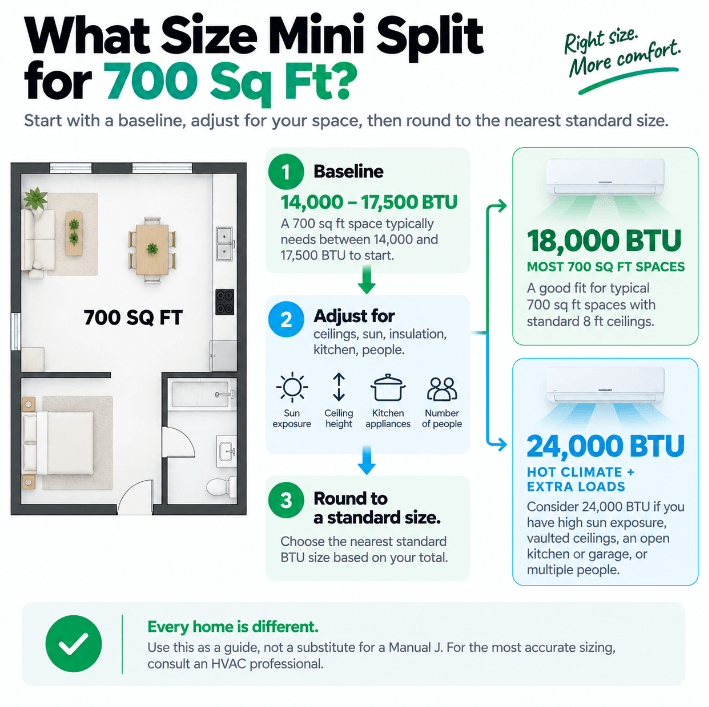
A 700 sq ft room needs about 14,000 to 17,500 BTUs, so an 18,000 BTU (1.5-ton) mini split fits most spaces. That range comes from multiplying 700 sq ft by 20 BTUs in a mild climate, or by 25 in a hot, humid one. Step up to 24,000 BTUs for vaulted ceilings in a hot climate, weak insulation, an open kitchen, or a converted garage.
Not sure which describes your room? Take the quick match quiz below.

Find the right mini split size for your space
Answer a few quick questions about your space, and we'll match you to a system that fits.
Already know your size? Browse 12,000, 18,000, and 24,000 BTU systems with free 2-day delivery on in-stock systems.
TL;DR: A 700 sq ft room or addition needs roughly 14,000 to 17,500 BTUs of cooling, which makes an 18,000 BTU (1.5-ton) mini split the right fit for most spaces. Step up to 24,000 BTUs for vaulted ceilings in a hot climate, weak insulation, an open kitchen, or a converted garage. In Filterbuy's experience, the bigger risk is expecting one indoor unit to cool rooms separated by doors.
Key Takeaways
An 18,000 BTU mini split fits most 700 sq ft rooms and additions, and Filterbuy's 18,000 BTU system covers up to 850 sq ft.
Start with square footage × 20 BTUs (mild climate) or × 25 (hot, humid): 14,000 to 17,500 BTUs.
High ceilings, strong afternoon sun, poor insulation, a kitchen, and extra occupants push a 700 sq ft space toward 24,000 BTUs.
In cold climates, check heating output at your winter design temperature.
An addition divided into rooms with doors usually needs an indoor unit per room, not one large unit.
How Many BTUs Does a 700 Sq Ft Room Need?
A 700 square foot room needs roughly 14,000 to 17,500 BTUs per hour of cooling, and an 18,000 BTU mini split covers that range in most homes. Well-insulated rooms in mild climates sit at the low end; hot, humid or sunny rooms land near the top.
With no federal sizing chart for mini splits, we use the closest one, the ENERGY STAR room air conditioner sizing chart. It assigns 14,000 BTUs to 550 up to 700 square feet and 18,000 BTUs to 700 up to 1,000, putting a 700 sq ft room right on the line. Like many brands, Filterbuy goes from 12,000 straight to 18,000 BTUs, so the 1.5-ton size covers the load without coming up short.
The 700 Sq Ft BTU Formula, Step by Step
To find the AC size for 700 sq ft, measure the floor area, multiply by 20 or 25 BTUs per square foot, adjust for your room's conditions, and round to the nearest standard mini split size.
Measure the space. Multiply length by width; a 20 × 35 foot addition is 700 sq ft.
Set your baseline. Multiply by 20 for a well-insulated room in a mild climate, or by 25 if summers are hot and humid or the room gets lots of sun.
Adjust for the room you actually have:
Ceilings above 8 feet: add 10% to 20%
Heavy west- or south-facing sun: add 10%
Poor insulation or drafty windows: add 20%
Heavily shaded room: subtract 10%
Kitchen in the space: add 4,000 BTUs
More than two regular occupants: add 600 BTUs per extra person
Round to a standard size. When your number falls between two sizes, Filterbuy's mini split sizing guide recommends going up one step, especially in a hot climate.
Worked example: A Georgia addition with 10-foot ceilings and four regular occupants starts at 17,500 BTUs. Adding 15% for the ceilings (2,625) and 1,200 for two extra people brings it to 21,325 BTUs, so this room calls for 24,000 BTUs.
700 Sq Ft Sizing Scenarios: When 18,000 BTUs Is Enough
An 18,000 BTU mini split handles most 700 sq ft spaces with standard ceilings, but few real rooms match the textbook.
Filterbuy estimates from ENERGY STAR adjustments and common rules of thumb; not a load calculation.
What Filterbuy's analysis found: ENERGY STAR's 18,000 BTU tier equals about 18 to 26 BTUs per square foot, so at 700 sq ft the chart and the 20 to 25 BTU rule agree.
The adjustment people underestimate: Raising a 700 sq ft ceiling from 8 to 12 feet adds 50% more air (5,600 to 8,400 cubic feet), yet the rule of thumb adds only 10% to 20% because much heat enters through windows and the roof.
Sizing a Mini Split for a 700 Sq Ft Addition
A ductless mini split is often the most practical choice for a 700 sq ft addition because it doesn't need ductwork from the main house. ENERGY STAR names additions where extending ductwork is difficult as a common use for mini splits. See how to cool a bonus room or home addition to compare alternatives.
Three details can change the size you need:
Count the doors before you count BTUs. ENERGY STAR points out that air from a wall unit can't travel through a closed door. The most common sizing complaint in Filterbuy's customer service tickets is a single indoor unit in the main room while a back bedroom stays warm. When an addition has rooms with doors, the U.S. Department of Energy's Building America Solution Center recommends a load calculation per zone. Filterbuy's line is single-zone only, so that means separate single-zone systems or a multi-zone system from another brand.
Converted garages run hotter than they look. Filterbuy often sees garages undersized, and Building America notes sunrooms and bonus rooms over garages heat and cool differently than the main house, so use the hot-climate multiplier.
Check your electrical panel. Most 18,000 BTU mini splits, Filterbuy's included, need a dedicated 208/230V circuit. See our guide to mini split electrical requirements.

Does a 700 Sq Ft Mini Split Need More Capacity for Heating?
Cooling usually sets the size, but cold climates can need more heating capacity than the 20 BTU rule suggests. The Building America Solution Center recommends different sizing methods when a heat pump will be the main heat source in IECC climate zone 4 or colder. Ask for heating output at your design temperature. Filterbuy mini splits provide reliable heating down to 5°F, so if one will be your main heat where winters go colder, choose a unit rated for lower temperatures.
What Happens If Your Mini Split Is the Wrong Size?
An undersized mini split runs nonstop without ever reaching the set temperature, while an oversized one short cycles and leaves the room cool but clammy. Oversizing is the mistake we hear about more often. Building America notes ductless systems remove less moisture than ducted ones, so in humid climates, dry mode or a dehumidifier can help.
"The North Texas jobs I get called back to are almost always oversized. A 24,000 BTU head in a 500-square-foot bedroom, cold and damp because it never runs long enough to dehumidify. Right-sizing beats capacity here." (David Clark, Licensed HVAC Technician, in Filterbuy's Dallas mini split guide)
Top Mini Split Picks for 700 Sq Ft
For most 700 sq ft spaces, we recommend the Filterbuy 18,000 BTU mini split: $899 with free 2-day delivery on in-stock systems and a 7-year compressor warranty. Choose the 24,000 BTU model for hotter or taller rooms.
At publication, the 24,000 BTU model is $1,349 and the 12,000 BTU is $799. Every unit is ETL and AHRI certified with a 7-year compressor and 3-year parts warranty. Professional installation is required, and the warranty is void if self-installed. Oversizing also costs more up front: choosing 24,000 BTUs when 18,000 would do adds $450 and usually a larger breaker (25 to 30 amps instead of 20).
Shopping other brands? Compare certified capacity in the AHRI Directory rather than the "up to" square footage on the box. Browse Filterbuy mini split systems or compare the mini split for 500 sq ft and the mini split for 1,000 sq ft.
Our Take: What Filterbuy Knows as a Filter Maker
Right-sizing is half the job; filter maintenance decides whether an 18,000 BTU system keeps performing. Filterbuy's 18,000 BTU unit moves roughly 50% more air than its 12,000 BTU model, so its washable pre-filter loads faster and needs rinsing every 2 to 4 weeks. That pre-filter protects the coil; if your home also has central HVAC, the whole-home filter does the heavy lifting for air quality. Filterbuy units add a filter-cleaning reminder and 55°C high-temperature self-cleaning.
"I don't want anyone to feel like they need an HVAC license just to pick the right filter. My job is to give you the straight answer, explain why it matters, and let you get back to your day."
— Michelle Wan, Brand Manager and Air Quality Writer, Filterbuy
Before you buy, ask your contractor for an ACCA Manual J load calculation, the standard most jurisdictions require.
Supporting Statistics
Improper installation can raise home heating and cooling energy use by about 30%, and oversizing is a commonly reported fault. Source: National Institute of Standards and Technology (NIST)
Air conditioning used about 19% of all electricity in U.S. homes in 2020. Source: U.S. Energy Information Administration
Inverter mini split compressors can ramp down to 10% of rated capacity, but oversized units can still short cycle. Source: U.S. Department of Energy, Building America Solution Center
Frequently Asked Questions
Glossary
BTU (British Thermal Unit): A unit of heat energy; AC capacity is measured in BTUs removed per hour.
Ton (cooling capacity): 12,000 BTUs per hour, so an 18,000 BTU unit is 1.5 tons.
Inverter compressor: A variable-speed compressor matching output to demand.
Design temperature: Your area's typical extreme temperature for sizing.
AHRI Directory: The Air-Conditioning, Heating, and Refrigeration Institute's certified ratings database.
IECC climate zone: A region on the International Energy Conservation Code's U.S. climate map. Zones 4 and higher are cool to cold.
Mini split (ductless mini split): A heat pump that connects an outdoor compressor to indoor units through refrigerant lines, with no ductwork.
Single-zone / multi-zone: A system with one indoor unit, or with several indoor units sharing one outdoor unit.
SEER2: Seasonal Energy Efficiency Ratio 2, the current U.S. cooling efficiency rating. Higher is more efficient.
Short cycling: An oversized system shutting off too quickly, leaving humidity behind.
Manual J: The Air Conditioning Contractors of America (ACCA) method for calculating the exact heating and cooling load of a home or room.