
Mini Split AC in Dallas, TX
Installation, Costs & Filter Guide (TX Climate)
By Michelle Wan · Reviewed by David Clark, Licensed HVAC Technician · Published August 7, 2026 · Updated August 7, 2026
Most Dallas rooms need a 12,000 to 24,000 BTU mini split, and a single zone system runs about $2,000 to $5,200 installed. The unit itself is roughly half that. Your contractor sets the rest. Filterbuy builds three variable speed sizes at 17 SEER2, with free 2 day delivery.
- 12,000 BTU (up to 550 sq ft) $799. Bedrooms, home offices, studios.
- 18,000 BTU (up to 850 sq ft) $899. Large living rooms and open plans.
- 24,000 BTU (up to 1,200 sq ft) $1,349. Combined and open spaces.
Not sure which size fits your room? Compare coverage below, then take the quick match quiz.

Answer a few quick questions and we will match you to the right size for your space.
TL;DR
A ductless mini split in Dallas runs about $2,000–$5,200 installed for one zone, $6,500–$11,000 for three, plus permits. The federal 25C credit is gone as of January 1, 2026. Oncor’s rebate is the money left, but it is built for replacing equipment, so garage and addition installs often fail. Filterbuy builds both the filters and the mini splits, so take the rest as it is meant: this fixes comfort, not cedar fever.
Key Takeaways
No federal tax credit exists for a 2026 install. Sections 25C and 25D ended December 31, 2025. Pages promising $2,000 are stale.
Oncor’s Home Energy Efficiency program is your main incentive, February through November or until funds run out.
You cannot apply for the Oncor incentive yourself. It reaches you as an invoice discount from an approved provider.
Texas’s $690 million in IRA rebates has not launched.
A mini split’s filter is a washable screen, not a rated filter. EPA says so directly.
Dallas requires a mechanical permit and a TDLR-licensed contractor.
How Much Does a Mini Split Cost in Dallas, TX?
A single-zone ductless mini split in Dallas typically costs $2,000 to $5,200 installed, about $3,100 on average for 12,000 BTU. A three-zone system runs $6,500 to $11,000. Add $300 to $900 for Dallas permits and inspections. Labor, not brand, is the swing factor in every quote.
Equipment and labor. Permits and inspections add $300 – $900. Current as of August 2026.
Filterbuy sells equipment, not labor, so the blunt version: we influence maybe half that number. Dallas HVAC labor runs $120 to $240 per hour, 35% to 60% of a project. Line-set runs, second-story heads, panel work, and attic access are what move a quote. Our national mini split installation cost breakdown shows how each line item is built.
What Will It Cost to Run in a Dallas Summer?
Install price is what everyone asks. Running cost is what shows up monthly, and nobody publishes it for Dallas, so Filterbuy ran the math against the Texas average rate.
Filterbuy calculation. Assumes a 17 SEER2 unit at full rated output and 16.99 cents per kWh, the Texas all-in residential average (EIA, April 2026 reporting). Variable-speed inverters modulate below full output, so real bills usually land under these figures. Texas is deregulated – your rate depends on your retail provider.
What Mini Split Rebates Are Available in Dallas in 2026?
Your Oncor incentive is the only meaningful rebate for a Dallas mini split in 2026. The federal Section 25C credit expired December 31, 2025, and Texas has no state income tax, so no state credit is possible. Oncor’s Home Energy Efficiency program pays performance-based incentives topping out near $3,400 on the largest, most efficient systems. Eligibility is narrower than most pages admit.
Filterbuy built the table below by reading Oncor’s 2026 terms against how people actually buy mini splits. It inverts the usual advice: the program targets replacing equipment, not adding cooling load, so the most common reason to buy one here is the least likely to qualify.
Verify amounts and eligibility with Oncor before purchasing.
Two more things: SEER2 16 or higher is the usual floor, plus a qualifying smart thermostat, and funds have run out before November. Start from Oncor’s approved provider list.
Texas also received $690 million in IRA rebate funding, the largest in the country, and none has reached homeowners. The State Energy Conservation Office still lists HOMES and HEAR as not currently available. Our Texas mini split rebates guide tracks the statewide picture.
What Size Mini Split Does a Dallas Home Need?
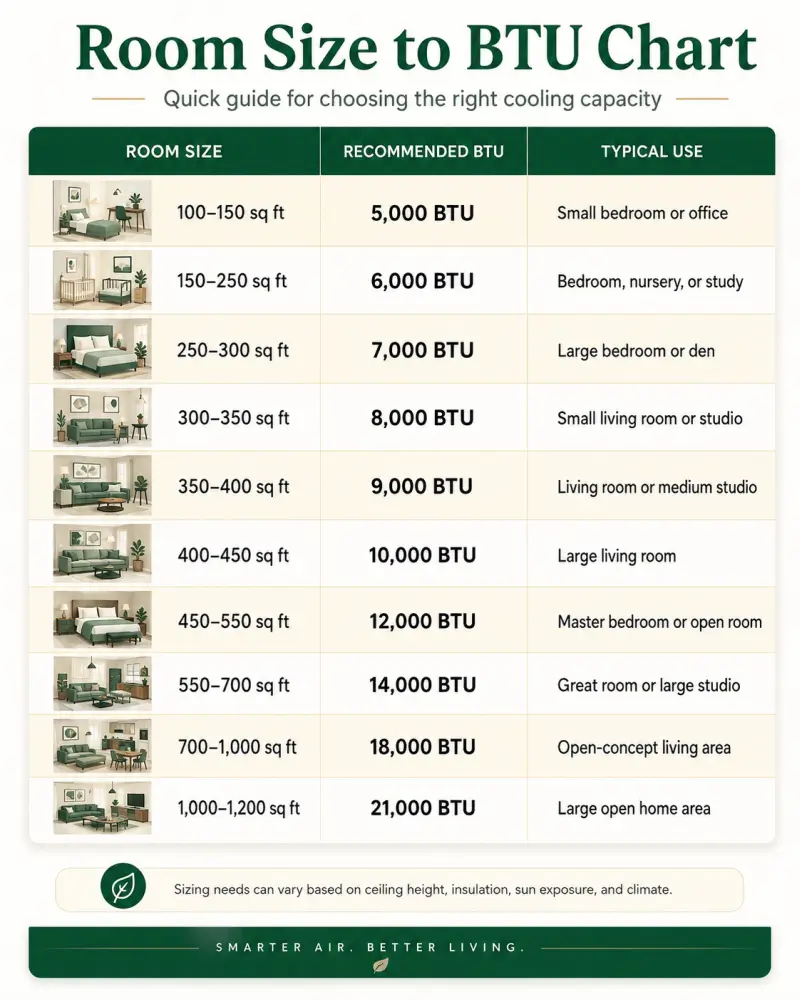
Dallas sits in IECC climate zone 3A: hot and humid, long cooling season, mild winter. Plan on 20 to 25 BTU per square foot for a well-insulated room, more for a garage, a west-facing room, or anything under an uninsulated attic.
Planning figures only. Ask your contractor for a Manual J load calculation.
Oversizing is the more common Dallas mistake, which is why Filterbuy rates its own units conservatively. Our mini split buying guide covers sizing in full.
How Do I Choose a Mini Split Contractor in Dallas?
Texas regulates HVAC at the state level, giving you a verification step most homeowners skip. Any contractor installing a mini split here needs a TDLR Air Conditioning and Refrigeration Contractor license and EPA 608 refrigerant certification. Dallas requires a mechanical permit, and your contractor normally pulls it.
Verify the license. Search the contractor’s name or number in the TDLR license search before you sign anything.
Confirm who pulls the permit. Normally the contractor. A quote that skips it is a red flag.
Ask for the Manual J, a real load calculation rather than a doorway guess, and ask whether they are an Oncor participating provider.
Request the AHRI certificate for your exact model numbers and verify it in the AHRI Directory.
Get three itemized bids and check warranty terms. Unlicensed work voids coverage.
Doing it yourself? Dallas publishes a Homeowner’s Exemption from Contractor Registration, so confirm with Development Services. Plano, Frisco, McKinney, and Allen run their own departments.
What Can a Mini Split Filter Actually Do About Dallas Air?
This is the part Filterbuy could sell you on, and will not. The EPA’s Guide to Air Cleaners in the Home addresses wall-mounted ductless units directly: they are built for temperature control, not filtration, and their filters exist to keep the unit clean, not to remove fine particles. The screen is not MERV-rated.
MERV 13 and above must remove at least 50% of the smallest particles tested. Filterbuy mapped Dallas air by season below because we sell filters into all four, and only two are a filter problem.
DFW is an EPA ozone nonattainment area – severe for the 2008 standard, serious for the 2015. Particle filters do not remove gases.
If someone in your house has cedar fever, pair it with real filtration. See mini split vs. air purifier and mini splits and indoor air quality.
How Often Should You Clean a Mini Split Filter in Dallas?
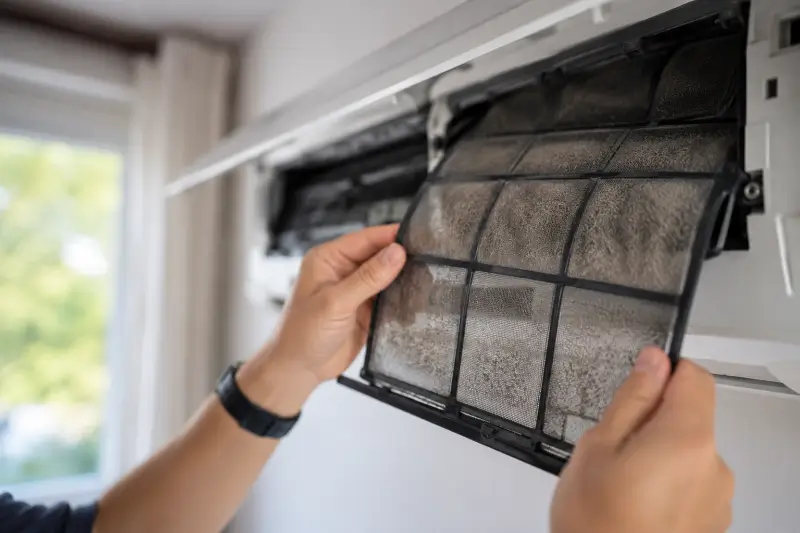
Clean the mesh filter every two weeks in heavy use, monthly otherwise. In Dallas that means every two weeks June through September, and weekly through January’s cedar peak. Filterbuy builds a cleaning reminder into its units because nobody keeps that schedule.
Power the unit off at the wall.
Open the front panel and slide the filters out.
Vacuum loose debris, then rinse in lukewarm soapy water.
Let them dry completely. A damp filter is the most common cause of a musty mini split.
Replace (do not wash) any secondary carbon or ion filter, per your manual.
When to stop cleaning and call for repair
Routine maintenance is yours. Repair is not. Ice on the line set in July, water dripping from the head, a burning smell that survives a dry filter, or warm air on a cool setting all point to refrigerant, drain, or control faults. Refrigerant work is licensed in Texas, so the same rules apply to a repair tech as to your installer.
Brand steps: how to clean mini split filters. Coil and drain service: how often to service a mini split.
Supporting Statistics
Three figures from U.S. government and nonprofit sources.
Almost half of a typical household’s $1,900 annual energy bill goes to heating and cooling.
In Dallas that skews to cooling, May to September.
ENERGY STAR units use up to 60% less energy than electric resistance heat.
Dallas-Fort Worth ranks 9th worst in the nation for ozone, at 27.8 unhealthy days a year.
Denton County: F grade, 2022–2024.
Worse than last year: 10th, 25.5 days.
Source: American Lung Association, State of the Air 2026 (Texas).
EPA: ductless mini splits generally do not filter fine particles.
Their filters protect the equipment from hair and lint.
Any fine-particle claim needs MERV 13 to verify.
Source: U.S. EPA, Do ductless mini splits filter fine particles? (July 2026).
Our Take: Filterbuy Sells Both Sides of This
Filterbuy has made pleated filters in Alabama for over a decade, and builds ductless systems from 12,000 to 24,000 BTU at 17 SEER2. So we have a commercial reason to tell you a mini split cleans your air. We will not. Three things we would rather say out loud.
Buying Filterbuy equipment will probably cost you the Oncor incentive. Our units clear the SEER2 16 floor the program cites. It will not matter: Oncor pays approved providers, not homeowners who supply their own equipment. If the rebate is worth more than the unit, start with Oncor’s provider list.
We rate our capacity conservatively, on purpose. We list our 12,000 BTU unit for 550 square feet where others claim 750. An oversized head cools fast, shuts off early, and never pulls moisture out.
We void our own warranty on self-installs. Same reason Texas requires a license and Dallas a permit.
“The January question is always some version of: I bought a mini split, why am I still miserable? They bought a comfort machine and expected an air cleaner. Cedar pollen does not care how new your equipment is.” Michelle Wan, Filterbuy
“The North Texas jobs I get called back to are almost always oversized. A 24,000 BTU head in a 500-square-foot bedroom, cold and damp because it never runs long enough to dehumidify. Right-sizing beats capacity here.” David Clark, Licensed HVAC Technician
Frequently Asked Questions
Get the Right Filter for Your Dallas Home
Dallas air gives your system a fight eleven months a year. Use the air filter size guide to measure, then shop MERV 13 air filters, shipped free from the Filterbuy factory in Alabama. Odd opening? We build custom air filters too.
Glossary
Ductless mini split. A heat pump with an outdoor compressor feeding one or more indoor heads.
MERV. The 1–16 particle-capture scale. MERV 13 is EPA’s fine-particle threshold. Mesh screens are unrated.
Manual J. The ACCA load calculation that sets equipment size.