Adding a Mini Split AC System in Mississippi:
Installation, Costs & Rebates (MS Guide)
By Michelle Wan · Reviewed by David Clark, Licensed HVAC Technician, Filterbuy HVAC Solutions · Published July 5, 2026 · Last updated July 5, 2026
A ductless mini split in Mississippi runs about $2,000–$6,000 installed for one room and $10,000–$18,000+ for a whole home in 2026. The federal tax credit ended December 31, 2025, so your savings now come from your utility: Entergy Mississippi pays up to $1,100, Mississippi Power up to $200 per ton, and TVA EnergyRight co-ops $500–$800 on a qualifying heat pump. In Mississippi's humidity, right-sizing your system matters more than raw power.

Not sure which system fits your home? Answer 3 quick questions and we'll match you to the right mini split.
Prefer to browse first? Shop Filterbuy mini split systems →
Most 2026 guides get one thing wrong before you even reach the cost table: they tell you to claim the 30% federal tax credit on your new mini split. In Mississippi, in 2026, that credit no longer exists. The good news is that the money that does still work here (utility rebates and, for income-qualified households, federal point-of-sale rebates) is real, and this guide walks you through exactly what applies in your utility territory.
After more than a decade manufacturing air filters and serving over two million households, our Filterbuy HVAC Solutions team has reviewed real installation invoices across brands, configurations, and climates. Mississippi is one of the strongest heat-pump markets in the country. You cool for six or seven months and heat for two or three, but the state's heat and humidity change how you should size and choose a system. We'll cover that too.
The pattern we keep seeing in Mississippi is consistent: the homeowners who get the best results aren't the ones who buy the biggest system. They're the ones who right-size for humidity and line up the utility rebate that still exists before they sign. This guide is built around those two moves.
TL;DR
Adding a ductless mini split in Mississippi costs roughly $2,000–$6,000 for a single zone and $10,000–$18,000+ for a whole-home multi-zone system in 2026, with Mississippi labor running among the lowest in the South. The federal 25C tax credit expired December 31, 2025, so there is no federal tax credit for 2026 installs. Real savings now come from your electric utility (Entergy Mississippi, Mississippi Power, or TVA EnergyRight co-ops) plus federal IRA rebates for income-qualified households once Mississippi's program opens. In a hot, humid climate, right-sizing for moisture removal matters more than raw cooling power.
Key Takeaways
A single-zone mini split runs about $2,000–$6,000 installed in Mississippi; whole-home multi-zone systems (4+ heads) reach $10,000–$18,000+. Low state labor rates tend to put comparable jobs in the lower-to-middle of national ranges.
The federal Section 25C tax credit expired on December 31, 2025 under the One Big Beautiful Bill Act. Mini splits placed in service in 2026 do not qualify for a federal tax credit.
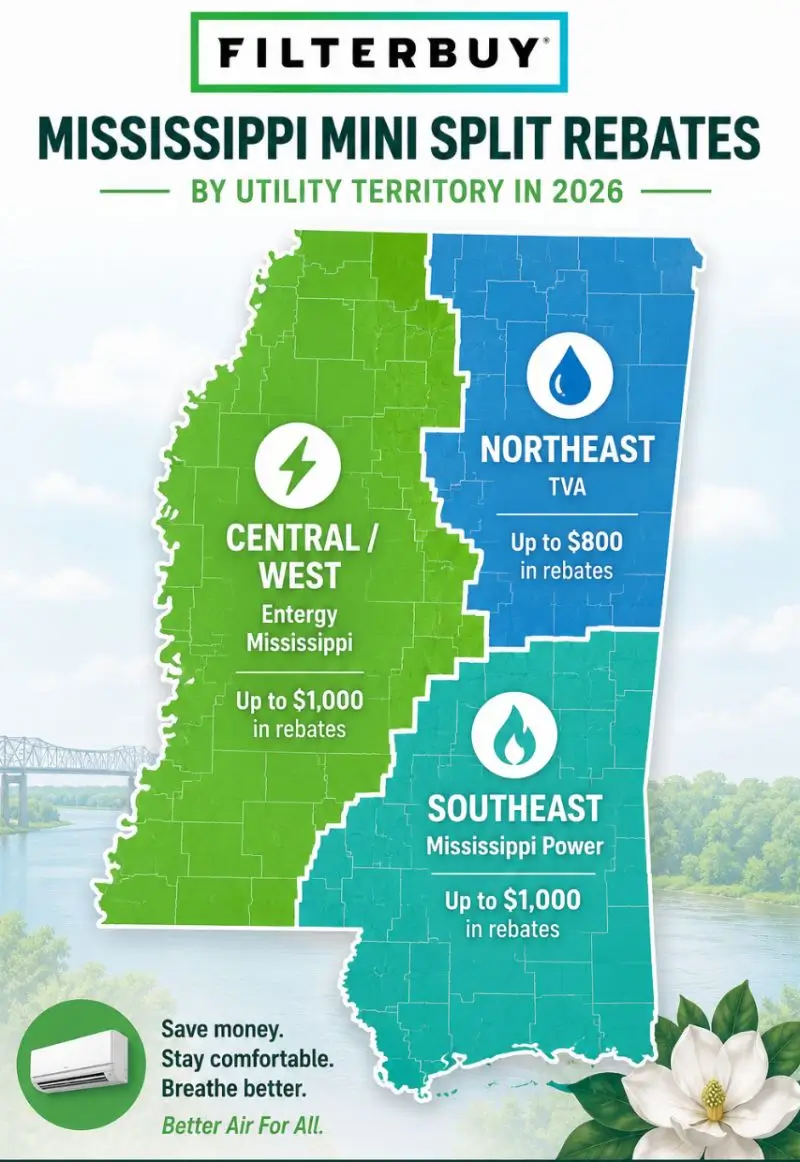
Utility rebates are the money that still works in 2026. Entergy Mississippi pays up to $1,100 on a qualifying high-efficiency heat pump or AC, Mississippi Power up to $200 per ton, and TVA EnergyRight co-ops $500–$800 on qualifying air-source heat pumps.
Federal IRA rebates (HEAR/HOMES) can reach $8,000 for a heat pump for households at or below 150% of area median income, but Mississippi's program was still in setup as of mid-2026, so confirm current status.
Humidity, not heat, is the real design challenge. An oversized mini split short-cycles and leaves the home cool but clammy; a right-sized, variable-speed (inverter) unit runs longer and removes far more moisture.
Mini split filters clog fast in Mississippi's pollen and humidity. A dirty filter cuts airflow, weakens dehumidification, and overworks the compressor, so clean or replace every 60–90 days.
Is a Mini Split a Good Fit for Mississippi Homes?
Yes. Mississippi is close to an ideal climate for a ductless mini split heat pump. The state sits in ASHRAE climate zones 2A along the Gulf Coast and 3A across central and northern Mississippi, both cooling-dominant. The Gulf Coast alone logs roughly 2,800–3,400+ cooling degree days a year, rivaling parts of Florida. Because a mini split heat pump is essentially a very efficient air conditioner that can also heat, the long Mississippi cooling season is exactly where its efficiency advantage compounds.
Across the Mississippi installs and invoices our team has reviewed, mini splits earn their keep in a few specific situations:
Older homes without ductwork, common across the Delta and historic districts, where adding ducts is invasive and expensive.
Room additions, sunrooms, bonus rooms, and garages your central system was never sized to reach.
That one room that's always too hot, the west-facing bedroom that bakes all afternoon.
Whole-home comfort where you'd rather zone room-by-room than rebuild ductwork.
Ductless systems also skip the roughly 30% energy loss that leaks out of ducts running through hot Mississippi attics, delivering conditioned air straight to the room. Per ENERGY STAR, certified mini split heat pumps use up to 60% less energy than standard electric resistance heating. For a plain-language primer, see our guide to what a ductless mini split is.
How Much Does It Cost to Add a Mini Split in Mississippi? (2026)
A ductless mini split costs $2,000–$18,000+ installed in Mississippi in 2026, depending on zone count, BTU capacity, brand, and site complexity. A single-zone system averages $2,000–$6,000 installed; each added zone runs roughly $2,000–$7,000. In the Mississippi invoices we review, the state's low labor rates tend to place comparable jobs in the lower-to-middle of national ranges rather than the top. For the national picture behind these figures, see our mini split cost breakdown and installation cost by zone and size.
Sizing by capacity, using national 2026 installed ranges:
What a Jackson-area install looks like on paper (illustrative)
Most cost guides stop at a big range and never show how the rebate actually nets out. This two-zone example in Entergy Mississippi territory is built from the ranges above (illustrative, not a quote):
Equipment (two mid-tier inverter heads + outdoor unit): $3,000–$5,000
Labor (two zones, standard line runs): $2,000–$3,500
Mechanical permit: $75–$400
Installed subtotal: about $5,000–$9,000 (matches the 2–3 zone range above)
Less Entergy Mississippi rebate on a qualifying heat pump: up to −$1,100
Estimated net after rebate: roughly $3,900–$7,900
These are illustrative ranges, not a bid. Your Manual J load calculation, the AHRI-matched model, and your utility's current rebate set the real number, which is exactly why we tell Mississippi homeowners to confirm all three before signing. Federal tax credits are not part of this math in 2026.
What actually drives your Mississippi quote
Zone count moves the total more than anything else. Each zone is its own indoor head, line set, and labor.
BTU size and correct sizing (oversizing is a costly mistake here; see the humidity section).
Brand and efficiency (SEER2 / HSPF2): entry-level systems run lower; premium Mitsubishi, Daikin, and Fujitsu run 20–40% more but often earn better rebates.
Electrical work: a dedicated circuit or panel upgrade adds $500–$2,000+, usually billed separately.
Permits: most Mississippi municipalities require a mechanical permit, commonly $75–$400.
Refrigerant transition: nearly all 2026 systems use low-GWP A2L refrigerants (R-32 or R-454B), which raised equipment prices ~10–15% versus 2024.
Gulf Coast corrosion: near the coast, salt air eats condensers, so corrosion-resistant coil coatings are worth specifying.
Always require an itemized quote and a Manual J load calculation with every bid. A lump-sum number with no load calc isn't a competitive quote. It's a blank check.
What Does a Mississippi Mini Split Cost to Run, and When Does It Pay Off?
A mini split is cheap to run because it moves heat instead of making it. Most single-zone systems cost only a few dollars a day to operate in Mississippi's climate, and the efficiency gap versus what they replace is where the real money is. Install cost is the sticker price; running cost is what you live with for the next 15 years.
Why the operating cost stays low:
An ENERGY STAR air-source heat pump delivers up to three times more heat energy than the electricity it uses (ENERGY STAR). Source.
A variable-speed inverter runs long and slow at part load, the efficient mode it sits in for most of a Mississippi cooling season.
Ductless delivery skips the 20–30% duct loss that drives up bills on central systems (see Supporting Statistics).
The U.S. Department of Energy groups Mississippi in its “hot-humid” tier, where an efficient air-source heat pump saves money over its life versus a lower-efficiency unit (DOE FEMP). Source.
Payback, in plain terms: against window units, space heaters, or old electric-resistance heat, a right-sized mini split usually pays back the difference in a few years through lower bills, faster in Mississippi than in mild-climate states because your cooling season is so long. Against a working central system in good ducts, the payback is slower; the win there is comfort and zoning, not just dollars. In our experience, the homes that see the fastest payback are the ones that paired the mini split with basic attic sealing first.
How to keep your Mississippi running cost down
Set it and leave it. Heat pumps run most efficiently at a steady temperature, so deep setbacks don't save the way they do on a furnace (ENERGY STAR).
Skip “Auto” mode. Lock it to heat or cool so it doesn't fight itself on a swingy Mississippi shoulder day.
Clean the filter every 60–90 days. A clogged pre-filter is the most common cause of a mini split quietly getting more expensive to run.
Right-size, don't oversize. An oversized unit short-cycles, which wastes energy and leaves the air humid, the opposite of what you want here.
If the upfront cost is the hurdle: several Mississippi utilities have $0-down, on-bill financing for a qualifying heat pump. For example, TVA EnergyRight financing (available through northeast Mississippi co-ops) runs from about $2,500 up to $20,000, repaid on your electric bill. Ask your utility whether financing can be stacked with its rebate. For the full purchase-price picture, see our mini split cost breakdown.
Mississippi Mini Split Rebates in 2026: What's Real, What's Gone
The federal tax credit is gone (don't budget for it)
The Section 25C Energy Efficient Home Improvement Credit, the “30%, up to $2,000” heat-pump credit, expired December 31, 2025. It was terminated by the One Big Beautiful Bill Act (P.L. 119-21, signed July 4, 2025), and the IRS Energy Efficient Home Improvement Credit page, along with the IRS OBBB FAQ, confirms that equipment placed in service on or after January 1, 2026 does not qualify. Placed in service means installed and operational, not when you paid a deposit or signed the contract. If a contractor quotes a price “after the 30% tax credit” for a 2026 install, that's your signal to get another quote.
(If your system was installed and running on or before December 31, 2025, you can still claim the credit on your 2025 return using IRS Form 5695, but that's a 2025 install, not a 2026 one. Our mini split tax credit guide walks through the filing details for 2025 installs.)
“The costliest mistake we see on Mississippi mini-split projects in 2026 isn't the equipment. It's budgeting for a federal tax credit that no longer exists, then missing the utility rebate that does. Across the systems our team tracked in 2025, paperwork and timing cost homeowners more than efficiency ratings ever did. Check your utility first, use a participating installer, and get the AHRI certificate in writing.”
Filterbuy HVAC Solutions team
Federal IRA rebates (HEAR / HOMES) for income-qualified households
The Inflation Reduction Act's rebate programs, the federal Home Energy Rebates (HEAR and HOMES), were funded as grants to states and survived the 2025 law change. HEAR can cover up to $8,000 toward a qualifying heat pump as a point-of-sale discount for households at or below 150% of area median income (AMI), with the largest rebates at or below 80% AMI.
The catch for Mississippi: these are administered by the state through the Mississippi Development Authority Office of Energy, and Mississippi's program was still in setup as of mid-2026, not yet open to homeowner applications. Confirm the current status on the DOE Home Energy Rebates program page before you count on it. Because funding is limited and first-come, it's worth registering interest early.
Utility rebates: the money that works right now
Which rebate you can get depends on who provides your electricity. Mississippi has no statewide HVAC rebate program, so incentives come from your utility. Check your electric bill if you're unsure which territory you're in, and search DSIRE by ZIP for any local program not listed here.
Program pages: Entergy Mississippi Residential Heating & Cooling, Mississippi Power Rebates & Incentives, and TVA EnergyRight mini split rebate.
Three things Mississippi homeowners miss on utility rebates:
Confirm the ductless model qualifies. Programs are often written around central/ducted equipment; a ductless mini split can qualify, but confirm your model meets the SEER2 minimum and appears in the AHRI Directory.
DIY kits usually don't qualify. Most utility rebates require professional installation, often by a participating “trade ally” contractor.
Apply within the window. Several programs require you to apply within a set number of days after installation. Build that into your timeline.
If money is tight
Mississippi's LIHEAP program (through the Department of Human Services) helps income-eligible households with heating and cooling bills and crisis assistance, up to $1,500 for heating/cooling in FY2026. It won't pay for a mini split install, but it can ease the running cost while you plan an upgrade.
Sizing a Mini Split for Mississippi Heat and Humidity
In Mississippi, the biggest sizing mistake is going too big. Humidity, not raw temperature, is what makes a Mississippi summer miserable, and an oversized mini split makes humidity worse. It's the single issue we flag most often when we review Gulf Coast and Delta quotes.
An oversized unit cools the air to the setpoint quickly, then shuts off, a pattern called short-cycling. Pulling moisture out of the air (latent cooling) only happens while the system runs. A unit that blasts cold and stops never runs long enough to dehumidify, so you get a house that's 74°F and clammy, which feels worse than a right-sized 76°F that's actually dry.
“In a humid climate, a properly sized system that runs longer at a lower output beats a bigger system that cools fast and quits. Longer runtime is what wrings the water out of the air.”
David Clark, Licensed HVAC Technician, Filterbuy HVAC Solutions (technical reviewer)
What that means when specifying a system for a Mississippi home:
Insist on a Manual J load calculation. It sizes the system to your home's actual heat and moisture load, not a rule-of-thumb “BTUs per square foot.” Reject any quote without one.
Choose a variable-speed (inverter) mini split. Inverter compressors modulate like a dimmer, running long and slow at low load, ideal for latent moisture removal. Our guide to the best mini splits for hot, humid climates compares models on dehumidification.
Check the dry/dehumidify mode and latent performance. Not all heads dehumidify equally; ask about documented moisture-removal capability.
Spec corrosion resistance on the coast. Gulf Coast salt air shortens condenser life, so corrosion-resistant coil coatings pay off.
Don't over-worry about winter. Standard heat pumps handle Mississippi winters comfortably. In the northern counties, confirm low-ambient heating capacity and defrost if the mini split is your only heat source; true cold-climate models are usually overkill for most of the state.
Adding a Mini Split by Mississippi Region
Mississippi isn't one climate, and the right mini split isn't the same statewide. The Gulf Coast fights salt air and near-tropical humidity; the northern counties see the occasional hard freeze. This table pulls together, in one place, what changes by region (climate zone, which utility runs the rebate, and the one spec worth prioritizing) so you can match the system to where you actually live.
How to Add a Mini Split in Mississippi: Step by Step
Check your rebate eligibility first. Identify your utility, read its current heat-pump rebate terms, and search DSIRE by ZIP. What's available changes how you evaluate every quote.
Decide how many zones you actually need. Walk the house; note which rooms run hot, cold, or sit outside your current system's reach.
Get at least three itemized quotes, each with a Manual J load calculation. No load calc, no deal.
Confirm the specific model qualifies for your rebate. Verify SEER2/HSPF2 against the program threshold and check the AHRI Directory; get the AHRI certificate in writing.
Verify installer credentials. Use a participating/trade-ally contractor where required, and confirm current A2L refrigerant certification. (Curious what the work involves? See our step-by-step mini split installation guide.)
Time it off-peak if you can. Spring and fall installs often mean lower labor costs and faster scheduling than the mid-summer rush.
Set up filter maintenance before the tech leaves. Put a 60–90 day cleaning/replacement reminder in place from day one.
Before You Sign: A Mississippi Mini-Split Checklist
Print this and bring it to every quote. If a contractor can't check these boxes, keep shopping.
[ ] Manual J load calculation included with the quote (no rule-of-thumb sizing).
[ ] AHRI certificate for the exact matched system, in writing. Your rebate depends on it.
[ ] Utility rebate confirmed for your territory (Entergy, Mississippi Power, or TVA co-op) and the model on the eligible list.
[ ] Variable-speed (inverter) unit chosen for real dehumidification, not just fast cooling.
[ ] Corrosion-resistant coils specified if you're within ~10 miles of the coast.
[ ] Itemized, written quote with equipment, labor, permit, and electrical broken out separately.
[ ] No “after the 30% federal tax credit” pricing. That credit ended December 31, 2025.
Mini Split Filters and Air Quality in a Humid Climate
Mississippi's pollen and humidity clog mini split filters faster than almost anywhere. Each indoor head has a washable mesh pre-filter that traps dust, pollen, and pet dander. When it clogs, airflow drops, and lower airflow means weaker dehumidification, higher power bills, and a harder-working compressor. After more than a decade making filters, we see a clear pattern: the mini splits that struggle by year three are almost always the ones mounted where nobody can comfortably reach them to clean. Clean or replace mini split filters every 60–90 days, and lean toward 60 (or less) during spring pollen season or with pets.
Filtration is Filterbuy's home turf. We've spent more than a decade making the filters that go inside HVAC systems for over two million U.S. households, so airflow and air quality are the part of this we know cold, and it's why we flag filter access as a real buying decision, not an afterthought.
If your home also runs a central HVAC system alongside the mini split (common in Mississippi, where a mini split often handles a problem room while ducted equipment covers the rest), keep quality filters on that system too. Filterbuy makes filters in 600+ sizes, factory-direct and made in the USA (including many common mini split sizes), and auto-delivery means the reminder isn't riding on your memory through a busy summer. In a climate this humid, clean filtration is part of keeping the system efficient and the air healthy.
Supporting Statistics
Three figures from U.S. government sources back up why a right-sized ductless mini split fits Mississippi. They also match what our Filterbuy HVAC Solutions team sees in the field.
1. 52%: heating and cooling's share of the average U.S. home's energy use.
Space heating and air conditioning are a home's two biggest energy uses (EIA, 2020).
Mississippi runs cooling six to seven months a year.
An efficient inverter heat pump pays back over that long season.
Source: EIA: Use of Energy in Homes
2. 20–30%: the share of ducted air lost to leaks.
In a typical house, that much conditioned air escapes through leaks and holes (ENERGY STAR).
A mini split has no ducts, so it delivers air straight to the room.
The payoff is biggest in older Mississippi homes with leaky attic runs.
Source: ENERGY STAR: Duct Sealing
3. 88%: U.S. households that use air conditioning.
Nearly nine in ten homes have AC, with the highest use across the hot, humid South (EIA, 2020 RECS).
A heat pump is an air conditioner that also heats.
One efficient system covers the long cooling season and the short heating season.
Source: EIA: 2020 RECS state results
Glossary
Mini split (ductless) system: Heating/cooling system with an outdoor compressor connected by refrigerant lines to one or more indoor “head” units, delivering air directly to a room without ductwork.
Zone: One indoor head serving one area with its own setpoint. “Multi-zone” connects several heads to one outdoor unit.
Heat pump: Equipment that moves heat rather than generating it, providing both cooling and heating.
SEER2: Seasonal Energy Efficiency Ratio 2, the current U.S. cooling-efficiency rating (higher is better).
HSPF2: Heating Seasonal Performance Factor 2, the companion rating for heat-pump heating efficiency.
Manual J: The industry-standard load calculation that sizes a system to a home's actual heating, cooling, and moisture load.
Latent cooling / dehumidification: Removing moisture (not just heat) from indoor air; depends on adequate runtime.
Inverter (variable-speed) compressor: A compressor that modulates output continuously instead of cycling on/off, improving efficiency and humidity control.
AHRI Directory: Public database of certified equipment and matched-system ratings; utility rebates often require an AHRI-listed system.
Section 25C: Federal Energy Efficient Home Improvement Credit (up to $2,000 for heat pumps). Expired December 31, 2025.
HEAR / HEEHRA: IRA-funded, income-qualified rebate program (up to $8,000 for a heat pump), administered by each state.
AMI: Area Median Income, the county-level benchmark that sets HEAR/HOMES eligibility and amount.
A2L refrigerant: Mildly flammable low-GWP refrigerants (R-32, R-454B) used in most 2026 systems, requiring updated installer certification.
Frequently Asked Questions
Your Next Steps
If you're ready to move on a Mississippi mini split, this is the order that saves the most money and headaches:
Confirm your rebate. Identify your utility (Entergy, Mississippi Power, or a TVA co-op) and check its current heat-pump terms before you shop.
Right-size the system. Get three itemized quotes, each with a Manual J load calculation and an AHRI-matched model.
Compare your equipment options. Weigh a premium nameplate against value-tier picks in our expert-tested mini split comparison, or look at Filterbuy's own ductless mini split line, inverter heat-pump systems with WiFi control and free 2-day shipping.
Keep the air clean. Clean the mini split's washable filter on schedule, and if you also run central HVAC, put it on Filterbuy auto-delivery so a fresh, USA-made filter shows up before each change is due.
Questions on sizing or filtration for your specific home? That's the part we know best. Filterbuy has helped millions of households breathe easier, and the same air-quality focus goes into every mini split guide we publish.
Authoritative Resources
IRS: Energy Efficient Home Improvement Credit (Section 25C): confirms the credit's 2026 expiration.
IRS: One Big Beautiful Bill (OBBB) FAQ: the “placed in service” cutoff for 25C/25D.
U.S. DOE: Home Energy Rebates Program: HEAR/HOMES status and how the programs work.
ENERGY STAR: Ductless Heating & Cooling: how mini splits work and efficiency claims.
DSIRE: search every Mississippi utility and state incentive by ZIP.
AHRI Directory: verify a model's certified SEER2/HSPF2 ratings.
Mississippi Development Authority: Office of Energy: the state administrator for Home Energy Rebates.
Mississippi DHS: LIHEAP: income-based heating/cooling bill assistance.
Utility programs: Entergy Mississippi, Mississippi Power, TVA EnergyRight.
Related Filterbuy Guides
How much does a mini split cost in 2026? (update this page's 2026 tax-credit references)
Best mini split air conditioners (incl. humid-climate picks)
This guide is informational and not tax or financial advice. Rebate amounts, program availability, and tax rules change, so verify current details with your utility, the Mississippi Development Authority, DSIRE, and a tax professional before making decisions. Reviewed for technical accuracy by David Clark, Licensed HVAC Technician.