
Do HVAC Filters Really Improve Winter Indoor Air?
February 25, 2026

Many homeowners notice that their homes feel stuffier or dustier during the colder months. And you might wonder if your heating system is to blame or if that rectangular filter in your furnace actually makes a difference.
The short answer is yes, your HVAC filter plays a massive role in your home's air quality during the winter, especially when your system is working overtime to keep you warm. Understanding how it works and why upgrading to a better filter like one from Filterbuy matters can be the difference between breathing easy and struggling with winter allergies.
TL;DR Quick Answers
Do HVAC filters improve air quality in winter?
Yes — and winter is the season your filter matters most. When your home is sealed tight against the cold, your furnace becomes the only thing moving air through your living space. A quality pleated filter in the MERV 8 to 13 range actively traps dust, pet dander, mold spores, and microscopic allergens every time your heater cycles on.
After over a decade of manufacturing filters in the U.S. and serving millions of households, here's what we know for certain:
Indoor air is 2 to 5x more polluted than outdoor air (EPA) — and winter's sealed-home conditions make it worse
A clean filter cuts HVAC energy use by 5% to 15% (U.S. Department of Energy) — saving you money when your furnace is running overtime
A clogged filter is a leading cause of HVAC system failure — a preventable breakdown that costs thousands
What to do right now:
Check your current filter — if it's gray, swap it out today
Upgrade to a pleated MERV 8 (basic), MERV 11 (pets/allergies), or MERV 13 (maximum protection)
Replace every 60–90 days in winter — or every 30–45 days with pets or heavy furnace use
The short version? A $15 filter change that takes 60 seconds is the single most effective thing you can do for your home's air quality, energy efficiency, and HVAC protection this winter.
Top Takeaways
Your HVAC filter absolutely improves winter air quality — if it's the right one. A pleated filter in the MERV 8 to 13 range scrubs pollutants from your air every time your furnace cycles. A clogged or cheap fiberglass panel? Barely doing anything.
Winter is the toughest season for your home's air. Sealed windows and a furnace running nonstop trap pollutants with nowhere to go. The EPA confirms indoor air is often 2 to 5 times more polluted than outdoor air — and can spike up to 100 times worse.
A dirty filter hits your wallet three ways:
Energy bills climb 5% to 15%, according to the U.S. Department of Energy
Your blower motor strains harder, shortening its lifespan
Restricted airflow is a leading cause of HVAC system failure — repairs that dwarf the cost of a new filter
Picking the right MERV rating is straightforward:
MERV 8 — Everyday dust and pollen, no pets or severe allergies
MERV 11 — Pet owners and mild allergy sufferers (our most popular)
MERV 13 — Maximum residential protection against smoke, bacteria, and microscopic allergens
The fix takes 60 seconds and costs less than a pizza. No expensive equipment. No service call. Just a fresh Filterbuy pleated filter — made in the USA, shipped fast and free to your door — and your home's air, efficiency, and HVAC protection improve immediately.
Why Indoor Air Quality Gets Worse in Winter
It seems counterintuitive that air quality would drop when you aren't bringing in pollen from the outdoors. However, winter presents a unique set of challenges for your home's atmosphere.
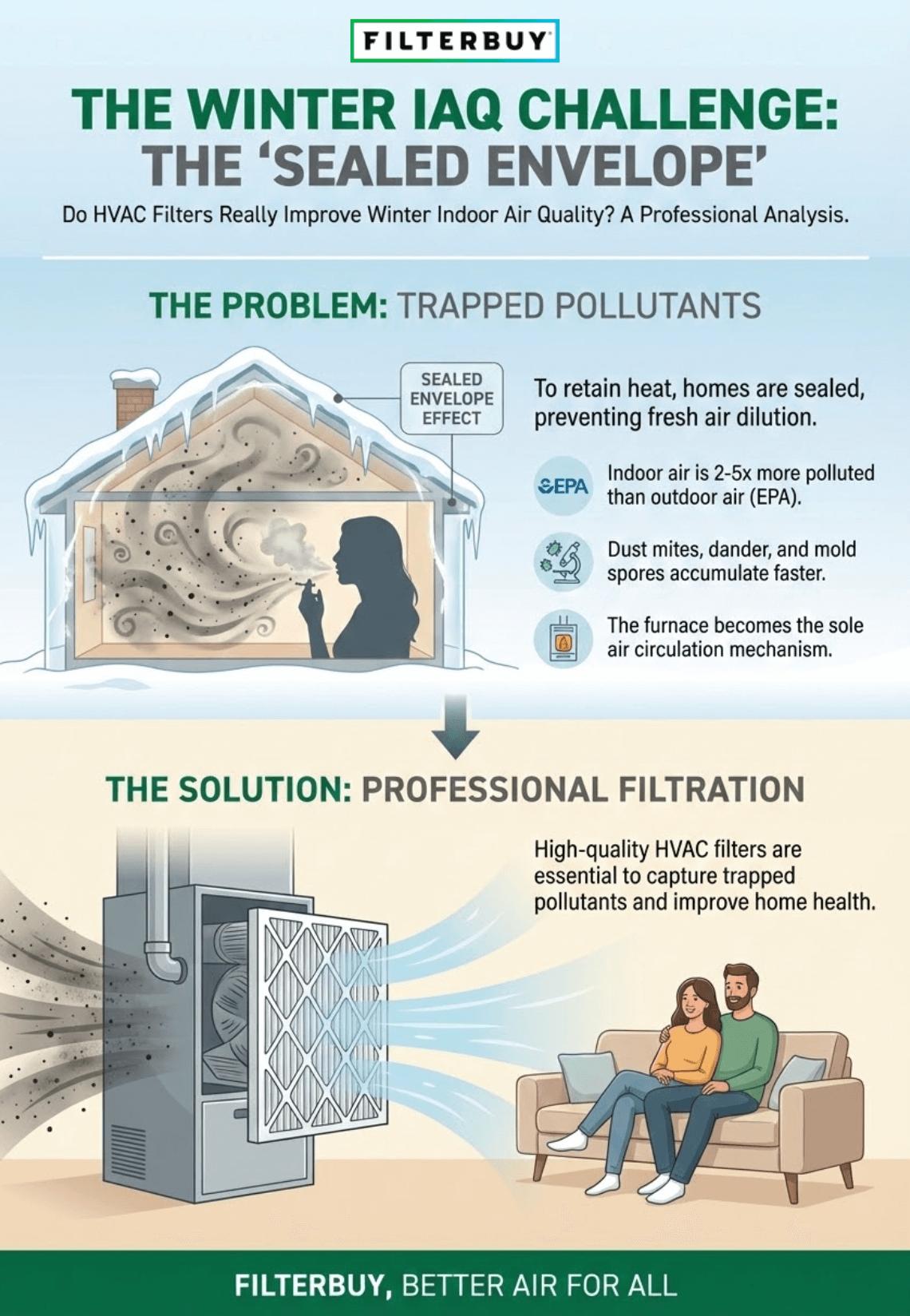
To keep energy bills down and comfort up, we seal our homes as tightly as possible. We use weather stripping and keep windows locked shut for months at a time. This creates a "sealed envelope" effect. While great for heat retention, it prevents fresh air from diluting indoor pollutants.
Simultaneously, your heating system is running frequently, constantly recirculating the existing air. Dust mites, pet dander, cooking fumes, and even fibers from cozy blankets build up faster than they can escape. Without fresh airflow, these contaminants accumulate, making effective filtration more critical in January than in June.
Do HVAC Filters Improve Air Quality in Winter?
This is the big question: do hvac filters improve air quality winter weather has been compromised?
Absolutely. But only if you are using the right kind of filter.
Think of your HVAC filter as the gatekeeper of your home’s respiratory system. As your furnace pulls air in to heat it, that air must pass through the filter first. A quality filter captures airborne particles, trapping dust, pollen, and dander in its fibers before the air is warmed and pushed back into your living rooms and bedrooms.
If you use a high-quality filter, you are effectively scrubbing the air every time your heater cycles on. However, if your filter is clogged with months of debris, it can’t do its job. Worse, a dirty filter can restrict airflow, forcing unfiltered air to bypass the system or causing your furnace to work harder than necessary.
Why Pleated HVAC Filters Are a Smart Choice
Not all filters are created equal. You may have seen the inexpensive, flat fiberglass filters at the hardware store. While these are cheap, they are designed primarily to protect your furnace equipment from large debris, not to clean the air you breathe.
For winter air quality, pleated air filters are a far superior choice.
Pleated filters are made from synthetic materials folded like an accordion. This design choice is brilliant for two reasons:
Surface Area: The folds drastically increase the surface area of the filter material, allowing it to capture more particles without clogging as quickly.
Efficiency: They are generally denser than fiberglass, meaning they can trap smaller particles like pet dander and mold spores.
Despite being denser, a clean pleated filter allows for excellent airflow, ensuring your heating system doesn't struggle to push warm air throughout your home.
Understanding MERV Ratings
When you shop for pleated filters, you will see a "MERV" rating. This stands for Minimum Efficiency Reporting Value. It’s essentially a score of how effective the filter is at trapping tiny particles.
MERV 8 air filter: This is the standard for residential homes. It does a great job of catching dust, lint, and pollen. If you don't have pets or severe allergies, this is likely all you need.
MERV 11 air filter: If you have pets, a MERV 11 air filter is a step up. It captures finer particles, including pet dander and some auto emissions that might sneak in from the garage.
MERV 13 air filter: This is the top tier for most residential HVAC systems. A MERV 13 air filter can trap bacteria-carrying particles, smoke, and microscopic allergens. It offers the highest level of protection for winter indoor air quality.
For most families, staying in the MERV 8 to 13 range provides the ideal balance of filtration and airflow. Going higher than MERV 13 is usually reserved for hospitals and surgery centers and can actually restrict airflow in a standard home furnace.
When to Replace a Furnace Filter at Home
Knowing when to replace the air filter in home maintenance schedules require is key to keeping that air clean.
The standard recommendation is to change your filter every 60 to 90 days. However, winter changes the game. Because your heating system is running more often, more air is cycling through the filter, causing it to load up with dust faster.
If you have pets, burn scented candles, or use a fireplace, you should check your filter once a month. If it looks gray and fuzzy, swap it out. A fresh filter ensures your heater runs efficiently and your air stays clean.
How Often to Change an Air Filter in an Apartment
Living in a multi-unit building brings different variables. If you are wondering how often to change the air filter in apartment settings, the answer depends on your building's infrastructure.
In apartments, ductwork is sometimes shared or connected to common areas, which can introduce dust and odors from neighbors or hallways. Because of this higher potential for contamination, it is wise to check your filter monthly.
If you have a dedicated furnace closet in your unit, the 60-to-90-day rule still applies, but lean toward the 60-day mark during winter. Apartment systems are often compact and can get overworked quickly if airflow is restricted by a dirty filter.
What Happens If You Don’t Change Your Filter in Winter
Ignoring your filter in the winter has consequences beyond just dustier shelves.
Higher Energy Bills: A clogged filter forces your furnace fan to work harder to pull air through. This extra effort uses more electricity and gas, leading to a spike in your utility bills.
Uneven Heating: Restricted airflow means warm air isn't getting to the vents efficiently. You might find that some rooms are freezing while others are roasting.
HVAC System Strain: The number one cause of HVAC failure is a dirty filter. The strain can cause motors to overheat or heat exchangers to crack—repairs that are significantly more expensive than a new filter.
Why Filterbuy Is the Best Place to Buy Pleated HVAC Filters
When you are ready to upgrade your winter air quality, you need a source you can trust. Filterbuy isn't just a retailer; we are indoor air quality experts who manufacture our filters right here in the USA.
We focus specifically on high-quality MERV 8, 11, and 13 pleated filters designed for residential and apartment systems. Whether you have a standard size or need a custom fit for an older unit, we have you covered.
With over 85,000 5-star reviews, we take the hassle out of home maintenance. You don't need to wander the aisles of a big-box store wondering which size is yours. We offer easy subscription options so your replacement filters arrive at your door exactly when you need them.
Winter HVAC Filter Best Practices
To keep your home comfortable and healthy this season, follow these simple best practices:
Match the MERV to your lifestyle: Use MERV 8 for basics, MERV 11 for pets, and MERV 13 for maximum protection.
Set a reminder: The holidays are busy, and it's easy to forget maintenance. Set a phone reminder to check your filter on the first of every month.
Pair with a check-up: When you change your filter, take a quick look at your vents to make sure they aren't blocked by furniture or curtains. This helps your system breathe even better.
Take Control of Your Indoor Air With Filterbuy
Don't let stale air and dust take over your home this winter. A simple filter change can improve your health, protect your HVAC system, and lower your energy bills.
Find the right MERV 8–13 pleated filter for your home today with Filterbuy and breathe easier all season long.
"After manufacturing millions of pleated filters and hearing from thousands of homeowners, we can tell you the single biggest mistake people make in winter isn't setting their thermostat wrong—it's forgetting that a sealed-up home means your filter is working twice as hard with nowhere for trapped pollutants to go."
Your Winter Air Quality Homework — 7 Resources Worth Bookmarking
We're air-obsessed, so we've done the digging for you. Whether you're figuring out why your home feels stuffier in January or deciding which filter actually makes a difference, these seven trusted resources will help you take charge of your indoor air — no guesswork required.
1. See How Your HVAC Filter Fits Into the Bigger Air Quality Picture
EPA: Guide to Air Cleaners in the Home
Your filter is one piece of a three-part strategy: source control, ventilation, and filtration. This consumer guide covers portable air cleaners and furnace or HVAC filters used in a home, including tips for selecting the right option. US EPA It's a great starting point if you want to understand how all the pieces work together — and why upgrading your filter is one of the easiest wins.
🔗 https://www.epa.gov/indoor-air-quality-iaq/guide-air-cleaners-home
2. Finally Understand What MERV Ratings Mean (Without the Jargon)
EPA: What Is a MERV Rating?
MERV ratings can sound technical, but they don't have to be. The rating system was developed by ASHRAE to help consumers compare filter performance, with higher numbers indicating better particle capture. US EPA Think of it as your filter's report card. This quick explainer helps you see exactly what a MERV 8, 11, or 13 catches — so you can match the right filter to your home and your family's needs.
🔗 https://www.epa.gov/indoor-air-quality-iaq/what-merv-rating
3. Know What's Really Floating Around Your Home (Even When You Can't See It)
American Lung Association: Clean Air at Home
Here's the thing most homeowners don't realize: the indoor air you breathe can be hazardous to your health without any telltale signs. American Lung Association The Lung Association breaks down the specific health effects of poor indoor air and gives you practical, actionable steps — especially important if anyone in your household deals with asthma or allergies.
🔗 https://www.lung.org/clean-air/indoor-air/building-type-air-resources/at-home
4. Learn Why Winter Is the Toughest Season for Your Home's Air
EPA: Winter Weather and Indoor Air Quality
Sealed-up windows and a furnace running nonstop create the perfect storm for indoor pollutant buildup. Winter storms and cold temperatures can create potentially dangerous conditions in and around your home, including by impacting your indoor air quality. US EPA This EPA resource covers the winter-specific risks most people overlook — from trapped cooking fumes to combustion appliance hazards — and how to stay ahead of them.
🔗 https://www.epa.gov/emergencies-iaq/winter-weather-and-indoor-air-quality
5. Stop a Dirty Filter From Quietly Driving Up Your Energy Bills
ENERGY STAR: How to Keep Your HVAC System Working Efficiently
A clogged filter doesn't just hurt your air quality — it hits your wallet, too. A dirty air filter will cause your heating and cooling system to work harder to distribute air throughout your home, increasing energy costs and potentially damaging equipment, leading to early failure. ENERGY STAR This ENERGY STAR checklist connects regular filter swaps to real savings and a longer life for your furnace. It's one of the simplest things you can do, and it takes about 60 seconds.
🔗 https://www.energystar.gov/products/ask-the-experts/how-keep-your-hvac-system-working-efficiently
6. Pick the Right MERV 8, 11, or 13 Pleated Filter for Your Home
Filterbuy: All About MERV Ratings — Chart, Range, and Scale
This is where we come in. We've been manufacturing pleated filters in the U.S. for over a decade, and we've helped millions of homeowners figure out exactly which filter fits their life. Filterbuy focuses on pleated, electrostatic filters in MERV 8, 11, 13, and a specialized Odor Eliminator option Filterbuy — with a side-by-side comparison chart and straight answers to the questions we hear most: pets, allergies, system compatibility, and how often to swap them out.
🔗 https://filterbuy.com/resources/air-filter-basics/all-about-merv-ratings/
7. Get the Full Rundown on Every Pollutant Source in Your Home
EPA & CPSC: The Inside Story — A Guide to Indoor Air Quality
Want the whole picture? This comprehensive guide was prepared by the EPA and the U.S. Consumer Product Safety Commission to help people decide whether to take actions that can reduce indoor air pollution in their own homes. US EPA It walks you through pollutant sources room by room, explains the health risks in plain language, and lays out corrective steps for every budget. If you're the type who likes to do your homework, this one's for you.
🔗 https://www.epa.gov/indoor-air-quality-iaq/inside-story-guide-indoor-air-quality
Supporting Statistics: What the Research Confirms (And What We See Every Day on the Factory Floor)
After manufacturing millions of filters and hearing from homeowners across the country, we've developed a clear picture of what happens when people take their indoor air seriously — and what happens when they don't. The leading U.S. research backs up exactly what we've been telling our customers for over a decade.
1. Your Winter Air Is Likely 2 to 5 Times More Polluted Than Outside
The EPA's own research confirms what we hear from customers every winter: Americans spend approximately 90 percent of their time indoors, where the concentrations of some pollutants are often 2 to 5 times higher than typical outdoor concentrations.
Why this gets worse in winter:
Sealed windows and weather stripping trap pollutants inside with no fresh air to dilute them
Dust, pet dander, cooking fumes, and cleaning product residues accumulate faster than they can escape
Your furnace recirculates that same contaminated air every time it cycles on
What we see firsthand: One of the most common things new customers tell us is "I didn't realize how dusty my home had gotten until I swapped in a pleated filter and saw what it caught in just 30 days." That gray, fuzzy filter they pull out tells the whole story.
Source: U.S. Environmental Protection Agency — Report on the Environment: Indoor Air Quality
🔗 https://www.epa.gov/report-environment/indoor-air-quality
2. A Clean Filter Can Cut Your Energy Use by 5% to 15%
A dirty filter doesn't just hurt your air — it hits your furnace hard. The U.S. Department of Energy confirms: replacing a dirty, clogged filter with a clean one can lower your air conditioner's energy consumption by 5% to 15%.
Why this matters most in winter:
Your heating system cycles more frequently, pushing more air through the filter daily
A clogged filter forces the blower motor to strain harder, running longer cycles and burning more fuel
That extra strain doesn't just cost money — it shortens your system's lifespan
What we've learned from our customers: Homeowners on our auto-delivery subscription have told us they noticed a measurable drop in their utility bill the very first month after switching from a flat fiberglass panel to a pleated MERV 11 or MERV 13 filter. A clean, properly rated pleated filter lets your system breathe the way it was designed to — shorter cycles, less fuel, longer equipment life.
Source: U.S. Department of Energy — Maintaining Your Air Conditioner
🔗 https://www.energy.gov/energysaver/maintaining-your-air-conditioner
3. Indoor Pollution Can Spike to 100 Times Outdoor Levels
This is the number that stops homeowners in their tracks. The American Lung Association reports: indoor air can be 2-5 times, even up to 100 times, more polluted than outdoor air.
Based on feedback from over 85,000 five-star reviews, the homes most at risk share a few common traits:
Multiple pets shedding dander around the clock
Heavy use of scented candles, fireplaces, or wood-burning stoves
Limited ventilation and tightly sealed construction
Filters that haven't been changed in four months or more
Winter amplifies every one of those factors. That's exactly why we designed our MERV 8, 11, and 13 pleated filters to cover this full range of household conditions — from everyday dust control up to trapping smoke particles, microscopic allergens, and bacteria-carrying particulates. When we test our filters against real-world pollutant loads at our U.S. manufacturing facilities, the difference between a basic fiberglass panel and a quality pleated filter is dramatic and measurable.
Source: American Lung Association — Clean Air Indoors
🔗 https://www.lung.org/clean-air/indoor-air
Final Thought: The Biggest Winter Air Quality Mistake Is Assuming You Don't Have a Problem
Here's an opinion we've earned after over a decade of manufacturing filters in the U.S., serving millions of households, and reading tens of thousands of customer stories: the single most expensive mistake homeowners make in winter isn't choosing the wrong thermostat setting — it's forgetting that the air inside their sealed-up home has nowhere to go.
The Pattern We See Every Winter
We've watched this cycle repeat year after year:
October: Homeowner seals their windows and weather-strips the doors
November: Furnace kicks on and starts recirculating the same trapped air
January: Mystery allergy flare-ups, dustier shelves, a utility bill that's crept up, and maybe an HVAC repair call nobody saw coming
Almost every time, the root cause traces back to the same overlooked rectangle sitting inside the return vent — a filter that's been silently choking the system for months.
Why We Think About Filters Differently
Most people treat an air filter as a maintenance item. After building filters at our facilities in Alabama, Florida, Pennsylvania, and Utah — and hearing directly from the families who rely on them — we see it differently. A quality pleated filter is the most cost-effective health and efficiency tool in your entire home.
Nothing else in your house simultaneously:
Removes allergens, dust, pet dander, and microscopic pollutants from every breath your family takes
Protects a furnace that costs thousands of dollars to replace
Lowers your energy consumption with a swap that takes 60 seconds
Pays for itself within the first month through reduced system strain
What the Data Confirms and Experience Proves
The government data we've cited on this page — from the EPA, the Department of Energy, and the American Lung Association — confirms what we already knew from the factory floor. Indoor air quality is worse in winter, dirty filters drive up bills and shorten system life, and pollutant levels inside your home can reach concentrations most people would find shocking.
But here's the part that doesn't show up in any study: The fix is absurdly simple. You don't need an expensive air purifier, a specialist, or a ductwork renovation. You need the right pleated filter — matched to your household, changed on schedule, and fitted properly. That's it.
What We Built Filterbuy to Do
We sold our first filter in 2013 around one belief: clean indoor air shouldn't be complicated, expensive, or hard to find.
Over 600 sizes so you always find your exact fit — including custom orders
Manufactured in the USA at our facilities in Alabama, Florida, Pennsylvania, and Utah
Shipped factory-direct — fast, free, no middlemen, no markups
Auto-delivery available so you never have to wonder if it's been too long since your last change
The Difference We Hear About From Real Homeowners
In our experience, the homeowners who match the right MERV rating to their lifestyle and swap their filter every 60 to 90 days are the ones who tell us their homes feel different:
Fewer allergy symptoms, especially through the winter months
Noticeably lower heating bills
A furnace that just runs quietly the way it should
That's not a sales pitch. That's what we've observed across millions of filters delivered to real families in real homes across the country.
Next Steps: Take Control of Your Winter Air Quality Today
You've seen the research. You know why your filter matters more in winter than any other season. Now it's time to act. Here's exactly how to get started — it takes less than five minutes.
Step 1: Find Your Filter Size
Check the size printed on the frame of your current filter. It's usually along one edge and looks something like 20x25x1 or 16x20x4. No filter installed? Measure the length, width, and depth of your filter slot in inches.
Can't find your size? Filterbuy offers over 600 standard sizes plus custom filters made to order. If it fits in an HVAC system, we can build it.
Step 2: Choose the Right MERV Rating
Not sure which level of protection you need? Here's the quick guide we share with customers every day:
MERV 8 — Standard Protection: Captures dust, pollen, and lint. Best for households without pets or severe allergies.
MERV 11 — Superior Protection: Traps pet dander, mold spores, and some auto emissions. Our most popular choice for families with pets or mild allergy concerns.
MERV 13 — Optimal Protection: Filters bacteria-carrying particles, smoke, and microscopic allergens. Ideal for asthma and allergy sufferers or anyone who wants the cleanest air possible.
Our recommendation from years of real-world experience: When in doubt, go with MERV 11. It hits the sweet spot for the vast majority of homes. Respiratory issues or a high-pollutant environment? Step up to MERV 13.
Step 3: Set Your Replacement Schedule
A filter only protects you if it's fresh. Based on what we've learned from millions of filters shipped to real households:
Every 90 days — Most homes, no pets, light furnace use
Every 60 days — One pet, moderate furnace use, or mild allergies
Every 30–45 days — Multiple pets, heavy furnace use, fireplace or candle use, asthma, or severe allergies
Winter pro tip from our team: Your furnace runs more and your home is sealed tighter this time of year. Your filter loads up faster than you'd expect. Check it monthly — if it looks gray, don't wait for the calendar. Swap it out.
Step 4: Set Up Auto-Delivery and Forget About It
Life gets busy, especially during the holidays and the coldest months. Filterbuy's auto-delivery takes the guesswork out of filter changes entirely:
Right filters arriving on time, every time — no store runs
Fast, free shipping on every delivery, factory-direct from our U.S. facilities
Change your size, MERV rating, or schedule anytime
One less thing on your winter to-do list
Step 5: Swap Your Filter and Feel the Difference
The easiest part. Three quick moves:
Pull out the old filter
Slide in the new one with the airflow arrow pointing toward the furnace
Make sure no furniture, curtains, or boxes are blocking your return vents
Total time: about 60 seconds.
Within the first month, many of our customers tell us they notice:
Less dust accumulating on surfaces
Fewer allergy symptoms throughout the house
Frequently Asked Questions
Q: Do HVAC filters actually make a difference in winter indoor air quality?
A: Yes — and winter is when they matter most. After manufacturing filters in the U.S. since 2013 and serving millions of households, we can say this with confidence. But here's the nuance most people miss: it only works with the right kind of filter.
We've tested this extensively at our facilities. The performance gap between a quality pleated filter and a cheap fiberglass panel is staggering:
A pleated MERV 8 to 13 filter traps dust, dander, mold spores, and microscopic allergens with every furnace cycle
A flat fiberglass filter does little more than protect equipment from large debris — it's not meaningfully cleaning your air
What our customers tell us after switching for the first time:
Less dust accumulating on furniture within days
Allergy symptoms easing up within weeks
A general sense that their home feels fresher — even with every window sealed shut
Q: Why does indoor air quality get worse in winter specifically?
A: This is something we've spent years educating homeowners about because it's so counterintuitive. People assume winter air is cleaner since there's no pollen. From what we've observed through thousands of customer conversations, the opposite is true.
Two forces work against you at the same time:
Your home becomes a sealed envelope. Weather stripping, closed windows, and insulation trap every indoor pollutant — cooking fumes, pet dander, dust mites, candle soot, cleaning chemicals — with no fresh air to dilute them.
Your furnace recirculates that same contaminated air. Every cycle pushes the same trapped pollutants through your home over and over. It's a compounding problem most families don't notice until symptoms appear.
The EPA confirms what we see in practice: indoor pollutant concentrations are typically 2 to 5 times higher than outdoor levels. In our experience, winter is consistently the season when new customers reach out for the first time — usually because unexplained allergy flare-ups or visible dust buildup finally prompted them to investigate.
Q: What MERV rating should I use for winter air quality?
A: After more than a decade of manufacturing and testing filters against real-world household conditions, here's the straightforward recommendation we've developed:
MERV 8 — Standard Protection. Captures dust, pollen, and lint. Best for homes without pets or severe allergies. A significant upgrade from any fiberglass panel.
MERV 11 — Superior Protection (our best-seller). Traps pet dander, mold spores, and some auto emissions. In our experience, this is the sweet spot where most families notice the biggest improvement — especially pet owners.
MERV 13 — Optimal Protection. Filters bacteria-carrying particles, smoke, and microscopic allergens. Designed for asthma, severe allergies, nearby construction, or anyone who wants the cleanest possible air.
Important: Going above MERV 13 is typically reserved for hospitals and can restrict airflow in standard home systems. We've seen homeowners try MERV 16 filters in residential furnaces and end up with worse performance and higher bills. Stay in the 8 to 13 range for the best balance of protection and system efficiency.
Q: How often should I change my HVAC filter in winter?
A: More often than most people realize. The standard recommendation is every 60 to 90 days, but winter rewrites the rules. Your furnace runs significantly more in cold months, cycling more air through the filter daily.
Our winter replacement schedule based on millions of filters delivered to real homes:
Every 90 days — Light furnace use, no pets, minimal pollutant sources
Every 60 days — One pet, moderate furnace use, or mild allergies
Every 30–45 days — Multiple pets, fireplace or candle use, heavy furnace operation, asthma, or severe allergies
Best practice from our team: Check your filter on the first of every month during winter. Pull it out and hold it up to the light. If it looks gray and matted, don't wait for the calendar — swap it. A $15 filter change today prevents the problems that lead to a $500 repair call tomorrow.
Q: Can a dirty filter in winter actually damage my HVAC system?
A: It absolutely can. From what we've seen across our customer base, a neglected filter is one of the most common — and most preventable — causes of winter HVAC breakdowns. We hear these stories every season from homeowners who call after an emergency repair, wishing they'd changed their filter sooner.
Here's the chain reaction that happens when a filter gets clogged:
Energy bills climb quietly. The U.S. Department of Energy estimates a clogged filter increases consumption by 5% to 15%. With winter heating costs already high, that adds up fast.
Heating becomes uneven. Restricted airflow means warm air can't reach vents efficiently. You get rooms that are freezing and others that are too warm — and no amount of thermostat adjusting fixes it.
Critical components start to fail. The blower motor overheats from working overtime. The heat exchanger can crack under stress — a repair that often costs more than the system is worth.
The bottom line from our experience: A quality pleated filter costs less than a family dinner out. Replacing it takes 60 seconds. And backed by over 85,000 five-star reviews, it's the single highest-return maintenance task you can do for your home this winter. Don't let a $15 oversight turn into a $3,000 repair.
Your HVAC Filter Is the Answer to Better Winter Indoor Air — Here's Your Next Step
Now that you know how much your filter impacts your home's health, comfort, and energy bills this winter, the only thing left is to make the switch. Find the right MERV 8, 11, or 13 pleated filter for your home at Filterbuy.com — manufactured in the USA and delivered fast, free, and factory-direct to your door.