September 15, 2026

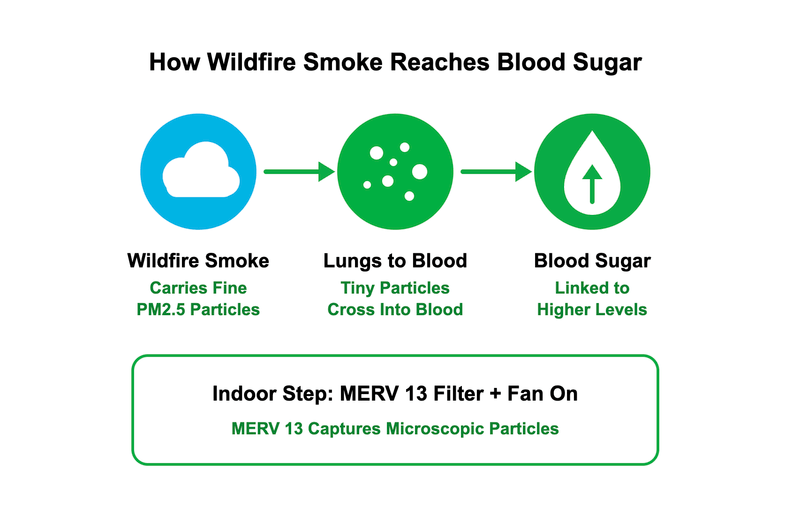
Yes, it can. Research links wildfire smoke to higher blood sugar and more diabetes hospital admissions. The concern is PM2.5, fine particles that can pass from the lungs into the bloodstream. The EPA recommends a MERV 13 filter with your HVAC fan set to "On" during smoky periods.
Not sure which filter fits your system? Take the quick quiz below.
Find Your Filter Match
Answer a few quick questions and we'll match you to the right filter.
Wildfire smoke is a source of PM2.5, the fine particle pollution now linked in peer-reviewed research to higher blood sugar, insulin resistance, and diabetes hospitalizations. A 2024 multi-country study in Diabetes Care found that diabetes hospital admissions climbed in the days after wildfire smoke spikes. Federal guidance still does not list people with diabetes as an at-risk group of their own, though the evidence suggests it should. At home, the best defense is a MERV 13 filter, a sealed house, and a clean room. One caveat that most guides leave out: smoke wears a filter down without changing how the system sounds, so replace it on a schedule instead of waiting for the airflow to drop.
PM2.5 is the pollutant that matters in wildfire smoke. Particles under 2.5 microns cross from the lungs into the bloodstream, where they drive inflammation linked to metabolic effects.
Each 10 ug/m3 rise in wildfire-specific PM2.5 was associated with roughly a 2.3% increase in type 2 diabetes hospitalizations over the same day and next three days, across 3.6 million hospitalizations in Diabetes Care (2024).
Running the fan matters as much as the filter. The EPA reports a high-efficiency filter may cut indoor PM2.5 by about 50% with the fan running continuously, versus about 24% for a low-efficiency filter.
A smoke-loaded filter fails silently. EPA-funded testing of 17 filter media found charged synthetic media lost most smoke-capture efficiency within 80 minutes while airflow resistance barely moved, so the usual airflow cue never appears.
Sealing the house has a ceiling. CDC notes diabetes can impair the body's ability to cool itself, so the standard smoke advice to close everything up collides with heat risk. Central AC on recirculate with a MERV 13 filter is the one setup that cools and filters at once.
Diabetes is under-named in federal smoke guidance. The EPA at-risk fact sheet mentions diabetes only under cardiovascular risk, while the Minnesota Department of Health lists people with diabetes as their own at-risk group.
Does Wildfire Smoke Affect Blood Sugar?
Wildfire smoke can affect blood sugar. The strongest evidence comes from a 2024 study in Diabetes Care, which analyzed 3,612,135 diabetes hospitalizations across 1,008 locations in seven countries between 2000 and 2019. Each 10 ug/m3 increase in wildfire-specific PM2.5 over the current day and previous three days carried a relative risk of 1.023 for type 2 diabetes hospitalization and 1.017 for all-cause. In plain terms: when smoke arrived, more people with diabetes ended up in the hospital within days.
Smoke appears more harmful than ordinary urban pollution. The same study found wildfire PM2.5 carried greater risk than non-wildfire PM2.5 and drove 38.7% of PM2.5-related diabetes hospitalizations. A separate analysis of cardiopulmonary hospitalizations across 20 U.S. states found the effects of both were stronger among people with obesity or diabetes.
Those are short-term effects, and they sit on top of a much larger body of long-term research. Over years rather than days, a 10 ug/m3 rise in PM2.5 carried a 15% higher risk of developing diabetes in a large longitudinal cohort study in The Lancet Planetary Health, which also tied ambient PM2.5 to roughly 3.2 million incident diabetes cases globally in 2016. A later Global Burden of Disease analysis estimated that about a fifth of the worldwide burden of type 2 diabetes is attributable to PM2.5 pollution.
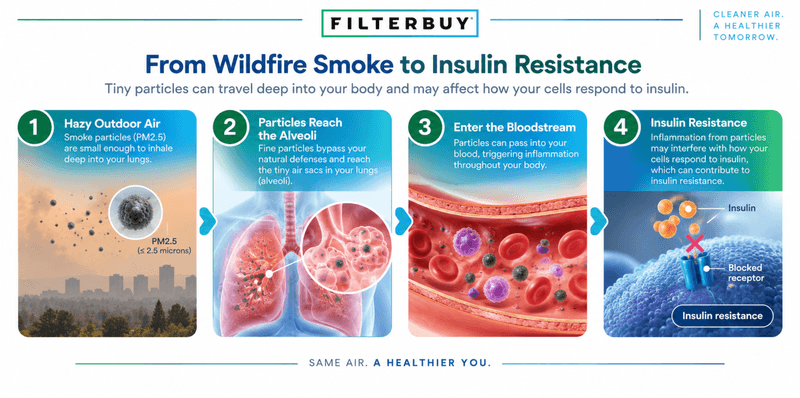
PM2.5 raises blood sugar through inflammation, oxidative stress, and hormone disruption rather than anything you eat. Particles smaller than 2.5 microns pass deep into the lungs and cross into the bloodstream, triggering a systemic stress response. That response makes cells less responsive to insulin, which is the definition of insulin resistance.
The clearest human evidence comes from an intervention study rather than an observational one. In a randomized, double-blind crossover trial published in Circulation, 55 healthy adults in Shanghai spent nine days breathing ambient PM2.5 that averaged around 101 ug/m3. Their blood pressure rose, their insulin resistance rose, and inflammation markers rose with them. Metabolomic analysis found significant increases in cortisol, cortisone, epinephrine, and norepinephrine. Since cortisol and epinephrine both raise blood glucose, that is the bridge between smoky air and a higher number on a meter.
Not consistently, and the inconsistency is worth knowing about before you decide how seriously to take a smoke advisory. The EPA's wildfire smoke at-risk groups fact sheet does not list diabetes as its own category. It appears only as a related condition under cardiovascular disease, in a note about smoke triggering cardiac events in people with heart disease.
Some state health departments are more direct. The Minnesota Department of Health lists people with diabetes as a distinct at-risk group, alongside children, adults 65 and older, and pregnant people. It also notes that smoke damage is cumulative, so repeated exposure can cause long-term problems even when a single smoky day produces no symptoms.
If you have diabetes and you have been reading AQI guidance on the assumption that it describes someone else, the research says otherwise. Read the orange days as though they were written for you.
Three numbers put the overlap in perspective. None of them is about wildfire smoke and diabetes together, which is rather the point: the two trends have been growing alongside each other without much notice.
40.1 million Americans have diabetes, roughly 1 in 8 people. The CDC National Diabetes Statistics Report, updated January 2026, puts diagnosed and undiagnosed diabetes at 12.0% of the population, with another 115.2 million adults with prediabetes.
52% of the fine particle pollution emitted in the United States came from wildland fires. That figure comes from the EPA 2020 National Emissions Inventory, and it reframes smoke as something other than a regional problem. By emissions, wildfire is now the largest single source of PM2.5 in the country.
152.3 million Americans, 44% of the country, live in counties with failing grades for ozone or particle pollution. Exposure, in other words, is no longer confined to fire country. The American Lung Association's State of the Air 2026 report names diabetes among the conditions that raise vulnerability to air pollution, and finds 61.5 million living in counties failing on short-term particle spikes, the category wildfire smoke drives.
Put the three together and the overlap is large and growing: a great many of those 40 million Americans now live somewhere wildfire smoke has become a normal part of the year.
Reduce indoor PM2.5 first, then carry on with the diabetes plan you already have. Start by checking your local AQI. The air quality steps below are ours to advise on; the medical ones belong to your care team, which is why the table keeps them in separate columns.
Framework by Filterbuy, combining EPA Air Quality Index categories with published research on wildfire PM2.5 and glycemic effects. Air quality actions follow EPA guidance; medical decisions belong to your clinician.
The filter is the load-bearing step, and how you run it matters as much as which one you buy. EPA guidance for reducing smoke exposure indoors recommends MERV 13 or higher during smoky periods, and reports that a high-efficiency filter may cut indoor PM2.5 by about 50% when the fan runs continuously, versus about 24% with a low-efficiency filter. With windows closed and no air cleaner, indoor PM2.5 still sits near 55% to 60% of outdoor levels.
In practice that means two small adjustments most people never make: switch the thermostat fan from "Auto" to "On" so the filter sees air all hour rather than only during a cooling cycle, and close any fresh-air intake. If you are unsure which rating your system can handle, our guide to choosing a MERV rating for a high AQI walks through the trade-off between filtration and airflow.
If you do not have central HVAC, the DIY route is well-tested. EPA research on DIY air cleaners found a box fan paired with MERV 13 filters cuts indoor smoke cost-effectively. In one wildfire event, a DIY cleaner dropped PM2.5 by about 56% in a large room within 90 minutes. Our guide to building a Corsi-Rosenthal box covers the safe build.
When the smoke finally clears, one job remains. A filter that ran through the event is loaded whether or not it looks it, and ash that settled during the smoky days gets stirred back into the air as soon as the house returns to normal use. Our guides to restoring your HVAC after wildfire smoke and recovering from wildfire smoke exposure at home cover what to do in the week afterward.
Almost every wildfire guide ends on the same sentence: install a MERV 13. Filterbuy has built pleated filters in Alabama, Florida, Pennsylvania, and Utah for over a decade, and we think that advice is right but incomplete, because it stops before the part that decides whether the filter still protects you on day three.
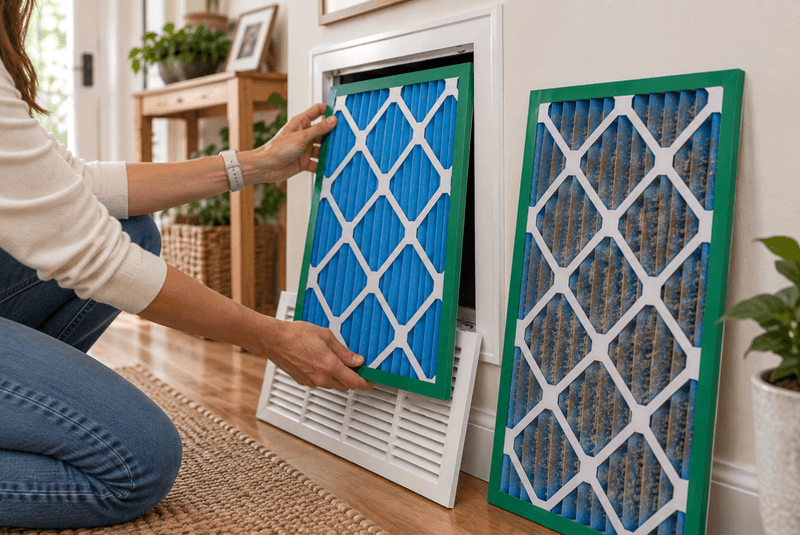
Smoke does not load a filter the way house dust does. Dust bridges the fibers until airflow drops and you can hear the system working harder, which is the cue everyone is taught to watch for. Wildfire smoke behaves differently. Its particles run roughly 100 to 300 nanometers and are mostly organic, so they coat the fibers instead of blocking the gaps between them. In benchtop testing of 17 commercial filter media funded by an EPA Small Business Innovation Research grant, charged synthetic media lost most of their smoke-capture efficiency within 80 minutes while airflow resistance barely moved. The authors concluded that rising pressure drop may not be a reliable signal for when to change a filter during a smoke event.
That is a silent failure, and it is the single most useful thing Filterbuy can tell you. The system sounds normal, the airflow feels normal, and the filter looks grey rather than black. All the while it is capturing far less than it did on the morning the smoke arrived, and nothing in the house will tell you so.
The practical conclusion is to judge the filter by the smoke rather than by the airflow or the date written on the frame. During an active smoke event, change it earlier than the box suggests, and buy the spare before fire season starts rather than in the middle of it, when everyone else is looking for one too.
Two caveats belong with that, the kind we would want if we were reading this page rather than writing it. The study tested flat media on a bench rather than whole pleated filters in real houses, a limit the authors state plainly, and the work comes from a company developing filtration technology of its own. None of it has changed EPA guidance, and a MERV 13 with the fan running remains the best residential defense available. What the research changes is not which filter to buy but how often to replace it.
There is a second gap in the standard advice, and this one has nothing to do with filters. Every smoke guide, this one included, tells you to close the windows. For someone with diabetes that instruction has a ceiling, and it arrives sooner for you than for your neighbors. We have not found another page on this topic that says so.
The CDC is direct about why. Diabetes complications that damage blood vessels and nerves can affect the sweat glands, so the body cannot cool itself as well. People with diabetes also dehydrate faster, and dehydration raises blood sugar, which drives further fluid loss. High temperatures change how the body uses insulin. The CDC advises taking steps once the heat index reaches 80F in the shade at 40% humidity, and notes plainly that in very high heat a room fan will not cool you enough.
Now set that beside the smoke playbook, which asks you to shut the windows, close the fresh-air intake, and leave the whole-house fan and the evaporative cooler switched off, since both pull unfiltered outdoor air straight through the house. A DIY box-fan cleaner will filter that air, but it will not cool it. Follow both sets of guidance at once and you can end up sealed into a hot room, which is its own kind of risk.
One setup solves both problems in the same pass: central air conditioning on recirculate, a MERV 13 filter, and the fan set to On, which cools and filters the same air on the same pass. Filterbuy sells those filters, so weigh that as you like, but the reasoning behind it is not ours. It is why EPA guidance pairs recirculation with filtration instead of treating them as alternatives.
There is also an honest fallback, and we would rather say it plainly than sell around it. If you cannot keep the house both cool and filtered, leave. The EPA at-risk guidance says to seek out an air-conditioned space such as a library, mall, or cleaner-air shelter. For someone whose body cannot shed heat normally, leaving is the right call, and no filter changes that.
Your supplies feel the heat too. The CDC warns that heat degrades insulin and can damage meters, pumps, and test strips, and that severe weather raises the odds of losing power, which fire season tends to bring along with the heat. Work out now how you would keep refrigerated medicine cold through an outage, and pack the go-bag while the sky is still blue rather than once it turns orange.
Research indicates it can. Wildfire PM2.5 triggers inflammation and raises cortisol and epinephrine, both of which increase blood glucose. A multi-country study in Diabetes Care found higher diabetes hospitalization rates in the days following wildfire smoke spikes.
Indirectly, by reducing the exposure. A randomized crossover trial in Circulation found air purification reduced insulin resistance and stress hormone levels versus sham filtration. Filters do not treat diabetes; they lower the exposure associated with metabolic stress.
MERV 13 or higher, per EPA guidance for residential HVAC during smoky periods. Our guide to MERV ratings for a high AQI covers what each level captures.
Far more often. The EPA advises replacing filters when they look dark brown or black, and smoke research suggests efficiency can fall before that point. See wildfire smoke and the AQI for how to time it against conditions.
Smoke seasons are getting longer, and the research on what fine particles do to metabolic health keeps strengthening. You cannot control the plume. You can control what your HVAC does with it, and how often you refresh it.
Shop Filterbuy MERV 13 filters built for smoke | American-made, 600+ sizes, factory-direct with free shipping. Set up auto-delivery and a fresh filter is waiting when fire season starts.
Check your local AQI on our live USA air quality map
Table 2. Key Terms on This Page
