Where Are My Air Filters Located?
August 23, 2026
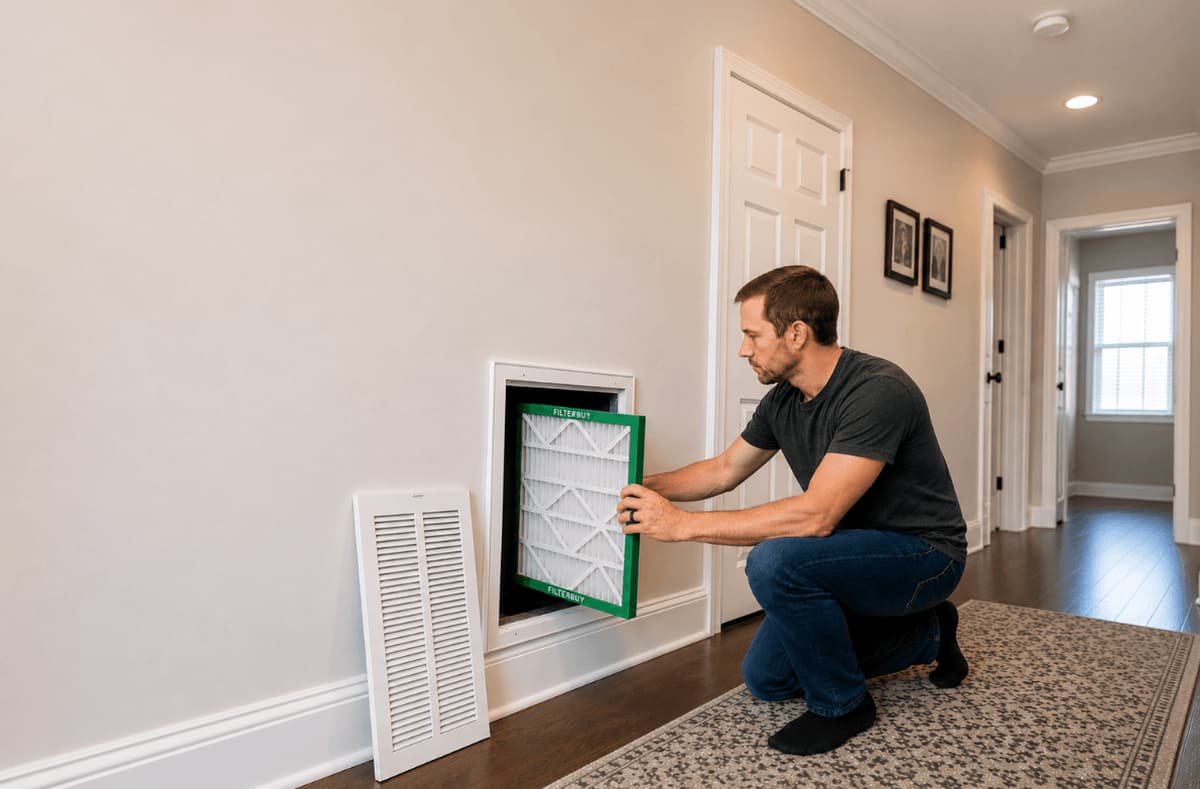
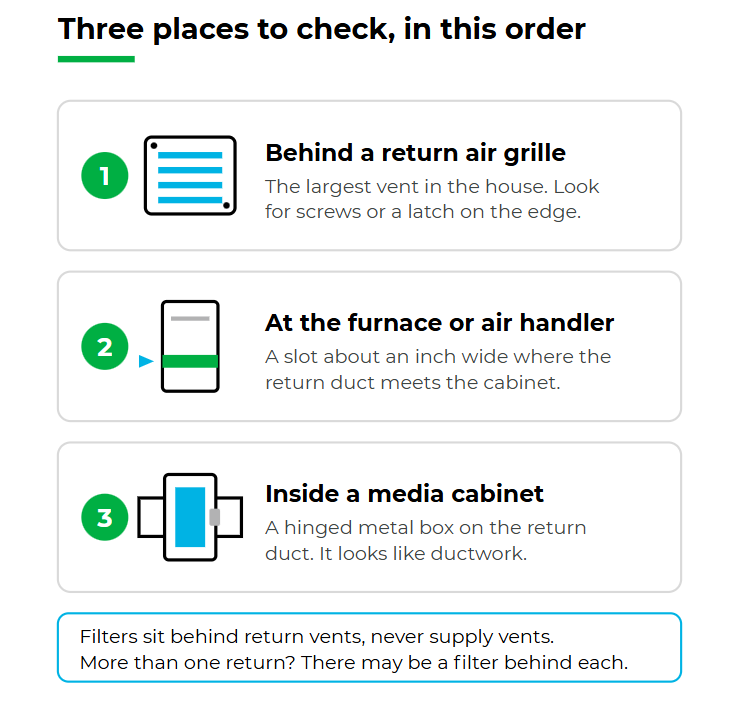
Your air filters are in one of three places: behind a return air grille, in a slot on your furnace or air handler, or inside a media cabinet on the return duct. Start with the return grilles, since that is where most homes keep them. Filters sit behind return vents, never supply vents. If your house has more than one return vent, there may be a filter behind each.
Return air grille — wall, ceiling, or floor. Look for screws or a latch along the edge.
Furnace or air handler — a slot about an inch wide where the return duct meets the cabinet.
Media cabinet — a hinged metal box on the return duct that looks like ductwork.
Turn the system off at the thermostat before you open anything. Once you have found your filters, use the quick match below to get the right size and rating.
Answer 3 quick questions and we'll match you to your perfect filter.
Already know your size? Shop air filters made in the USA at Filterbuy, in over 600 sizes plus custom cuts.
By Michelle Wan, Brand Manager and Air Quality Writer at Filterbuy
Reviewed by David Clark, Licensed HVAC Technician and President of Filterbuy HVAC Solutions
Updated August 17, 2026
Filterbuy has manufactured air filters in the USA since 2013, more than 50 million of them, and Filterbuy HVAC Solutions technicians work in homes across Florida and Texas. This guide comes from both sides of that: the sizes people order, and what those technicians find behind a return grille.
TL;DR
Your air filters are located in one of three places: behind a return air grille on a wall, ceiling, or floor, in a slim slot on the side or bottom of your furnace or air handler, or inside a media cabinet bolted to the return duct. Start with the return grilles, where most homes keep them. If your house has more than one return vent, there may be a filter behind each.
"The mistake we see most is buying before looking. People order a filter for a slot they have not opened yet, sometimes for a slot that does not exist. Find every filter first, write the sizes down, then order once."
Michelle Wan, Brand Manager and Air Quality Writer, Filterbuy
Key takeaways
The largest vent in your hallway is the most common hiding place. Filters sit behind return vents, never supply vents.
Homes with several return grilles often run several filters. Open every return before deciding you have found them all.
The arrow printed on the filter frame points toward the blower, away from the return grille.
How do I tell a return vent from a supply vent?
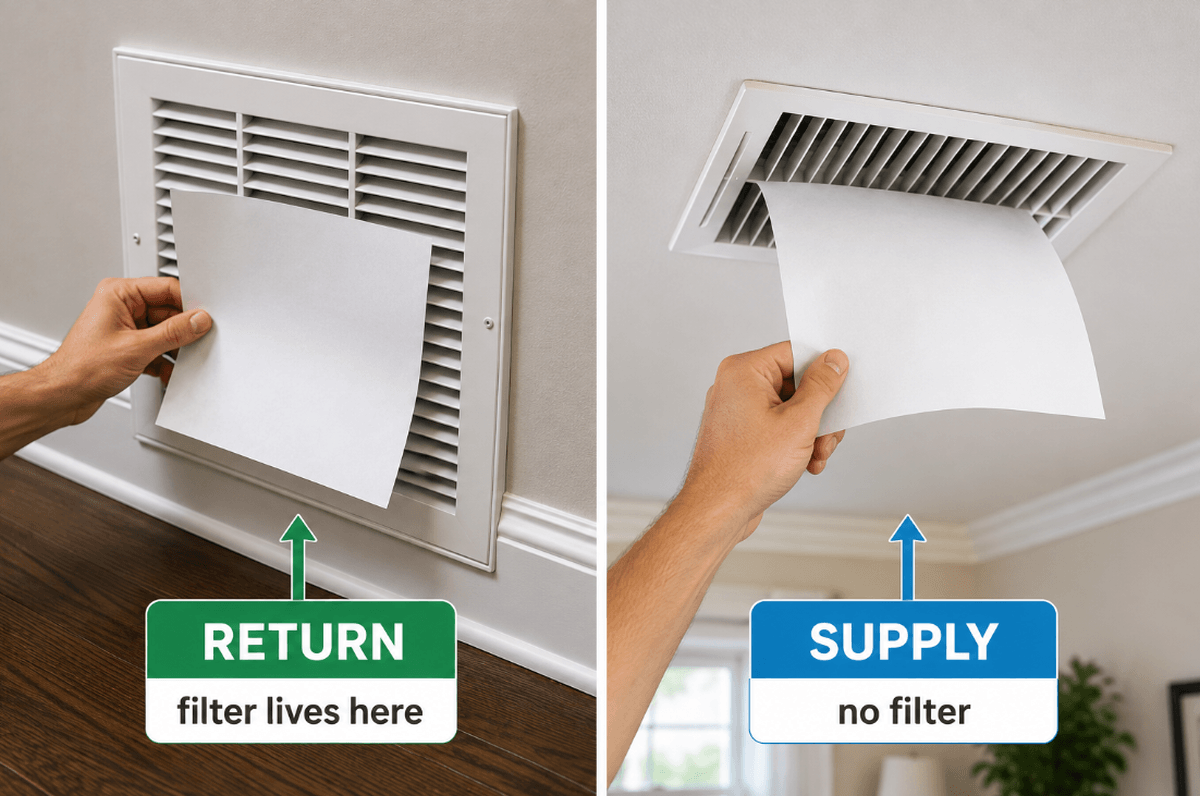
The fastest way to find an air filter is to find the return vents, because filters only sit behind returns. Turn the system on and hold a sheet of paper flat against each vent: a return pulls the paper toward the grille, while a supply pushes it away.
Returns are the largest vents in the house and there are far fewer of them. Check a hallway wall, low on a living room wall, the ceiling toward the middle of the floor plan, and the equipment closet door. Supply registers are smaller and cluster near windows.
Where is the air filter behind a return grille?
Switch the system off at the thermostat before you pull anything, so the blower is not running against an open return. Then look along the edge of the grille for two small screws, a spring latch, or a hinge, swing the cover open, and the filter frame is right there. It lies flat against the back of the cover and pulls straight out. On a ceiling return, keep a hand on the grille as you release the latches, because the filter often drops with it.
Where is the air filter on a furnace or air handler?
If every return grille comes up empty, the filter is at the equipment. Find the indoor unit, the metal cabinet that holds the blower, usually in a basement, attic, garage, or utility closet. Then look where the return duct meets it for a slot roughly an inch wide, covered by a removable plate, a hinged door, or foil tape.
Horizontal units complicate this. These lie on their side in attics and crawl spaces, and their slot sits at one end rather than underneath. Installers use either end, so check both.
Where is the air filter located by system type?
Filter placement follows the equipment rather than the house, so your system type narrows the search before you start opening panels.
Typical U.S. residential placements. Installers vary, so confirm against your own system.
For a deeper breakdown, see furnace filter location by system type.
How many air filters does my house have?
Most homes have one air filter and some have four. If you stopped at the first filter you found, a second may still be sitting somewhere, showing the signs of a clogged air filter. That costs more than air quality: the U.S. Department of Energy reports that swapping a clogged filter for a clean one can lower an air conditioner's energy use by 5% to 15%.
One case gets missed constantly. Two-story homes often run two complete systems, one per floor, which means two filters at minimum, usually two different sizes. The upstairs unit sits in the attic, and it is the one nobody checks.
What if I cannot find an air filter anywhere?
If you have opened every return grille, inspected the furnace or air handler, and come up empty, one of four things is true.
It is in a media cabinet you mistook for ductwork. A 4-inch or 5-inch filter lives in its own metal box on the return duct, which reads as duct until you spot the latch.
There is a slot, but nothing in it. Run a finger along the rails: a clean line through the dust means a filter belongs there. Do not keep running the system this way, because dust goes straight onto the coil and blower.
Your system does not use one. Boiler, baseboard, and radiant floor heat have no ducted return, so no central filter.
The slot was never installed, which happens after duct renovations. A tech can add a rack in about an hour, and odd openings take custom air filter sizes.
The empty slot is the one Filterbuy HVAC Solutions technicians run into most, and the attic is where it hides: the rack is there, but blown-in insulation has drifted across the access panel.
Which way does the air filter face?
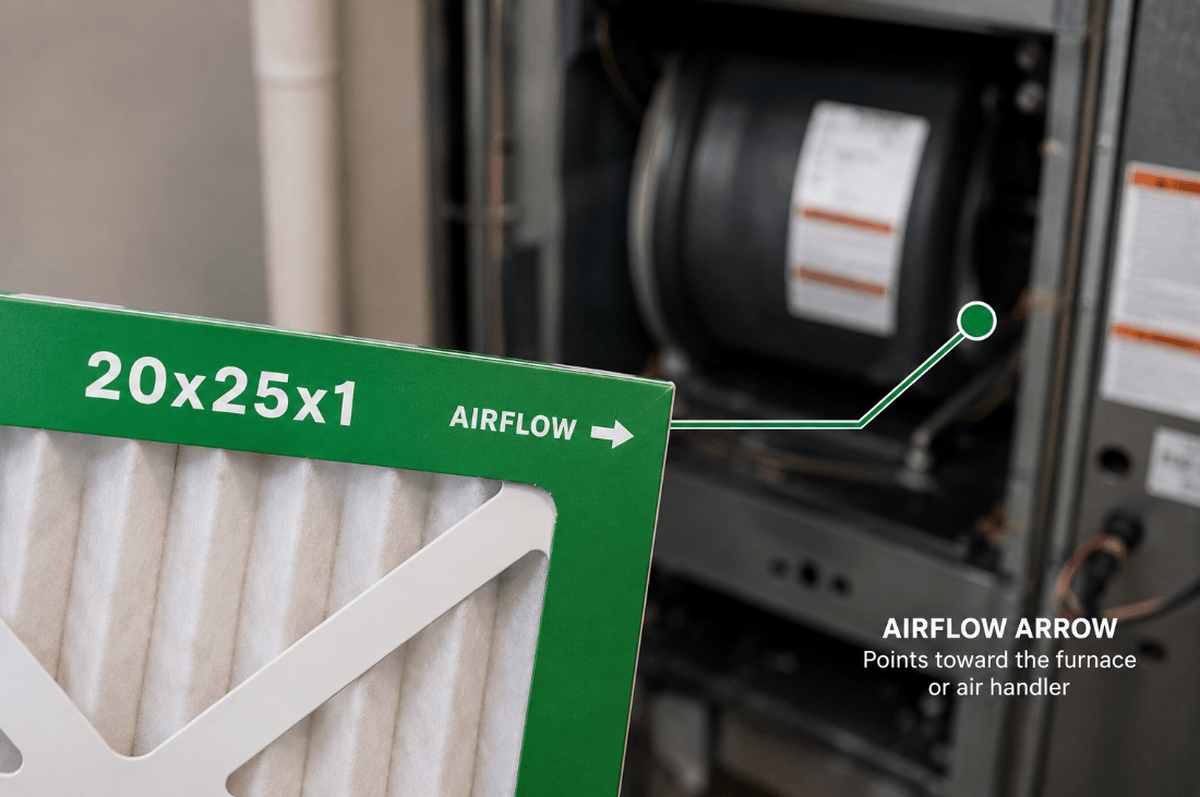
The arrow printed on the side of the filter frame points toward the blower and away from the return grille. It marks the direction air travels, not the direction you push it in, so at a return grille it points into the wall or ceiling, and at the equipment it points into the cabinet.
Get it backwards and the filter still traps dust, but the pleats collapse sooner. Our guide on how to replace a furnace filter walks through the swap.
How do I know if the filter I found needs changing?
Hold it up to a light. If light still comes through most of the surface, the filter has life left. If the media reads solid gray, it is finished. Opacity tells you more than color: a filter can look filthy and still flow fine, or look barely tinted and be packed with fine particles. Other signs of a clogged air filter usually show up before it gets that far.
Change it now, whatever the calendar says, if:
The pleats are bowed or collapsed toward the blower
The frame is damp or smells musty
No light passes through the media
You cannot remember the last change
How do I find my air filter size?
The size is printed on the cardboard frame, usually along one long edge, as three numbers such as 20x25x1: length, width, and depth in inches. Photograph it before the old filter goes in the trash.
That printed figure is the nominal size rather than a tape measurement. An actual 20x25x1 filter comes in closer to 19.5 by 24.5 by 0.75 inches, and the gap lets it seat in the rack. Order by the nominal number. If the frame has worn illegible, measure your air filter slot and round up, or work backwards from the air filter sizes chart.
One warning from the Filterbuy manufacturing floor. The mistake we see most is the third number: people get length and width right, skip depth, and order a 1-inch filter for a 4-inch cabinet. If a size does arrive wrong, Filterbuy exchanges it free, so a bad guess costs time rather than money.
Which MERV rating should I choose?
Once you have the size, the rating is the last decision. The EPA Guide to Air Cleaners in the Home recommends at least MERV 13, or as high as your system will take, and notes that most furnaces and air handlers run MERV 13 without trouble when the filter is changed on schedule.
Capture rates are Filterbuy product specifications. See the EPA link above for guidance.
Supporting statistics
Three federal datasets back the advice above.
Almost every home has a filter to find. 88% of U.S. households use air conditioning; two-thirds run central AC or a heat pump.
If you have central heating or cooling, the filter exists. The question is where.
The filter is the biggest airflow restriction you control. It accounts for 20% to 50% of a residential system's total pressure drop, against a design target of 0.4 to 0.5 in. w.c.
A bad filter is not a small problem, and it is the one you fix in five minutes.
It cleans the air you breathe most of the day. Americans spend about 90% of their time indoors, where some pollutants run two to five times higher.
This filter works on your air, not outdoor air.
Frequently asked questions
Where is the air filter in an apartment or condo?
Usually in a utility closet, behind a louvered door near the kitchen or laundry hookup. The air handler sits inside and the filter slides into a slot at the bottom or side, though some units place it behind a grille in the closet door.
Where is the filter on a mini split?
Behind the hinged front panel of each indoor head, where two washable mesh screens slide out. They are rinsed rather than replaced. See cleaning mini split filters.
How often should I check my air filter?
ENERGY STAR recommends checking it every month and changing it at least every three months, sooner with pets, allergies, or nearby construction.
What to do once you have found them
Once the list is written, order for every location at once rather than one filter at a time. Filterbuy builds over 600 sizes in the USA and cuts custom filters for slots that match nothing standard, so an odd size is no reason to give up. Shop your size, or set up air filter auto-delivery so replacements arrive on their own.