July 8, 2026
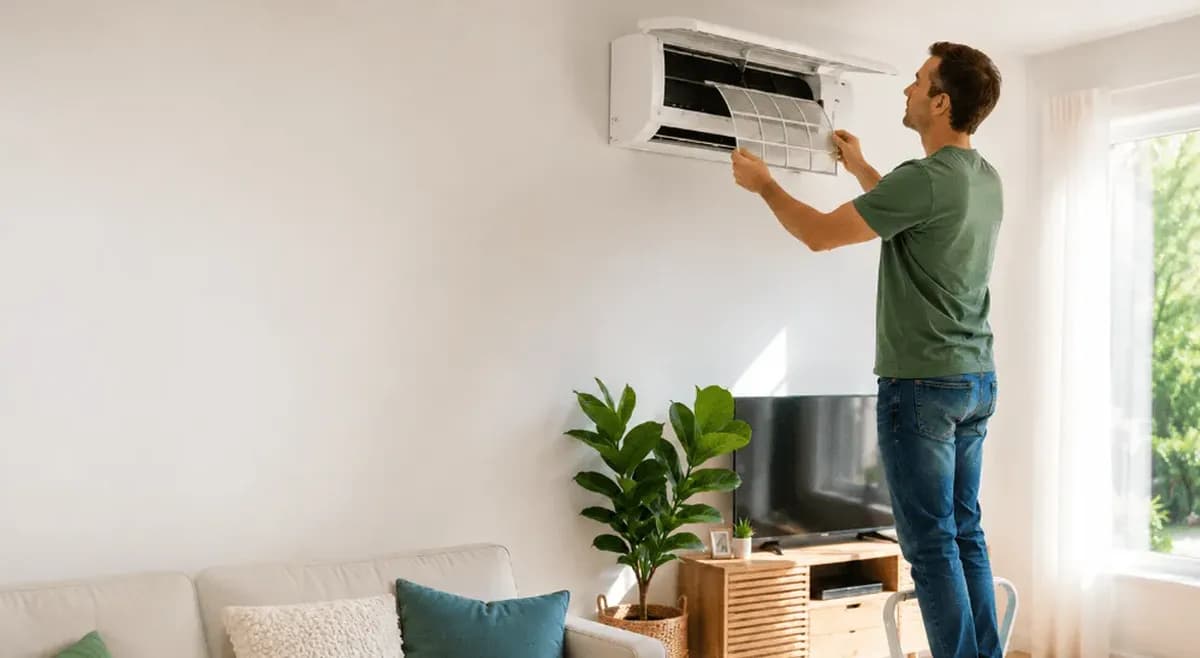
TL;DR: To clean a mini split filter, turn the unit off and cut power at the breaker, open the front panel, and slide out the mesh filters. Vacuum off loose dust, then wash them in lukewarm water (never above 104°F) with a little mild soap. Skip harsh chemicals and scrub brushes. Let them dry completely before reinstalling, since a damp filter can grow mold. Most manufacturers recommend cleaning every two weeks during heavy use.
Mini split filters are washable and reusable. The main mesh screen is designed to be rinsed and put back, not thrown away, so routine cleaning costs almost nothing.
Every two weeks is the standard for heavy-use seasons across most major brands (Mitsubishi Electric, Daikin, Fujitsu, and LG all cite this); light or seasonal use can stretch to monthly.
Use lukewarm water and mild soap only. Manufacturers warn against hot water above 104°F, benzine, thinners, polishing powder, and stiff scrub brushes, all of which damage the mesh.
Never reinstall a wet filter. Trapped moisture is the top cause of the musty smell people notice after cleaning, because it lets mold grow inside the unit.
Secondary filters are different. Carbon (deodorizing), silver-ion, and photocatalytic filters are usually replaced on a schedule, not washed like the mesh.
Your ductless mini split is only as good as the air moving through it, and that air runs through the filter first. When the mesh clogs with dust, pet hair, and pollen, your system works harder, your energy bill creeps up, and the air in the room gets a little less fresh. The good news? Cleaning a mini split filter is one of the easiest home maintenance jobs there is. No tools, no HVAC experience, about ten minutes.
Our take differs from the generic guides. We've manufactured air filters in the U.S. since 2013, more than 50 million of them, and our HVAC Solutions team services ductless systems in Florida and Texas homes. So this advice is built on the filters we actually see come back: clogged, mildewed, or worn past saving. We'll keep it simple and honest: the universal method that works on any mini split, the exact schedule your specific brand recommends, and how to tell when a filter is done for good. A clean filter is also the foundation of how well a mini split protects your indoor air quality.
Across the ductless systems our team services, the most common failure isn't a broken part. It's a filter no one thought to check. In our own service data, a dirty, restricted filter cuts a mini split's efficiency by 5–30%, depending on how bad the buildup is. On a ductless head the mesh sits right in front of the coil, so that airflow loss shows up fast, in weaker cooling and a higher bill.
We also learned this the hard way in our own factories: when we tested particle capture, fine dust under 10 microns proved harder on a system than visible dirt, because it settles deeper and is far tougher to clean off later. Translation for you: don't wait until the mesh looks filthy.
To clean a mini split filter, power the unit down at both the remote and the breaker, open the front panel, and slide the mesh filters out. Vacuum away loose debris, wash the filters in lukewarm water with a little mild soap, rinse, and let them air-dry completely. Reinstall them the way they came out, close the panel, and restore power. Start to finish, it takes about ten minutes.
What you'll need: a step stool, a vacuum with a brush attachment, a sink or hose, a few drops of mild dish soap, and a soft microfiber cloth. No special HVAC tools required on virtually every residential unit made in the last 15 years.
Turn the unit off and cut the power. Switch off the mini split with the remote, then flip the breaker for that unit. This protects you and keeps the fan from pulling loose dust deeper into the system.
Open the front panel. Grip the bottom edge of the cover and lift until it clicks and holds. Most panels open by hand; a few have small side release tabs. Never force it. Check your manual.
Note how the filters sit, then slide them out. The mesh filters sit in front of the coil, usually in two pieces. Take a quick phone photo of their orientation so reinstalling is foolproof, then slide them straight out.
Vacuum off the loose dust. Run a brush attachment gently over each filter. For a lightly used filter, this may be all you need.
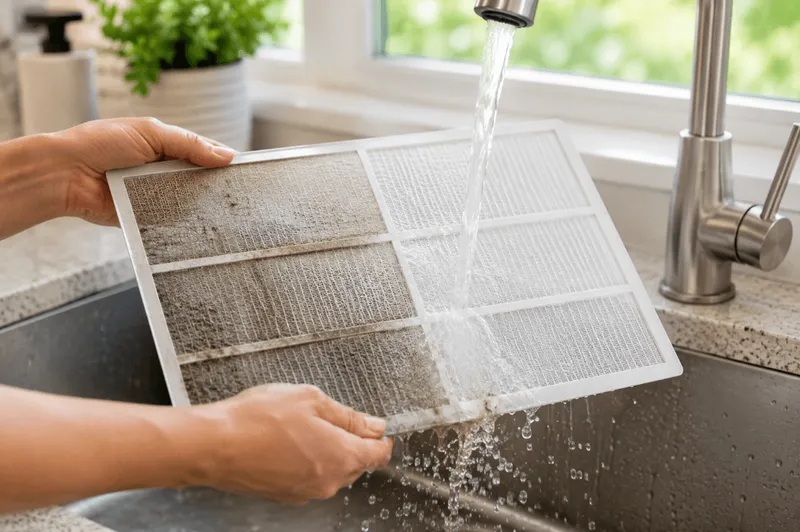
Wash the filters. For anything greasy, rinse under lukewarm water (never hotter than 104°F/40°C) with a few drops of mild soap. Rinse from the back of the mesh toward the front. Skip harsh cleaners and stiff brushes.
Let them dry completely. Shake off excess water and set the filters flat in a shaded spot. Rushing this step is what causes mold and that musty smell. Keep them out of direct sun and away from heaters.
Wipe down the unit while you wait. Pass a damp microfiber cloth over the panel and louvers. Avoid liquid near the electrical connections on the side of the unit.
Reinstall, close up, and power on. Slide the fully dry filters back in the same orientation, lower the panel until it clicks, restore power, and run the unit for a minute. You should feel stronger, cleaner airflow right away.
Clean your mini split filter every two weeks during heavy heating or cooling season, and at least once a month the rest of the year. Homes with pets, allergies, or lots of dust should lean toward the shorter end, every one to two weeks, because those filters clog faster. A quick monthly peek behind the panel tells you everything: if the mesh looks gray, it's time.
Think of it like brushing your teeth: a small, regular habit beats a big cleanup later. Set a recurring phone reminder so the out-of-sight wall unit doesn't become out of mind. The American Lung Association suggests a quick test for any filter: hold it up to a sheet of white paper, and if it looks gray, it's time to clean. Many newer units take the guesswork out with a built-in filter-clean reminder, and Filterbuy mini splits include one, though that light tracks run hours, not actual dirt, so the white-paper check still wins. For the full ductless routine (coils, drain line, and outdoor unit), see our complete guide to mini split maintenance.
The cleaning method is nearly identical across brands, but the recommended frequency and the handling of secondary filters vary by manufacturer. Below is a consolidated reference so you can match the routine to the unit on your wall. Always defer to your specific model's manual, but this covers the guidance the major brands publish.
Sources: manufacturer owner's manuals and support pages (Mitsubishi Electric, Daikin, Fujitsu, LG, Gree, MRCOOL, Senville, Filterbuy), 2024–2026.
The pattern is clear: every two weeks during heavy use is the industry standard for premium ductless brands, while value and DIY brands often list a slightly more relaxed two-to-four-week window. The bigger differentiator isn't the schedule. It's whether your unit has extra filters hiding behind the mesh.
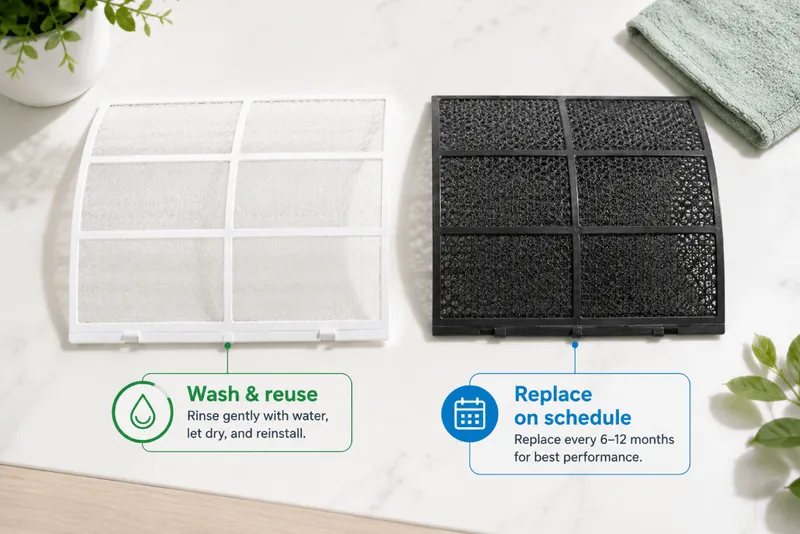
Wash the main mesh filter; replace the specialty ones. The primary mesh screen is built to be rinsed and reused for the life of the unit, so most of the time, cleaning is all you'll ever do. But three things call for a replacement: a secondary filter that isn't washable, a mesh screen that's worn out, or a filter that still looks dirty after a thorough wash.
Replace these on a schedule, don't wash them: carbon or "deodorizing" filters, silver-ion or anti-allergen filters, and photocatalytic filters. These use materials that break down when soaked, so manufacturers have you swap them every few months. Check your manual for the interval and part number.
Replace the mesh itself when it's torn, misshapen, brittle, or permanently discolored after cleaning. A damaged filter can't seal properly, letting unfiltered air slip past into the unit.
The EPA points out that wall-mounted ductless units filter mainly to keep the unit itself clean, not to scrub every fine particle from your home's air, so if you also run a central system, that filter still carries the whole-home load. Because the mini split mesh is reusable, you won't be buying filters for it every month the way you do for a central HVAC system. Where we can help is the rest of your home's air: our American-made, factory-direct filters ship free in 600+ standard and custom sizes, and auto-delivery means the right size just shows up when it's time.
Cleaning the filter is the easy part. When you're ready to go a little deeper, or you just want to know your ten minutes actually pays off, these are the resources we'd point a neighbor to. Trusted, straight-up, and no jargon.
The EPA's Guide to Air Cleaners in the Home lays out, in plain terms, what a ductless filter handles (mostly protecting your unit) and what it doesn't. Worth a read if you're wondering whether your whole home needs a little more help.
The Department of Energy puts a number on it: a clean filter cuts cooling energy use by 5–15% compared to a clogged one. That's real money back for a chore you can finish before your coffee gets cold.
The CDC's latest asthma numbers show about 1 in 12 adults has it, with dust, mold, and pet dander among the top triggers. A clean mesh screen helps catch them before they reach the room.
Not sure your filter's due? The American Lung Association has a dead-simple trick: hold it up to a sheet of white paper, and if it looks gray, clean it. They also break down when those specialty filters need swapping.
This EPA report shows indoor air can run 2–5× more polluted than the air outside, and we're inside for most of the day. It's the bigger reason that small filter habit really adds up.
Once the filter's handled, this is your next stop: our plain-English guide to maintaining your mini split, covering the coils, condensate drain, and outdoor unit that keep a ductless system humming for years.
We connect the dots between a clean filter and the air you're breathing in our mini split and indoor air quality guide, and show where a ductless unit fits alongside the rest of your home's setup.
Cleaning a filter is a small chore with an outsized payoff. Three findings from U.S. government sources make the case:
5–15% lower energy use
A clean filter cuts an AC's energy use by 5–15% versus a clogged one.
Lower power bills, less strain on the system.
Source: U.S. Department of Energy, Energy Saver 101: Home Cooling
90% indoors · 2–5× more pollutants
Americans spend about 90% of their time indoors.
Indoor pollutant levels often run 2–5× higher than outdoors.
Your filter is a key line of defense for that air.
Source: U.S. EPA, Report on the Environment: Indoor Air Quality
About 1 in 12 adults has asthma
8.6% of U.S. adults currently have asthma (2024).
Common triggers: dust mites, mold, pet dander.
A clean mesh filter helps trap them before they reach the room.
Source: CDC, FastStats: Asthma (2024)
A few small missteps can undo your good work, or shorten the life of your unit. Here are the ones our technicians see most often.
“The number-one callback we could prevent is the damp-filter mold call. A mesh that goes back in even slightly wet is how mold gets started inside the head. Give it the full drying time. A few extra minutes beats a service visit.”David Clark, Licensed HVAC Technician
Reinstalling a damp filter. The most common mistake, and the reason a "clean" unit still smells musty. Let filters dry completely first.
Using hot water or harsh chemicals. Water above 104°F, benzine, thinners, and polishing powders warp the frame and degrade the mesh. Lukewarm water and mild soap are all you need.
Scrubbing with a stiff brush. The mesh is delicate. A soft brush or vacuum attachment is plenty; hard bristles tear it.
Skipping the breaker. Turning off the remote isn't the same as cutting power. Flip the breaker so the fan can't spin while you work.
Pressure-washing the coil fins. Those thin aluminum fins bend easily. Use a gentle stream and a fin comb if they're bent.
Forgetting the secondary filter. If your model has a carbon or ion filter behind the mesh, cleaning only the front screen leaves half the job undone.
Most issues clear the moment a clean, dry filter slides back in. If something's still off, this table maps the symptom to the likely cause and your next move, so you know what you can fix yourself and what needs a technician. One reason to stay ahead of it: in our customer-service data, restoring a dust-coated coil after a neglected filter runs about $350–600, versus a mesh you rinse for free.
Filter cleaning is a DIY job, but some symptoms point to a deeper problem. Call a licensed HVAC technician if, after cleaning, you notice: little or no conditioned air from the unit, water dripping from the front of the indoor unit (a clogged condensate drain), a musty smell that lingers with a clean, dry filter (possible internal mold), the system short-cycling on and off every few minutes, or ice forming on the coils. These aren't filter issues, and forcing the unit to run through them can lead to expensive repairs. The EPA is clear that a filter alone won't solve a mold problem. Mold comes from moisture, so the source has to be fixed directly.
Beyond routine cleaning, plan on a professional tune-up once or twice a year. A tech can deep-clean the evaporator coil and blower wheel, check the refrigerant charge, and catch small issues early. That kind of care keeps a mini split running its full 15-to-20-year lifespan.
Mini split (ductless mini split): A heating and cooling system with a wall- or ceiling-mounted indoor unit connected to an outdoor compressor, delivering conditioned air to a room without ductwork.
Mesh filter: The primary, washable screen in a mini split's indoor unit that captures dust, hair, and pollen. Rinsed and reused rather than replaced.
Deodorizing (carbon) filter: A secondary filter with activated carbon that absorbs odors, smoke, and VOCs. Replaced on a schedule, not washed.
Silver-ion / anti-allergen filter: A secondary filter that targets bacteria and allergens; typically replaced periodically.
Photocatalytic (titanium apatite) filter: A specialty air-purifying filter in some Daikin units, refreshed in sunlight and replaced roughly every three years.
Evaporator coil: The finned component inside the indoor unit that absorbs heat; it sits behind the mesh filters and its thin aluminum fins bend easily.
Condensate drain: The line that carries away moisture the mini split removes from the air; a clog can cause water to drip from the front of the unit.
VOCs (volatile organic compounds): Gases released by paints, cleaners, and household products that carbon filters help absorb.
MERV: Minimum Efficiency Reporting Value, the standard scale rating how effectively a filter captures particles.
Yes. The main mesh filter is designed to be washed and reused. Rinse it in lukewarm water with mild soap, let it dry completely, and put it back. Secondary filters like carbon or ion filters are the exception. Those are replaced, not washed.
Every two weeks during heavy use is the standard most manufacturers recommend, dropping to about once a month for light or seasonal use. Homes with pets, allergies, or heavy dust should clean every one to two weeks.
Almost always because the filter went back in while still damp, letting mold grow. Let filters air-dry completely before reinstalling. If the smell persists with a clean, dry filter, there may be mold deeper in the unit, so call a pro.
No. Running without the filter lets dust coat the evaporator coil and blower wheel, reducing efficiency and risking malfunction. Only remove the filter for cleaning, and reinstall it once dry.
The core method (power off, remove, vacuum, wash, dry, reinstall) is the same across Mitsubishi, Daikin, Fujitsu, LG, Gree, MRCOOL, and others. What varies is the recommended frequency and whether the unit has replaceable secondary filters.
It's a maintenance reminder that the mesh is due for a cleaning, common on Mitsubishi, LG, and Daikin units. Clean the filter, then reset the indicator per your manual (often a button on the remote or unit). The light usually tracks run hours, not actual dirt, so keep inspecting the mesh yourself between resets.
Start with the mesh: wash it in lukewarm water with mild soap and let it dry completely, since trapped moisture is the usual culprit. If the smell returns with a clean, dry filter in place, the source is mold in the coil or drain pan, so flush the condensate drain line, and call a pro if it persists. Skip harsh chemicals on the mesh.
Yes. Clean it once before the season starts and once after, and give it a quick look monthly even in light use. Dust settles on an idle unit, and a clean start keeps that first-run dust from coating the coil.
A clogged filter restricts airflow, forcing the system to work harder. That raises energy bills, weakens heating and cooling, can trigger icing or error codes, and shortens the unit's lifespan. Our guide on ductless mini split resources break down the full upkeep routine.
Right now, pop the panel and look at your filter. If the mesh is gray, it's already costing you airflow, so give it the ten minutes. Then set a recurring reminder so it never sneaks up on you again.
Keeping up a central system too? After more than a decade of manufacturing filters, we'll say it plainly: a high efficiency rating never makes up for a clogged filter. Filterbuy ships custom-size filters free, factory-direct, with auto-delivery so the right size arrives on schedule. And if you're shopping a genuinely low-maintenance ductless unit, Filterbuy's own mini split line builds in self-clean tech and filter-care reminders that make this routine even easier.
“I don’t want anyone to feel like they need an HVAC license just to pick the right filter. My job is to give you the straight answer, explain why it matters, and let you get back to your day.”
Michelle Wan, Brand Manager & Air Quality Writer, Filterbuy
Written by Michelle Wan • Reviewed by David Clark, Licensed HVAC Technician
Michelle Wan is Filterbuy's Brand Manager and air quality writer. She works directly with Filterbuy's U.S.-based manufacturing team across factories in Alabama, Florida, Pennsylvania, and Utah, so her guidance is grounded in how filters are actually built, tested, and used in real homes. Filterbuy has manufactured air filters in the United States since 2013, producing more than 50 million and serving over two million households, and its HVAC Solutions team services ductless systems in the field. Published July 8, 2026. Last updated July 8, 2026.
Questions about your specific unit? Filterbuy's Mini Split Support Center can help you register a warranty, find an installer, or get answers from a real person.
Related reading: How to maintain your mini split AC • How mini splits affect indoor air quality • How home air filters work • Check your local air quality
