June 20, 2026
Written by Michelle Wan
Reviewed by David Clark, Filterbuy HVAC
Published June 20, 2026
Updated June 20, 2026
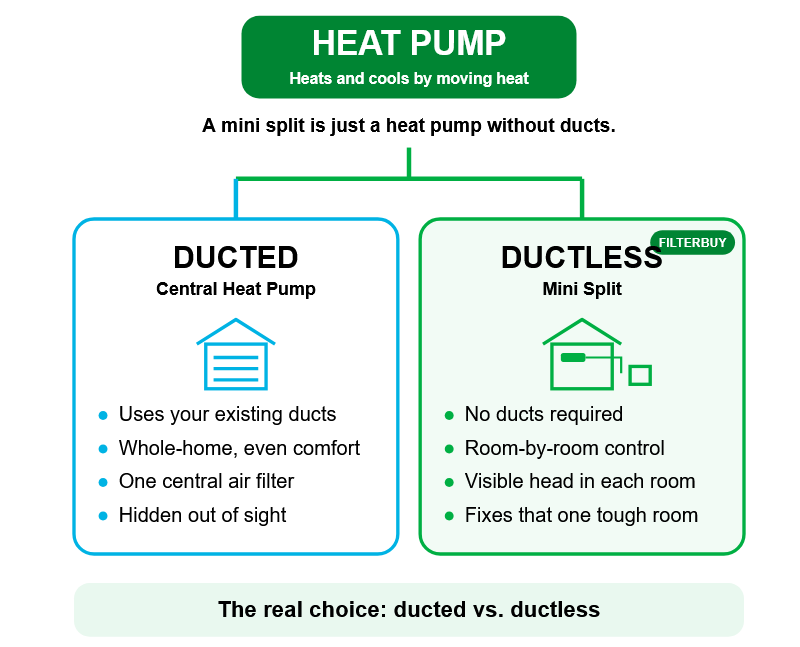
A mini split is a heat pump — just the ductless kind. So it isn't really heat pump vs. mini split; the real choice is ducted vs. ductless. Have ductwork in good shape and want whole-home comfort? A central (ducted) heat pump usually wins. No ducts, or just one stubborn hot-or-cold room to fix? A ductless mini split is hard to beat.
Ducted central heat pump — uses your existing ducts, whole-home even comfort, one central air filter.
Ductless mini split — no ducts needed, room-by-room control, fixes that one tough room.
Not sure which fits your space? Take the quick match quiz below — or shop Filterbuy mini split systems.
In Brief: A mini split is a heat pump, specifically a ductless one. So “heat pump vs. mini split” isn’t really a head-to-head. The decision that actually matters is ducted vs. ductless. Got good ductwork and want whole-home comfort? A central (ducted) heat pump usually wins on price and even temperatures. No ducts, or just one stubborn hot-or-cold room to fix? A ductless mini split is tough to beat.
If you’ve been shopping for a new heating and cooling system, you’ve probably seen “heat pump” and “mini split” used like they’re two different things you have to choose between. Here’s the part most articles bury: they’re not. A mini split is one type of heat pump. Once that clicks, the whole decision gets a lot simpler, and this guide walks you through it in plain English, with the costs, the efficiency numbers that matter, and a quick way to match a system to your space.
A heat pump is a system that heats and cools your home by moving heat instead of burning fuel to make it. In summer it pulls heat out of your indoor air and dumps it outside (exactly like an air conditioner). In winter it runs in reverse, pulling heat out of the outdoor air (yes, even cold air has heat in it) and bringing it inside. The one part that makes a heat pump different from a plain AC is a reversing valve that lets it flip directions.
A mini split is simply a heat pump without ducts. Instead of pushing air through ductwork, it uses one or more indoor units (the wall-mounted “heads” you’ve seen) connected to an outdoor condenser by a thin line set running through a small hole in the wall. That’s why you’ll also hear it called a “ductless heat pump.” So when people ask “heat pump vs. mini split,” what they’re really deciding is ducted vs. ductless, and that comes down to one word: ductwork.
Here’s how a central, ducted heat pump stacks up against a ductless mini split on the things shoppers ask about most:
| Factor | Central (Ducted) Heat Pump | Ductless Mini Split |
|---|---|---|
| Needs ductwork? | Yes, uses your existing ducts | No, that's the whole point |
| Best for | Whole-home, even comfort | Single rooms, additions, zoned control |
| Temperature control | One setting for the whole house | Independent control, room by room |
| Central air filtration | Yes, all air passes one filter | No, thin washable screen at each head |
| Install footprint | Larger; ties into ducts & thermostat | Smaller; one hole per indoor head |
| Visible indoors | Hidden (vents only) | Visible wall/ceiling head in each room |
| Typical upfront cost | Lower if ducts already exist | Low for one room; higher for whole-home multi-zone |
Think of a heat pump as a two-way air conditioner. A standard AC only knows how to move heat one direction, out of your house. Add a reversing valve and the same machine can move heat into your house too, which means one system handles both summer cooling and winter heating. Because it’s moving heat rather than generating it from a flame or a heating element, it does the job using far less energy than older electric or fuel-based heating. That’s often the most efficient way to keep a home comfortable.
“Heat pump” is the umbrella term. Under it you’ll find ducted (central) systems, ductless mini splits, and geothermal versions that pull heat from the ground instead of the air. The most common kind, and the kind a mini split belongs to, is the air-source heat pump.
A mini split is an air-source heat pump built for spaces where ducts don’t exist or don’t make sense. Each indoor head has its own thermostat, so you can keep the bedroom cool while the living room stays warm, giving you true room-by-room control. A single outdoor unit can feed one head (single-zone) or several (multi-zone), and modern variable-speed models ramp up and down instead of just blasting on and off, which keeps temperatures steady and quiet.
That flexibility is why mini splits shine in additions, garages, basements, sunrooms, older homes without ducts, and rooms your central system just can’t keep comfortable. The trade-off: there’s a visible head in each space, and cooling a whole house this way means several zones, which adds up.
The filtration detail most comparisons skip
A ducted system pulls all your home’s air through one central filter, which is exactly where a quality MERV-rated air filter does the heavy lifting for your whole home’s air. A mini split only has a thin, washable screen at each head to protect the unit; it isn’t whole-home filtration. If clean indoor air is a priority and you go ductless, plan to pair it with a portable air purifier or keep up with those screens. It’s a real difference worth knowing before you buy.
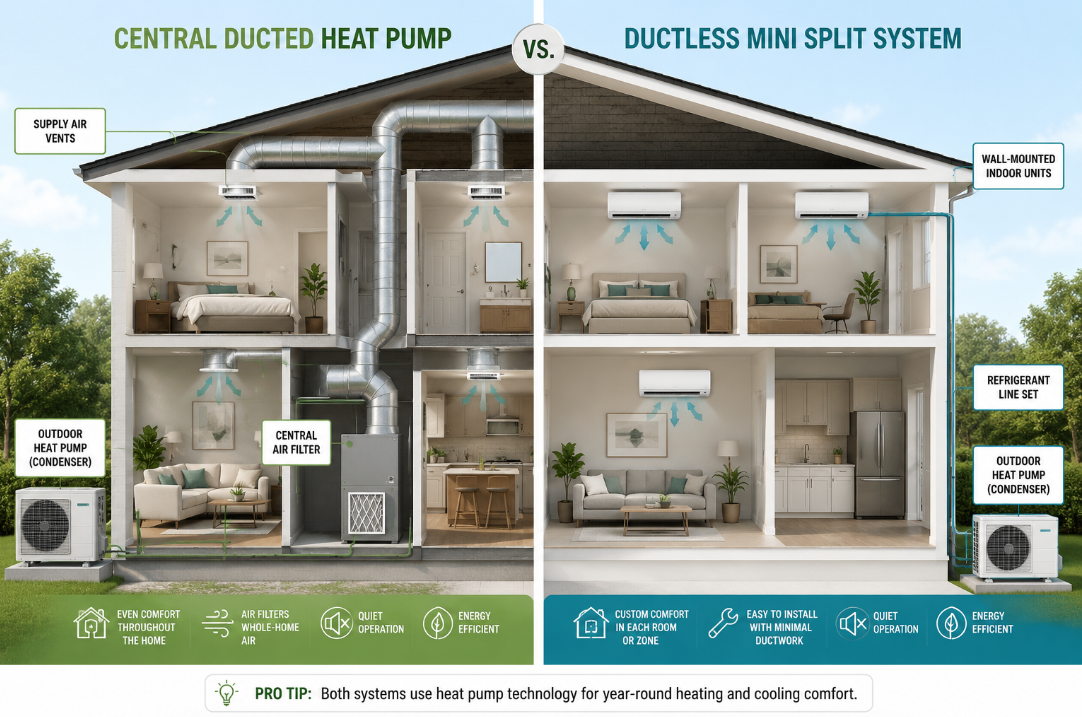
Strip away the labels and the question is almost always this: does your home have ductwork in good shape?
If yes, a ducted central heat pump is usually the practical, cost-effective pick. It reuses what you already have and delivers steady comfort to the whole house from one system. If no, or if you only need to fix one or two problem spaces, a ductless mini split skips the expensive duct installation entirely and gives you zoned control as a bonus. Everything else (cost, efficiency, looks) flows from that one fork in the road. ENERGY STAR gives the same guidance: homes with existing ductwork lean toward a ducted system, and homes without it toward ductless.
Costs swing a lot by home size, climate, number of zones, and whether ducts already exist. Treat the figures below as typical installed ranges, not quotes. Always confirm with current local pricing. For a deeper breakdown by zone count and BTU, see Filterbuy’s full mini split cost guide, built from real installation invoices.
| System | Typical installed range | What drives the price |
|---|---|---|
| Single-zone ductless mini split | ~$3,000 - $5,000 per zone | One head, one room; lowest entry point |
| Whole-home multi-zone ductless | ~$10,000 - $26,000+ | Several heads + outdoor unit; cost climbs per zone |
| Ducted central heat pump | ~$10,000 - $18,000 (avg ~$14,500) | Cheaper when usable ducts already exist |
| Equipment-only DIY-ready mini split | [ADD Filterbuy 12K/18K/24K pricing] | Lowest upfront if you skip the full contractor install |
Cost ranges reflect 2025–2026 U.S. averages reported by EnergySage and industry installers; multi-zone and cold-climate setups land at the higher end. See references.
Both systems are measured with the same yardsticks, so you can compare apples to apples:
SEER2 rates cooling efficiency over a season, and higher is better. HSPF2 does the same for heating. EER2 measures efficiency at one fixed hot-day condition. You don’t need to memorize the formulas; you just need to know that bigger SEER2 and HSPF2 numbers mean lower energy bills for the same comfort.
Variable-speed mini splits tend to post excellent SEER2 numbers because they rarely run at full blast. For example, Filterbuy’s mini split systems are 17 SEER2 variable-speed units with mobile-app control. Ducted systems are efficient too, but some energy is always lost moving air through ducts. The U.S. Department of Energy notes that duct losses can account for more than 30% of energy use for space conditioning, especially when ducts run through an unconditioned space like a hot attic. Want to go deeper on the numbers? Our SEER rating chart and EER-to-SEER converter break it all down.
If you’re leaning ductless, sizing is everything. An undersized unit runs nonstop and wears out early, while an oversized one short-cycles. Here’s a quick map from Filterbuy’s variable-speed lineup to match BTU capacity to the room you’re trying to fix:
| Capacity | Coverage area | Great for | Shop |
|---|---|---|---|
| 12,000 BTU | 300 - 550 sq ft | Bedrooms, home offices, small additions | 12,000 BTU |
| 18,000 BTU | 700 - 900 sq ft | Master suites, large living rooms, finished basements | 18,000 BTU |
| 24,000 BTU | 1,000 - 1,200 sq ft | Open main floors, full two-car garages | 24,000 BTU |
Sizing rule of thumb: when a room falls between two sizes, size up. An undersized mini split runs constantly and burns through compressors faster. For an exact match, walk through our room-by-room BTU sizing guide.
| Ducted Central Heat Pump | Ductless Mini Split | |
|---|---|---|
| Pros | Even whole-home comfort · Equipment hidden out of sight · Central air filtration for the whole house · Lower cost when ducts already exist | No ductwork required · Independent room-by-room control · Very efficient, quiet variable-speed operation · Easy to add to a single space |
| Cons | Needs ducts in good shape · Some energy lost through ducts · One temperature for the whole house · Bigger, more involved install | Visible head in each room · Pricey for whole-home multi-zone · No central filtration · Each zone is its own unit to maintain |
Run through these in order. The first clear “yes” usually settles it:
Do you have ductwork in good shape? Yes → a ducted central heat pump is likely your best value. No → go ductless.
Whole house, or just a room or two? One or two spaces (addition, garage, that one hot bedroom) → a mini split. Whole house with good ducts → central heat pump.
Do you want different temperatures in different rooms? If yes, mini split zoning is the easy win.
Cold winters? Look for a cold-climate-rated unit and a strong HSPF2, and size up so it keeps up on the coldest nights.
Lowest upfront cost? A single-zone ductless system, especially equipment you install or have installed, is the most budget-friendly entry point.
Heads up, because a lot of older articles still get this wrong: the federal Section 25C Energy Efficient Home Improvement Credit (the one that gave up to $2,000 (30% of cost) on a qualifying heat pump or mini split) expired on December 31, 2025 under the One Big Beautiful Bill Act. Systems placed in service in 2026 don’t qualify for that federal credit. State and utility rebates may still be available depending on your ZIP code and income, so it’s worth checking locally. For the full breakdown, see our mini split tax credit guide for 2026.
Ready to fix that room?
If a ductless mini split is the answer, Filterbuy’s 17 SEER2 variable-speed systems cool and heat year-round, ship free in 2 days, and come backed by a 7-year compressor warranty and U.S.-based support. Shop mini split systems →
Essentially, yes. A mini split is a type of heat pump, a ductless one. All mini splits are heat pumps, but not all heat pumps are mini splits (many are ducted, central systems).
It depends on scope. A single-zone mini split is the cheapest way to heat and cool one room. For a whole house, a ducted central heat pump is usually cheaper than a multi-zone ductless setup, if you already have usable ductwork.
Both heat well because they use the same technology. Ductless mini splits avoid duct energy losses and let you heat only the rooms you’re using. For very cold climates, choose a cold-climate-rated model with a high HSPF2 and size it correctly.
Not the same way. A central, ducted system filters all your home’s air through one filter. A mini split only has a thin washable screen at each head to protect the unit, so it doesn’t provide whole-home filtration.
Yes. A multi-zone mini split connects several indoor heads to a single outdoor condenser, each with its own temperature control.
Both can be very efficient. Variable-speed ductless mini splits often post strong SEER2 numbers and skip duct losses; ducted systems are efficient too but lose a little energy moving air through ducts.
U.S. Department of Energy: Ductless Minisplit Heat Pumps (SEER2 efficiency ranges; duct-loss figure)
U.S. Department of Energy: Heat Pump Systems (how air-source heat pumps work)
ENERGY STAR: Ductless Heating & Cooling (ducted vs. ductless guidance; cold-climate performance)
ENERGY STAR: Air-Source Heat Pumps
EnergySage: Heat Pump vs. Mini-Split (installed cost averages)
Filterbuy: Mini Split Cost (2026) (installed-cost breakdown from real invoices)
Filterbuy: Mini Split Tax Credits & Rebates in 2026 (Section 25C expiration under the One Big Beautiful Bill Act)
Filterbuy: Ductless Mini Split Systems (product specs: 17 SEER2, BTU/coverage, warranty)
