filterbuy
 

Shop by

resources
>
health and wellness
>
filters for bacteria
>
Are MERV Filters Effective Against Bacteria Indoors?

Are MERV Filters Effective Against Bacteria Indoors?

On this page

Bacteria travel through your home's air every time someone coughs, walks across the room, or even opens a door — and most basic filters let them pass right through.

Based on over a decade of manufacturing filters in the U.S. and testing across our MERV 8, MERV 11, and MERV 13 product lines, we've seen firsthand that the right MERV rating makes a real difference. Our MERV 13 filters are engineered to capture particles as small as 0.3 microns — including many common airborne bacteria, mold spores, and other bioaerosols that lower-rated filters simply miss.

Below, we'll share what we've learned from building millions of filters and helping homeowners find the right level of protection — so you can make a confident choice for your home's air without the guesswork.

TL;DR: Quick Answers

Are MERV Filters Effective Against Bacteria Indoors?

Yes. MERV filters—particularly MERV 13—are effective at capturing bacteria indoors. Bacteria range from 0.3 to 10 microns, and MERV 13 filters are tested to capture at least 50% of the smallest particles in that range, 85% of mid-range, and 90%+ of the largest.

Key facts at a glance:

After building millions of MERV 13 filters in our U.S. facilities, we've seen firsthand that the upgrade from MERV 8 to MERV 13 is the single most impactful step homeowners can take to reduce indoor airborne bacteria, allergens, and respiratory pathogens.

Bottom line: A quality MERV 13 filter, changed consistently, is the most practical and affordable way to protect your household from bacteria circulating through your HVAC system.

Top Takeaways

  1. Your indoor air is dirtier than you think.
    • Indoor pollutant levels are 2–5x higher than outdoors (EPA)
    • You spend ~90% of your time breathing it
    • Your HVAC filter is your primary line of defense
  2. MERV 13 is the science-backed sweet spot.
    • Recommended by both ASHRAE and the CDC
    • Captures ~77% of infectious aerosol particles
    • Removes at least 90% of larger contaminants like dust and mold
  3. The upgrade is easier than you think.
    • Fits standard HVAC systems — no modifications needed
    • Millions of homes already run MERV 13 without issues
    • Proper pleat design keeps pressure drops comparable to MERV 8
  4. Consistency matters as much as the rating.
    • Change every 60–90 days for peak performance
    • All Filterbuy filters are built in-house across four U.S. facilities
    • Auto-delivery keeps you on schedule automatically
  5. Clean air is simple.
    • Find your size
    • Choose MERV 13
    • Set up auto-delivery
    • Swap in 60 seconds
    • Breathe better — done

How Bacteria Travel Through Your Home's Air

Indoor bacteria don't stay put. Everyday activities like cooking, cleaning, sneezing, and even your HVAC system cycling on generate airborne particles that circulate throughout your home. Pet dander, skin cells, and moisture from bathrooms and kitchens create ideal conditions for bacteria to hitch a ride on dust and droplets — often recirculating for hours before settling on surfaces or being pulled into your HVAC return.

Without adequate filtration, your system is essentially pushing those particles from room to room.

What MERV Ratings Actually Mean for Bacteria Filtration

MERV stands for Minimum Efficiency Reporting Value, and it measures a filter's ability to capture particles within specific size ranges. Here's where it matters for bacteria:

Most airborne bacteria range from 0.3 to 10 microns in size. A MERV 8 filter effectively captures larger particles like dust and lint, but isn't designed to catch most bacteria. MERV 11 begins capturing finer particles, including some mold spores and larger bioaerosols. MERV 13, however, is where bacterial filtration becomes meaningful — trapping particles down to 0.3 microns, which covers the majority of common indoor bacteria.

From our experience manufacturing across all three ratings, the jump from MERV 8 to MERV 13 isn't incremental — it's a significant upgrade in what your filter actually removes from your air.

Why MERV 13 Is the Sweet Spot for Most Homes

Hospital-grade HEPA filters capture even smaller particles, but they require specialized systems that most residential HVAC units aren't built to handle. Forcing a HEPA filter into a standard system can restrict airflow, strain your equipment, and drive up energy costs.

MERV 13 delivers the highest level of filtration that most home HVAC systems can support without performance issues. It's the rating we recommend most often — and the one our customers consistently report the biggest difference with, especially households dealing with allergies, pets, or respiratory sensitivities.

Real-World Results: What Our Customers Experience

We've shipped millions of MERV 13 filters to homes across the country, and the feedback is consistent: less dust buildup, fewer allergy flare-ups, and noticeably fresher air within days of the first filter change. Customers with pets, young children, or older HVAC systems frequently tell us they wish they'd upgraded sooner.

That said, no single filter eliminates 100% of bacteria. Filtration works best as part of a broader approach that includes regular filter changes every 60 to 90 days, proper ventilation, and consistent HVAC maintenance.

How to Choose the Right MERV Rating for Your Home

Selecting the right filter depends on your household's specific needs:

MERV 8 works well for homes without pets or allergy concerns, capturing standard dust, pollen, and lint at an affordable price point.

MERV 11 is a solid middle ground for homes with mild allergies or one or two pets, adding protection against finer dust and some mold spores.

MERV 13 is ideal for households that want the strongest residential-grade bacteria and allergen protection — especially those with multiple pets, respiratory conditions, or anyone who simply wants the cleanest air their system can deliver.

Not sure which is right for you? We carry all three ratings in over 600 sizes, with custom sizing available for nonstandard systems — all shipped fast, free, and factory-direct.

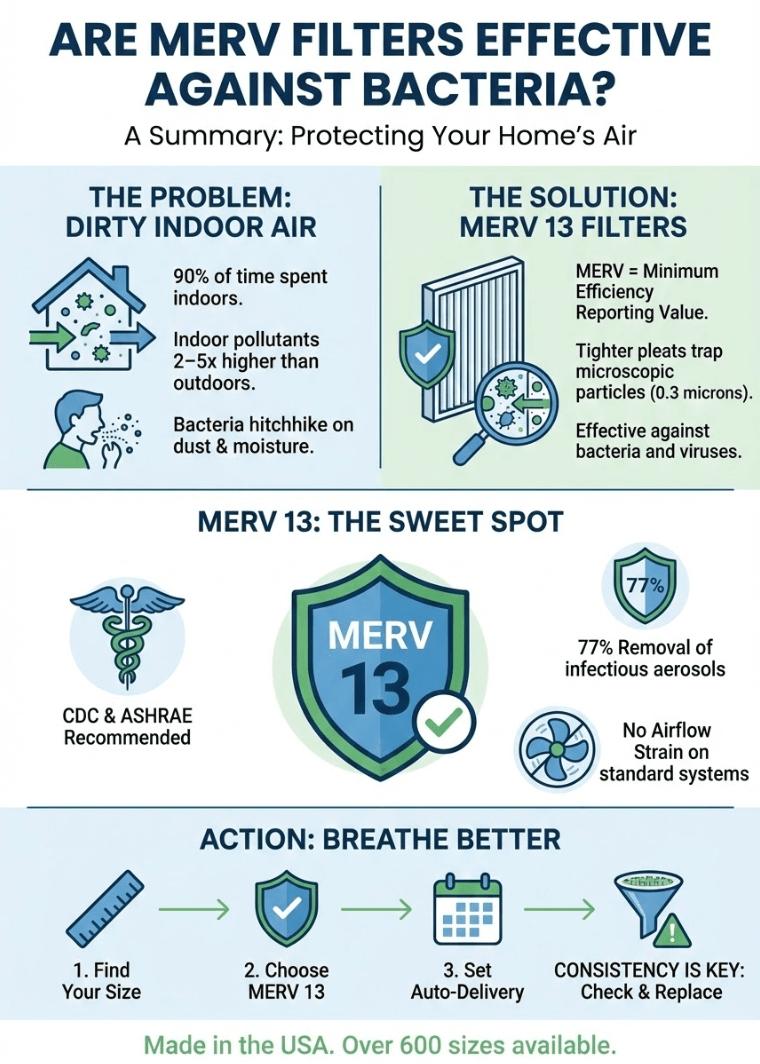
Infographic showing if are MERV Filters effective against bacteria.

"After building millions of filters across every MERV rating in our U.S. facilities, we can tell you that the jump from MERV 8 to MERV 13 is the single most impactful upgrade most homeowners can make for their indoor air — it's where filtration goes from catching what you can see to protecting against what you can't."

— Filterbuy Air Quality Team

7 Trusted Resources That'll Make You a Smarter Filter Buyer

We're air-obsessed—so we've done the homework for you. Whether you're figuring out what MERV rating you need or just want to know what's actually floating through your home, these are the resources we trust most. They come straight from the agencies that write the rules on indoor air quality, and they'll help you feel confident about protecting your family's air.

1. Find Out What MERV Ratings Really Mean (and Why They Matter)

MERV ratings can sound technical, but they don't have to be. The EPA breaks it all down here—how filters are scored, what particle sizes each rating captures, and where bacteria fall on that scale. If you've ever stood in the filter aisle wondering what the difference is between a MERV 8 and a MERV 13, this is where you start.

Source: U.S. Environmental Protection Agency – "What Is a MERV Rating?" → https://www.epa.gov/indoor-air-quality-iaq/what-merv-rating

2. Learn How Your Air Filter Fits Into the Bigger Picture

A great filter is one of the best things you can do for your home's air—but it's not the only thing. The EPA's indoor air quality guide walks you through how filtration works alongside ventilation and everyday habits to keep your air cleaner. Think of it as the full playbook for healthier indoor air.

Source: U.S. Environmental Protection Agency – "Care for Your Air: A Guide to Indoor Air Quality" → https://www.epa.gov/indoor-air-quality-iaq/care-your-air-guide-indoor-air-quality

3. See Why the EPA Says MERV 13 Is the Sweet Spot

Here's the thing—the EPA specifically recommends upgrading to MERV 13 for home HVAC systems. This guide explains why that rating hits the mark for reducing airborne pathogens, including bacteria. It's the same recommendation we stand behind at Filterbuy, because we've seen firsthand what that upgrade does for families.

Source: U.S. Environmental Protection Agency – "Ventilation and Respiratory Viruses" → https://www.epa.gov/indoor-air-quality-iaq/ventilation-and-respiratory-viruses

4. Understand How Filters Are Actually Tested and Rated

Ever wonder how a filter earns its MERV rating? The CDC's NIOSH team explains the testing process behind ASHRAE Standard 52.2—the industry benchmark for filter performance. It's the kind of detail that helps you see past marketing claims and understand what you're really getting when you choose a higher-rated filter.

Source: Centers for Disease Control and Prevention / NIOSH – "Ventilation FAQs" → https://www.cdc.gov/niosh/ventilation/faq/index.html

5. Get Practical Steps for Cleaner Air at Home

This CDC resource is as straightforward as it gets—clear, actionable guidance on improving your indoor air through better HVAC filtration, with a direct recommendation for MERV 13 or higher. It's especially worth reading if anyone in your household deals with allergies, asthma, or is more sensitive to airborne bacteria and contaminants.

Source: Centers for Disease Control and Prevention / NIOSH – "Improving Air Cleanliness" → https://www.cdc.gov/niosh/ventilation/prevention/air-cleanliness.html

6. See What Hospitals Know About Filtering Bacteria from the Air

If you want proof that HVAC filtration works against airborne bacteria, look at how hospitals do it. The CDC's infection control guidelines show why healthcare facilities depend on high-efficiency filters to keep patients safe. The good news? You can apply those same principles at home—and it's simpler than you'd think.

Source: Centers for Disease Control and Prevention – "Guidelines for Environmental Infection Control: Air" → https://www.cdc.gov/infection-control/hcp/environmental-control/air.html

7. Go Deeper with the People Who Created the MERV System

ASHRAE literally wrote the book on MERV ratings. Their filtration FAQ gives you a closer look at how filters are evaluated and what separates good filtration from great filtration. If you're the type who likes to really understand what you're buying, this one's for you.

Source: ASHRAE – "Filtration and Disinfection FAQ" → https://www.ashrae.org/technical-resources/filtration-and-disinfection-faq

3 Eye-Opening Stats That Changed How We Build Our Filters

After over a decade of manufacturing air filters in the U.S. and talking directly with thousands of homeowners, we've learned that most people don't realize how critical their filter choice really is. These three stats from the EPA and ASHRAE helped shape our approach—and once you see the numbers, you'll understand why we're so obsessed with indoor air quality.

1. You Spend About 90% of Your Time Breathing Indoor Air

According to the EPA, Americans spend roughly 90 percent of their time indoors. When we share that number with customers, the reaction is almost always the same: "I had no idea."

That stat is a big reason we do what we do. We've seen firsthand what happens when homeowners pull out a 90-day-old filter—the buildup tells the story.

Why it matters for your filter choice:

Source: U.S. Environmental Protection Agency — Indoor Air Quality Report https://www.epa.gov/report-environment/indoor-air-quality

2. Indoor Pollutant Levels Can Be 2–5x Higher Than Outdoors

The EPA's TEAM studies found that common indoor pollutant concentrations were two to five times higher than outdoor levels—even in rural areas far from industrial zones.

We hear from customers all the time who assume their indoor air is fine because they live in a clean neighborhood. But from testing our filters across every MERV rating in our facilities, we can tell you: what accumulates on a used filter doesn't lie.

Why indoor air gets so concentrated:

How we responded: This data is one of the main reasons we expanded our product line to include MERV 13 and our Odor Eliminator with activated carbon—because standard filtration alone can't always keep up with what's building up inside your walls.

Source: U.S. Environmental Protection Agency — The Inside Story: A Guide to Indoor Air Quality https://www.epa.gov/indoor-air-quality-iaq/inside-story-guide-indoor-air-quality

3. MERV 13 Filters Remove ~77% of Infectious Aerosol Particles

According to a USGBC/ASHRAE fact sheet, MERV 13 delivers serious protection against airborne bacteria, flu, and respiratory pathogens.

MERV 13 minimum capture rates by particle size:

We've watched this play out in real customer feedback. During flu and allergy seasons, our MERV 13 customers consistently report noticeable improvements in how their homes feel and how their families breathe.

What we did with this data: That performance gap between MERV 8 and MERV 13 is exactly why we invested in manufacturing capacity to produce commercial-grade MERV 13 filters at a price point residential customers can actually afford. Both ASHRAE and the CDC now recommend MERV 13 as the minimum for managing airborne health risks—and based on what we've seen across millions of filters shipped, we agree completely.

Source: U.S. Green Building Council & ASHRAE — School Indoor Air Quality Fact Sheet https://cleanair.camfil.us/2025/08/26/us-green-building-council-and-ashrae-fact-sheet-tips-for-smarter-hvac-filtration-and-cleaner-air-in-schools/

The Bottom Line

These numbers aren't abstract—they shaped how we design, build, and deliver our filters every day:

We build every Filterbuy MERV 13 filter in our U.S. facilities to meet these exact performance standards. Find your size, set up auto-delivery, and let cleaner air come to you.

Our Take: Why We Believe MERV 13 Is the New Standard for Every Home

After building millions of air filters across every MERV rating in our U.S. facilities—and hearing directly from the families who use them—we've developed a strong point of view on this topic. Here's our honest take.

The industry has underserved homeowners for too long.

For years, the default advice was simple: grab the cheapest filter and swap it every few months. But the science has caught up:

Yet most American homes are still running MERV 8 filters—or worse, fiberglass panels that barely catch visible dust.

Our view: That gap between what the research recommends and what homeowners actually use is one of the biggest overlooked health issues in residential living today.

What we've seen firsthand, building filters every day:

  1. Customers who upgrade from MERV 8 to MERV 13 rarely go back. Less dust on surfaces, fewer allergy flare-ups, cleaner-smelling air—noticeable within days, not weeks.
  2. The "my system can't handle MERV 13" myth is fading. We've shipped MERV 13 filters to millions of homes across every major HVAC brand. A well-constructed MERV 13 with proper pleat design can operate at pressure drops comparable to a basic MERV 8.
  3. Pet owners and allergy sufferers see the most dramatic results. These are the customers who email us unsolicited, saying they wish they'd switched sooner. When you combine pet dander, pollen, and bacteria, MERV 13 isn't overkill—it's the right tool for the job.
  4. Consistency matters as much as the rating. A MERV 13 only performs like one if it's built to reliable standards. That's why we manufacture in-house across four U.S. facilities with strict quality control—because a number on a box means nothing if the filter doesn't deliver every time.

Our opinion: MERV 13 should be the baseline, not the upgrade.

The conversation needs to shift:

The research supports it. The regulatory bodies recommend it. And after building filters for over a decade, our experience confirms it.

The jump from MERV 8 to MERV 13 is where filtration goes from catching what you can see to protecting against what you can't—including bacteria, mold spores, and fine particulates that affect your health, comfort, and HVAC lifespan.

We didn't arrive at this position because it's good marketing. We arrived here because we've seen the used filters, read the customer feedback, and watched the data evolve.

What this means for you:

The bottom line:

Clean indoor air isn't a luxury. It's not complicated. And after everything the research tells us—and everything we've experienced building filters for American homes—we believe it should be the standard, not the exception.

Find your size. Pick your MERV rating. Let better air come to you.

Ready to Breathe Better? Here's Exactly What to Do Next

You've seen the research. You know why MERV ratings matter. Now let's get you set up. The whole process takes less than 10 minutes.

Step 1: Check Your Current Filter

Find out what you're working with right now:

Quick check: If your filter is gray, matted, or visibly clogged—it's past due, regardless of when you installed it.

Step 2: Choose Your MERV Rating

Pick the level that matches your household:

Our recommendation for most homes: MERV 13. Commercial-grade bacteria and allergen protection. No HVAC modifications required.

Step 3: Find Your Size at Filterbuy.com

Over 600 standard sizes. Custom filters for non-standard dimensions.

Most customers find their filter and check out in under 3 minutes.

Step 4: Set Up Auto-Delivery

Forgetting to change your filter is one of the most common—and costly—HVAC mistakes. Auto-delivery makes clean air effortless:

Setup takes seconds: Choose your frequency at checkout (every 1, 2, or 3 months). Adjust, pause, or cancel anytime. No contracts.

Step 5: Swap Your Filter in 60 Seconds

When your filters arrive:

  1. Turn off your HVAC system (optional but recommended)
  2. Remove the old filter from the return vent
  3. Check the airflow arrow on your new filter — point it toward the duct
  4. Slide the new filter in and close the vent
  5. Bag the old filter to avoid releasing trapped particles

Under a minute of effort. Up to 90 days of cleaner air.

FAQ on "Are MERV Filters Effective Against Bacteria Indoors?"

Q: Can MERV filters actually capture bacteria from indoor air?

A: Yes. Bacteria range from 0.3 to 10 microns—exactly the particle sizes MERV filters are tested to capture.

MERV 13 minimum capture rates:

From our experience pulling used filters off test lines, the visible difference between a used MERV 13 and a used MERV 8 is striking. That buildup isn't just dust—it's the microscopic bacteria a lower-rated filter would have recirculated. Both ASHRAE and the CDC now recommend MERV 13 as the minimum for airborne health risks.

Q: What MERV rating do I need to protect my family from bacteria indoors?

A: MERV 13 for most homes. Here's why:

How MERV ratings compare for bacteria protection:

After working with millions of customers, our team's advice when people ask about allergies, lingering dust, or respiratory concerns is always the same: start with MERV 13. Customers who make the switch consistently notice a difference within the first week.

Q: Will a MERV 13 filter damage or strain my HVAC system?

A: No—for the vast majority of standard residential systems.

This is the most common question our support team receives. After shipping MERV 13 to millions of homes across every major HVAC brand, here's what we've learned:

Our MERV 13 filters are designed with optimized pleat geometry to deliver commercial-grade filtration without restricting airflow. Our testing shows pressure drops comparable to many basic MERV 8 filters on the market.

Still unsure? Our team can walk you through compatibility for your specific system.

Q: How often should I change my MERV filter to keep it effective against bacteria?

A: Every 60–90 days, depending on your home.

General guidelines based on our customer data:

How to check if yours is due: Pull the filter out at the 60-day mark. If it's gray or matted, your home's cycle is shorter than average.

Why timing matters:

The easiest HVAC solution: Set up auto-delivery. Fresh filters arrive before the old one gives out. No reminders. No store runs. Consistent protection on autopilot.

Q: Is a MERV 13 filter enough, or do I need a HEPA filter for bacteria?

A: For residential HVAC systems, MERV 13 is the right answer for almost every home.

Your Home's Air Doesn't Have to Be Full of Bacteria—Find Your MERV 13 Filter Now

Now that you know MERV filters are effective against bacteria indoors, the next step is simple: find your size, choose MERV 13, and let us ship it to your door for free. Visit filterbuy.com or call 1-800-222-3344 to get started with a one-time order or hassle-free auto-delivery today.