filterbuy
 

Shop by

Mini Splits
Home
resources
health and wellness
air purifiers
Health and Wellness

Air Purifier Replacement Filters: How to Choose the Right One and Keep It Working

September 10, 2026

Air Purifier Replacement Filters: How to Choose the Right One and Keep It Working

TL;DR

Pull your old filter out and find the model number on the frame. That number, not the physical dimensions, is what guarantees a proper seal. Then check how many layers your unit uses, because a pre-filter, HEPA media, and activated carbon each do a different job and wear out on different schedules. Pre-filters get cleaned monthly. HEPA media lasts 6 to 12 months. 

Carbon lasts 3 to 6 months. Almost no HEPA filter is washable, so rinsing or vacuuming one usually ends its useful life early. And if you only fix one thing this month, make it the filter in your central HVAC system, since that one treats every room in the house instead of just the room the purifier is standing in.

Key Takeaways

Buy by model number, not by size. A filter that misses the housing by a quarter inch lets unfiltered air slip around the edges.

Know which layers you have. Pre-filter, HEPA, and carbon are three separate jobs on three separate replacement clocks.

"True HEPA" is a defined standard. It means 99.97% capture at 0.3 microns. "HEPA-type" and "HEPA-like" carry no certification behind them.

Odors need carbon. HEPA media captures particles, and odors are gas molecules that pass straight through it.

Most HEPA media cannot be washed. Pre-filters usually can. Carbon never regenerates by rinsing.

HEPA and MERV are different scales. A product advertised as both is describing something that does not exist.

Your HVAC filter carries the bigger load. A portable unit treats one room. Your central system filters the whole house every time the blower runs.

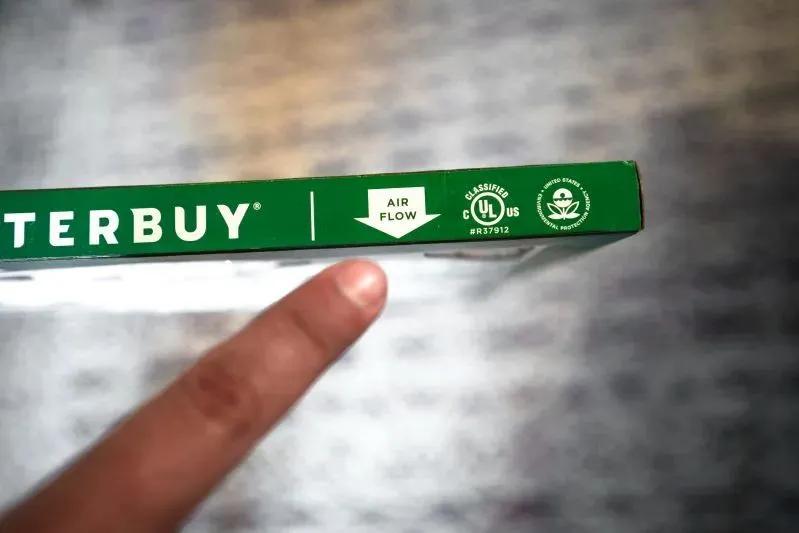
Best Air Purifier Replacement Filters - image of a person pointing at a green Filterbuy air filter label with airflow direction and certification icons.


Why Filter Choice Matters More Than the Purifier Itself

An air purifier is only as good as the filter inside it. Once that filter loads up with dust, pollen, dander, and smoke particles, airflow drops, noise climbs, and the unit stops pulling its weight even though the fan is still running.

The complication is that "air purifier filter" is not one product. Most units stack two or three different media types inside one housing, each with its own job, its own lifespan, and its own rules about cleaning. Treating them all the same is the fastest way to shorten the life of a purifier and the filter in it.

This guide covers how to identify what your purifier actually takes, how to choose a replacement that matches your home rather than a marketing label, when each layer needs to be swapped, and what you can safely clean. It also clears up the most common mix-up in this category: HEPA and MERV are two different rating systems, and a filter cannot meaningfully be both.

Step 1: Identify the Filter Your Purifier Actually Takes

Nearly every replacement mistake starts here. Before you shop, pull the old filter out and look at it.

Find the model number. It is usually printed on the filter frame, on a sticker inside the filter compartment, or on the back panel of the unit. That number is what guarantees a proper seal. A filter that runs a quarter inch small in either direction lets air slip around the edges instead of passing through the media, and unfiltered air takes the path of least resistance every time.

Count the layers. Some purifiers use a single wrapped cartridge that combines pre-filter, HEPA, and carbon in one piece. Others use two or three separate components you replace independently. If yours is a combination cartridge, the whole thing goes when any one layer is spent, and the HEPA usually decides when that is.

Check the airflow arrow. Pleated and cartridge filters are directional. Installed backward, they still fit and still make noise, but they load unevenly and restrict airflow sooner.

Step 2: Match the Replacement to Your Air

Once you know what the unit takes, the remaining choices come down to what you are trying to remove from the air.

What "True HEPA" Means, and Why "HEPA-Type" Is Not the Same

In the United States, the HEPA standard traces back to a Department of Energy specification: the filter must capture at least 99.97% of particles at 0.3 microns. That size is not arbitrary. It is the most penetrating particle size, the hardest diameter for filter media to catch. Particles both larger and smaller are captured at even higher rates, which is why HEPA media handles fine smoke particles and larger pollen grains alike. The European equivalent, EN 1822, sets comparable classes for HEPA and ULPA media.

"HEPA-type," "HEPA-style," and similar phrasing carry no certification. Performance varies widely between products using those labels. If a listing does not state an efficiency percentage and the particle size it was measured at, treat that as a gap in the spec sheet rather than an oversight.

Why Carbon Is the Only Layer That Handles Odors

HEPA media is a particle filter. It does not remove gases, cooking smells, or volatile organic compounds, because those are molecules rather than particles and they pass straight through. That is the carbon layer's job. Activated carbon works by adsorption, holding gas molecules on its surface until that surface saturates.

Two things follow. A thin carbon-dusted mesh saturates quickly, so the weight and depth of the carbon matter far more than its presence on the label. And once carbon is loaded, it is finished. It cannot be washed, baked, or otherwise recharged at home.

How to Size a Purifier to the Room

If you are shopping for a unit rather than just a filter, look for the AHAM Verifide CADR rating, which reports clean air delivery for smoke, dust, and pollen separately. The common rule of thumb is that the smoke CADR should be at least two-thirds of the room's square footage in a space with standard eight-foot ceilings. A correctly sized unit at a medium fan setting outperforms an undersized unit running flat out, and it loads its filter more slowly.

One Category of "Purifier" Worth Skipping

Devices marketed as ionizers, ozone generators, or "activated oxygen" purifiers sit in a separate category from filtration, and some of them produce ozone as a byproduct. Ozone is a respiratory irritant. California limits ozone emissions from air cleaning devices sold in the state to 0.050 ppm and maintains a list of certified devices, which is a useful reference even outside California. Mechanical filtration does not carry that tradeoff.

How Often to Replace Each Filter Layer

The blanket "every three months" advice you see everywhere fits some filters and badly misleads on others. Intervals depend on the layer and on the air it is working in.

Pre-filter: clean roughly every 30 days, and replace it when it looks worn or stops holding its shape. Its job is to catch hair and large debris before they reach the expensive media behind it, which is exactly why it loads fastest.

HEPA media: typically 6 to 12 months in a residential unit, and closer to the shorter end in a home with multiple pets, heavy allergy season exposure, or nearby smoke.

Activated carbon: typically 3 to 6 months, and sooner in kitchens or in homes where odor control is the main reason the unit runs.

HVAC filters: a 1-inch pleated filter generally runs 30 to 90 days. Filterbuy's 4-inch pleated filters last 6 to 12 months, because the deeper pleat pack gives the media far more surface area to load before airflow suffers.

Manufacturer guidance always takes precedence over these ranges. Treat them as outer boundaries and let the conditions in your home pull them shorter.

Signs Your Filter Needs Changing Early

Swap the filter ahead of schedule if you notice any of the following:

  • Weaker airflow at the same fan setting

  • A fan that has climbed to a higher speed on auto mode and stayed there

  • Odors returning that the unit used to handle

  • Visible grey or brown loading across the face of the media

  • Dust settling faster on surfaces in the room

Keep in mind that a filter indicator light is usually a timer rather than a sensor. It tracks hours of runtime, so it has no way of knowing how dirty your air actually is.

Which Filters You Can Clean, and Which You Will Ruin Trying

This is where a lot of well-meaning maintenance destroys a perfectly good filter.

Pre-filters: yes. Most are washable mesh or foam. Rinse with cool water, skip the detergent, and let them dry completely before reinstalling. A damp pre-filter reintroduces moisture into the housing and can grow the exact thing you were trying to filter out. If yours is not labeled washable, vacuum it gently with a brush attachment instead.

HEPA media: almost never. Standard HEPA media is a dense mat of fine fibers, and its efficiency depends on the structure of that mat. Water pushes the fibers apart and opens channels through the media. Vacuuming crushes them and can release captured particles back into the room. A small number of units use filters explicitly labeled washable or permanent, and those are engineered for it, usually at lower efficiency than true HEPA. If the frame or the manual does not say washable, it is not.

Carbon: no. Rinsing carbon does not restore its capacity, and wetting it can accelerate breakdown of the substrate.

The housing: yes, and make a habit of it. Wipe the interior of the filter compartment, the intake grille, and the fan housing with a dry or barely damp cloth every time you swap a filter. Dust that builds up on the intake side never reaches the filter at all.

HEPA vs. MERV: Two Ratings That Are Not Interchangeable

You will see filters advertised as "MERV 13 True HEPA." That phrasing does not describe a real product category, and it is worth understanding why before you shop.

MERV comes from ASHRAE Standard 52.2. It runs from 1 to 16 and rates HVAC filters on how well they capture particles across three size ranges, tested under airflow conditions typical of a central heating and cooling system. It is a scale, and it was built for whole-home systems.

HEPA is a single pass-or-fail threshold tested under entirely different conditions. HEPA media is also far more restrictive to airflow than an HVAC filter is designed to be. Dropping true HEPA media into a residential return duct tends to starve the blower rather than clean the house.

The two coexist. The purifier in your bedroom uses HEPA media in a housing with a fan built for that resistance. Your furnace or air handler uses a MERV-rated filter sized for a system moving air through every room. Neither one replaces the other, and any listing that stacks both ratings on a single product is misdescribing itself.

Feature MERV HEPA
What It Is A rating scale for HVAC filtration A single pass-or-fail filtration threshold
Rating System MERV 1–16 HEPA qualification rather than a MERV-style scale
Standard / Testing Based on ASHRAE Standard 52.2 and evaluated across three particle-size ranges Tested under different conditions from MERV
Designed For Central heating and cooling systems Air purifiers and equipment specifically designed for HEPA media
Typical Application Furnace or air-handler filters serving the whole home Portable air purifiers, such as a bedroom purifier
Airflow Designed for the airflow requirements of residential HVAC systems HEPA media creates substantially more airflow resistance
Can It Go in a Typical HVAC Return? Yes, when the filter is properly sized and compatible with the system Generally no. True HEPA media can excessively restrict airflow and starve a residential HVAC blower
Does It Replace the Other? No No
Can a Filter Be “MERV 13 True HEPA”? No. MERV and HEPA describe different filtration standards and should not be stacked together as though they were one rating.
Key takeaway: MERV and HEPA can work together in a home, but they perform different jobs. A MERV-rated filter serves the central HVAC system, while HEPA media belongs in equipment engineered to handle its greater airflow resistance.

Why Your HVAC Filter Does the Heavier Lifting

A portable purifier treats the room it is standing in. Your central system moves air through the whole house on every cycle, which makes the filter in it the highest-leverage filtration decision in most homes. EPA guidance on residential indoor air consistently points toward using both together rather than relying on either one alone.

Choosing the Right MERV Rating for Your Household

The right rating depends on your home, not on picking the highest number on the shelf.

One caution about going higher than your system was built for: older or undersized equipment can struggle against a very restrictive filter, and a starved blower ends up filtering less air overall. If you are unsure, MERV 8 to 11 is a safe operating range for most residential systems.

Filterbuy builds pleated filters in over 600 sizes, including custom dimensions, and ships direct from our own facilities. Ordering through Filterbuy.com means the size you order is the size that arrives, with subscription options that time deliveries to your actual replacement schedule instead of to whenever you happen to remember.

What the Standards and Research Directly Say

HEPA efficiency is a defined standard, not a marketing term. The 99.97% at 0.3 microns threshold comes from a Department of Energy specification and is tested against the most penetrating particle size, which is why capture rates run higher both above and below that diameter. Source: U.S. Department of Energy standard for HEPA filtration.

Filtration works best in layers. EPA guidance on residential indoor air points to combining source control, ventilation, HVAC filtration, and portable air cleaners rather than treating any single device as a complete solution. Source: U.S. Environmental Protection Agency, guidance on air cleaners and filters in the home.

MERV is defined by ASHRAE. Standard 52.2 establishes the test method and the 1 to 16 scale used for residential and commercial HVAC filters, measuring capture across defined particle size ranges. Source: ASHRAE Standard 52.2.

Ozone-generating devices are regulated for a reason. California's Air Resources Board sets a 0.050 ppm ozone emission limit for air cleaning devices sold in the state and publishes a list of certified products. Source: California Air Resources Board air cleaner regulation.

Filter loading is measurable. As a pleated filter loads, pressure drop across the media rises and airflow through the system falls. That is the mechanism behind every "reduced airflow means change the filter" recommendation. Source: ASHRAE Standard 52.2 test methodology.

Your Filter Replacement Checklist

1. Identify the filter. Pull the old one and write down the model number on the frame. If there is no number, check the manual or the sticker inside the compartment.

2. Note the layers. One combination cartridge, or separate pre-filter, HEPA, and carbon pieces? This decides whether you are buying one part or three.

3. Match the choice to your air. Pets and allergies point toward finer particle capture. Cooking odors and general smells point toward carbon. Smoke points toward the highest particle capture your equipment supports.

4. Clean what is washable and replace what is not. Rinse the pre-filter and dry it completely. Replace the HEPA and carbon. Wipe out the housing while it is open.

5. Handle the filter that covers the whole house. Measure your HVAC filter, depth included, and put it on a schedule that matches its type: 30 to 90 days for 1-inch, 6 to 12 months for 4-inch.

6. Set it up so you never have to remember. A calendar reminder works. A subscription works better, because the replacement is already sitting in the closet when the filter is due.

Shop air filters at Filterbuy.com

Frequently Asked Questions

How Often Should I Replace My Air Purifier Filter?

It depends on the layer. Pre-filters get cleaned monthly. HEPA media generally lasts 6 to 12 months in a home. Activated carbon generally lasts 3 to 6 months. Pets, smoke, and heavy use pull all three toward the shorter end. Follow the manufacturer's interval for your specific model, and change early if you notice reduced airflow or returning odors.

Can HEPA Filters Be Washed And Reused?

Almost never. Standard HEPA media loses efficiency when it gets wet, because water separates the fibers that do the filtering, and vacuuming can crush them. Only filters explicitly labeled washable or permanent by the manufacturer are built for it, and those typically operate below true HEPA efficiency. If the frame does not say washable, assume it is not.

What Is The Difference Between True Hepa And HEPA-Type Filters?

True HEPA meets a defined standard of 99.97% capture at 0.3 microns. HEPA-type, HEPA-like, and similar terms carry no certification, and performance varies widely between products. Look for a stated efficiency percentage along with the particle size it was measured at.

Is Merv 13 The Same As HEPA?

No. MERV is the ASHRAE 1 to 16 scale for HVAC filters, tested under central system airflow conditions. HEPA is a separate pass-or-fail standard for much denser media used in portable purifiers and specialized equipment. MERV 13 is the finest common residential HVAC option and the right pick for smoke, but it is not HEPA, and a product advertised as both is misdescribing itself.

What MERV Rating Should I Use In My Home?

MERV 8 covers everyday dust and pollen and suits most households. MERV 11 is the step up for allergies or pets. MERV 13 is for smoke and the finest particles. Odor Eliminator filters add carbon for cooking and pet smells. Higher is not automatically better, since very restrictive filters can reduce airflow in older systems.

Does An Air Purifier Filter Remove Odors?

Only if it includes an activated carbon layer. HEPA media captures particles, not gas molecules, so odors and volatile organic compounds pass straight through it. Carbon depth and weight determine how long that odor control lasts.

Why Is My Air Purifier Louder Than It Used To Be?

Usually a loaded filter. As media fills with captured particles, resistance rises, and the fan works harder, or auto mode steps up to a higher speed to maintain airflow. Check the pre-filter first, since it loads fastest, then inspect the main media.

Do I Still Need An Air Purifier If I Use A Good HVAC Filter?

They do different jobs. Your HVAC filter treats the whole house, but only while the blower is running. A portable purifier treats one room continuously. Homes dealing with a specific problem in a specific space, like a bedroom during allergy season, benefit from running both.

On this page

Related Posts

    Best Air Purifier Replacement Filters & How to Clean HEPA Filters for Maximum Performance and Air Quality