Shop by

Last January, we took a service call about a three-year-old furnace that wouldn’t hold a temperature. The previous contractor had sized the unit by square footage alone, skipped the Manual J load calculation, and the oversized equipment had been working against the ductwork from the first cold snap. Day & Night made a perfectly good furnace. That call was never about the furnace.
We’ve installed, serviced, and repaired Day & Night systems across hundreds of homes as a certified Day & Night Elite Dealer. What we know about these furnaces comes from crawl spaces, mechanical rooms, and the winter calls we field when something goes sideways. This guide covers what that experience actually taught us: what these systems cost, which models earn their price, how the warranty works, and what to watch for after installation.
We install this equipment for a living. What follows is what we actually tell customers who ask us directly.
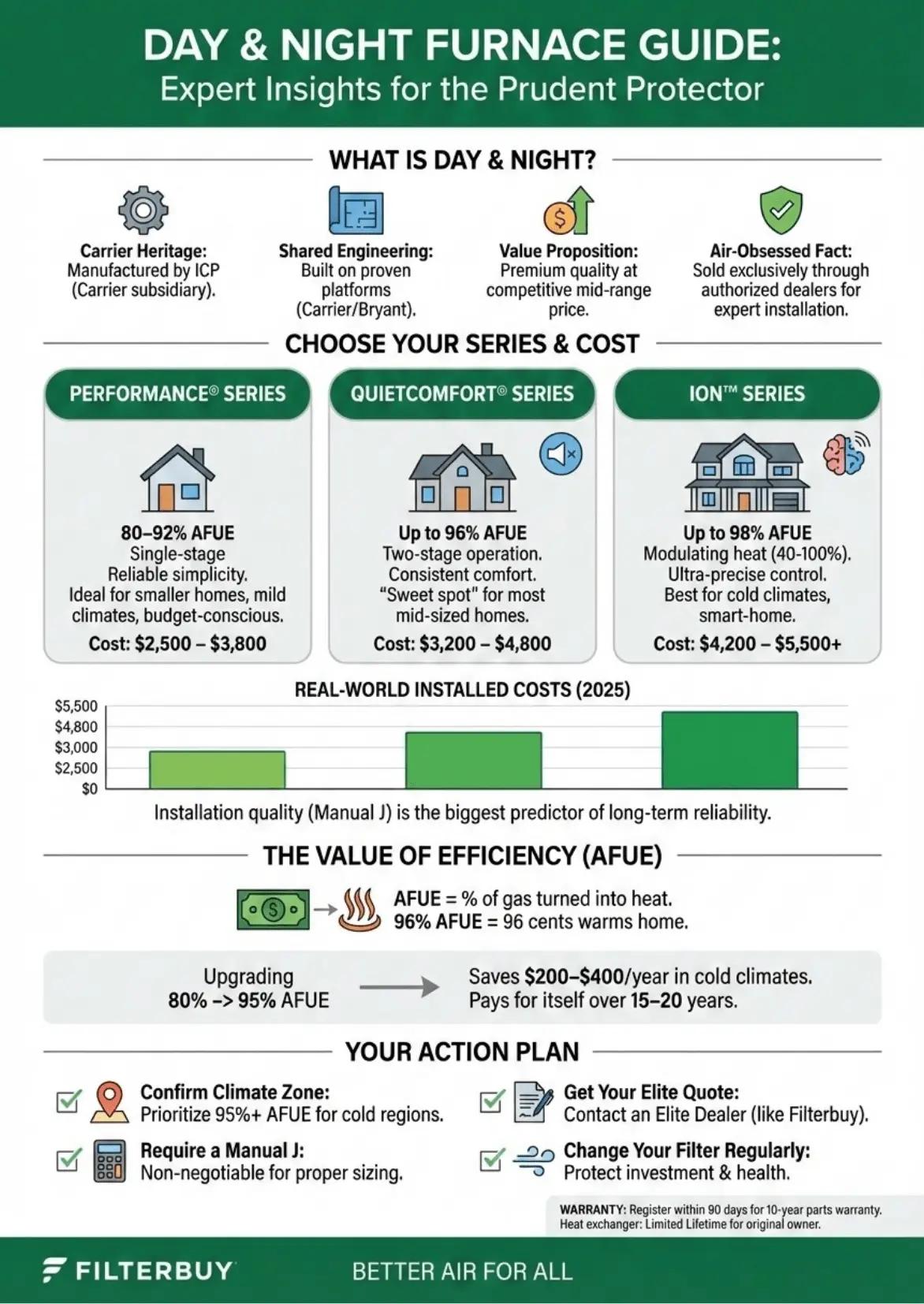
Day & Night is a residential gas furnace brand manufactured by International Comfort Products (ICP), a subsidiary of Carrier Global. Their furnaces share engineering platforms with Carrier and Bryant, making them a well-built mid-range option at a lower price point than the premium brands they're related to.
Day & Night offers three gas furnace series:
Performance® Series — 80–92% AFUE, single-stage, best for smaller homes and mild climates
QuietComfort® Series — up to 96% AFUE, two-stage, the best-value option for most homes
Ion™ Series — up to 98% AFUE, modulating, best for cold climates and homeowners who want smart-home HVAC control
Installed cost typically runs $2,500–$5,500 for most homes, depending on the model, home size, and local labor rates. Day & Night furnaces are sold exclusively through authorized dealers, not in big-box stores. The warranty includes a limited lifetime heat exchanger warranty and a 10-year parts warranty — but only if the equipment is registered within 90 days of installation.
Bottom line: Day & Night furnaces are a reliable, competitively priced choice backed by the same engineering that supports Carrier's own product line. The right model depends on your climate zone, home size, and how long you plan to stay in the home.
Day & Night is a Carrier family brand. Manufactured by International Comfort Products (ICP), a Carrier subsidiary. Shared engineering with Carrier, Bryant, and Heil: solid manufacturing foundation at a mid-range price.
There are three series to choose from. Performance (80–92% AFUE, single-stage), QuietComfort (up to 96% AFUE, two-stage), and Ion (up to 98% AFUE, modulating). Match the series to your climate and budget, not just the sticker price.
All-in cost runs $2,500–$5,500 for most homes. Equipment alone is $800–$1,800. Installation, permits, and labor account for the rest. High-efficiency models cost more upfront but deliver energy savings that offset the difference over time.
Installation quality is non-negotiable. The warranty requires it. Code compliance requires it. And frankly, your system’s long-term reliability depends on it more than the brand name on the unit.
Register within 90 days. The difference between a 5-year and a 10-year parts warranty. Don’t miss this. Your installer should handle it for you.
Tax credits expired December 31, 2025. If you installed in 2025, you may still be eligible to claim up to $600 via IRS Form 5695. Verify with a tax professional.
Change your filter. Regularly. It protects your furnace, your air quality, and your energy bills. Filterbuy has your size, ships free, and can deliver on a schedule so you never forget.
Day & Night is a residential HVAC brand manufactured by International Comfort Products (ICP), a subsidiary of Carrier Global Corporation. Carrier is also behind Bryant, Heil, and Tempstar, which means Day & Night furnaces share engineering platforms, heat exchanger designs, and core components with some of the most proven equipment in the business. Buying one means buying into the same supply chain and manufacturing standards that back Carrier’s own product line.
The Day & Night brand sits at the value-to-mid-range price point: better quality than entry-level discount brands, priced below Carrier and Bryant. It’s sold exclusively through a dealer network, so you won’t find one on a big-box store shelf. That’s a feature, not a limitation. Every installation goes through a trained professional who stands behind the work. For more background on how central heating furnaces work, the Wikipedia overview on furnaces is a useful starting point.
Learn more: How Central Heating Furnaces Work (Wikipedia)
Your furnace also directly affects the Air Quality Index in your home. The air circulating through your system and through your filter carries dust, allergens, and airborne contaminants. Choosing the right MERV rating for your filter is as important as choosing the right furnace efficiency rating.
Want to go deeper? Browse Filterbuy’s full HVAC resource library for plain-language guides covering everything from filter selection and MERV ratings to full system comparisons and seasonal maintenance checklists. No jargon required.
Day & Night organizes its gas furnace lineup into three series. Here’s what we actually think of each one based on field experience.
The Ion Series is Day & Night’s flagship line. These are modulating furnaces, meaning they don’t just run at on or off. They continuously adjust output from roughly 40% to 100% capacity, matching exactly how much heat your home needs at any given moment. The result is tighter temperature control, quieter operation, and the highest efficiency in the lineup.
AFUE: Up to 98%, among the highest in any residential gas furnace
Blower: Variable-speed ECM motor for whisper-quiet airflow
Smart integration: Pairs with the Ion™ Black System Control with Wi-Fi® for full remote management
Best for: Cold-climate homes, larger square footage, and homeowners who want full smart-home HVAC control
Our take: If you’re in a cold climate and planning to stay put for a decade or more, the Ion Series is where the long-term math gets interesting. Energy savings against an older 80% AFUE system compound year after year.
The QuietComfort Series is where we steer most customers who want strong performance without the Ion’s price tag. Two-stage operation means the furnace runs at low fire (around 65% capacity) most of the time and only kicks to full output on the coldest days. That translates to consistent comfort, lower energy bills, and a noticeably quieter system than a standard single-stage unit.
AFUE: Up to 96%, qualifies as high-efficiency for most climate zones
Staging: Two-stage operation with enhanced comfort management
Sound: Insulated cabinet and multi-speed blower, quieter than single-stage units in every home we’ve installed one
Best for: Most mid-size to large homes in moderate-to-cold climates where comfort and efficiency both matter
Our take: This is the sweet spot for most homeowners. You get the efficiency of a condensing furnace without paying top-tier Ion prices, and it’s one of the easier models to service. That matters when you’re thinking about the long game.
The Performance Series is Day & Night’s entry-level line. “Entry-level” here means straightforward, not cheap or unreliable. Single-stage operation runs at 100% capacity when on and off when not. That’s less efficient and can create slight temperature swings, but for smaller homes, mild climates, or homeowners managing upfront costs, it gets the job done.
AFUE: 80–92%. The N92MSN model reaches 92% with an 18-speed blower motor for precision airflow
Staging: Single-stage: simple, reliable, lower upfront cost
Best for: Smaller homes, mild climates, or budget-conscious replacements where the priority is reliability over premium efficiency
Our take: Don’t overthink it for a small home in a warm-to-moderate climate. An 80% unit can absolutely be the right call when your heating season is short. Where we push back is on cold-climate homeowners defaulting to an 80% model to save money upfront. The operating cost difference usually doesn’t pencil out over a 15–20-year lifespan.
Day & Night furnace equipment alone typically runs $800–$1,800, depending on the series and model. Add professional installation, which is required for warranty coverage and code compliance, and the all-in cost for most homeowners lands between $2,500 and $5,500.
The Performance® Series runs $800–$1,100 for equipment only and $2,500–$3,800 installed. It’s the right fit for small homes and mild climates. The QuietComfort® Series runs $1,100–$1,500 for equipment and $3,200–$4,800 installed, covering most mid-size homes well. The Ion™ Series, with efficiency up to 98% AFUE, runs $1,400–$1,800 for equipment and $4,200–$5,500 or more installed, which is where it makes the most sense for cold climates and larger homes.
Installation cost is where the real variation lives. Labor typically accounts for 25–40% of the total bill, and factors like ductwork condition, local permitting requirements, gas line work, and whether you’re doing a straight swap or a new installation all move that number. Urban markets also run 20–40% higher than national averages.
The lowest quote isn’t always the best deal. A furnace installed incorrectly can cost thousands in early repairs and void your warranty. Installation quality is the single biggest predictor of long-term system reliability.
Also budget for cooling: A new furnace is only half of your HVAC system. If your AC unit is aging, replacing both at the same time can reduce total labor costs significantly. Explore our HVAC cooling services to understand what a full heating and cooling system upgrade looks like and whether bundling both makes financial sense for your home.
Need a local contractor? If you’re searching for a professional Day and Night furnace installation contractor in Central Florida, our Filterbuy HVAC Solutions team serves the Poinciana area and surrounding communities. We handle permitting, load calculations, installation, and warranty registration.
Ductwork is one of the most underestimated cost factors. If your ducts are leaking, undersized, or in poor condition, a new furnace alone won’t solve your comfort problems. Learn what’s involved in a duct replacement project before your installation quote. It may be a line item you need to budget for separately.
Worth knowing: If your furnace’s ignitor fails down the road, that’s the single most common repair call we get, and the most frequently DIY-attempted. Before you tackle it yourself, read our guide on furnace ignitor replacement cost, signs of failure, and whether it’s a DIY job or a pro call.
Annual Fuel Utilization Efficiency (AFUE) is the number that tells you how much of the gas you’re paying for actually becomes heat in your home. An 80% AFUE furnace means 80 cents of every dollar you spend on gas warms your house. The other 20 cents goes out the flue as exhaust. A 96% AFUE unit keeps 96 cents of that dollar, and that 16-cent difference adds up to real money over a full heating season.
For a 2,000 sq ft home in a cold climate, the difference between an 80% and a 96% AFUE furnace can translate to $200–$400 in annual energy savings, depending on your local gas rates. Over a 15–20-year system lifespan, that’s $3,000–$8,000 in cumulative savings, often more than the upfront cost premium of the high-efficiency model.
For cold climates, we strongly recommend a minimum of 95% AFUE. For warmer regions where the furnace runs infrequently, the 80–92% Performance Series may offer faster payback on the lower upfront cost. Match AFUE to your climate zone, not just your budget.
Filter efficiency works alongside furnace efficiency. Your filter’s MERV rating determines what’s actually being captured before it recirculates through your home. If your filter is wrong for your system, you’re still breathing whatever slips through. Our complete MERV rating guide explains how to match filter grade to your home and health needs.
Short cycling is a performance issue worth knowing: if your furnace starts, runs briefly, and shuts off repeatedly, it’s a symptom worth diagnosing before it becomes a bigger problem. Our HVAC maintenance guide on why your AC keeps turning itself on and off covers the most common causes and what to do about each one.
In the Central Florida region, our team provides annual preventative AC maintenance service care plans in Orlando designed to keep both your furnace and cooling system running at peak efficiency year-round. Scheduled maintenance catches small issues before they become expensive repairs.
Professional installation by a licensed HVAC contractor is a warranty requirement, full stop. DIY installation voids Day & Night’s warranty entirely. Proper installation requires a Manual J load calculation to correctly size the system for your home’s specific heat loss, ductwork inspection and sealing, gas line sizing, venting configuration, and electrical connections. Getting any of these wrong creates safety risks, not just efficiency problems.
Site assessment and Manual J load calculation to determine the correct BTU capacity
Equipment delivery, safe removal, and disposal of your old furnace
Gas line inspection and connection to local code requirements
Vent and flue installation (critical for condensing high-efficiency models)
Electrical and thermostat wiring, including smart thermostat setup if applicable
Full system commissioning: testing ignition, airflow, temperature rise, and safety controls
Warranty registration handled on your behalf within the required 90-day window
Not every HVAC contractor is an authorized Day & Night dealer, and the difference matters. Day & Night Elite Dealers have met factory training requirements, maintain accountability to manufacturer standards, and have direct access to warranty support and equipment resources. When something goes wrong (a warranty claim, a parts issue, or an unexpected service call), you want the person who installed it to have that manufacturer relationship.
The Filterbuy HVAC Solutions team holds Day & Night Elite Dealer certification. When we install a Day & Night system, we handle your warranty registration, walk you through what voids coverage, and stay accountable to both the manufacturer’s standards and to you.
Older system? If your home’s HVAC equipment is aging and you’re facing multiple repairs at once, a complete HVAC restoration may be more cost-effective than patching individual components. Our team can assess your existing ductwork, electrical panel, and equipment to determine whether a full system upgrade makes better financial sense than continued repair spending.
Day & Night’s warranty is competitive, but the registration requirements catch a lot of homeowners off guard. Here’s exactly how it breaks down:
Heat exchanger warranty: Limited lifetime warranty for the original owner in an owner-occupied residence, upon timely registration. The heat exchanger is the most expensive component in the system.
Parts warranty (registered): 10-year limited parts warranty, but only if you register within 90 days of installation.
Parts warranty (unregistered): Drops to 5 years if you miss the window. That is a meaningful difference in coverage.
What voids coverage: DIY installation, installation by an unlicensed contractor, failure to register, and improper maintenance.
When Filterbuy HVAC Solutions installs your Day & Night system, we handle the warranty registration for you at the time of installation. You shouldn’t have to remember a 90-day deadline on top of everything else.
Federal tax credits, utility rebates, and manufacturer offers can meaningfully reduce your total cost. Here’s what’s actually available and how to use it.
Federal Section 25C Tax Credit: Qualifying high-efficiency furnaces are eligible for a federal tax credit of up to $600 (30% of installation cost, capped at $600 for furnaces). This credit applied to qualifying installations made before December 31, 2025. If you installed in 2025, file IRS Form 5695 with your tax return. Consult a tax professional for your specific situation.
Utility rebates: Many utility providers offer additional rebates on high-efficiency HVAC equipment. Use the DSIRE database (dsireusa.org) to find programs in your state.
Manufacturer rebates: Day & Night and ICP run seasonal promotional rebates through authorized dealers. Ask your Elite Dealer about current offers at the time of purchase.
Financing: Most authorized Day & Night dealers offer financing options. Common programs include 18-month same-as-cash plans and extended low-interest financing. Ask Filterbuy HVAC Solutions about current availability.
Maintenance plans: Annual servicing is the most reliable way to protect your investment and maintain warranty compliance. You can book a Filterbuy HVAC Solutions annual furnace care plan online in minutes. Our care plans include priority seasonal scheduling, full system inspection, and the proactive attention that keeps small issues from becoming expensive emergency calls.
We get more service calls in January and February than any other time of year, and most of them fall into the same five categories. Almost all are preventable.
Furnace won’t ignite: The most common culprit is a failed hot surface ignitor (HSI). These are wear items with a typical lifespan of 3–7 years. Before you call it a gas valve or control board problem, check the ignitor first. Our detailed guide covers HSI ignitor replacement cost, signs of failure, and when to DIY vs. call a pro.
Short cycling: Furnace starts, runs briefly, shuts off, repeats. Usual causes are an oversized unit, a dirty air filter restricting airflow, or a tripped limit switch. Change your filter first. If that doesn’t resolve it, call a tech.
Blower runs but no heat: Usually points to a flame sensor that needs cleaning, a gas valve issue, or a control board fault. This one needs a professional diagnosis.
Unusual noises: Banging on startup usually means dirty burners or delayed ignition. Squealing points to a blower motor bearing. Rattling often comes from loose panels or ductwork. None of these gets better on their own.
Error blink codes: Day & Night furnaces use LED blink codes on the control board to signal fault codes. The code legend is printed on the inside of the blower compartment door. Count the blinks, look up the code, and that will usually tell you exactly where to start.
Air quality and filtration: Your furnace drives your indoor air quality, for better or worse. If you’re concerned about chemical odors or airborne contaminants, our guide on whether activated carbon filters remove VOCs from indoor air is essential reading. Especially relevant for newer construction, post-renovation homes, or households with pets.
Choosing the right filter: Start with the dimensions your furnace takes, then choose your MERV rating based on your air quality needs. Our 10x30x2 air filter page is a good example of what to look for: filter size, MERV options, and how to match filtration level to your household (MERV 8 for standard use, MERV 11–13 for allergy and pet households).
Does filter thickness matter? More than most homeowners expect. The depth of your furnace filter affects static pressure, airflow restriction, and how often you need to change it. Our detailed guide on furnace filter thickness — does it really matter walks through when a 1-inch filter is fine and when upgrading to a 4- or 5-inch media filter makes a real difference.

“We’ve installed hundreds of Day & Night systems, and the honest truth is this: the furnace itself rarely fails when it’s sized right and installed correctly. What we see fail is the installation. Equipment that’s oversized for the space, ductwork that was never inspected, gas pressure that was never verified. Day & Night makes a solid product. But a solid product installed wrong will still give you a bad experience. That’s why we perform a Manual J load calculation on every single job, no exceptions. It’s what separates a system that lasts 20 years from one that gives you problems in year three.”
— Lead HVAC Technician, Filterbuy HVAC Solutions
We’ve done the link-chasing, so you don’t have to. These are the seven most useful resources for any homeowner researching or maintaining a Day & Night furnace.
1. Day & Night Official Gas Furnace Product Pages
Browse the complete lineup of current Day & Night gas furnaces, including specs, AFUE ratings, and model details directly from the manufacturer.
dayandnightcomfort.com — Gas Furnaces
2. Filterbuy: Furnace Ignitor Replacement Cost Guide
The hot surface ignitor is the most common Day & Night furnace repair call. Our guide covers symptoms of a failing HSI, what it costs to replace, and whether it’s a safe DIY job or one to hand off to a pro.
filterbuy.com — Furnace Ignitor Replacement Cost, DIY Signs & Installation Guide
3. IRS: Energy Efficient Home Improvement Credit (Section 25C)
The official IRS page for the Section 25C tax credit that covers qualifying high-efficiency furnace installations. Verify eligibility requirements, file Form 5695, and understand what documentation you’ll need.
irs.gov — Energy Efficient Home Improvement Credit
4. ENERGY STAR: Federal Tax Credits for Energy Efficiency
Plain-language breakdown of which HVAC equipment qualifies for federal credits, including minimum efficiency standards, credit amounts by category, and how to claim.
energystar.gov — Federal Tax Credits for Energy Efficiency
5. DSIRE: Database of State Incentives for Renewables & Efficiency
The most complete database of state and local energy incentive programs in the U.S. Enter your ZIP code to find utility rebates, state tax credits, and additional incentives available for high-efficiency HVAC equipment in your area.
dsireusa.org — DSIRE Incentive Finder
6. Wikipedia: How Furnaces Work (Central Heating Overview)
Not a purchasing guide, but a useful primer for homeowners who want to understand what’s actually happening inside a gas furnace before making a buying decision. Clear, fact-checked background on combustion, heat exchangers, and distribution.
en.wikipedia.org — Furnace (Central Heating)
7. HomeAdvisor: Furnace Replacement Cost Guide
An independently compiled national cost database with real homeowner-reported project costs for furnace replacement. Useful for benchmarking quotes from local contractors and understanding what factors drive price variation.
homeadvisor.com — Furnace Installation & Replacement Cost Guide
The national average total cost for a furnace replacement, including equipment and professional installation, per HomeAdvisor’s verified homeowner cost database. Day & Night installations typically land in the $2,500–$5,500 range depending on model and complexity, in line with or below the national average for comparable-quality systems.
Source: HomeAdvisor — Furnace Replacement Cost 2026
The estimated annual heating cost savings when upgrading from an 80% AFUE furnace to a 95%+ AFUE model, per HVAC efficiency data. For a household spending $1,200–$1,800 per year on home heating, that’s $180–$360 back in your pocket annually, and it adds up significantly over a 15–20-year system lifespan.
Source: Fixr.com — Furnace Replacement Cost Guide
The federal tax credit available to qualifying homeowners who installed a high-efficiency furnace meeting the Section 25C CEE highest-efficiency tier requirements before December 31, 2025. The credit equals 30% of qualifying installation costs, capped at $600 for furnaces. File IRS Form 5695 to claim it. Consult a tax professional for your specific situation.
Source: IRS.gov — Energy Efficient Home Improvement Credit
We recommend Day & Night furnaces regularly and stand behind that recommendation. The brand earns it because it delivers on the fundamentals: reliable heat exchanger design, competitive AFUE options across the lineup, a strong warranty structure, and manufacturing backed by Carrier Global. These aren’t cheaply made units. They’re built to last 15–20 years when installed right and maintained consistently.
Where we see homeowners go wrong comes down to two things. First, choosing the wrong model for their climate: defaulting to an 80% unit in Minnesota because it’s $400 cheaper upfront, and then paying more in gas every single winter for the next two decades. Second, choosing the wrong contractor. Day & Night makes a well-engineered product, but it cannot install itself. The equipment is only as good as the installation behind it.
If you’re in a cold climate and planning to stay in your home, the QuietComfort or Ion Series is where the value equation works best. The efficiency premium pays back in energy savings and comfort. If you’re in a mild climate, or if upfront cost is a genuine constraint, the Performance Series will serve you well. Just be realistic about the long-term operating cost trade-off.
Day & Night hits the value equation in a way that works for most homeowners: competitive efficiency, a strong warranty structure, and manufacturing backed by Carrier Global at a price that doesn’t require a premium-brand budget. Get the right model for your climate and a certified installer who’ll do it correctly. That’s the whole answer.
Whether you’re still comparing options or ready to commit, these are the steps that actually matter.
Confirm your climate zone. Cold climates (Zone 4 and above) should prioritize 95%+ AFUE. Mild climates have more flexibility. This single factor should drive your model selection more than anything else.
Require a Manual J load calculation, not just a square footage estimate. Any reputable HVAC contractor does this before recommending equipment. If they don’t mention it, ask. If they dismiss it, walk.
Get at least two quotes from authorized Day & Night dealers. Ask each contractor specifically about Elite Dealer status. The price difference between a qualified and an unqualified installer can be small. The accountability difference is significant.
Check for rebates before you buy. Visit DSIRE (dsireusa.org) to find state and utility rebates. For federal credits, confirm eligibility with IRS Form 5695 criteria and your tax professional. Rebates and credits must typically be applied at or after the time of purchase.
Register your equipment within 90 days of installation. This is the most important post-installation step most homeowners forget. It’s the difference between a 5-year and a 10-year parts warranty. When Filterbuy HVAC Solutions handles your installation, we take care of registration for you.
Schedule annual maintenance. A well-maintained Day & Night furnace can run reliably for 20 years. An ignored one might give you 10. Annual tune-ups run $100–$200 and pay for themselves in avoided repair calls and sustained efficiency.
Replace your air filter regularly. This is the simplest, cheapest thing you can do to extend the life of your furnace and protect your indoor air quality. Every 1–3 months, depending on your home and filter type. Filterbuy makes it easy.

Day and Night furnace equipment typically runs $800–$1,800, depending on the series. With professional installation, most homeowners spend $2,500–$5,500 all-in. High-efficiency Ion Series installations in larger homes or complex setups can push above $5,500. The best way to get an accurate number is an in-home assessment by a certified installer who can account for your specific ductwork, gas line, and home size.
Yes. Day & Night is manufactured by International Comfort Products, a Carrier Global subsidiary, so their furnaces share engineering platforms with Carrier and Bryant. At the mid-range price point, Day & Night delivers competitive efficiency, solid warranty terms, and reliable performance when installed correctly. It’s not the most talked-about brand in the industry, but it’s genuinely well-built.
Day & Night offers a limited lifetime warranty on the heat exchanger for the original owner in an owner-occupied residence, plus a 10-year limited parts warranty, but only when the equipment is registered within 90 days of installation. Miss that window, and the parts warranty drops to 5 years. DIY installation or installation by an unlicensed contractor voids the warranty entirely.
Day & Night currently offers three gas furnace series: the Ion™ Series (modulating, up to 98% AFUE, premium comfort and smart-home integration), the QuietComfort® Series (two-stage, up to 96% AFUE, the best-value mid-range option), and the Performance® Series (single-stage, 80–92% AFUE, budget-friendly entry-level). Choose based on your climate zone and how long you plan to stay in your home.
Qualifying Day & Night furnaces that met the CEE highest-efficiency tier were eligible for the federal Section 25C tax credit of up to $600 (30% of installation cost, capped at $600 for furnaces) for qualifying installations completed before December 31, 2025. If you installed in 2025, file IRS Form 5695 with your return. Check eligibility with a tax professional; specific model and documentation requirements apply.
Day & Night Elite Dealers are factory-authorized HVAC contractors who have met manufacturer training requirements, sales performance standards, and customer service accountability criteria. They have direct access to Day & Night equipment, warranty support, and factory rebate programs. Choosing an Elite Dealer gives you assurance that your system is installed by someone with documented training and direct manufacturer accountability. Filterbuy HVAC Solutions holds Elite Dealer certification.
With proper installation and annual maintenance, a Day & Night furnace should deliver 15–20 years of reliable service. The heat exchanger (the core of the system) carries a limited lifetime warranty. What shortens that lifespan in practice is usually deferred maintenance: ignored air filters, skipped annual tune-ups, and small problems left to compound. Stay ahead of maintenance, and the system will take care of itself.
Get a free, no-obligation Day & Night furnace installation quote from your local Filterbuy HVAC Solutions team. We’re a certified Day & Night Elite Dealer: we handle the sizing, installation, permitting, and warranty registration. You handle the warm part.