
Choosing the wrong furnace filter is one of the most common and most invisible mistakes homeowners make. After manufacturing millions of air filters across our facilities in Alabama, Pennsylvania, Texas, and Utah, we've learned something that surprises most people: the type of filter you choose matters more than the brand name on the box. Washable, pleated, and HEPA filters don't just differ in price. They differ in how effectively they capture the microscopic pollutants your family breathes every day, how they affect your HVAC system's lifespan, and how much they actually cost you over time once you factor in replacement frequency, energy efficiency, and potential system damage.
Through over a decade of hands-on filter production and real feedback from more than two million households, we've identified the specific scenarios where each filter type excels and where each one falls short. This guide shares what we've seen on our production lines and heard from real homeowners so you can match the right filter type to your home's unique needs.
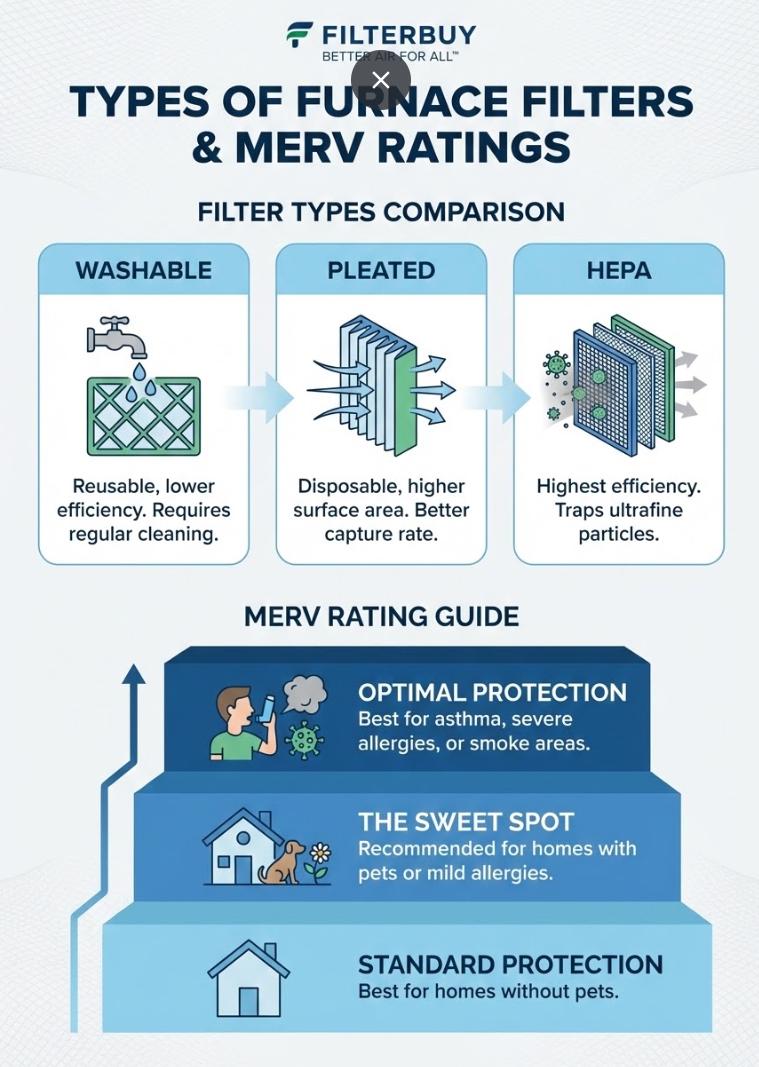
There are three main types of furnace filters used in residential HVAC systems. After manufacturing millions of filters and serving over two million households, here's what we've learned about how each one performs in real homes:
Washable Furnace Filters
Reusable mesh filters you rinse and reinstall every 1–3 months
Most rated MERV 1 - 4
Catch large particles like lint and visible dust only
Best suited for vacation properties, workshops, or low-demand spaces
Not recommended for primary residences where air quality protection matters
Pleated Furnace Filters
Disposable accordion-folded media that maximizes surface area for particle capture
Available in MERV 8 through MERV 13 for residential use
Capture pollen, mold spores, pet dander, dust mite debris, and fine particulates
Maintain healthy HVAC airflow throughout the filter's service life
Best option for the vast majority of American homes, confirmed by our manufacturing data and over two million customer households
HEPA Furnace Filters
Capture 99.97% of particles down to 0.3 microns
Too dense for most standard residential HVAC blower motors
Can cause frozen coils, compressor strain, and higher energy bills
Best used as a standalone portable air purifier paired with a pleated furnace filter, not installed directly in your furnace
Bottom line: A quality pleated filter in the MERV 8–13 range offers the best balance of filtration performance, HVAC system compatibility, and long-term value for most homes. The EPA, DOE, American Lung Association, and ASHRAE all support this conclusion, and our decade-plus of manufacturing experience confirms it.
Washable filters cap out around MERV 4 — they only catch visible debris
Pleated filters range from MERV 8–13 — they capture the microscopic contaminants that actually affect respiratory health
HEPA filters achieve 99.97% capture — but create airflow problems most residential systems can't handle
We've seen these differences confirmed across millions of filters and more than two million households
The EPA, DOE, American Lung Association, and ASHRAE all support this conclusion.
Our own manufacturing data and customer feedback confirm it
Best balance of particle capture, system compatibility, and long-term value
The right filter is only half the equation
A clogged filter can increase HVAC energy consumption by up to 15% (DOE)
Families who maintain a consistent replacement schedule report cleaner air, lower bills, and fewer repairs
We can manufacture residential HEPA furnace filters we choose not to
Our testing and customer data show they cause frozen coils, compressor strain, and costly repairs in standard systems.
Better approach: pair a MERV 11 or MERV 13 pleated filter with a standalone HEPA purifier for near-HEPA whole-home performance
Our most recommended rating across over two million households
Covers the needs of most homes with pets, mild allergies, or general air quality concerns
Customers consistently notice the difference within the first filter cycle
Every forced-air HVAC system pushes air through a filter before circulating it into your living spaces. That filter's job is to capture airborne particles, dust, pollen, pet dander, mold spores, and other contaminants before they reach your family's lungs and your system's sensitive components. What most homeowners don't realize is that the filter's material and construction determine not only what it catches but how hard your HVAC system has to work to push air through it. A filter that's too restrictive starves your system of airflow. One that's too porous lets harmful particles pass right through. Understanding this balance is the key to choosing the right filter type for your home.
Washable filters use a layered mesh, typically electrostatic polypropylene or aluminum, that you rinse clean and reinsert every one to three months. Their appeal is obvious: buy once and reuse for years. But in our experience, manufacturing filters across every MERV rating, we've seen a significant tradeoff that the "eco-friendly" marketing rarely mentions.
Most washable filters max out around MERV 4, meaning they capture large particles like lint and household dust but let the smaller, more harmful contaminants pass through freely. Pollen, mold spores, pet dander, and fine dust particles slip right past. They also require thorough drying before reinstallation. Put a damp filter back in your system, and you're creating a breeding ground for mold inside your ductwork, which is far worse than the problem you were trying to solve.
Washable filters can make sense for vacation properties, workshops, or spaces where basic debris protection is the only goal. For a primary residence where your family lives and breathes every day, there are significant gaps in air quality protection.
Pleated filters are made from sheets of polyester or cotton-polyester blend media folded into accordion-style pleats. Those folds dramatically increase the filter's surface area, which means two things that matter to your home: they capture far more particles, and they maintain better airflow while doing it.
This is where our manufacturing experience tells a story the specs alone can't. Pleat count and media density vary enormously from one filter to the next. A low-quality pleated filter with shallow, loosely packed pleats may technically carry a decent MERV rating, but won't hold up over a full replacement cycle. We engineer our pleated filters with consistent pleat spacing and electrostatically charged media to maintain capture efficiency from the day you install them to the day you replace them.
Pleated filters are available across a wide MERV range, typically MERV 8 through MERV 13, giving you the flexibility to match filtration to your household's specific needs. A home with pets and allergy sufferers benefits from a MERV 11 or higher, while a household without those concerns can run a MERV 8 and still enjoy significantly cleaner air than any washable filter provides. For most American homes, pleated filters deliver the strongest combination of air quality protection, HVAC system compatibility, and long-term value.
HEPA filters represent the gold standard of particle capture, removing 99.97% of airborne particles down to 0.3 microns. That includes bacteria, fine dust, smoke particles, and virtually every common household allergen. For families managing asthma, severe allergies, or compromised immune systems, that level of filtration can be life-changing.
But here's what many homeowners don't know before purchasing one: true HEPA filters are so dense that most standard residential HVAC systems cannot generate enough airflow to push air through them effectively. Installing a genuine HEPA filter in a system not designed for one can cause frozen evaporator coils, compressor strain, uneven heating and cooling, and significantly higher energy bills. Over time, that kind of strain shortens your system's lifespan, an expensive consequence of choosing more filtration than your equipment can handle.
If your home requires HEPA-level filtration, the most effective approach is a dedicated HEPA air purifier working alongside a high-quality pleated furnace filter in the MERV 11 to MERV 13 range. This combination gives you near-HEPA air quality throughout your home without forcing your HVAC system to do something it wasn't built to do.
After producing filters for over a decade and hearing directly from more than two million households about what works in real homes, our recommendation is clear for most homeowners: pleated filters in the MERV 8 to MERV 13 range offer the best balance of filtration performance, system compatibility, and cost-effectiveness.
Washable filters save money upfront but sacrifice the particle capture that actually protects your family's health. HEPA filters deliver extraordinary filtration but create airflow restrictions that most residential systems can't sustain. Pleated filters sit in the sweet spot, engineered to capture the pollutants that matter most while working in harmony with your HVAC system rather than against it.
The right choice ultimately depends on your household. Homes with pets, allergy sufferers, or smokers benefit from a higher-rated pleated filter. Homes in areas prone to wildfire smoke or high outdoor pollution should consider pairing a strong pleated filter with a standalone HEPA purifier. And every home benefits from consistent replacement on the schedule recommended for your specific filter — because even the best filter loses its effectiveness once it's overloaded with the contaminants it was designed to catch.
"After manufacturing millions of filters and hearing from over two million households, one thing is clear — most homeowners don't need the most expensive filter on the shelf, they need the right filter for their system, and nine times out of ten, a quality pleated filter in the MERV 8 to MERV 13 range protects both their family's air and their HVAC investment better than any alternative."
Don't take your indoor air for granted, especially when you're making a decision that affects every breath your family takes. We're obsessed with air filtration, and after manufacturing millions of filters across our facilities in Alabama, Pennsylvania, Texas, and Utah, we know that the best decisions come from the best information. These are the seven resources we trust on our own production floor, and they'll empower you to choose the right furnace filter type with confidence, not guesswork.
Here's something most homeowners don't realize: not all filter ratings mean the same thing. The U.S. Environmental Protection Agency created this guide to cut through the confusion around MERV, MPR, and FPR ratings so you can compare filters on a level playing field. Since every furnace filter decision starts with understanding MERV, this is your essential first stop, and it's the same standard we build every one of our filters to meet. https://www.epa.gov/indoor-air-quality-iaq/what-merv-rating
This is one of the most comprehensive resources the EPA offers for homeowners, and it tackles the exact question we hear from customers every day: should I upgrade my furnace filter, add a portable air purifier, or both? It provides an honest look at what each filtration approach can and can't do, which is especially valuable if you're considering a HEPA setup but aren't sure your system can handle it. We reference this guide regularly because it reinforces what we've seen across more than two million households: the right combination matters more than the highest price tag. https://www.epa.gov/indoor-air-quality-iaq/guide-air-cleaners-home
3. ASHRAE — Filtration and Disinfection FAQ
ASHRAE wrote the rulebook our entire industry plays by. They developed the MERV rating standard, and their filtration FAQ answers the technical questions that matter most when you're choosing between washable, pleated, and HEPA filters things like airflow resistance, system compatibility, and how to get the best filtration without overtaxing your HVAC equipment. We've built our manufacturing processes around ASHRAE standards since day one, and this resource helps you understand why those standards exist to protect both your air quality and your system. https://www.ashrae.org/technical-resources/filtration-and-disinfection-faq
4. American Lung Association — "Air Cleaning and Filtration"
Clean air isn't just about comfort, it's about protecting your family's health. The American Lung Association recommends MERV 10 or higher for residential HVAC systems and identifies HEPA-rated portable air cleaners as the most effective single-room option. If anyone in your household manages asthma, allergies, or respiratory sensitivities, this resource helps you understand exactly which filter type delivers the health protection your family needs. It's the kind of guidance that turns an invisible threat into a visible, solvable problem. https://www.lung.org/clean-air/indoor-air/protecting-from-air-pollution/air-cleaning
Here's a number that surprises most homeowners: a clogged air filter can increase your HVAC system's energy consumption by up to 15%. The DOE's efficiency guide connects the dots between filter maintenance, airflow, and your utility bills, the hidden cost most people never think about when comparing filter types. Whether you're evaluating the ongoing cleaning demands of a washable filter or the replacement schedule of a pleated one, this resource helps you see the full cost picture, not just the price on the shelf. https://www.energystar.gov/saveathome/heating-cooling
We built this resource from our own manufacturing experience because we kept hearing the same question from customers: "Which MERV rating is actually right for my home?" Our MERV comparison guide breaks down exactly how each rating performs in real-world conditions, explains why we manufacture pleated electrostatic filters in MERV 8, 11, and 13, and helps you match the right level of protection to your household whether you have pets, allergy sufferers, or just want cleaner air for your family. It's the kind of practical, no-nonsense guidance that comes from over a decade of making filters and listening to the people who use them. https://filterbuy.com/resources/air-filter-basics/all-about-merv-ratings/
For the homeowner who wants the full story, this EPA technical document is the deep dive. It covers filtration technologies, health studies, and scientific evidence behind every major air-cleaning approach and it confirms something we've observed on our own production lines: medium-efficiency pleated filters in the MERV 7 to 13 range are nearly as effective as true HEPA filters at removing allergens in residential HVAC systems. That's a powerful finding, and it's exactly why we believe pleated filters remain the smartest choice for most homes. https://www.epa.gov/sites/default/files/2018-07/documents/residential_air_cleaners_-_a_technical_summary_3rd_edition.pdf
When you manufacture millions of air filters and work directly with over two million households, you start seeing patterns the statistics alone can't fully capture. These three data points from leading government and health organizations mirror the exact problems our customers call us about every week.
Source: U.S. Environmental Protection Agency (EPA) — "Indoor Air Quality"
Link: https://www.epa.gov/report-environment/indoor-air-quality
We see the proof of this every time a customer sends us a photo of their old filter. Even a 30-day-old pleated filter tells a story most homeowners never see: layers of dust, dander, pollen, and fine particulates that were circulating through their home with every HVAC cycle.
Here's what that means for your filter choice:
Washable filters rated MERV 1–4 catch visible debris like lint and large dust
The smaller contaminants that actually affect respiratory health pet dander, mold spores, pollen, fine dust — pass right through the mesh and recirculate continuously.
Customers who upgrade from a washable to a MERV 11 or MERV 13 pleated filter consistently tell us within weeks: "I had no idea how much was getting through my old filter.r"
The air inside your home carries far more than what you can see. Your filter type determines how much of it your family keeps breathing.
Source: U.S. Department of Energy (DOE), referenced via ENERGY STAR — "Heat and Cool Efficient.ly"
This statistic hits differently when you've spent over a decade engineering filter media for optimal airflow. On our production lines, we measure airflow resistance at multiple stages because how air moves through a filter matters just as much as what it catches.
What our manufacturing data has shown us:
A washable filter with uneven mesh density or residual moisture from incomplete drying creates unpredictable airflow resistance from the moment it goes back in
We engineered our pleated filters with consistent pleat spacing and electrostatically charged media specifically because our testing showed uniform construction holds airflow resistance steady across the filter's entire service life.
A well-built pleated filter maintains consistent airflow from day one through day ninety a washable filter that missed a proper cleaning cycle starts restricting airflow immediately and compounds the problem weekly.
With heating and cooling consuming nearly half the average household's energy bill, that 15% penalty translates to real dollars most families don't realize they're wasting until they switch to a quality pleated filter and watch their next utility bill drop.
Source: American Lung Association — "Air Cleaning and Filtration"
Link: https://www.lung.org/clean-air/indoor-air/protecting-from-air-pollution/air-cleaning
That 99.97% capture rate is remarkable. It's also exactly why homeowners assume HEPA is always the best choice. But our customer support logs tell a different story.
What we consistently hear from families who installed true HEPA filters in standard residential furnaces:
Frozen evaporator coils within weeks of installation
Compressor short-cycling and uneven temperatures throughout the house
Repair bills that far exceeded the cost of the filter itself
The issue isn't the HEPA technology, it's that the media density required for that level of capture creates more airflow resistance than most residential blower motors can overcome.
What works instead:
The American Lung Association recommends MERV 10 or higher for home HVAC systems, a threshold that aligns precisely with what we've seen work across more than two million households
Our MERV 11 and MERV 13 pleated filters capture the contaminants that matter most: pollen, mold spores, pet dander, dust mite debris, and fine particulates while keeping airflow within your system's design range.
For families needing HEPA-level protection due to severe allergies, asthma, or compromised immune systems, the most effective setup we've seen across thousands of customer conversations is pairing a high-MERV pleated furnace filter with a standalone portable HEPA purifier in the rooms where your family spends the most time.
You get near-HEPA whole-home performance without asking your HVAC system to do something it was never built to do.
Most furnace filter articles end with a generic recommendation to "choose the best filter for your needs." After manufacturing millions of filters across four U.S. facilities and listening to real feedback from over two million households, we think you deserve more than that.
The furnace filter industry has a transparency problem.
Washable filter brands lean on the "buy once, save forever" promise without disclosing a critical gap:
Most washable filters cap out around MERV 4
That rating lets the contaminants your family should be most concerned about, pollen, mold spores, pet dander, and fine dust, circulate freely through every room
The "eco-friendly savings" disappear when you factor in what those filters aren't catching
On the other end, HEPA marketing has convinced millions of homeowners that anything less than 99.97% particle capture is settling. What it doesn't mention:
Installing a true HEPA filter in a standard residential system is like forcing a garden hose through a coffee filter. The air still moves, but your system pays the price
Frozen coils, compressor strain, and unexpected energy bills are the real-world consequences we hear about from customers every single week.
A family that spent $80 on a HEPA furnace filter and ended up facing a $600 HVAC repair didn't get better air quality; they got a costly lesson.
These aren't hypothetical scenarios. They're patterns we've tracked across a decade of customer conversations, and they shaped every engineering decision we make on our production floor today.
Our position is simple, and we'll say it plainly.
For the vast majority of American homes, a quality pleated filter in the MERV 8 to MERV 13 range delivers the strongest combination of particle capture, system compatibility, and long-term value. Not the cheapest option. Not the most impressive-sounding. The one that actually works confirmed across millions of filters and millions of households.
Here's how to match the right MERV level to your home:
MERV 8 — Standard filtration for homes with no specific health concerns or elevated air quality needs
MERV 11 — Our most recommended option for households with pets, mild allergies, or moderate air quality concerns
MERV 13 — Best for families managing asthma, severe allergies, or living in areas prone to wildfire smoke or high outdoor pollution
If your home needs HEPA-level protection, here's what we'd actually recommend.
We'll tell you something most filter companies won't: don't put a HEPA filter in your furnace. Instead:
Install a quality MERV 11 or MERV 13 pleated filter in your HVAC system to handle whole-home baseline filtration
Add a dedicated portable HEPA air purifier in the rooms where your family spends the most time, bedrooms, living areas, and home offices
Run both consistently to achieve near-HEPA whole-home performance without overtaxing your HVAC system.
We have the production capability to manufacture residential HEPA furnace filters. We choose not to because our own data tells us they cause more problems than they solve in standard residential systems. That's not a business limitation. It's an honest engineering decision.
What we want you to take away from this page.
The EPA, DOE, American Lung Association, and ASHRAE all point toward the same conclusion: our manufacturing experience has confirmed that a well-engineered pleated filter balances air quality protection, system health, and energy efficiency better than any alternative for most homes.
The government data supports it.
Our production-line testing confirms it.
Over two million households have validated it in the only lab that truly matters, their own homes
Your family's air quality isn't something to leave to guesswork or marketing claims. You're the one who maintains the home. You're the one who changes the filter. And now you're the one with the information to make that choice with real confidence, not because a brand told you what to buy, but because you understand exactly why one filter type outperforms the others where it counts.
That's the kind of homeowner we built Filterbuy to serve. And that's the kind of honesty we think this industry needs more of.
You've got the knowledge. Now put it to work. These six steps are the same process our customer support team walks homeowners through every day.
Pull out your existing filter and check the size printed on the frame (example: 20x25x1)
No size printed? Measure length, width, and depth in inches with a tape measure
No filter installed? Measure the filter slot opening in your HVAC unit or return air vent.
Use the nominal (rounded) size for ordering — a filter measuring 19.5 × 24.5 × 0.75 is a 20x25x1
We manufacture over 600 sizes because even a half-inch gap matters. A filter that doesn't sit snugly lets unfiltered air bypass the media entirely. Your system works harder while your family gets less protection.
MERV 8 — Baseline protection for homes without pets or elevated air quality concerns
MERV 11 — Our most recommended option for households with pets, mild allergies, or anyone wanting noticeably cleaner air
MERV 13 — Maximum residential-grade protection for asthma, severe allergies, or wildfire smoke exposure
Not sure? Start with MERV 11. After working with over two million households, we've found that it covers the needs of most American homes.
Review your unit's owner's manual for the manufacturer's maximum recommended MERV rating.
Can't find the manual? Search the model number on the manufacturer's website.
When in doubt, a quick call to a local HVAC technician can save you from airflow problems
Most standard residential systems handle MERV 8 through MERV 13 without issues — it's only true HEPA filters (MERV 17+) that cause the airflow restriction problems we discussed earlier
The best filter stops working once it's overloaded. Here's what we recommend based on millions of customer interactions:
1-inch pleated filters: Every 60–90 days under normal conditions
Households with pets: Every 30–60 days — dander and hair accelerate filter loading significantly
Allergy or asthma households: Every 30–60 days during peak seasons, 60–90 days otherwise
Multiple pets or smokers: Check monthly and replace as soon as the media appears gray or visibly loaded
Set a recurring reminder on your phone. Homeowners who stay on schedule consistently report better air quality, lower energy bills, and fewer HVAC service calls — that's straight from our customer data.
It takes less than two minutes. Doing it right matters:
Turn off your HVAC system
Slide out the old filter and note the airflow direction arrow on the frame
Insert the new filter with the arrow pointing toward the blower motor, typically toward the ductwork, away from the return vent
Confirm the filter sits flush with no gaps around the edges
Turn your system back on
Common mistake we hear about constantly: Installing the filter backwards. Our pleated filters are engineered with media density and electrostatic charge calibrated for one specific airflow direction. Reversing it reduces capture efficiency and shortens the filter's effective lifespan.
The number one reason filters don't get changed on time isn't forgetfulness; it's not having a replacement on hand. After seeing this pattern across millions of interactions, we built our subscription service to solve it.
Choose your size, MERV rating, and delivery frequency
We ship directly to your door on your schedule
Adjust, pause, or cancel anytime
When the right filter shows up exactly when you need it, staying on schedule becomes effortless. That consistency is what protects your family's air, extends your system's lifespan, and keeps energy costs predictable.
A: The difference comes down to what each filter captures and how it affects your HVAC system's airflow. After manufacturing millions of filters across every MERV rating, here's what our production testing shows:
Washable filters:
Use a layered mesh that you rinse and reuse
Most capture around MERV 4
Catch visible particles like lint, large dust, and carpet fibers
Let microscopic contaminants, such as pollen, mold spores, pet dander, and fine dust, pass through and recirculate
Pleated filters:
Use accordion-folded media engineered with specific pleat counts, media density, and electrostatic charge
Available in MERV 8 through MERV 13 for residential use
Capture exponentially more fine particulates than washable filters
Maintain the airflow your system needs throughout the full filter cycle
HEPA filters:
Achieve 99.97% particle capture down to 0.3 microns
Media is so dense that it chokes most residential blower motors
We can manufacture residential HEPA furnace filters we choose not to because our data consistently shows they create more problems than they solve in standard home systems.
The real differentiator isn't just what each filter catches. It's whether your HVAC system can sustain the performance over a full cycle without suffering for it.
A: In specific situations, yes. For a primary residence, our decade of manufacturing experience and customer data say no.
Where washable filters make sense:
Vacation cabins and seasonal properties
Detached workshops or garages
Storage spaces where basic debris protection is the only goal
Where they fall short — based on millions of customer interactions:
MERV 1–4 ratings let microscopic allergens, mold spores, and fine dust recirculate every cycle,the same contaminants the EPA identifies as 2 to 5 times more concentrated indoors than outdoors
Proper maintenance requires complete rinsing and thorough drying before reinstallation. Most homeowners eventually rush the drying step or skip a cycle.
A filter reinstalled damp doesn't just restrict airflow; it creates a mold-breeding environment inside your ductwork that our customer service team has seen turn a $15 filter into a $500 remediation call.
What our customer feedback reveals: Homeowners who switch from washable to MERV 11 pleated filters after years of unexplained allergy symptoms consistently tell us within 30 days: "I can't believe I waited this long." That reaction has repeated thousands of times across our customer base.
A: In most cases, no. This is the question we wish every homeowner would ask before installing one because the answer saves families hundreds in preventable HVAC repairs.
We test filter media across the full MERV spectrum on our production floor. When media density exceeds what a standard residential blower motor can handle, airflow doesn't just decrease; it drops to a point where the system can no longer maintain proper temperature exchange.
What our customer support logs document weekly from HEPA furnace filter installations:
Evaporator coils freezing within 2–4 weeks
Compressors short-cycling as the system struggles to maintain set temperatures
Rooms far from the unit receive noticeably less airflow
Energy bills are spiking from blower motors running at maximum capacity against resistance they weren't designed to overcome
What works instead — validated across thousands of customer conversations:
Install a MERV 11 or MERV 13 pleated filter in your HVAC system for whole-home baseline filtration
Add a dedicated portable HEPA purifier in rooms where your family spends the most time
Run both consistently for near-HEPA whole-home performance
The American Lung Association recommends MERV 10 or higher for residential systems, not HEPA. After serving more than two million households, that threshold matches exactly what we've seen deliver real results without system damage.
Q: What MERV rating should I choose for my home's furnace filter?
A: After manufacturing at every MERV level and tracking results from over two million households, we've identified three ratings that cover the vast majority of American homes.
MERV 8 — Best for households without pets, smokers, or specific health concerns. Captures dust, common pollen, and mold spores with minimal airflow resistance. A meaningful upgrade from any washable or fiberglass filter.
MERV 11 — Our most recommended rating. Ideal for homes with pets, mild to moderate allergies, or general air quality concerns. Captures finer contaminants, including pet dander, dust mite debris, and smog particles. Customers consistently report noticeable improvements within the first filter cycle.
MERV 13 — Our highest residential recommendation. Engineered for families managing asthma, severe allergies, or elevated exposure from wildfire smoke and outdoor pollution. Undergoes the most rigorous density and electrostatic testing on our production lines because the margin between effective filtration and excessive airflow restriction is narrowest at this level.
Our recommendation if you're unsure: Start with MERV 11. It's the answer we give most often because it fits most homes. After tracking results across our entire customer base, it's where most families find the sweet spot between noticeably cleaner air and seamless system performance.
A: We've tracked replacement patterns across more than two million households. The data is clear: homeowners on a consistent schedule report better air quality, lower energy costs, and fewer HVAC service calls.
Replacement timelines refined through a decade of data:
Standard homes (no pets, no specific concerns): Every 60–90 days
Households with pets: Every 30–60 days — dander and hair are among the fastest particle types to load a filter
Allergy or asthma households: Every 30–60 days during peak seasons, 60–90 days otherwise
Multiple pets, smokers, or active renovation: Check monthly, replace when media appears gray or visibly loaded
What most filter guides won't tell you:
Consistency matters more than perfection. The DOE estimates a clogged filter can increase HVAC energy consumption by up to 15%. Our customer feedback confirms that families who change on schedule, even a few days early or late,e outperform families who wait for visible signs of loading every single time.
Two habits that make the biggest difference:
Set a recurring reminder on your phone
Keep a spare filter on hand, so you're never waiting on a replacement
That single routine protects your air, your system, and your energy bill simultaneously, and it's the most impactful advice we give after over a decade of making filters and talking to the people who use them.
Now that you understand how washable, pleated, and HEPA furnace filters compare, the next step is matching the right filter to your system. Enter your filter size above to explore our full line of Filterbuy American-made pleated filters engineered from over a decade of manufacturing experience and trusted by more than two million households to deliver cleaner air, lower energy costs, and longer HVAC system life.

