July 7, 2026
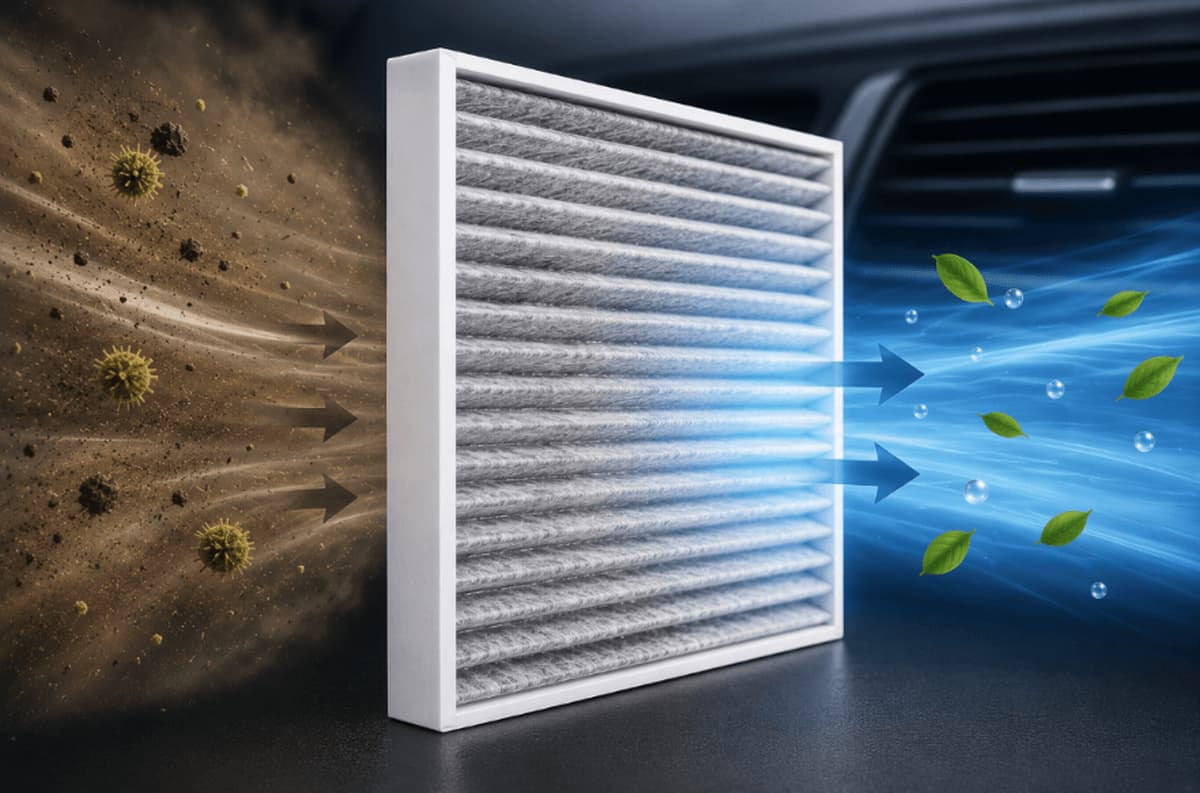
A car's engine air filter cleans the outside air your engine burns, trapping dust, pollen, and road grit before it reaches the combustion chamber. That keeps abrasive particles off your pistons, cylinders, and valves, so the engine runs the way it should. But your car has a second air filter too, and it does a completely different job.
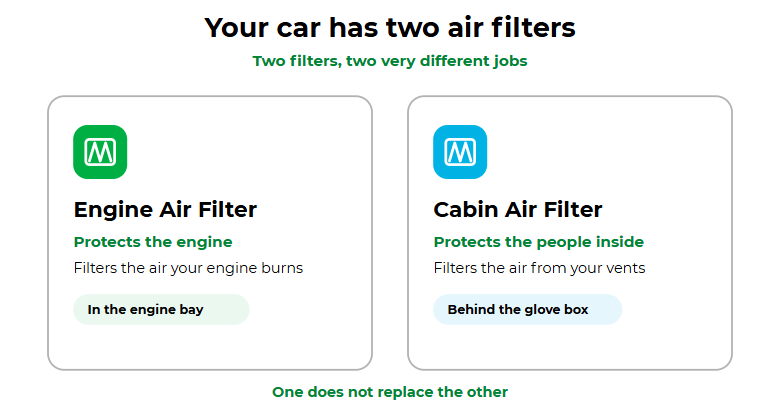
Engine air filter — protects the engine. Filters the intake air for combustion. Lives in the airbox in the engine bay.
Cabin air filter — protects the people inside. Filters the air your vents pull into the cabin. Sits behind the glove box.
Filterbuy makes the cabin air filter for your exact year, make, and model. Not sure which one your car needs? Match your vehicle in the quick quiz below, or find your cabin filter now.

Not sure what fits? Answer a few quick questions and we'll match you to your filter.
Your engine needs three things to run: fuel, spark, and a steady supply of clean air. Fuel and spark get plenty of attention at service time. The air filter rarely does, right up until it starts causing problems.
A clogged or neglected engine air filter quietly chips away at performance, fuel economy, and engine longevity. Understanding what it does, how it works, and when to replace it is one of the simplest ways to protect your vehicle.
The engine air filter is essential for providing clean air to your engine, allowing it to run efficiently.
Neglecting the air filter can lead to reduced performance, lower fuel economy, and potential engine damage over time.
Replacing the air filter at recommended intervals is a simple yet effective way to maintain your vehicle's health.
A clean air filter ensures proper combustion, contributing to smoother operation and better longevity for your engine.
The engine air filter's job is straightforward: keep contaminants out of the combustion chamber. Every time your engine fires, it pulls in a significant volume of outside air. That air is not clean. It carries dust, pollen, road grit, and fine debris that can wear down cylinder walls, accelerate piston ring wear, and damage valve seats over time. The filter intercepts those particles before they ever reach the engine.
Think of it as the engine's first and only line of defense against the outside world.
Following the air from outside the vehicle all the way to the combustion chamber shows exactly where the filter fits in.
Here is how air moves from outside the vehicle into the engine, step by step:
Outside air enters the intake snorkel. The intake tube draws air from outside the engine bay, typically near a fender or grille. Cooler outside air is denser and richer in oxygen, which supports better combustion.
Air passes through the engine air filter. The filter sits inside a sealed plastic housing called the airbox. Its pleated media captures dust, pollen, debris, and road grit while allowing clean airflow to continue downstream.
A mass airflow (MAF) sensor measures the airstream. After the filter, the engine control module measures exactly how much air is entering so it can calculate the correct fuel injection quantity. Any disruption to airflow here directly affects the air-to-fuel ratio.
Air travels through the throttle body and intake manifold. The throttle body regulates how much air the engine receives based on accelerator input. The intake manifold then distributes air evenly to each cylinder.
Combustion happens. Clean, measured air mixes with fuel in the cylinder, the spark plug fires, and the engine produces power.
Every stage downstream depends on the filter doing its job at stage two. A compromised filter sends contaminated or unmetered air into a system designed to receive neither.
These two filters serve completely different purposes, and confusing them is a common mistake. The engine air filter and cabin air filter each protect something different, as the table below makes clear.
| Engine Air Filter | Cabin Air Filter | |
|---|---|---|
| Protects | The engine | Vehicle occupants |
| Filters | Intake air for combustion | Air entering the passenger cabin via HVAC |
| Location | Airbox in the engine bay | Behind the glove box or under the dashboard |
| Replacement interval | Every 12,000 to 15,000 miles | Every 15,000 to 25,000 miles |
Replacing one does not replace the other. A fresh engine air filter can coexist with a clogged cabin air filter, and vice versa. Weak airflow from your vents or a musty smell inside the car may indicate a problem with the cabin air filter. Sluggish acceleration or dropping fuel economy points to the engine air filter.
An engine air filter does not fail suddenly. Performance degrades gradually as the filter media loads up with debris, so the symptoms can be easy to miss at first. If you want a full breakdown of what to watch for, our guide to dirty engine air filter symptoms covers each one in detail.
Reduced fuel economy. A clogged filter restricts airflow into the combustion chamber. The engine compensates by working harder and burning more fuel to maintain the same output.
Loss of power and sluggish acceleration. When the engine cannot draw sufficient air, the air-to-fuel ratio runs rich. Throttle response slows, and the car feels hesitant under acceleration.
Rough idle or engine misfires. A severely restricted filter disrupts combustion timing enough to cause stumbling at idle or misfires under load.
Check engine light. If the air-to-fuel ratio drifts far enough from spec, the engine control module logs a fault code and triggers the warning light.
Black smoke from the exhaust. Dark exhaust smoke signals an overly rich fuel mixture, often caused by insufficient airflow due to a clogged filter.
Failed emissions inspection. Incomplete combustion produces more hydrocarbons and carbon monoxide. A dirty engine air filter is a common reason vehicles fail state emissions tests.
Most manufacturers recommend replacing the engine air filter every 12,000 to 15,000 miles, or roughly once per year for average drivers. That interval shortens for drivers in dusty climates, on dirt roads, or in high-pollution urban environments. For the most accurate guidance, check your vehicle's owner's manual since replacement schedules can vary by make and model.
Inspect the filter sooner if any of the following apply:
You drive frequently on unpaved or dusty roads
You have noticed any of the performance symptoms listed above
The filter looks visibly gray, brown, or packed with debris when you pull it out
You recently purchased a used vehicle and do not know its service history
Replacing an engine air filter is one of the fastest and least expensive maintenance tasks on any vehicle. On most cars, it requires no tools at all.
A car engine air filter is a small, inexpensive component that shields one of the most expensive assemblies in your vehicle. Keeping it clean preserves fuel efficiency, maintains power output, and extends engine life by stopping abrasive particles from reaching critical internal surfaces.
Filterbuy carries a full range of engine air filters sized to fit your specific year, make, and model. Getting the right filter for your vehicle takes the guesswork out of one of the most important maintenance tasks you can do.
An engine air filter removes dust, pollen, road grit, and airborne debris from intake air before it enters the combustion chamber. This protects internal engine components, including pistons, cylinders, and valves, from abrasive wear caused by contaminated airflow.
The engine air filter protects the engine. Combustion engines require large volumes of outside air to run. Without filtration, fine particles carried in the air would act as abrasives inside the engine, causing accelerated wear on precision-machined components and considerably shortening engine lifespan.
After passing through the engine air filter and airbox, clean air flows through a mass airflow sensor, moves to the throttle body, distributes through the intake manifold, and enters each cylinder through the intake valves. There, it mixes with fuel and ignites, producing combustion.
No. These are separate components with different functions. The engine air filter cleans intake air for combustion and sits in the engine bay. The cabin air filter cleans air circulated through the vehicle's HVAC system and sits behind the glove box or under the dashboard. Replacing one does not replace the other.
Common signs include reduced fuel economy, sluggish acceleration, rough idling, engine misfires, a check engine light, or dark exhaust smoke. Most manufacturers recommend replacing the engine air filter every 12,000 to 15,000 miles. Drivers in dusty or high-pollution environments should inspect theirs more frequently.
