July 6, 2026

Written by Michelle Wan · Reviewed by David Clark, Licensed HVAC Technician | Published July 4, 2026 · Updated July 4, 2026
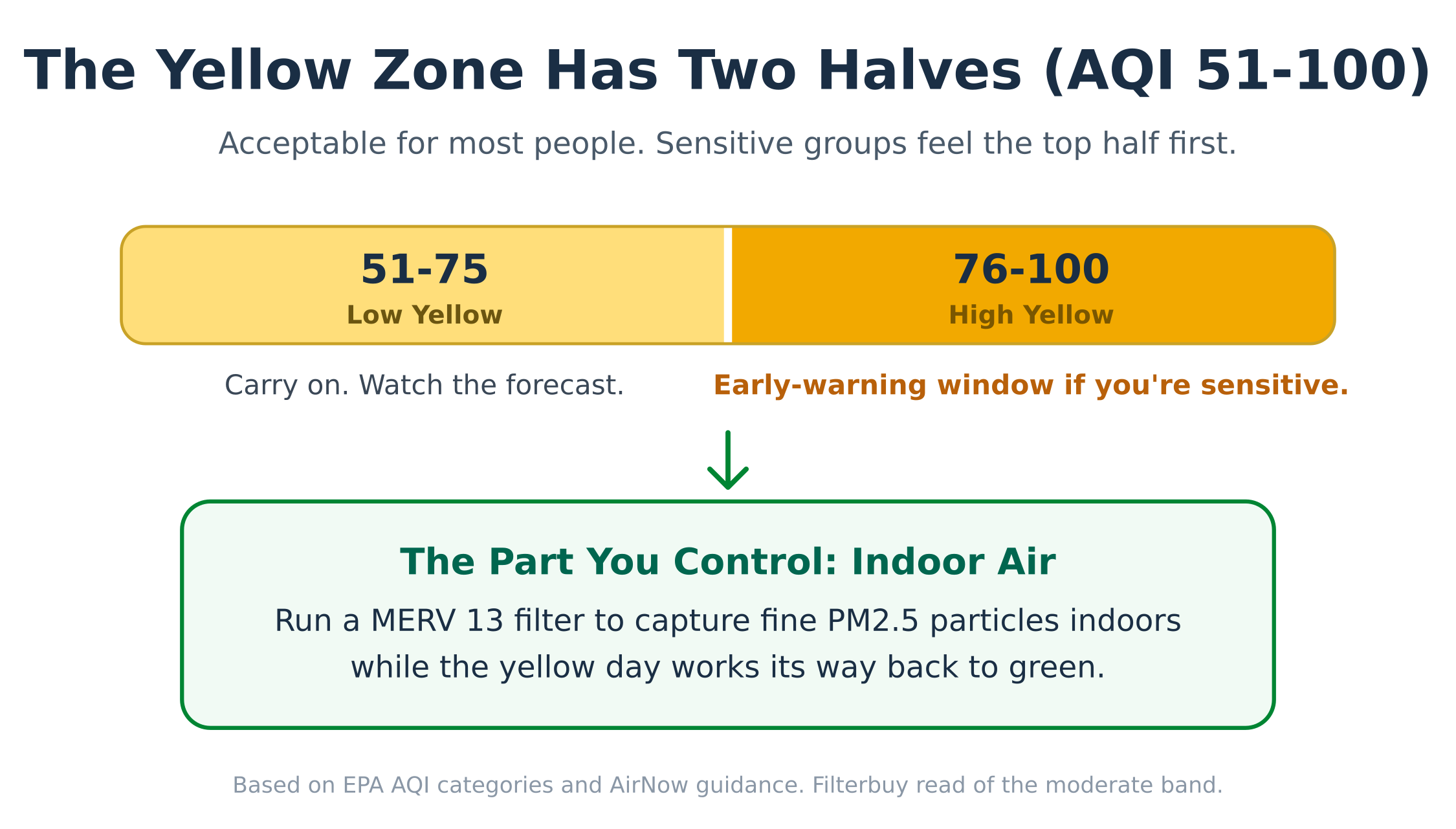
Moderate air quality is an AQI between 51 and 100, the yellow band on the EPA's six-color scale. It's acceptable for most people, and the upper half (76 to 100) is where sensitive groups start to feel it.
Here's how to read a yellow day at a glance:
Your indoor air is the part you fully control, and the right MERV rating is what makes the difference on a yellow day.
Not sure which MERV rating you need? Answer a few quick questions and we'll match you to the right filter.
An AQI between 51 and 100 puts your area in the yellow band the U.S. Environmental Protection Agency labels “Moderate.” The word reads like a green light, and for most healthy adults it nearly is. The catch is that the same yellow number a weekend runner can shrug off is the number that sends a kid with asthma reaching for an inhaler after recess. That difference in who feels it is the entire point of the moderate category, and it drives the question we field more than almost any other about air quality. Is a yellow day actually bad? After years of helping families read these numbers and building the filters that clean their air, our honest answer is that it depends entirely on who's breathing it. We're obsessed at Filterbuy with what floats in the air you can't see, so we'll make this particular shade of yellow visible and practical.
Moderate air quality means the Air Quality Index (AQI) sits between 51 and 100, shown as yellow on the EPA's six-color scale. Air at this level is acceptable for most people. Unusually sensitive individuals, including some people with asthma, heart disease, or lung disease, may notice symptoms and should consider easing up on long or intense outdoor activity.
Put plainly, a moderate AQI is the first step up from “Good.” The EPA built the index so that a value of 100 marks the edge of its short-term health standard for a pollutant, which is why anything above 100 tips into “Unhealthy for Sensitive Groups.” Yellow is the buffer that sits right below that edge.
Moderate air quality is an AQI of 51–100 (the yellow zone) and it's safe for the general public. It matters most for sensitive people, and it matters more in its upper half (76–100) than its lower half (51–75). Running your HVAC system with a high-efficiency filter keeps your indoor air cleaner while a yellow day passes.
Moderate air quality is an AQI of 51 to 100, color-coded yellow, and it ranks second on the EPA's six-level scale, just above “Good.”
At a moderate AQI, air is acceptable for the general public, while unusually sensitive people may feel respiratory or cardiovascular symptoms.
The two pollutants that most often push a day into the yellow zone are ground-level ozone and fine particle pollution, known as PM2.5.
A reading of 76 to 100 (the top half of yellow) is where local forecasters often start flagging caution for sensitive groups, so it deserves more attention than a reading in the low 50s.
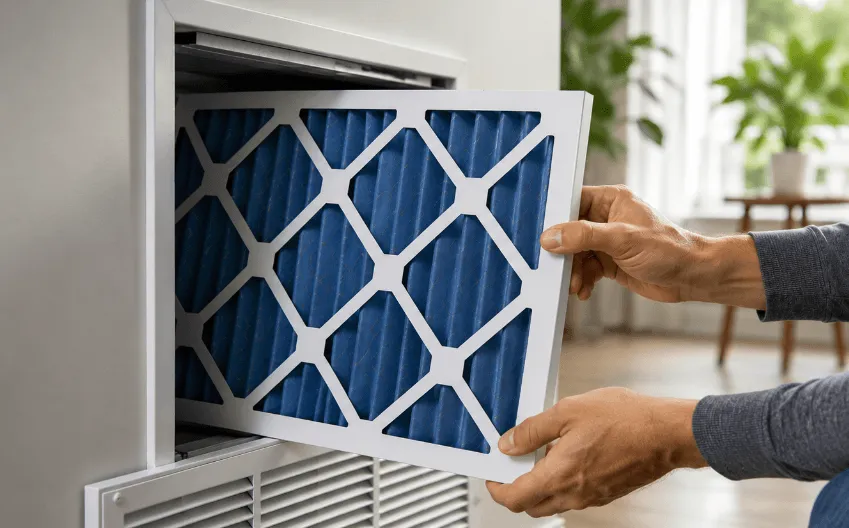
Running central heating and cooling with a high-efficiency filter such as a MERV 13 is one of the simplest ways to keep indoor air cleaner on a moderate day.
The Air Quality Index runs from 0 to 500 and splits into six categories. Moderate is the second category, covering AQI 51 to 100 in yellow. The EPA calculates the index for five pollutants and reports whichever one is worst that day. On most yellow days in the United States, that pollutant is either ground-level ozone or PM2.5.
The AQI works like a health-based yardstick rather than a raw pollution reading. Each pollutant has its own averaging window. Ozone runs on an 8-hour index, and particle pollution runs on a 24-hour index, so a yellow ozone afternoon and a yellow PM2.5 day don't behave the same way hour to hour. Knowing which pollutant is driving the color tells you when the risk peaks and what to do about it.
Here's the full scale for context, with the moderate band highlighted in the middle of the range. For a deeper walkthrough of every color and what to do at each level, see our complete guide to the Air Quality Index.
The moderate band is wide enough that its bottom and top behave differently. An AQI of 51 to 75 (low yellow) rarely affects anyone. An AQI of 76 to 100 (high yellow) sits one nudge below “Unhealthy for Sensitive Groups,” and it's the range where sensitive people often start noticing symptoms and where forecasters begin issuing early caution.
We started splitting the yellow band in two after watching how differently a low-50s morning and a high-90s afternoon play out in the homes we help. The Filterbuy team treats 76–100 as an early-warning window rather than an all-clear. This is our practical read of EPA guidance, not a new rule the government publishes, so use it as a rule of thumb. If your local AQI is climbing through the 80s and 90s and you or someone in your home is sensitive, act as though orange is on the way. If it's sitting at 55 on a clear morning, carry on and just keep an eye on the forecast.
Moderate air quality is not bad for the general public, and it's considered safe for healthy adults and children going about a normal day. It can be bad for a smaller group of unusually sensitive people. Anyone with asthma, COPD, other lung disease, or heart disease, along with older adults, pregnant people, and young children, has more reason to watch a yellow reading.
Sensitivity isn't only about a diagnosis. People who exercise hard outdoors breathe far more air per hour, which raises their real exposure even on a moderate day. That's why a healthy trail runner and a healthy office worker can experience the same yellow number very differently. In our experience, the people who get caught off guard on a yellow day usually aren't the ones with the most fragile health. They're the ones who assumed “moderate” meant “fine for everyone.” The table below turns all of that into a single decision tool you can glance at on any yellow day, and for the households that need it most, the right filter can ease asthma and allergy triggers indoors while the air outside clears.
Filterbuy synthesis of EPA and AirNow action guidance for the Moderate AQI category. General information, not medical advice. Follow your own care plan and your clinician's guidance.
A moderate day is usually driven by one of two pollutants. Ground-level ozone forms when sunlight cooks vehicle and industrial emissions, so it peaks on hot, sunny afternoons. Fine particle pollution (PM2.5) comes from combustion sources like traffic, wood smoke, and wildfires, and it can linger for hours. AirNow reports whichever pollutant is highest, so check which one owns your yellow number.
The distinction changes your timing. If ozone is the culprit, the safest windows are early morning and evening, when the reaction slows. If PM2.5 is the culprit, the smart move is to keep those fine particles out of your lungs and out of your house, because they're small enough to slip deep into the respiratory tract and into the bloodstream. Either way, clean indoor air is the part you can fully control, and it helps to know how your HVAC filter captures fine particles before the next yellow day.
How the two most common causes of a yellow day differ and what each one calls for. A Filterbuy comparison based on EPA and AirNow guidance.
A moderate AQI is a useful headline, not the whole story. The number on your app reflects outdoor air, reports only the single worst pollutant that day, and is usually a daily forecast or average. Your real exposure depends on where you are, when you're active, how hard you're breathing, and the quality of the air inside your own home.
It measures outdoor air. Your indoor air can be cleaner with good filtration, or dirtier from cooking, candles, dust, or smoke that drifts inside.
It shows one pollutant. The AQI reports whichever pollutant is worst, so an ozone yellow day and a PM2.5 yellow day share the same number but call for different moves.
It's a snapshot or forecast. Real levels rise and fall by the hour, so a calm yellow morning can turn into a rougher afternoon.
It doesn't know you. The same reading of 85 is a non-event for a healthy adult and a real signal for a child with asthma or someone who has heart disease.
A moderate AQI is a good cue to lean on your HVAC system. Set the fan to keep air moving, close windows if outdoor air is the source, and run a high-efficiency filter rated to capture fine particles. A MERV 13 filter is the common sweet spot for homes that want strong PM2.5 capture without straining a typical residential blower.
MERV, short for Minimum Efficiency Reporting Value, tells you how well a filter traps small particles, and higher numbers capture more of the fine stuff. If you're weighing options, how MERV 8, MERV 11, and MERV 13 compare breaks down which rating fits which home. MERV 13 is widely recognized in the industry for capturing a large share of particles in the PM2.5 size range while still fitting most residential systems.
On a yellow day, the goal is boring and effective. Keep the air indoors circulating through a good filter, replace that filter on schedule so it keeps pulling its weight, and you turn your home into the cleanest room in the neighborhood while the AQI works its way back to green.
When I service homes during a stretch of yellow-air days, the ones that stay comfortable are almost always running a clean, higher-MERV filter with the fan set to keep air moving. The calls I get after a bad-air week tend to come from homes that waited until symptoms showed up. On a moderate day, the cheapest fix is often the one you already own: a fresh filter and a system that's actually circulating.
— David Clark, Licensed HVAC Technician and Technical Reviewer, Filterbuy
A yellow day is the easiest air quality problem to ignore and one of the most worth catching early. After manufacturing filters for over a decade and serving more than two million households, we've learned that the families who stay ahead of moderate days aren't reacting to smoke or headlines. They already treat their HVAC system as their first line of defense, so when the AQI creeps toward 100, their indoor air is handled before they even think about it.
— David Heacock, Founder and CEO, Filterbuy
Every claim on this page traces back to a primary or authoritative source. These seven cover the science and the safety guidance behind the moderate category.
The EPA's official plain-language explainer for the AQI scale and its six categories. Source: AirNow's Air Quality Index (AQI) Basics
How fine particle pollution affects health and who is most at risk. Source: EPA guidance on the health effects of particulate matter
A public-health overview of outdoor air quality and simple protective steps. Source: the CDC's overview of air quality and your health
Why air quality matters and how forecasts and alerts work, from the National Weather Service. Source: the National Weather Service on why air quality is important
Federally funded research linking air pollution exposure to disease. Source: NIEHS on air pollution and your health
How air pollution triggers and worsens asthma, with practical precautions. Source: the Asthma and Allergy Foundation of America on air pollution and asthma
The cardiovascular risks of air pollution for people with heart conditions. Source: the American Heart Association on air pollution, heart disease, and stroke
152.3 million Americans breathe unhealthy air. That's about 44% of the country, all living in counties with failing grades for ozone or particle pollution (2026).
Source: the American Lung Association's 2026 State of the Air key findings
PM2.5 contributes to roughly 5,400 premature deaths a year in California. It also drives about 6,700 asthma-related ER visits each year. The highest risk falls on people with heart or lung disease, along with children and older adults.
Source: the California Air Resources Board on inhalable particulate matter and health
Americans spend up to 90% of their time indoors. That makes the air in your HVAC system the air your family breathes most.
Source: the National Environmental Education Foundation on indoor air quality
Here's our honest take at Filterbuy, after years of watching how families respond to air quality alerts. The moderate zone is where good habits are built or skipped. Nobody argues about a hazardous purple day, because the danger is obvious. Yellow is quieter, and that's exactly why it's the category worth respecting. The households that treat a yellow reading as a gentle prompt rather than a non-event are the ones who never get caught off guard when the number climbs.
You don't need to reorganize your life around the AQI. You need a simple response you can repeat without thinking. Check the reading, notice whether ozone or particles are behind it, protect the sensitive people under your roof, and let your HVAC system carry the load indoors. That's the whole habit, and it pays off on every day above green.
Check your local AQI at AirNow.gov, in a trusted weather app, or with our live AQI tool, before outdoor plans.
Note which pollutant is driving the color, since ozone and PM2.5 call for different timing.
If the reading is 76–100 and someone in your home is sensitive, shift hard activity to the morning or indoors.
Close windows when outdoor air is the source, and keep your HVAC fan moving air through a high-efficiency filter.
Replace that filter on schedule so it keeps capturing fine particles at full strength.
Q: Is Moderate Air Quality Bad For You?
A: Moderate air quality (AQI 51–100) is not bad for the general public and is considered acceptable for most healthy people. It can cause symptoms in unusually sensitive individuals, such as some people with asthma, heart disease, or lung disease, who may want to ease up on long or intense outdoor activity, especially in the upper half of the range.
Q: Is It Safe To Exercise Outside When Air Quality Is Moderate?
A: For most healthy people, yes, exercising outdoors during a moderate AQI is generally safe. If you have a heart or lung condition, or you're doing prolonged, heavy exertion, consider lighter or shorter workouts once the AQI climbs into the 76–100 range, and favor cooler morning hours when ozone is the pollutant behind the reading.
Q: What Does The Yellow AQI Color Mean?
A: Yellow on the AQI scale means the Moderate category, an index value between 51 and 100. It sits one step above green (“Good”) and one step below orange (“Unhealthy for Sensitive Groups”). Yellow signals that air is acceptable for the general public while remaining a mild concern for the most sensitive people.
Q: What Does An AQI Of 51 To 100 Mean?
A: An AQI of 51 to 100 means moderate air quality, the yellow zone on the EPA's six-category scale. The pollutant driving the reading, usually ozone or PM2.5, is present at a level that's acceptable for most people but can affect sensitive groups, particularly as the number approaches 100.
Q: Should I Run An Air Purifier On A Moderate Air Quality Day?
A: Running an air purifier or your HVAC system with a high-efficiency filter is a smart, low-effort step on a moderate day, especially if outdoor particle pollution is the cause or a sensitive person lives in your home. A MERV 13 filter in a central system, or a portable HEPA unit in the rooms you use most, both help keep indoor air cleaner.
Q: Does Moderate Air Quality Affect Pets?
A: Pets can be affected by air pollution much like people, and animals with existing heart or respiratory conditions are the most sensitive. On a moderate day this is rarely a serious worry, but keeping indoor air filtered and giving older or ill pets shorter outdoor time is a reasonable precaution when the AQI runs high in the yellow range.
You can't control the forecast, but you can control the air inside your home. Filterbuy manufactures high-efficiency HVAC filters in the USA in more than 600 sizes, including MERV 13 options built for fine-particle days. Ready to make the invisible visible in your own home? Find your Filterbuy filter size and shop MERV 13 so your indoor air is handled before the next yellow day arrives.