
Outdoor Air Quality And Asthma: Triggers, Thresholds, And Indoor Protection
July 3, 2026
Author: Michelle Wan | Reviewed by: David Clark, Licensed HVAC Technician
Published: July 3, 2026 | Last updated: July 3, 2026
Outdoor Air Quality And Asthma Triggers: What A Home Filter Captures
The outdoor triggers that affect asthma most are ground-level ozone, fine particles (PM2.5), nitrogen dioxide, and pollen. Watch the Air Quality Index (AQI) from the Moderate range of 51 to 100, and move activity indoors at 101 or higher. A MERV 13 HVAC filter captures a large share of the pollen, dust, and fine smoke particles that drift inside, but it does not remove gases like ozone.
A MERV 13 filter and outdoor air, side by side:
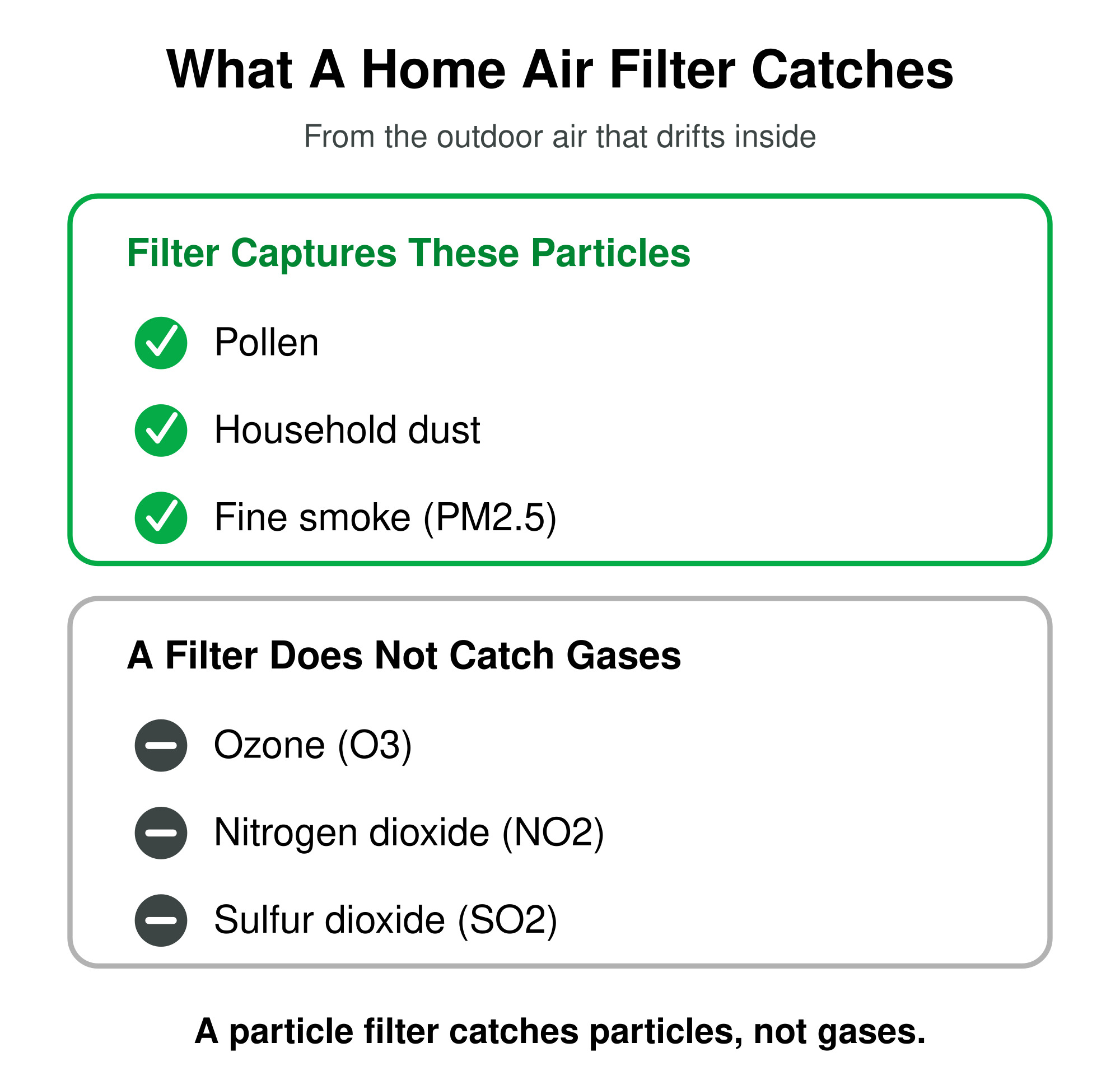
- Captured (particles): pollen, household dust, and fine smoke (PM2.5).
- Not captured (gases): ozone, nitrogen dioxide, and sulfur dioxide.
Answer a few quick questions below and we will match you to the right filter for your system.
Answer a few quick questions and we will match you to the right filter for your home.
Ready to shop instead?
Shop Air Filters at FilterbuyOn a hot, still afternoon, ground-level ozone over many U.S. cities can climb high enough to tighten a child’s airways after a short time on the playground, even when the sky looks clear and blue. That mismatch, clean-looking air that still sets off symptoms, is the daily challenge for families managing asthma. Outdoor air pollution ranks among the most common asthma triggers, and the pollutants that cause the most trouble behave differently, peak at different hours, and call for different defenses.
Ground-level ozone irritates and inflames the airways. Fine particle pollution lodges deep in the lungs and can reach the bloodstream. Nitrogen dioxide from traffic adds another layer of irritation. Airborne pollen sets off allergic asthma in people who are sensitized to it. Knowing which pollutant is high, and when, is what turns a vague worry about bad air into a plan a caregiver can act on.
At Filterbuy, we build and test HVAC filters for a living, and the same gap shows up in home after home. Families assume the bad air outside stays outside, so they lean on the filter and skip the forecast. The households that breathe easier through a rough air week tend to do both. They read the air by pollutant, and they let a well-fitted filter handle what drifts indoors.
TL;DR
Outdoor air pollution is a leading asthma trigger. The four exposures that matter most are ground-level ozone, fine particles (PM2.5), nitrogen dioxide, and pollen. People with asthma should watch the Air Quality Index (AQI) from the Moderate range of 51 to 100 and act at 101 or higher. A MERV 13 HVAC filter captures much of the fine particles, smoke, and pollen indoors, but not gases like ozone, so pair filtration with AQI-based activity planning.
Quick Answers
What air quality level is dangerous for asthma?
For most people with asthma, an Air Quality Index (AQI) of 101 or higher is the point to limit time outdoors and shift activity inside. The Asthma and Allergy Foundation of America flags 101 and above, the orange band, as unhealthy for people with asthma. Individuals who are especially sensitive to ozone can notice symptoms earlier, in the Moderate range of 51 to 100.
Which outdoor pollutants trigger asthma the most?
Ground-level ozone and fine particle pollution (PM2.5) trigger the most asthma symptoms. Ozone is a reactive gas that inflames the airways, and PM2.5 includes tiny particles from traffic, combustion, and wildfire smoke that travel deep into the lungs. Nitrogen dioxide from vehicle exhaust and airborne pollen round out the outdoor triggers people with asthma feel most often.
Do air filters help with asthma from outdoor air pollution?
A high-efficiency HVAC filter helps by capturing the particles that drift indoors, including pollen, dust, and fine smoke. A filter rated MERV 13 captures roughly half of the smallest particles measured in testing and most larger ones. Standard particle filters do not remove gases such as ozone or nitrogen dioxide, which call for activated carbon media or reduced outdoor air exchange instead.
Key Takeaways
Ground-level ozone and fine particle pollution (PM2.5) are the two outdoor pollutants most likely to trigger asthma symptoms, and each is reported on the U.S. Air Quality Index.
People with asthma should treat an AQI of 101 or higher, the orange “Unhealthy for Sensitive Groups” band, as a signal to move activity indoors, and ozone-sensitive individuals may react even in the Moderate range of 51 to 100.
Ozone peaks on hot, sunny afternoons, while wildfire smoke and traffic particles can spike at any time, so checking the AQI by pollutant tells an asthma family more than a single number does.
An HVAC filter rated MERV 13 captures a high share of the pollen, dust, and fine smoke particles that drift indoors, but no particle filter removes gases such as ozone or nitrogen dioxide.
Filters reduce indoor exposure only while the system fan runs, so setting the thermostat fan to “On” during high-pollution days increases the volume of air cleaned.
Pairing AQI-based activity planning with year-round filtration protects an asthma household better than either step alone.
Which Outdoor Pollutants Trigger Asthma And How Each One Affects Your Airways
Five outdoor exposures cause most pollution-related asthma symptoms: ground-level ozone, fine particle pollution (PM2.5), nitrogen dioxide (NO2), sulfur dioxide (SO2), and airborne pollen. Ozone and PM2.5 affect the largest number of people with asthma. Each one comes from different sources and irritates the airways in its own way, which is why a single air quality number rarely tells the whole story for an asthma household.
Ground-Level Ozone
Ground-level ozone is a reactive gas that forms when pollution from traffic and industry reacts with sunlight, which is why it peaks on hot, sunny afternoons rather than in the early morning. Ozone is a powerful oxidant, and breathing it inflames and narrows the airways, a combination that can bring on coughing, chest tightness, and wheezing in people with asthma. The AQI reports ozone as an 8-hour average, so a mid-afternoon spike can keep the reading high into the early evening.
Fine Particle Pollution (PM2.5)
PM2.5 refers to fine particles 2.5 microns across or smaller, roughly thirty times thinner than a human hair. These particles come from vehicle exhaust, combustion, industry, and wildfire smoke, and their small size lets them travel deep into lung tissue and, in some cases, into the bloodstream. For an asthma household, PM2.5 is the trigger a good filter can do the most about, since a high-efficiency filter captures a large share of particles in this range. Wildfire smoke is mostly PM2.5, and research suggests smoke particles can be harder on the lungs than particles from other sources.
Nitrogen Dioxide, Sulfur Dioxide, And Pollen
Nitrogen dioxide (NO2) is a traffic-related irritant gas that inflames the airways and can raise sensitivity to allergens, and it tends to run highest near busy roads. Sulfur dioxide (SO2) comes mainly from fossil-fuel burning and industry and can cause rapid airway narrowing in people with asthma. Airborne pollen is different from the others because it is an allergen rather than a pollutant gas or combustion particle, and it triggers allergic asthma in people who are sensitized to tree, grass, or weed pollen. Pollen is not part of the AQI and is tracked separately through local pollen counts.
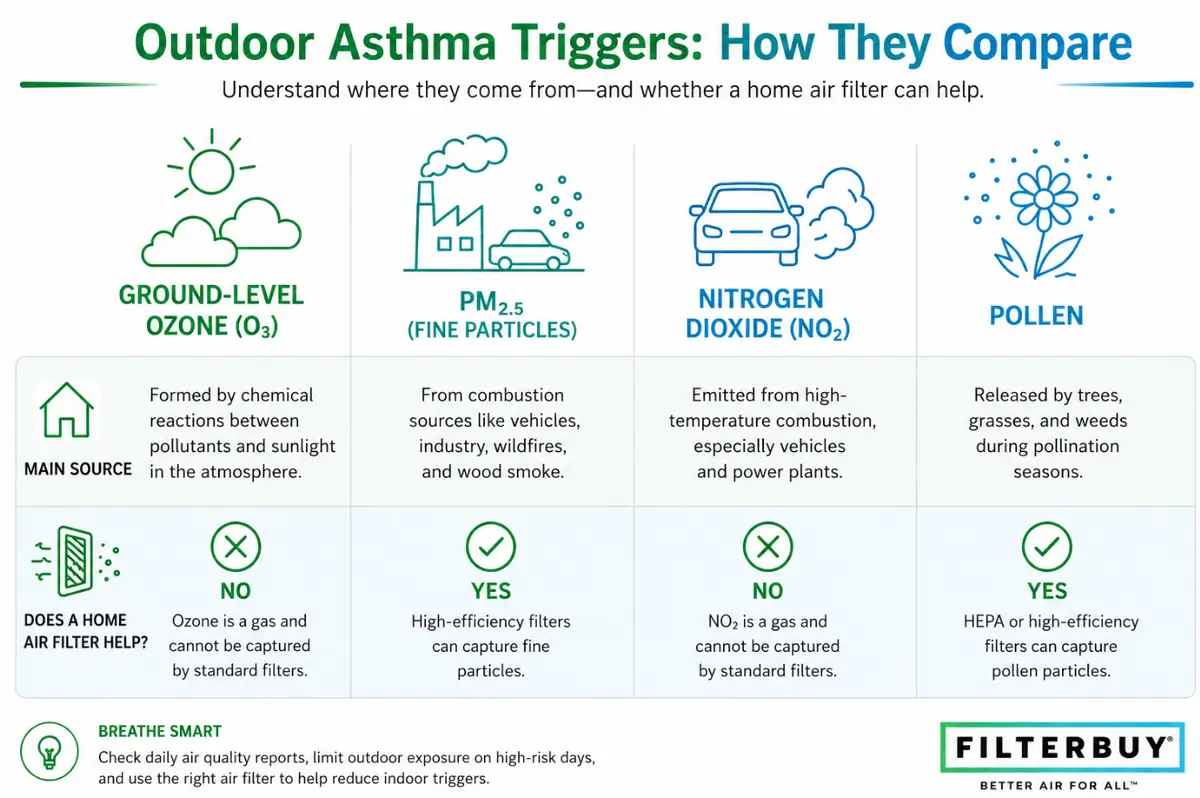
The table below summarizes how the main outdoor triggers differ, including whether a standard home air filter can help with each one.
Which AQI Thresholds Matter Most For Asthma Families
The Air Quality Index runs from 0 to 500 across six color-coded categories. For people with asthma, two thresholds matter most: 51 to 100 (Moderate), where ozone-sensitive individuals may notice early symptoms, and 101 to 150 (Unhealthy for Sensitive Groups, or orange), where health agencies advise people with asthma to cut back on outdoor exertion and move activity indoors. The higher the number climbs, the wider the group of people affected.
The EPA sets an AQI value of 100 as the national air quality standard for each pollutant, so readings above 100 mean the air has passed the level meant to protect public health. Ozone and particle pollution use different clocks: ozone as an 8-hour average and PM2.5 as a 24-hour average, which is one more reason to open the AQI and look at the individual pollutant rather than a single headline value.
How Air Quality Alerts Work And How To Turn Them On
Air quality alerts let a household react before symptoms start rather than after. The EPA and its state and local partners run AirNow, which publishes a current AQI using a real-time calculation called the NowCast, along with next-day forecasts and free notifications. Many agencies also call “action days” when the AQI is forecast to reach the orange band, a public signal that sensitive groups should limit outdoor exertion. For a quick visual read on current conditions, you can also check Filterbuy’s live U.S. AQI map. Setting alerts up once takes a few minutes.
Install the free AirNow app or open airnow.gov and enter your ZIP code to see the current AQI and the next-day forecast for your area.
Turn on the pollutant view so you can see ozone and PM2.5 separately, since one can be high while the other is fine.
Sign up for free EnviroFlash email or text alerts through your state or local air agency to get action-day notices automatically.
On a smart thermostat, note where the fan setting lives so you can switch it to “On” quickly when smoke or high particle levels are forecast.
Share the alert setup with everyone who cares for a child with asthma, including school and daycare, so activity plans change together.
Which HVAC Filter Rating Helps Reduce Indoor Asthma Triggers
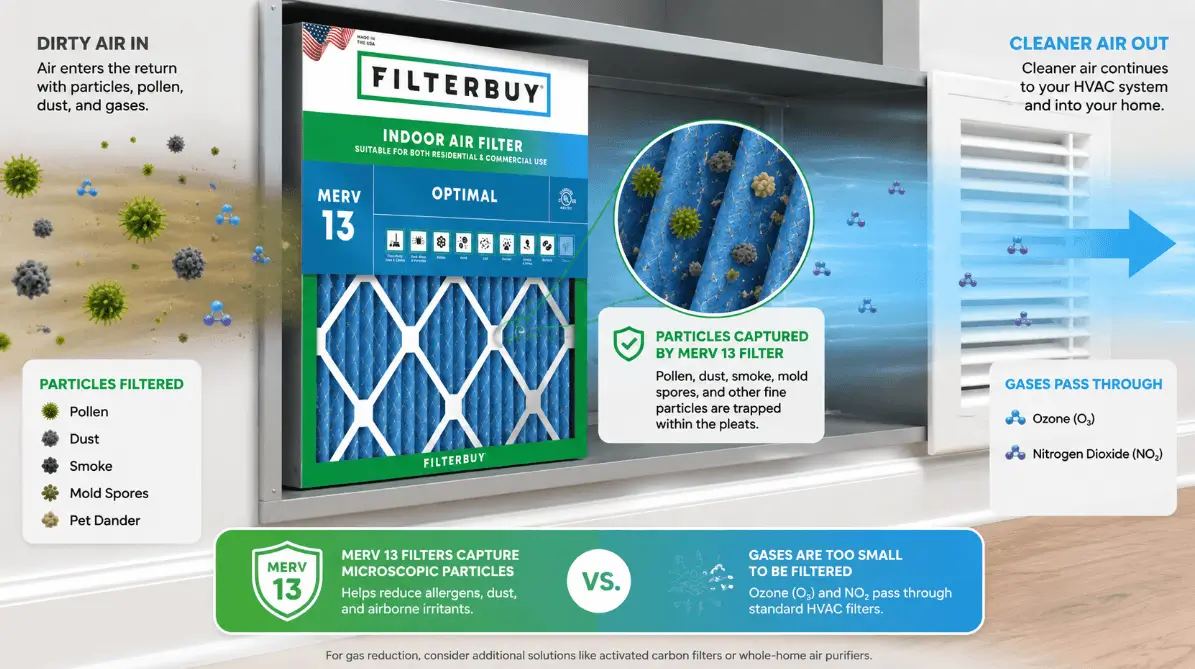
A MERV 13 filter is the practical choice for most homes looking to reduce indoor asthma triggers. MERV stands for Minimum Efficiency Reporting Value, the 1-to-16 scale defined by the ASHRAE 52.2 test method. The EPA advises upgrading to at least MERV 13 when a system can handle it. A MERV 13 filter captures a high share of pollen, dust, and fine smoke particles, though it works only while the system fan runs and only on the particles it is designed to catch.
What MERV 13 Captures, And What It Does Not
EPA figures put a MERV 13 filter at roughly 90 percent capture of coarse particles (3 to 10 microns), about 85 percent of fine particles (1 to 3 microns), and around 50 percent of the smallest particles measured (0.3 to 1 micron). That range covers most pollen, household dust, and a meaningful share of fine smoke. The correction we make most often at Filterbuy is about gases. No particle filter removes ozone, nitrogen dioxide, or sulfur dioxide, so a filter marketed as a fix for smog is overpromising. Reducing gas exposure calls for activated carbon media where your system supports it, or for keeping outdoor air out during high-ozone hours.
MERV 13 Is Not HEPA
MERV 13 and HEPA are not the same rating. A true HEPA filter captures at least 99.97 percent of particles at 0.3 microns, but HEPA media is usually too dense for a residential blower to pull air through without strain unless the equipment was built for it. Forcing a filter your system cannot handle starves the blower and can cut airflow, which is worse for your air than the next-best rating. For severe wildfire smoke, a common setup is a MERV 13 filter in the HVAC system plus a portable HEPA air cleaner in the bedroom. You can compare the two ratings in more detail in
Filterbuy’s guide to the difference between MERV 13 and HEPA filters.
Runtime, Replacement, And Fit
A filter cleans air only when the system is moving it, so setting the thermostat fan to “On” during smoky or high-particle days increases the volume of air that passes through the media. Heavy smoke loads a filter far faster than normal, so check it monthly and replace it more often during wildfire season. Before jumping to a higher rating, confirm your system can handle the added airflow resistance, and check with an HVAC technician if you have older or variable-speed equipment. From building filters at Filterbuy, we push one point that sounds backward. A properly sealed MERV 8 can outperform a loose MERV 13, because a filter only cleans the air that passes through the media, not the air that sneaks around a bad fit.
How To Protect An Asthma Household On A Bad-Air Day
When the AQI climbs, a few specific moves lower what an asthma household actually breathes. Each one is small on its own, and together they matter most on the worst days.
Time Outdoor Activity Around The Pollutant
Ozone and fine particles run on different clocks, so the same AQI number can call for different timing.
On high-ozone days, ozone builds through hot, sunny afternoons and eases after sunset, so schedule a run or recess for early morning, when levels are usually lowest.
With fine particles, a calm morning can trap smoke and traffic soot near the ground, and a wildfire plume can linger for days, so check the current reading before any outdoor plan rather than trusting a time of day.
Build A Clean Room When Smoke Moves In
The EPA and AirNow both point families to a clean room during smoke events, and it helps most for people with asthma. Setting one up takes a few steps.
Pick one room where the household spends the most time, ideally a bedroom, and keep its windows and doors closed.
Set the central system or a window unit to recirculate so it stops pulling smoky air inside.
Run a portable air cleaner sized for the room, and skip any model that makes ozone.
If a portable unit is out of reach, the EPA says you can tape a MERV 13 filter to a newer box fan as a temporary stand-in. Use a fan built in 2012 or later with a UL or ETL safety mark, and never leave it running unattended.
Replace the filter often, because heavy smoke can load it in days rather than months.
Do Not Add Pollution Indoors While You Wait It Out
Once you seal the house and recirculate, indoor sources count for more, so hold off on anything that adds particles until the air clears.
Skip frying, candles, incense, wood fires, and smoking indoors.
Hold off on dry dusting and on vacuuming without a sealed HEPA vacuum, since both stir settled particles back into the air.
Wipe hard surfaces with a damp cloth instead, which traps dust rather than scattering it.
After manufacturing filters for over a decade and serving more than two million households, we have seen the same pattern in homes across the country. When outdoor air turns bad, the families who stay ahead of it are the ones who treat their filter as part of their health routine, not an afterthought. A MERV 13 filter will not change the air outside, but it captures a large share of the pollen and fine smoke that would otherwise settle into your living room. Match the filter to what your system can handle, run the fan when the air is bad, and change it on schedule.
— David Heacock, Founder and CEO, Filterbuy
Seven Resources We Trust To Help Asthma Families Read The Air
Most people cannot see the ozone and fine particles that push an asthma flare, and that invisible gap is exactly where a little knowledge pays off. We build and test filters every day at Filterbuy, and these are the sources we point asthma families to when they want to read the air with confidence and protect the people under their roof.
Read The Air Before You Step Outside
This is the tool we reach for first. AirNow, run by the EPA and its local partners, shows your current AQI broken out by pollutant and sends free next-day forecasts, so you can plan a run or a recess before ozone or smoke climbs.
Source: Using The Air Quality Index (AirNow)
Pin Down Exactly Which Pollutant Is Triggering You
When you cannot tell what is behind a flare, the EPA sorts it out for you. It names the outdoor triggers that worsen asthma, from ozone to particle pollution to nitrogen dioxide, and pairs each one with a simple move to cut your exposure.
Source: How To Gain Control Over Outdoor Asthma Triggers (U.S. EPA)
See What Bad Air Actually Does Inside Your Lungs
We spend our days making invisible threats visible, and the American Lung Association does the same for your lungs. Their guide shows how ozone and fine particles inflame and narrow the airways, which is the reason a clear-looking sky can still tighten your chest.
Source: How Air Pollution Triggers Asthma Symptoms (American Lung Association)
Know The One Number That Tells You To Head Indoors
If you memorize a single number, make it this one. The Asthma and Allergy Foundation of America marks an AQI of 101 and above as the point where people with asthma should ease off outdoor exertion and move activity inside.
Source: Air Pollution, Smog, And Asthma (Asthma and Allergy Foundation of America)
Get Up To Speed Fast As Your Family's Air Protector
New to guarding an asthma household? The National Environmental Education Foundation gives caregivers a plain-language overview that connects daily air quality readings to symptoms and to the small habits that keep your family breathing easier.
Source: Asthma And Air Quality Overview (National Environmental Education Foundation)
Keep Your Kids Playing Safely On High-Ozone Days
You want your kids outside and active, and this resource helps you do it wisely. Nemours KidsHealth shows parents how ozone and poor outdoor air trigger a child's asthma and when to shift play indoors.
Source: Ozone, Air Quality, And Childhood Asthma (Nemours KidsHealth)
Understand Why Your Kids Feel Bad Air First
Children breathe faster and take in more air for their size, which is why bad air often hits them before it hits you. The American Academy of Pediatrics explains the biology and gives you clear steps to protect them at home, including cleaner indoor air.
Source: Pollution And Children's Respiratory Health (American Academy of Pediatrics)
Reading the air protects your hours outside. Pairing that habit with a well-fitted filter protects the many more hours your family spends indoors, and that combination is what we see work best in real homes.
3 Supporting Statistics On Air Pollution And Asthma
Every figure below is a U.S. statistic from a government agency or a national medical society.
6.5 percent of U.S. children have asthma. It is the primary diagnosis in about 1.4 million emergency department visits a year.
Source: U.S. Asthma Prevalence And Emergency Visit Data (CDC FastStats)
Ozone and fine particles above recommended limits account for about 21,300 avoidable U.S. deaths a year. The same pollution drives roughly 748,660 heart and lung illnesses annually.
Source: U.S. Health Impacts Of Ozone And Particle Pollution (American Thoracic Society Health of the Air)
Wildfire smoke hits the lungs harder than everyday pollution. In Southern California, each 10-microgram rise in wildfire PM2.5 was linked to up to a 10 percent jump in respiratory hospitalizations, versus about 1 percent for other fine particles.
Source: Wildfire Smoke And Respiratory Hospitalizations Study (Aguilera et al., 2021)
Final Thoughts And Opinion
Building and testing filters has earned us one strong opinion. The most useful habit for an asthma family is to stop treating air quality as a single number and start reading it by pollutant. Ozone and fine particles rarely peak at the same time, and the response is different for each, so a family that knows which one is high can make a smarter call about the playground, the morning run, or the school pickup. That five-second habit does more for day-to-day symptoms than any product we make.
Filtration earns its place as the second half of the plan. A MERV 13 filter will never fix the air outside, and it does nothing about ozone, so anyone promising a filter that removes smog is overselling. What a good filter does is lower the baseline of pollen, dust, and fine smoke inside the one space a family controls, and it does that quietly, all year, as long as the system runs and the filter fits. If you are unsure how high to go, checking which MERV rating your system can handle keeps you from starving the blower. Reading the AQI protects the hours outdoors, and the right filter protects the many more hours spent inside.
Next Steps
Set up AQI alerts today through the AirNow app and your local EnviroFlash notifications so you get action-day warnings automatically.
Learn your two thresholds: watch for ozone symptoms at 51 to 100, and move activity indoors at 101 and above.
Check your system’s compatibility, then upgrade to a properly fitted MERV 13 filter, or as high a rating as your equipment can handle.
Switch the thermostat fan to “On” during smoke or high-particle days, and inspect the filter monthly during wildfire season.
For smoke specifically, review the best MERV rating for wildfire smoke.
Frequently Asked Questions
Is MERV 13 the same as HEPA?
No. MERV 13 is a rating on the ASHRAE 52.2 scale for HVAC filters, while HEPA is a separate standard requiring at least 99.97 percent capture at 0.3 microns. HEPA media is usually too restrictive for a home HVAC blower, so MERV 13 is the common central-system choice, sometimes paired with a portable HEPA air cleaner in a bedroom.
Can an air filter remove ozone or smog?
No. Standard HVAC and portable filters capture particles, not gases, so they do not remove ozone or the gaseous part of smog. Reducing gas exposure means limiting outdoor air during high-ozone hours or using activated carbon media where your system supports it.
What AQI level is safe for exercising outdoors with asthma?
An AQI of 0 to 50 is generally fine for outdoor exercise. In the Moderate range of 51 to 100, ozone-sensitive people with asthma should watch for symptoms, especially on hot afternoons. At 101 and above, move longer or intense activity indoors. Follow your own asthma action plan from your clinician.
Does wildfire smoke need a different filter than everyday pollution?
The rating is the same idea, but the demands are higher. Wildfire smoke is mostly PM2.5, so a MERV 13 filter still applies, but heavy smoke clogs it much faster and a portable HEPA air cleaner in a main room helps during severe events.
How often should I change my filter during wildfire season?
Check it monthly at a minimum during smoke season, and replace it whenever the media looks gray and matted, or airflow feels weak. A 1-inch filter that normally lasts 60 to 90 days can load up in a week or two under heavy smoke.
Are air quality alerts free?
Yes. The AirNow app and website are free, and EnviroFlash email and text alerts from state and local agencies are free to sign up for.
Protect Your Family’s Indoor Air With Filterbuy
Clean indoor air is the part of the plan you control. Filterbuy manufactures MERV 13 air filters in the United States in more than 600 sizes, with custom sizing for non-standard systems and auto-delivery so a fresh filter arrives before the old one is overdue. Shop American-made MERV 13 air filters and set your home up to capture more of the pollen, dust, and fine smoke that outdoor air sends inside.
Glossary
Air Quality Index (AQI). The EPA scale from 0 to 500 that reports daily air quality for five criteria pollutants, with 100 set at the national health standard for each pollutant.
Ground-Level Ozone (O3). A reactive gas formed when traffic and industrial emissions react with sunlight, most common on hot afternoons. It is a respiratory irritant that inflames the airways.
Fine Particle Pollution (PM2.5). Airborne particles 2.5 microns across or smaller, from sources such as combustion and wildfire smoke, small enough to reach deep into the lungs.
Nitrogen Dioxide (NO2). A traffic-related irritant gas that inflames the airways and can raise sensitivity to allergens.
MERV. Minimum Efficiency Reporting Value, the 1-to-16 scale from the ASHRAE 52.2 test that rates how well an HVAC filter captures particles of different sizes.
HEPA. High Efficiency Particulate Air, a filter standard requiring at least 99.97 percent capture of 0.3-micron particles, typically used in portable air cleaners rather than home HVAC systems.
Unhealthy For Sensitive Groups. The orange AQI category is from 101 to 150, at which people with asthma and other sensitive groups are at greater risk, while the general public is less affected.
NowCast. The EPA calculation that turns hourly monitor readings into a current AQI for ozone and particle pollution, used for real-time reporting.
Activated Carbon Filter. A filter media that adsorbs certain gases and odors, used in addition to a particle filter to address pollutants a MERV-rated filter cannot capture.
Allergic Asthma. Asthma triggered by allergens such as pollen, in which the immune system reacts to a normally harmless substance and inflames the airways.