July 3, 2026

By Michelle Wan | Reviewed by David Clark, Licensed HVAC Technician
Published: July 4, 2026 | Updated: July 4, 2026
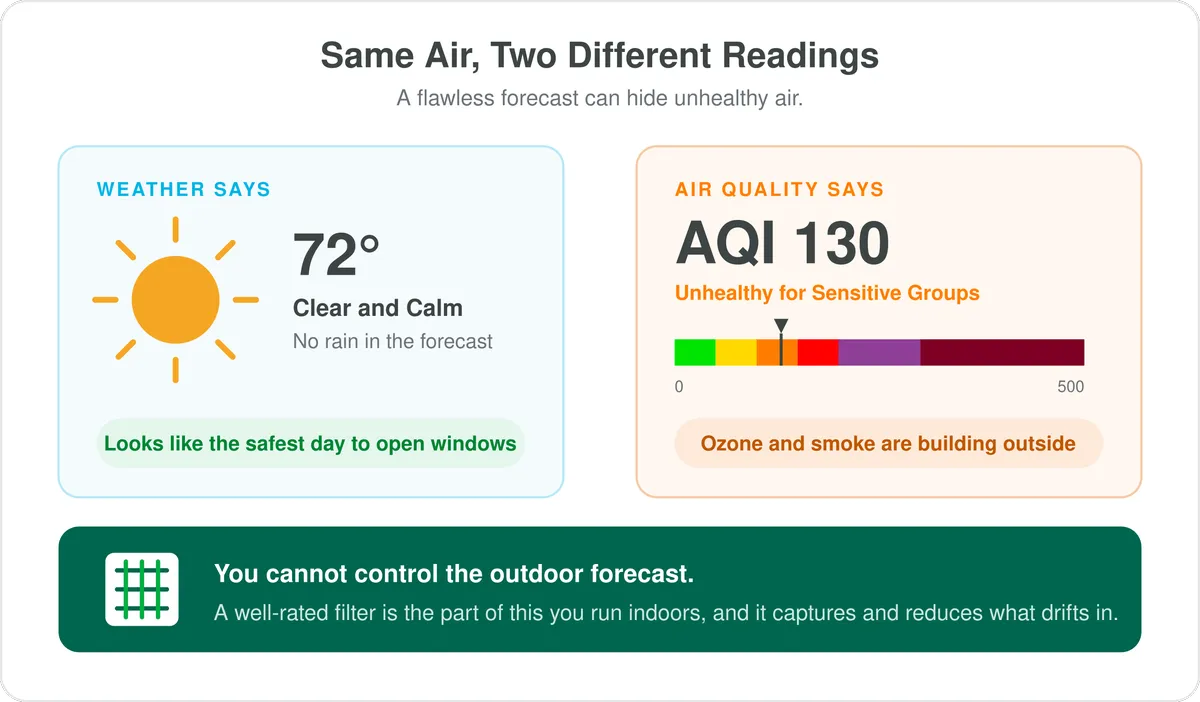
Weather and air quality measure two different things, so a bright, calm, sunny day can still push the AQI into the orange, unhealthy zone while the sky overhead looks flawless.
Put the right filter between your family and bad-air days.
Filterbuy manufactures American-made filters in more than 600 sizes, including custom cuts, so you can match the exact filter your system needs to capture and reduce the particles drifting inside. Fast, free shipping on every order, no minimum, backed by over 85,000 five-star reviews.
Find American-Made Filters for Your SystemNot Sure Which Filter Fits Your Home?
Answer a few quick questions and get matched in under a minute.
You step outside on a bright, cloudless afternoon, the kind of day a weather app rates a perfect ten. The temperature is mild, no rain sits in the forecast, and the sky looks flawless. Yet the air quality reading on that same app rests in the orange zone, flagged as unhealthy for sensitive groups. That gap surprises a lot of people, because weather and air quality get reported side by side as if they track the same thing, when they actually measure two very different parts of the air around you. Weather describes the physical state of the atmosphere, including temperature, wind, humidity, and precipitation. Air quality describes what is floating in the air you breathe, from ground-level ozone to fine particle pollution. That difference is worth understanding, because it helps you protect your household on the days the forecast looks perfect but the air is not.
We hear about that gap constantly. Filterbuy builds the air filters meant to catch what drifts indoors, so we spend our days on the half of this problem most people never see, and the pattern rarely changes. The forecast looks flawless, the air quality tells a different story, and the households that get caught out are usually the ones who trusted the sky.
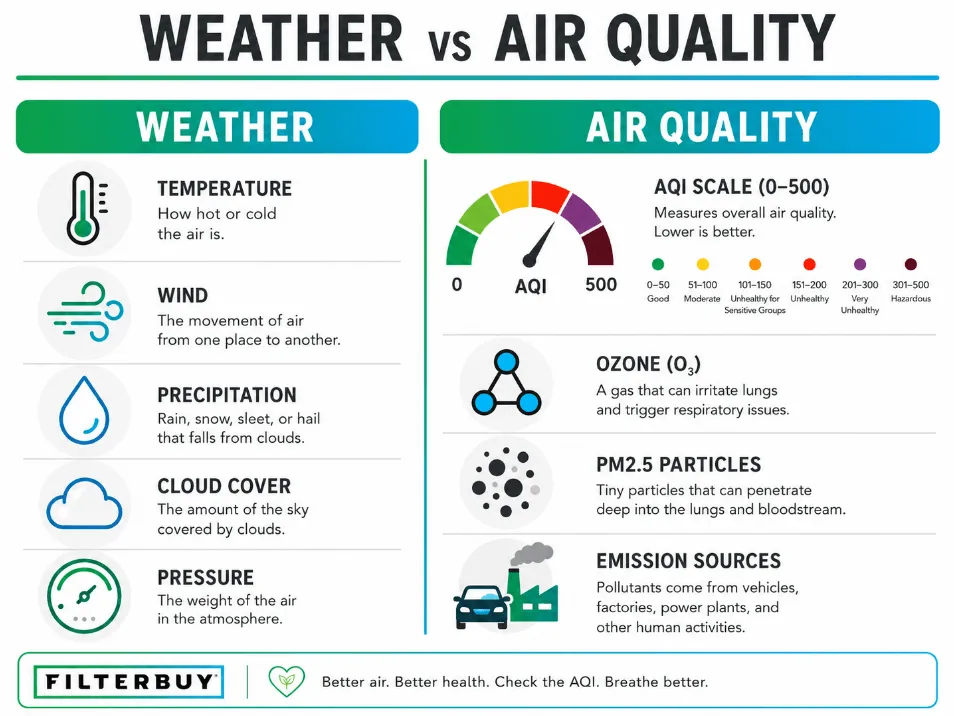
Weather and air quality get reported together but measure different things. Weather tracks the physical conditions of the atmosphere, such as temperature, wind, humidity, and rain. Air quality, summarized by the Air Quality Index (AQI), tracks how much pollution sits in the air, mainly ground-level ozone and fine particles. A clear, sunny day can still carry a high, unhealthy AQI, which is why the EPA recommends checking the air quality forecast alongside the weather.
Q: What is the difference between air quality and weather?
A: Weather is the physical state of the atmosphere, measured by temperature, wind, humidity, pressure, and precipitation. Air quality is the amount of pollution in the air, measured by the Air Quality Index. Weather tells you how the air feels and behaves, while air quality tells you how safe the air is to breathe.
Q: Is air quality part of the weather forecast?
A: No. Air quality is a separate measurement, even though forecasters report it alongside the weather. Weather agencies track atmospheric conditions, while environmental agencies such as the EPA track pollution levels and publish the AQI through the AirNow service.
Q: Can the weather be nice but the air quality be bad?
A: Yes. Hot, sunny, and calm days often produce the worst ground-level ozone, and wildfire smoke can push fine-particle pollution to dangerous levels under a clear blue sky. A pleasant forecast does not mean the air is clean.
Weather measures the physical state of the atmosphere, including temperature, wind, humidity, air pressure, and precipitation.
Air quality measures pollution in the air and is summarized by the Air Quality Index (AQI), a 0 to 500 scale the EPA created for five major pollutants.
Air quality is not a part of weather. The two are related but separate, and weather conditions strongly influence air quality.
A sunny, calm, hot day is exactly when ground-level ozone tends to build to unhealthy levels, so good weather does not guarantee clean air.
Weather apps and news outlets report the AQI next to the forecast because both change daily and both affect how you plan time outdoors.
Indoor air is where most people spend roughly 90 percent of their time, and a quality HVAC filter helps capture and reduce the particles that drift inside on bad-air days.
Weather and air quality describe two different properties of the same air. Weather is the physical condition of the atmosphere at a given time, measured through temperature, wind, humidity, air pressure, and precipitation. Air quality is the level of pollution in that air, measured through the Air Quality Index. One measurement answers whether to grab a jacket, and the other answers whether the air is safe to breathe deeply.
The two connect closely, which is why they travel together in a forecast. Weather conditions like heat, sunlight, wind, and rain directly shape how much pollution builds up or clears out. Still, a warm and beautiful day and clean air are not the same promise.
Air quality measures how much pollution sits in the outdoor air, and the U.S. Environmental Protection Agency (EPA) summarizes it with the Air Quality Index. The AQI runs from 0 to 500 across six color-coded categories, where higher numbers mean more pollution and greater health risk. The index covers five major pollutants regulated under the Clean Air Act: ground-level ozone, particle pollution, carbon monoxide, sulfur dioxide, and nitrogen dioxide.
An AQI value of 50 or below counts as good, and values up to 100 are generally acceptable. Once the AQI passes 100, the air turns unhealthy, first for sensitive groups and then for everyone as the number climbs. According to the EPA, ground-level ozone and fine particle pollution pose the greatest risk to health in the United States, so those two pollutants usually drive the daily reading. For a full breakdown of the scale and its categories, Filterbuy's guide explains what the Air Quality Index measures.
The six AQI categories break down like this:
Weather measures the physical behavior of the atmosphere over short periods. Meteorologists at the National Weather Service track temperature, humidity, wind speed and direction, air pressure, cloud cover, and precipitation to forecast conditions hours or days. These measurements tell you how the air will feel and move, yet on their own they say nothing about how clean that air is to breathe.
No. Air quality is not a component of weather, even though the two stay closely linked. Weather describes atmospheric conditions, while air quality describes the pollution within those conditions. Different agencies handle each one. Meteorologists forecast the weather, and environmental agencies such as the EPA and state air boards monitor and forecast air quality. Weather heavily influences air quality, which is the main reason the two appear together in the same report.
Air quality appears next to the weather because both change daily and both shape how you plan your day. The American Lung Association notes that you can usually find the daily AQI wherever you get your weather, from a phone app to the local news. The EPA offers a helpful comparison for why that pairing works. Much as a weather forecast tells you whether to pack an umbrella, an air quality forecast tells you when to adjust outdoor activity so you breathe in less pollution.
There is a practical reason too. Air quality forecasters build their predictions using weather data, including temperature, wind patterns, and satellite images, so the two forecasts come from overlapping science and naturally get published together.
Weather and air quality are not the same measurement, but weather is the biggest lever on what the AQI does from one day to the next. The trouble also shifts with the calendar. Ground-level ozone is mostly a hot-afternoon, summer problem, while fine-particle pollution tends to spike during wildfire season and on cold, stagnant winter nights. Here is how the most common conditions push the air in your area up or down.
Geography matters too. Two towns can share the same 88-degree forecast and still land on opposite ends of the AQI, because the one with an afternoon sea breeze clears its ozone while the one sitting in a still inland basin bakes it. That is why your own local reading beats any regional rule of thumb. The weather over your neighborhood is out of your hands, but the filter doing the work indoors is not, and that is the part Filterbuy pays attention to.
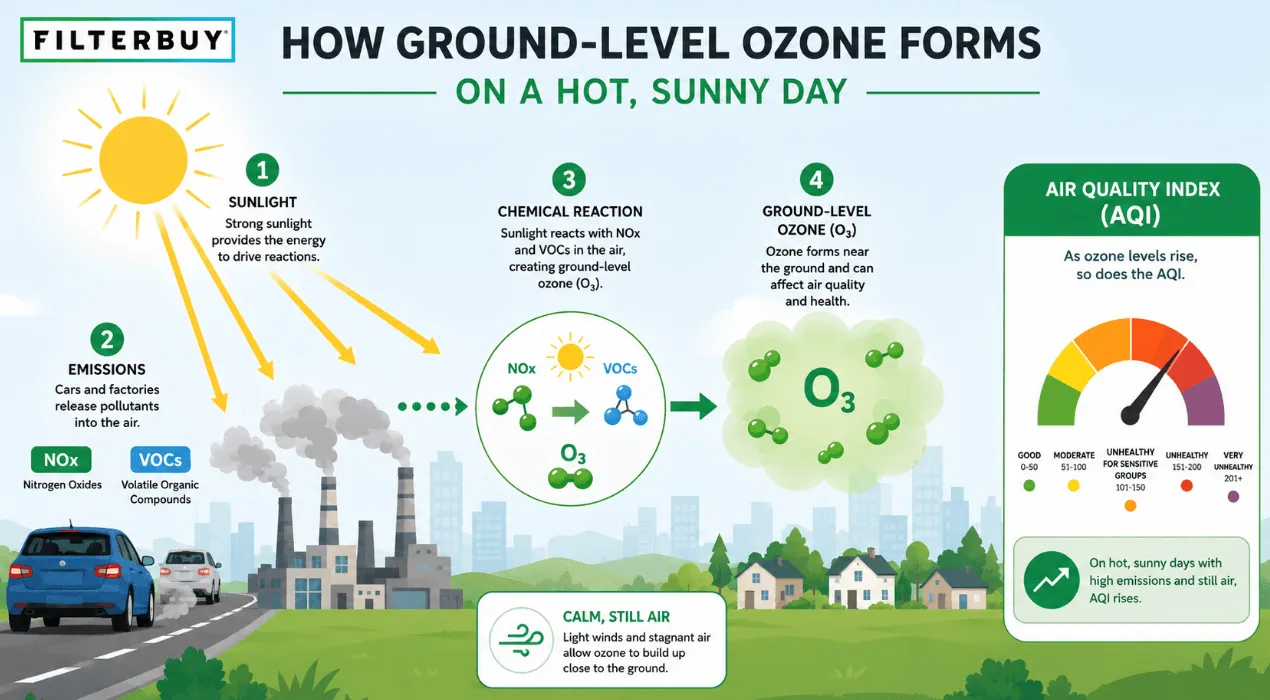
A clear, sunny day is often the worst kind of day for ground-level ozone. Ground-level ozone is not released directly into the air. Instead, it forms when sunlight drives a chemical reaction between pollutants from cars, power plants, and industry. Heat, strong sunshine, and calm winds speed that reaction and let the pollution accumulate, so a beautiful afternoon can carry an unhealthy ozone reading even when the weather looks ideal. This is the setup we watch for most, because a calm, brilliant afternoon feels like the safest time to throw the windows open, which is exactly when ozone days catch households off guard.
Wildfire smoke works the same way against a pretty sky. Smoke is made of fine particles that wind can carry hundreds of miles, so a city far from any fire can record a high AQI while the sky overhead still looks mostly blue. A temperature inversion, where a layer of warm air traps cooler air near the ground, can also lock pollution in place for days. In all of these cases, the weather feels fine, yet the air is not safe to breathe deeply.
When outdoor air quality drops, the pollution does not stay outside. Fine particles and smoke slip indoors through windows, doors, and your HVAC system, and people spend roughly 90 percent of their time inside. A well-maintained air filter is one of the most direct ways to capture and reduce those particles before they circulate through the rooms where your family spends the most time.
Here is something we notice from our side of the business. The used filters that come back to us after a smoky or high-ozone stretch are visibly darker and load up faster than the ones from a clear month. That darkening is the outdoor AQI showing up inside a home, captured before it reached anyone in the family.
On high-AQI days, keep windows and doors closed, run your HVAC system so it keeps cycling air through the filter, and choose a filter rated to capture fine particles. Higher-MERV filters capture more small particles, and choosing the right MERV rating comes down to what your HVAC system can handle and the air you face. A MERV 13 filter captures a high share of fine particle pollution, though a MERV 13 filter is not the same as a true HEPA filter. Because Filterbuy builds filters in more than 600 sizes, including custom cuts, you can match one to the exact system defending your home, even in an odd or hard-to-find size.
Pro Tip: Check the AQI on the hottest, stillest, sunniest days of the year, not just the gray ones. Those calm blue-sky afternoons are when ground-level ozone peaks, and they are exactly when most people throw the windows open.
Here is a quick guide to what each AQI category calls for:
"After manufacturing filters for over a decade and serving more than two million households, we have seen the same pattern every wildfire season and every summer ozone spike. The forecast looks calm, so families leave the windows open, and indoor particle levels climb for days. The single most effective habit is simple. Check the air quality forecast the way you check the weather, and put a fresh, well-rated filter in your system before the smoke arrives rather than after."
David Heacock, Founder and CEO of Filterbuy
We are obsessed with what floats through the air you breathe, so we spend a lot of time reading the same sources we point customers toward. These seven are the ones we trust most for understanding the gap between a pretty forecast and safe air, arranged the way a homeowner actually needs them: start with reading the daily number, then learn the pollutants behind it, then see how the pros measure it all.
This is the official EPA and partner-agency playbook for AQI categories, forecasts, and the hourly NowCast, and it turns a confusing number into a plan you can act on before you open a window.
Source: AirNow Guide to Using the Air Quality Index.
We watch this pattern every summer, and the EPA explains the chemistry behind it: heat and strong sunlight cook everyday emissions into ground-level ozone right when the day feels safest.
Source: EPA Ground-Level Ozone Basics
The weather service itself lays out the AQI and its five pollutants, which shows you exactly why forecasters report the air quality number right beside the temperature.
Source: National Weather Service Air Quality Index Guide
This overview pairs the health meaning of each AQI color with where the daily reading shows up, so checking the air becomes as automatic as checking whether to grab a jacket.
Source: American Lung Association Air Quality Index Overview
The CDC walks through how ozone and fine particles reach the lungs, heart, and bloodstream, which is the reason we push families to take sensitive-group warnings seriously.
Source: CDC Air Pollutants and Your Health
NOAA shows how ground monitors and satellites team up to track pollution, the science that produces the number you glance at on your phone.
Source: NOAA NESDIS: How Air Quality Is Measured
NASA now maps pollution across North America from orbit, hour by hour, and it is a genuinely exciting look at where air quality forecasting is heading next.
Source: NASA TEMPO Air Quality Mission
Wildfire smoke is more dangerous than ordinary particle pollution. Wildfire-specific PM2.5 was tied to respiratory hospitalization increases up to about ten times larger than the same amount of PM2.5 from other sources.
Source: UC San Diego study of Southern California wildfire smoke
Indoor air is often more polluted than the air outside. Federal TEAM studies found about a dozen common organic pollutants average two to five times higher indoors than outdoors.
Source: EPA and CPSC guide to indoor air quality
Nearly 28 million Americans have asthma. That is about 8 percent of the population, one of the sensitive groups the AQI flags first when air quality drops.
Source: Asthma and Allergy Foundation of America asthma facts
Here is where we land after years of watching air quality patterns. Most air quality guides stop at the outdoor number. We pay just as much attention to what happens after the smoke reaches your door, because that is the half of the story a homeowner can actually control. Most families already check the weather out of habit, yet very few give the AQI the same glance, and that is the gap worth closing. A sunny sky earns a trust it has not always earned, because the same heat and stillness that make a day feel perfect are the conditions that let ozone and trapped particles build. At Filterbuy, our view is that air quality deserves a permanent spot in your daily routine, right next to the temperature. You cannot control the outdoor forecast, but you can control the air inside your home by keeping windows closed on bad-air days and running a fresh, well-rated filter that captures and reduces the particles trying to get in.
Check both the weather and the AQI each morning. You can look up your local AQI by ZIP code through the EPA AirNow service or your weather app.
On days the AQI is orange or higher, keep windows and doors closed and limit strenuous outdoor activity.
Run your HVAC system with a clean, well-rated filter, such as a Filterbuy filter sized to your system, so it can capture and reduce indoor particles.
Replace your filter on schedule, and sooner during wildfire season or summer ozone spikes.
If anyone in your home has asthma, heart disease, or other sensitivities, follow their action plan on high-AQI days.
Q: Does bad weather always mean bad air quality?
A: No. Rain and strong wind often clean the air by washing out or dispersing pollution, while calm, sunny, hot weather tends to make ozone worse. The connection depends on the specific conditions, not on whether the weather feels pleasant.
Q: What AQI level is considered unhealthy?
A: An AQI at or below 50 is good, and readings up to 100 are generally acceptable. Once the AQI passes 100, it becomes unhealthy for sensitive groups, shown as orange, and higher values become unhealthy for everyone. An AQI above 300 is hazardous.
Q: Why does wildfire smoke make the air dangerous even far from the fire?
A: Wildfire smoke is made of fine particles that wind can carry hundreds of miles. These particles are small enough to reach deep into your lungs, so a city with clear skies can still record a high, unhealthy AQI when smoke drifts in from a distant fire.
Q: Can an air filter help with poor outdoor air quality?
A: Yes, indoors. A quality HVAC filter, like the ones Filterbuy builds, captures and reduces fine particles that enter your home, which lowers your indoor exposure on high-AQI days. A good filter plus closed windows gives you the most protection.
Q: Is the weather forecast or the air quality forecast more important?
A: Both matter, for different reasons. The weather forecast helps you plan for comfort and storms, while the air quality forecast protects your lungs and heart. On a hot, sunny, smoky day, the AQI may be the more important of the two.
Q: Is the air quality number on my weather app accurate for my exact location?
A: It is close, but not exact. Most apps pull the reading from the nearest government monitors, so the number reflects your area rather than your street. During wildfire smoke or heavy traffic, air quality can shift from one neighborhood to the next, so it helps to check a ZIP-level source and to look again later in the day as conditions change.
Do not let a sunny forecast leave your family exposed. The next time the AQI climbs, your HVAC filter is the frontline that keeps ozone-season and wildfire particles from taking over your indoor air. Filterbuy manufactures American-made filters in more than 600 sizes, including custom cuts, so you can match the exact filter your system needs to capture and reduce the pollutants drifting inside. Find American-made filters sized for your system. Change your filter and breathe easier, confident your household is protected.
Air Quality Index (AQI): A 0 to 500 scale created by the U.S. EPA that reports how polluted the outdoor air is and what health precautions to take. Higher numbers mean more pollution and greater risk.
Weather: The short-term physical state of the atmosphere, including temperature, wind, humidity, air pressure, and precipitation.
Ground-Level Ozone: A harmful gas formed when sunlight triggers reactions between pollutants from vehicles and industry. It is the main ingredient in summertime smog.
Particle Pollution (PM2.5): Tiny airborne particles 2.5 micrometers or smaller, small enough to reach deep into the lungs and the bloodstream.
Criteria Pollutants: The common air pollutants the EPA regulates under the Clean Air Act, including ozone, particle pollution, carbon monoxide, sulfur dioxide, and nitrogen dioxide.
Temperature Inversion: A weather condition in which a layer of warm air traps cooler, polluted air near the ground and raises pollution levels.
MERV Rating: The Minimum Efficiency Reporting Value, a scale that rates how well an air filter captures particles. Higher numbers capture more small particles. A MERV 13 filter captures a high share of fine particles but is not the same as a HEPA filter.
HVAC System: The heating, ventilation, and air conditioning system that circulates and filters air throughout a home.
NowCast: The EPA method that converts hourly monitor readings into the current AQI so the index reflects real-time conditions.
