July 23, 2026
Author: Michelle Wan | Reviewer: David Clark, Licensed HVAC Technician | Published: July 23, 2026 | Updated: July 23, 2026
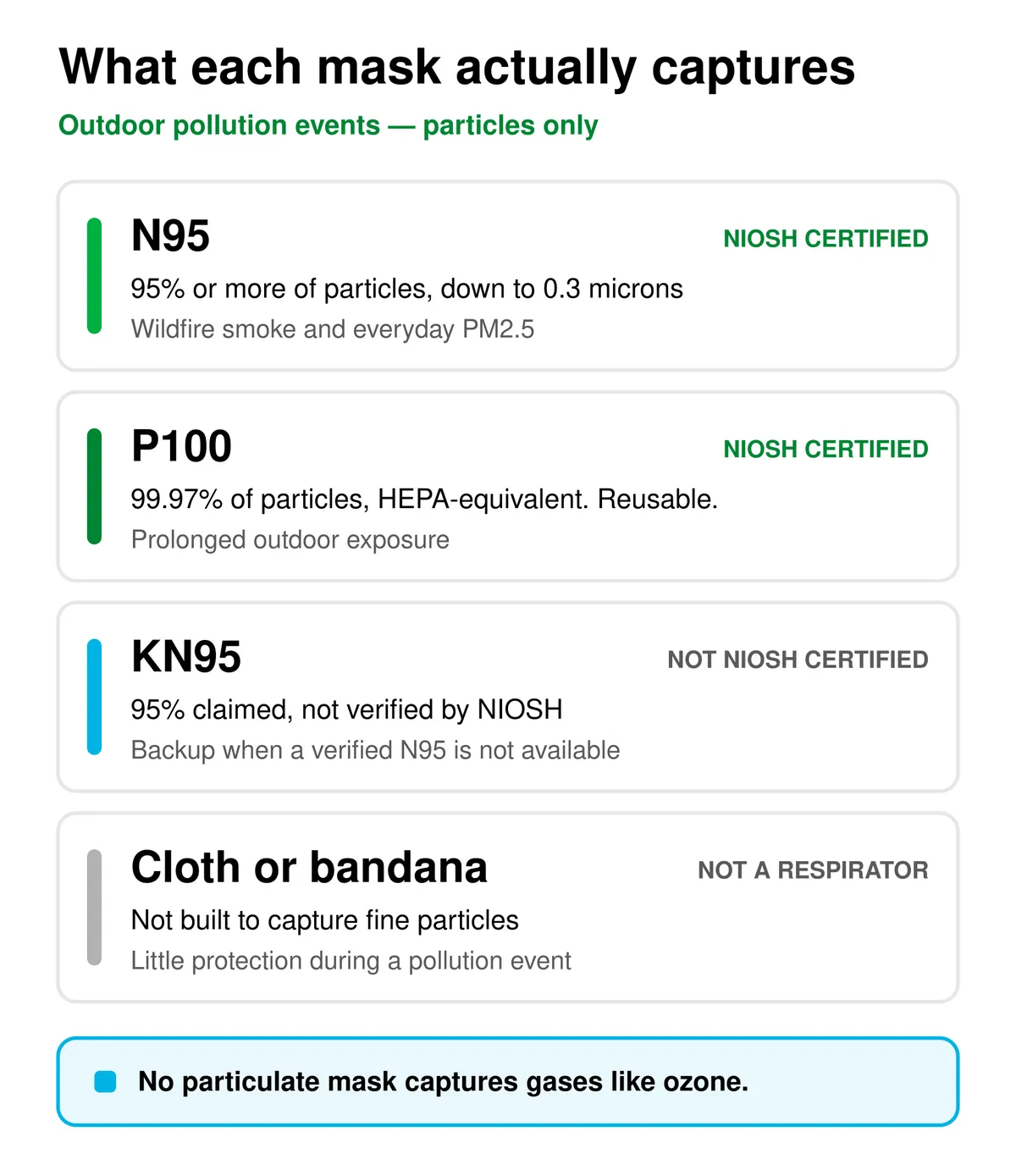
For most people on a bad-air day, a properly fitted N95 is the mask to reach for. It is the only one of the three common ratings certified by NIOSH, and it captures at least 95 percent of airborne particles down to 0.3 microns when it seals to your face. Fit decides the rest: gaps at the nose or cheeks let air bypass the filter entirely. And no mask of any rating captures gases like ozone.
A mask is the outdoor half of the plan. Indoors, where most of your hours actually happen, the filter in your HVAC system is what keeps capturing that same PM2.5-range matter — and the right MERV rating depends on your home. See Filterbuy air filters.
Answer 3 quick questions and we will match you to the right filter for your home.
A properly fitted N95 handles wildfire smoke and PM2.5 for most people. A certified KN95 substitutes when fit is good, and a P100 suits prolonged exposure or higher-risk groups. Cloth masks and bandanas do not filter fine particles, and no mask filters gases like ozone. Fit matters more than the rating on the box.
N95 respirators filter at least 95 percent of airborne particles down to 0.3 microns when properly sealed, per the FDA.
KN95 masks are not NIOSH-certified, and CDC testing found many KN95 products fail to meet their advertised filtration rate.
P100 respirators filter at the HEPA-equivalent 99.97 percent level and are reusable, fitting people with significant respiratory conditions outdoors for long stretches.
A mask can be reused across a multi-day smoke event as long as it stays clean, dry, and undamaged.
No particulate respirator, including N95 or P100, filters gases such as ozone, a key ingredient in smog.
A mask protects you outdoors during a pollution event. It does not replace filtering the air indoors the rest of the time.
One honest note. Filterbuy manufactures air filters, not masks, and has not tested the products named here. What follows is reported from NIOSH, CDC, EPA, and peer-reviewed sources. What happens to these particles past your front door is the part we work on every day.
Outdoor air pollution mixes particulate matter and gases, and a mask addresses only one. Fine particulate matter, listed as PM2.5 on most AQI apps, includes wildfire smoke, vehicle soot, and industrial emissions, small enough to bypass your nose and throat and settle deep in the lungs. Ground-level ozone, the main ingredient in smog, forms when nitrogen oxides react with organic compounds in heat and sunlight, per the National Weather Service, and passes straight through any filter.
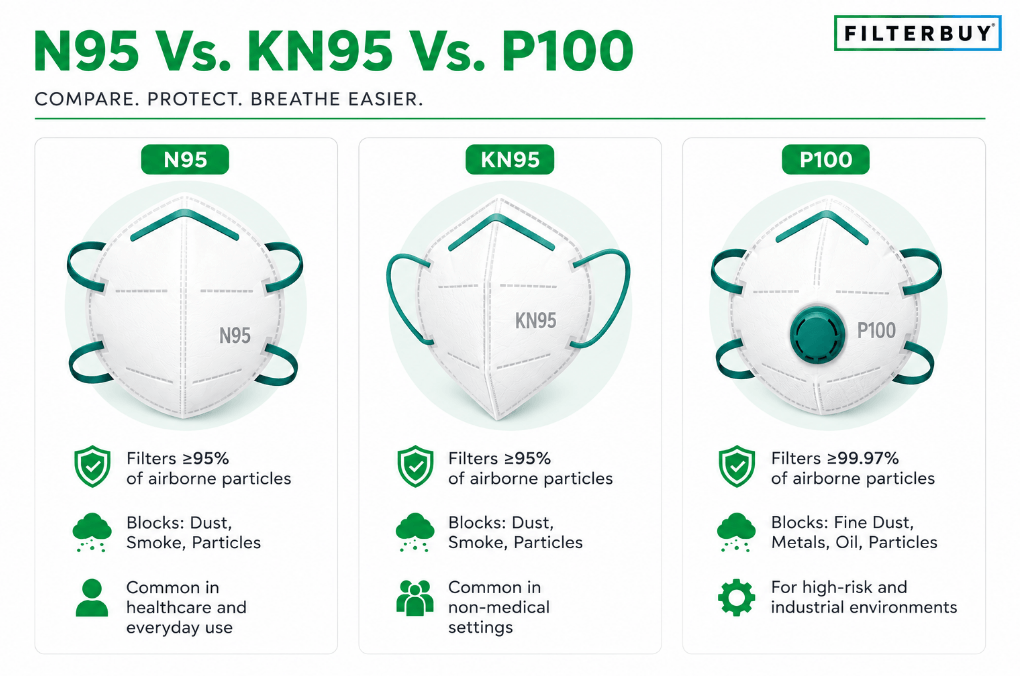
An N95 filters at least 95 percent of airborne particles and is the only one of the three tested and certified by NIOSH, the U.S. agency for respirator standards. A KN95 is made to a Chinese standard (GB2626) with similar claims but is not NIOSH-certified, and CDC testing during past shortages found many KN95 products failed to meet their advertised rate. A P100 filters at the HEPA-equivalent 99.97 percent level, per OSHA's standard (29 CFR 1910.134), and is typically sold as a reusable cartridge, better suited to repeated exposure than occasional wear. A well-fitted N95 covers most single bad-air days. A P100 makes more sense for outdoor workers, firefighters, or people with respiratory conditions outside for hours at a stretch.
Filtration levels reflect NIOSH testing standards where certified. KN95 filtration claims are not independently verified by NIOSH.
For wildfire smoke, EPA guidance is direct: an N95 reduces exposure to fine particles if it fits snugly with no gaps, while cloth masks and bandanas provide little protection. Wildfire-specific PM2.5 appears to affect respiratory health more than PM2.5 from other sources, per a 2021 study in Nature Communications. For smog, an N95 or KN95 filters the particulate portion but does nothing for the ozone or nitrogen oxide portion, since those are gases. On a high-ozone day, reducing outdoor time during peak hours matters more than mask choice.
General guidance for typical outdoor exposure. People with asthma, COPD, or cardiovascular disease should follow their own care plan.
A mask is the outdoor piece of the plan. For the indoor half, see Filterbuy's guide to choosing an air filter for wildfire smoke season.
Per OSHA's standard, particulate respirators including N95, KN95, and P100 provide no protection against gases or vapors. Ozone, carbon monoxide, and volatile organic compounds pass through a particulate filter unaffected. Protection against particles and gases together, more common in industrial settings, requires a combination cartridge, not a standard mask.
According to CDC, a genuine NIOSH-approved N95 carries a "TC-84A" approval number, verifiable against the NIOSH Certified Equipment List. Red flags include ear loops replacing head straps, misspelled "NIOSH" markings, and claims that a KN95 is "CDC-approved," since CDC does not approve international standards. Because KN95 masks are not NIOSH-certified at all, checking manufacturer and markings is the closest thing to a quality check for that category.
A 95 percent filtration rating only holds if the mask seals to your face. Gaps around the nose, cheeks, or chin let unfiltered air bypass the filter media, which is why a poorly fitted N95 can perform worse than a well-fitted KN95. Two-strap head bands seal more consistently than ear loops, and facial hair breaks the seal on any disposable respirator. Check your seal before heading out:
Cup your hands over the mask without disturbing it, then exhale sharply. Air should not rush out around your nose or cheeks.
Inhale sharply. The material should collapse slightly inward. A mask that stays rigid usually lets air slip in around the edges instead of through the filter.
Adjust the nose bridge and straps, then repeat. If you still feel leakage after two adjustments, the size or model is wrong for your face.
A mask stays usable as long as it holds its shape, seals cleanly, and lets you breathe without noticeably more effort than when new. Retire it once wet, visibly dirty, crushed, or once the straps loosen enough that it no longer seals. Between uses, store it in a paper bag rather than sealed plastic, which lets breath moisture evaporate instead of trapping it against the filter media. Never wash an N95 or KN95: the electrostatic charge that does the filtering breaks down with water and soap, so a washed mask filters less than an unwashed one.
NIOSH does not approve any respirator for children, and disposable N95s are not designed or tested for pediatric fit. Some manufacturers sell smaller sizes for older children, but these are not formally certified. For children, older adults, or people with asthma or heart or lung disease, the more reliable strategy on a bad-air day is limiting outdoor time and improving indoor air quality rather than relying on a respirator not built for that face.
A respirator solves a narrow, temporary problem: reducing what you breathe while outside during a pollution event. It does nothing for the air indoors, and outdoor smoke and smog both find their way in through doors, windows, and HVAC air exchange. A high-efficiency filter, such as one of Filterbuy's MERV 13 rated filters, captures that same PM2.5-range matter continuously inside your HVAC system, a different job than a mask and not a replacement for one during an active outdoor event.
"We don't sell masks, and we're not trying to take credit for products we didn't make. A mask is something you reach for on days when outdoor air quality is especially poor. Your HVAC filter, on the other hand, works quietly every day in the background. After manufacturing filters for over a decade and serving more than two million households, we've come to see indoor air filtration as your everyday foundation, with a well-fitted mask serving as an extra layer of protection when AQI levels spike."
Michelle Wan, Brand Manager and Air Quality Writer, Filterbuy
To check conditions before deciding whether a mask is warranted today, start with Filterbuy's live AQI and wildfire smoke map, not the mask aisle.
An N95 filters the particulate portion of smog but does not protect against ground-level ozone, which is a gas. On days with high ozone levels, limiting your time outdoors is more important than your choice of mask.
A genuine, properly manufactured KN95 can perform similarly to an N95, but it is not NIOSH-certified and counterfeit products are common. An N95 with verified NIOSH markings is generally the more reliable option.
NIOSH does not approve any respirators for children, and standard N95 and KN95 sizes are not designed to provide a proper pediatric fit. Reducing children's outdoor exposure during smoke events is the more dependable protective measure.
Yes. P100 respirators provide a higher level of particle filtration and are reusable, making them better suited for prolonged exposure or people at higher risk rather than occasional everyday use.
No. Particulate respirators, including N95, KN95, and P100 masks, do not filter gases such as carbon monoxide or ozone. Protection from these gases requires a different type of respirator with the appropriate chemical cartridges.
AirNow.gov's smoke guide covers when a mask helps versus when staying indoors is better.
Source: When Smoke Is in the Air – AirNow.gov
EPA's smoke exposure factsheet covers indoor and outdoor precautions, including MERV 13 filters and NIOSH-approved N95 guidance.
Source: Reduce Your Smoke Exposure – EPA
CDC's guide compares filtration levels for N95, KN95, elastomeric, and disposable masks.
Source: Respirators and Mask Types and Performance – CDC
This peer-reviewed study links wildfire-specific PM2.5 to higher respiratory hospitalization rates than PM2.5 from other sources.
Source: Wildfire Smoke Impacts Respiratory Health More Than Fine Particles From Other Sources – PMC
The American Lung Association's guide covers proper mask fit and who should avoid wearing one, including children under two.
Source: How to Wear a Mask – American Lung Association
AAFA's guide adds precautions for asthma and allergy sufferers, including evacuation and cleanup steps.
Source: Wildfires and How They Affect Air Quality and Asthma – AAFA
OSHA's standard is the source of the P100-to-HEPA equivalence used throughout this guide.
Source: Respiratory Protection Standard, 29 CFR 1910.134 – OSHA
5.1 million acres burned in 2025. U.S. wildfires burned 5,131,474 acres across 77,850 fires last year.
Source: 2025 Wildland Fire Summary and Statistics Annual Report – NIFC
95% minimum filtration for N95. The FDA confirms N95 respirators filter at least 95 percent of airborne particles when properly fitted.
Source: Face Masks, Barrier Face Coverings, Surgical Masks, and Respirators for COVID-19 – FDA
Ozone forms from heat and sunlight, not smoke. Ground-level ozone forms when vehicle and industrial emissions react with sunlight, which is why smog peaks on hot afternoons.
