Installation, Costs & Filter Guide (TX Climate)
By Michelle Wan | Reviewed by David Clark, Licensed HVAC Technician | Published August 11, 2026 | Updated August 11, 2026
Most San Antonio rooms take a 9,000 to 24,000 BTU single zone, and installed cost runs about $4,000 to $10,500. Capacity is the part people get wrong. San Antonio summers are humid, so a unit that is too large cools the room quickly, shuts off, and never runs long enough to pull the moisture out.
These are starting points. Take the quiz below and we will match your room to a size, or browse the Filterbuy mini split systems we build.

Answer 3 quick questions and we will match you to the right size mini split.
A ductless mini split in San Antonio costs roughly $4,000 to $10,500 installed for a single zone in 2026. CPS Energy pays $90 to $310 per ton depending on efficiency, but only on a one-for-one replacement, so adding a unit to a garage or addition usually will not qualify. The federal 25C credit expired at the end of 2025. San Antonio's humid summers make correct sizing matter more than raw capacity.
A single-zone mini split installed in San Antonio runs about $4,000 to $10,500 in 2026, depending on tonnage, line-set length, and electrical work.
CPS Energy pays $90 to $310 per cooling ton, scaled across five SEER2 tiers, with Early Replacement paying more than Replace on Burnout.
The CPS rebate requires a one-for-one replacement of existing equipment. New zones in spaces that never had a system generally do not qualify.
The federal 25C credit is gone. It expired December 31, 2025, so 2026 installs earn no federal tax credit.
Texas requires a TDLR-licensed ACR contractor, and a permit number is mandatory for any HVAC project inside San Antonio city limits.
The mesh filter inside a mini split protects the coil, not your lungs. It will not stop the mountain cedar pollen that peaks every January.
A ductless mini split installed in San Antonio costs about $4,000 to $10,500 for a single zone in 2026. Local contractors quote single-room installs in the $5,000 to $10,000 range, while market estimator data for the metro puts ductless installation at $3,200 to $10,500 depending on zone count. Our mini split installation cost guide breaks the line items down further.
Ranges synthesized from San Antonio contractor pricing and market estimator data, August 2026. Equipment-only costs are lower. Confirm with written local quotes.
Four things move a quote inside these ranges: the number of indoor heads, the line-set distance, whether an electrician must pull a 230V circuit, and the SEER2 rating. A 115V unit on an existing outlet skips the electrician, often a $400 to $900 difference.
Those figures are installed cost. Equipment alone is a much smaller number, which matters if you already have an installer lined up. Filterbuy is an American air filter manufacturer that also builds its own ductless line, selling 12,000 to 24,000 BTU R-32 systems direct. They cover roughly 300 to 1,200 square feet. Buying equipment and hiring labour separately is a legitimate path in San Antonio, with one caveat covered below: many local companies install only what they supply.
CPS Energy pays $90 to $310 per cooling ton on a qualifying ductless mini split through its Sustainable Tomorrow Energy Plan rebate. The amount depends on two things: your SEER2 tier, and whether you are replacing working equipment (Early Replacement) or a dead system (Replace on Burnout). Early Replacement pays more at every tier.
CPS Energy STEP rebate tiers, 2026 program year. One ton = 12,000 BTU. Mini-split heat pumps must meet 14.3 SEER2 / 11.7 EER2 / 7.5 HSPF2 minimums. Verify current amounts with CPS Energy before purchase.
Worked example: a 24,000 BTU unit is two tons. At 17.1 to 19.9 SEER2, that is $500 as an Early Replacement or $450 on burnout. The jump from the 16.2–17.0 tier to the 17.1–19.9 tier is worth $75 per ton, which often covers the equipment upgrade outright. Check your quoted unit against this table before you sign. Our own Filterbuy systems are 17 SEER2, which lands in the 16.2–17.0 band rather than the top one. Full tier detail sits on the CPS Energy HVAC rebate specifications page.
The catch most guides miss: CPS Energy states these rebates apply to retrofit projects only and must be a one-for-one replacement. If you are adding a mini split to a garage, casita, or addition that never had its own system, it very likely will not qualify. Confirm with CPS Energy before you budget around the rebate.
Three more requirements catch homeowners out. Equipment must be installed by a contractor licensed in Texas. A permit number is required for any HVAC project inside San Antonio city limits. And the system must match an AHRI certificate, verifiable in the AHRI Directory. CPS Energy also runs a find-a-contractor tool and you apply for the rebate online.
There is no federal tax credit for a 2026 mini split install. Section 25C was eliminated by legislation signed July 4, 2025 and expired December 31, 2025 per IRS guidance. If a proposal still shows a 30% federal credit, it is out of date. See our full guide to mini split rebates in Texas for other utilities.
Size for humidity, not just heat. San Antonio has a humid subtropical climate, with dew points above 65F from June through September. An oversized mini split satisfies the thermostat fast, shuts off, and never runs long enough to pull moisture from the air, leaving a room cold and clammy rather than comfortable.
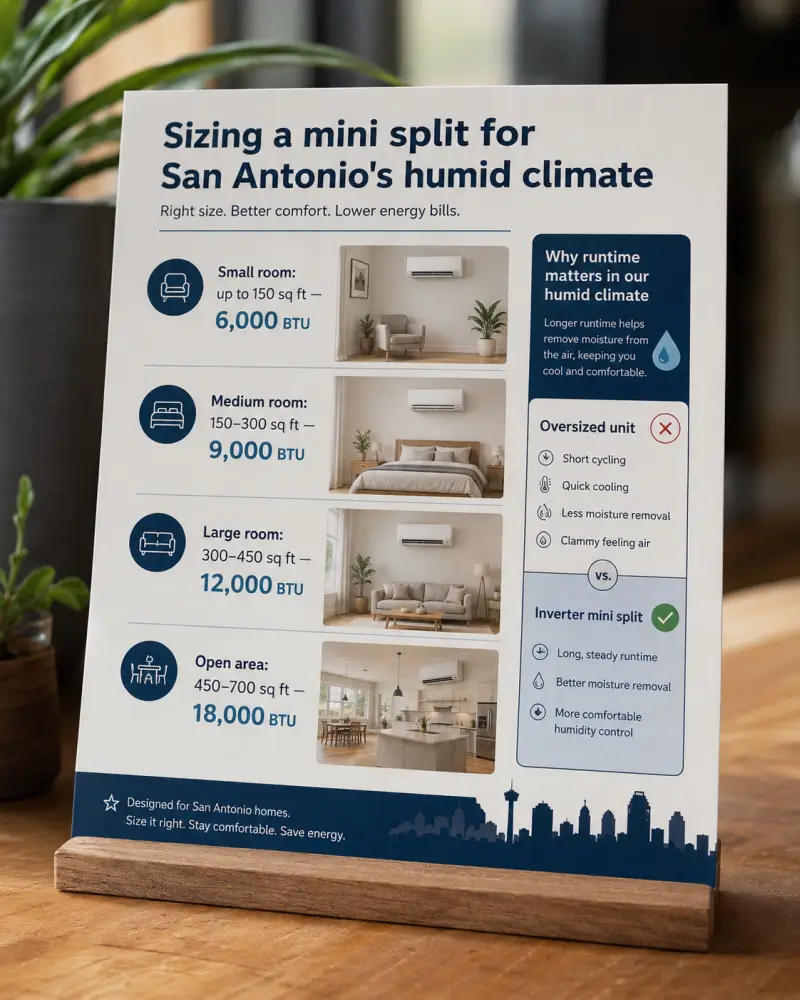
Starting point only. Add capacity for west-facing glass, an uninsulated garage, or a room under a dark roof. Confirm with a Manual J load calculation.
Add capacity for west-facing glass, an uninsulated garage, or a room under a dark roof. Then have your contractor run a Manual J load calculation. A contractor who sizes off square footage alone is guessing. Our guide on how to size a mini split system walks through the variables.
Choose a variable-speed inverter compressor. Inverter systems modulate output instead of cycling on and off, which is what a humid climate needs: long, low-speed runtime that keeps stripping moisture. Every unit in the Filterbuy mini split lineup uses one.
Verify the license before you take a quote. Texas requires an Air Conditioning and Refrigeration contractor license from the TDLR. San Antonio has no separate city contractor registration, so the state database is your primary verification source.
Check the license free at TDLR License Search. Numbers start with TACLA (Class A, unlimited tonnage) or TACLB (Class B, under 25 tons). Class B covers essentially all residential work.
Confirm they will pull the mechanical permit. Unpermitted work can surface at resale and will cost you the CPS Energy rebate, which requires a permit number inside city limits.
Request proof of general liability insurance naming you as additional insured. The ACCA contractor locator is a useful cross-check.
Get the warranty in writing, separating manufacturer parts coverage from the contractor's labor warranty.
Ask for the Manual J, and confirm whether they will install equipment you supplied. Self-installation voids most manufacturer warranties.
A note on our own position: Filterbuy manufactures air filters in the USA and sells ductless mini split systems nationwide. Filterbuy HVAC Solutions performs installation and service in Florida only. We do not install in Texas. Use the checklist above to choose a local Bexar County contractor.
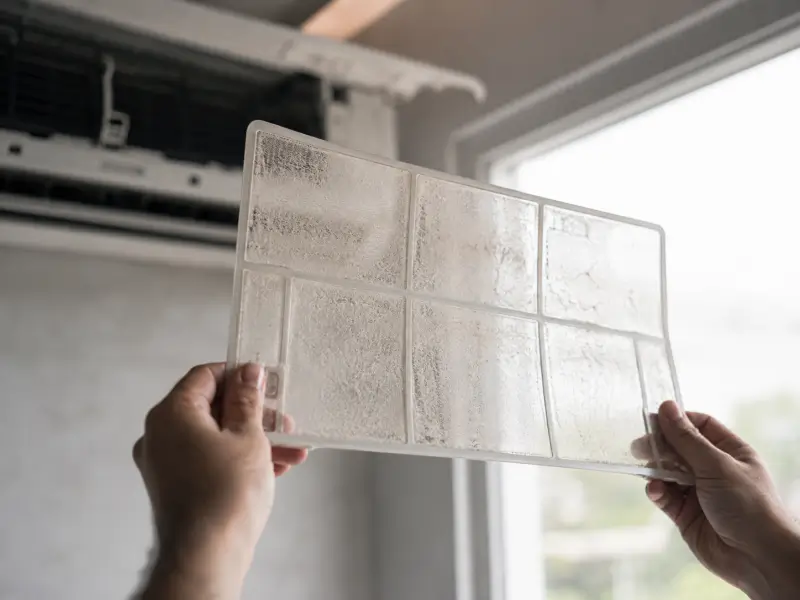
The mesh filter inside a ductless head is a comfort filter, not a health filter. The EPA notes that wall-mounted ductless units filter mainly to keep the unit itself clean rather than to remove fine particles from room air. In San Antonio, that gap has a name.
We have a specific vantage point on this. Filterbuy has manufactured air filters in the USA since 2013, more than 50 million of them, across more than two million households. We make the filters that go inside these systems, which is why we are comfortable saying plainly what the mesh screen in a ductless head is for, and what it is not for.
Mountain cedar pollen peaks in mid-January, exactly when San Antonio mini splits are running in heat mode. According to the Texas A&M Forest Service, Ashe juniper trees begin producing pollen in mid-December, peak in mid-January, and taper off toward the beginning of March, with cold fronts triggering the heaviest releases. Cedar fever causes congestion, fatigue, and headache severe enough that newcomers mistake it for the flu.
Three things actually help:
Clean the mesh filter every two weeks during heavy use. Mitsubishi, Daikin, Fujitsu, and LG all specify this, roughly six times more often than a central filter swap. Our mini split filter cleaning guide covers every brand. Never reinstall a damp filter.
Replace, do not wash, the secondary filters. Carbon, silver-ion, and photocatalytic inserts behind the mesh run on replacement schedules. Some units accept a HEPA upgrade; most do not.
Put real filtration on your central system. The Department of Energy estimates a clean filter cuts cooling energy use by 5 to 15% versus a clogged one. A MERV 13 filter captures the fine particles a mesh pre-filter lets through. We build ours in 600+ standard and custom sizes, with auto-delivery so the right size arrives on schedule.
Before cedar season starts, check conditions on our live AQI map for San Antonio. For the full ductless routine, see how to maintain your mini split and how mini splits affect indoor air quality.
Most mini split repairs land between $75 and $600, with compressor failure the expensive outlier. The useful question is not what each repair costs but which ones you can prevent, so that column is in the table.
Ranges synthesized from 2026 manufacturer and contractor sources. A diagnostic or service call runs $60–$150 and is often credited toward the repair. Confirm that policy when you book.
The top two lines are the same bill. A neglected mesh filter lets dust reach the coil, the coil stops shedding heat, and the drain pan backs up. In our own service data, restoring a dust-coated coil after a neglected filter runs roughly $350 to $600. A ten-minute rinse every two weeks prevents that charge outright. An annual tune-up runs $150 to $250 for a single zone.
Generic maintenance schedules assume a generic climate. San Antonio has a specific one, and the filter work should follow the local calendar rather than a national average.
Built around San Antonio's actual allergen and runtime calendar rather than a generic national schedule.
Spring is the cheapest time to book a tune-up and the easiest time to get one. Every San Antonio HVAC company is triaged into emergencies by July. A March visit is the same work, scheduled at your convenience, and it catches a weak capacitor before it fails at 103F.
The mesh cleaning is free and takes ten minutes. The part that does need buying is the central-system filter this calendar keeps pointing at, and the reason we built auto-delivery is that a schedule nobody remembers is not a schedule. Set it to land in early December and again in June, ahead of the two runtime peaks above.
Three judgements we have formed that you will not find on a contractor's page, including two that work against us.
Filterbuy ductless systems are rated 17 SEER2.
On the CPS table that is the 16.2–17.0 band: $175 per ton, not $310.
We would rather say it than let you assume the top tier and get a smaller check than you planned for.
Ductless shines in garages, casitas, additions, and older homes without ducts.
CPS pays on one-for-one replacements of existing equipment.
Those two facts rarely overlap. Budget as though you will get nothing, and treat a rebate as upside.
It is what a mesh screen sitting directly in front of a coil actually requires.
Borrowing your furnace's three-month habit is the fastest way to starve a ductless system.
The filtration that protects your family lives elsewhere in the house, on the central system, at MERV 13.
"In a San Antonio summer the mistake I see most is a unit sized for the hottest hour instead of the whole season. It reaches temperature fast, shuts off, and never runs long enough to pull the humidity out. The thermostat reads 74 and the room still feels damp. Size it to run longer at a lower speed and that same room feels better at a higher setpoint." David Clark, Licensed HVAC Technician
"People assume the filter in a mini split is doing what their furnace filter does. It is not. It is there to keep dust off the coil. Once you know that, the January cedar problem makes sense, and so does the fix, which usually lives somewhere else in the house." Michelle Wan, Brand Manager and Air Quality Writer, Filterbuy
Three federal findings back the advice above.
NIST tested seven common installation faults on a heat pump.
Improper installation raises heating and cooling energy use by about 30%.
Oversizing is one of those faults.
Takeaway: the sizing table above is a starting point. Get a Manual J.
Source: NIST, Energy Efficiency of HVAC Equipment Suffers Due to Poor Installation
EPA: keep indoor relative humidity below 60%. The ideal range is 30% to 50%.
Pulling moisture from the air is one of an HVAC system's jobs.
NIST: in hot, humid climates, excess indoor moisture makes people lower the thermostat.
Takeaway: a unit that cools without dehumidifying costs you twice.
Source: U.S. EPA, Mold Course Chapter 2: Why and Where Mold Grows
EIA 2020 survey: 93% of South census region households use AC. Highest in the country.
EIA counts mini splits among "individual AC units."
AC is about 19% of all U.S. home electricity use, or 254 billion kWh.
Takeaway: your SEER2 tier shows up on every summer bill, not just the rebate check.
Source: U.S. EIA, Nearly 90% of U.S. households used air conditioning in 2020 and EIA FAQ on electricity used for air conditioning
Yes, particularly for spaces central air never reached: garages, casitas, additions, and older homes without ductwork. They avoid the energy lost through leaky ducts in a hot attic. For a whole home with sound ductwork, a high-efficiency central system is often the better value.
Usually not. CPS Energy limits these rebates to retrofit projects that replace existing equipment one-for-one. A brand-new zone in a space that never had a system generally falls outside the program. Confirm directly with CPS Energy before counting on the money.
Clean the mesh yourself every two weeks through cedar season and through summer, monthly the rest of the year. Book the professional tune-up in spring, before local contractors are buried in emergency calls.
A common rule: replace when the compressor repair plus labor exceeds half the cost of a new outdoor unit, or when the system is past 10 to 12 years. Below that, repair usually wins.
Ready to improve what your system breathes? Find your filter size and set up auto-delivery, or compare Filterbuy mini split systems.
Michelle Wan is Filterbuy's Brand Manager and air quality writer. She works directly with Filterbuy's U.S. manufacturing team across factories in Alabama, Florida, Pennsylvania, and Utah, so her guidance is grounded in how filters are actually built and used. Filterbuy has manufactured air filters in the United States since 2013. This guide was reviewed for technical accuracy by David Clark, a licensed HVAC technician. Cost, rebate, and program figures reflect publicly available information as of August 2026; verify current amounts with CPS Energy and your contractor before purchasing.
Texas Department of Licensing and Regulation: Air Conditioning and Refrigeration Contractors
Texas A&M Forest Service: Cedar Fever Season Begins in Texas
NIST: Energy Efficiency of HVAC Equipment Suffers Due to Poor Installation
U.S. EIA: Nearly 90% of U.S. households used air conditioning in 2020
IRS: FAQs on the One Big Beautiful Bill, Sections 25C and 25D
Ductless mini split: A heating and cooling system with an outdoor compressor connected to one or more indoor air handlers, requiring no ductwork.
SEER2: Seasonal Energy Efficiency Ratio 2, the current federal cooling efficiency metric. CPS Energy rebate tiers are set by SEER2 rating.
MERV: Minimum Efficiency Reporting Value, the ASHRAE scale rating how well a filter captures particles.
Ton: A unit of cooling capacity equal to 12,000 BTU per hour. CPS Energy rebates are paid per ton.
Early Replacement vs. Replace on Burnout: CPS rebate tracks. Early Replacement covers working equipment and pays more; Replace on Burnout covers a failed system.
TDLR / ACR license: The Texas agency and the Air Conditioning and Refrigeration contractor license required for HVAC work in Texas.
Manual J: The ACCA standard load calculation that determines correct equipment size for a specific room or home.
Mountain cedar (Ashe juniper): A Central Texas juniper whose winter pollen causes cedar fever, peaking in mid-January.