
Concealed Duct Mini Splits:
The Hidden Comfort Solution For Modern Homes
What Is a Concealed Duct Mini Split?
A concealed duct mini split hides the entire indoor unit in your attic or soffit, delivering air through small ceiling grilles instead of a visible wall unit. It uses the same core components as a standard ductless system, just connected to short duct runs that reach nearby rooms. This style suits whole-home comfort projects and design-first remodels where you want no visible equipment in the room. A licensed installer handles setup, and filter access is the detail worth planning for early. Answer three quick questions below and we will match you to the right mini split for your space.

Answer 3 quick questions and we will match you to the right mini split for your space.
TL;DR
A concealed duct mini split hides its entire air handler inside a ceiling cavity, attic, or closet, so the room shows only a flush, paintable register. It uses the same inverter-driven heat pump technology as a standard mini split, then routes conditioned air through short, insulated ducts to one or more rooms. Installed cost runs $4,000 to $7,500 per zone. The return-air filter sits behind a dedicated access panel, and checking it on schedule protects airflow and compressor life.
Key Takeaways
The air handler hides in an attic, ceiling cavity, or closet, leaving only a flush register visible.
Installed cost runs $4,000 to $7,500 per zone, more than a wall-mounted head, due to ductwork, carpentry, and condensate management.
One hidden air handler can serve several rooms through short duct runs, unlike wall-mounted or cassette units, which need one per room.
Check the return-air filter every 60 to 90 days, since restricted airflow is a leading cause of blower motor strain in hidden installations.
Walk into a room cooled by a concealed duct mini split and there's nothing to look at, just a plain register moving quiet air. The air handler works out of sight in an attic bay, soffit, or closet ceiling, while short duct runs carry conditioned air to the room below.
How Concealed Duct Mini Splits Work
A concealed duct mini split uses the same heat pump principle as any mini split: an outdoor condenser moves refrigerant to an indoor air handler, which absorbs or releases heat by season. The difference is indoor placement, with the handler hidden in an attic bay, soffit, or closet ceiling, pushing air through a short duct run to flush registers, while return air travels back through a plenum box and filter.
Because air moves through ductwork, the system fights external static pressure (ESP), the resistance the blower works against, and undersized ductwork commonly causes weak airflow at the farthest register. The U.S. Department of Energy notes ductwork in unconditioned space, like a typical attic, can lose more than 30 percent of space-conditioning energy, though a concealed system's short, single-floor runs face far less of that loss.
Because the air handler is hidden, it also loses the built-in sensor a wall-mounted unit carries in its faceplate. Most concealed systems solve this with a wired wall thermostat or remote sensor placed where people sit, rather than reading hot attic air.
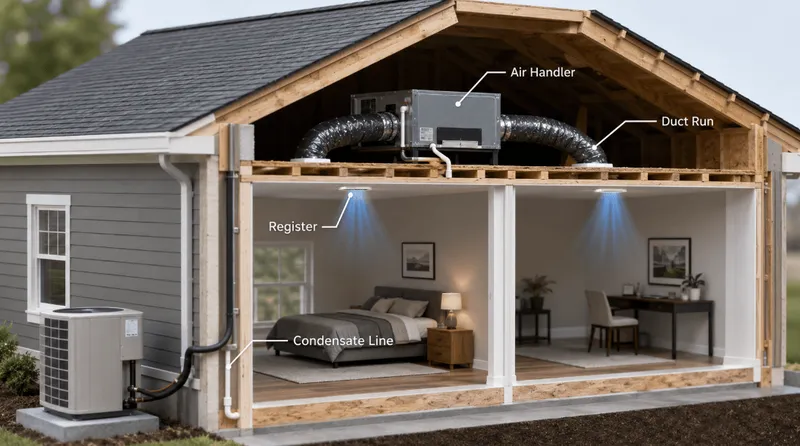
Concealed Duct vs. Ceiling Cassette vs. Wall-Mounted Mini Splits
Cost ranges reflect national installed averages for single-zone systems in 2026 and vary by market, brand, and site conditions.
Sound Levels: What You'll Actually Hear
A concealed duct system doesn't eliminate sound, it relocates it. Filterbuy's own wall-mounted units run as quiet as 19 decibels, and a concealed handler adds a ceiling and duct run between that equipment and the room, usually quieter at the register. The exception: undersized or poorly sealed ductwork can introduce a rattle or whistle at higher speeds, so ask your installer about duct sizing before approving the design.
Where Concealed Duct Mini Splits Fit Best
Whole-floor comfort in an addition or primary suite where no wall unit fits the design
Historic or architecturally sensitive homes where a visible unit is not an option
Serving two or three adjacent bedrooms from one hidden air handler instead of three wall units
New construction or a gut renovation, where attic access is easiest before drywall closes
What Concealed Duct Mini Splits Cost
Installed cost typically runs $4,000 to $7,500 per zone, covering the air handler, condenser, line set, ductwork, registers, electrical work, and labor, more than a wall-mounted unit's $2,000 to $5,000 since a concealed system adds carpentry, duct fabrication, and condensate management. The gap narrows when one hidden air handler serves several rooms, since extending ductwork often costs less than a separate wall unit per room. The line item homeowners most underestimate is condensate management, since a concealed handler can't drip onto the ground like an outdoor condenser.
Ranges reflect national 2026 averages and will vary by contractor, permit jurisdiction, and equipment brand.
The federal Section 25C Energy Efficient Home Improvement Credit, which had allowed up to $2,000 for a qualifying heat pump installation, expired December 31, 2025, and does not apply to 2026 installations. Some state and utility rebates remain active, so check with your state energy office.
The Installation Process, Step By Step
A concealed duct install is not a weekend DIY project, and it calls for a licensed contractor from the first step.
1. Load Calculation And Design. A contractor sizes the air handler and duct run to the room's BTU needs and plans register placement before cutting begins.
2. Air Handler Mounting. The handler hangs in the attic bay, soffit, or closet ceiling, pitched toward the drain port for correct condensate flow.
3. Ductwork And Registers. Short, insulated duct runs connect the handler to flush registers, with an access panel built in at the filter location.
4. Refrigerant Line Set And Electrical. A technician holding EPA Section 608 certification runs the line set and completes electrical connections.
5. Evacuation, Commissioning, And Permit Inspection. The technician pulls a vacuum, confirms it holds, releases refrigerant charge, verifies performance, and closes out permits with a final inspection.
Maintaining The Ducted Filter System Inside
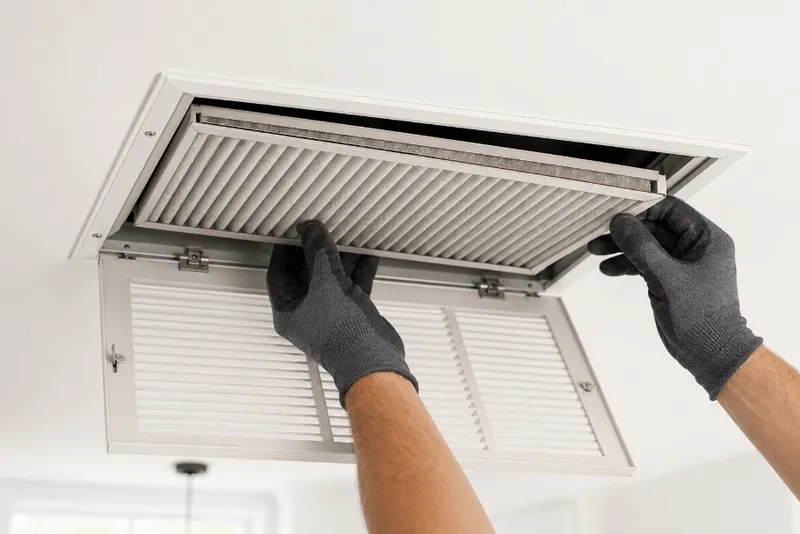
The return-air filter is the part most homeowners never see, and it does the most work. Once ductwork closes behind drywall, it is reachable only through the access panel at the return plenum. A dirty filter restricts airflow, a leading cause of blower motor strain in hidden installations, and can raise energy use and shorten equipment life.
Check the filter every 60 to 90 days, sooner with pets, dust, or nearby construction. Some handlers accept upgraded media filtration, though the manufacturer's ESP rating determines whether the ductwork handles the added resistance. Confirm the access panel is easy to reach before the ceiling closes, since skipping that step often means cutting into finished drywall later. Manufacturers may also require documented filter maintenance to keep a compressor warranty valid.
“On too many service calls, I find the access panel painted shut or hidden behind a light fixture that went in after the HVAC rough-in. If the panel isn't easy to reach, the filter doesn't get checked, and that's when the blower motor starts working overtime,” says David Clark, Licensed HVAC Technician.
Warning Signs Something's Wrong Behind The Ceiling
A brown or yellow ceiling stain near the register, usually a failed condensate line or pump
A musty smell at startup, often standing water in the pan or mold on a dirty filter
Warm air from a register that should be cooling, pointing to a failed compressor, refrigerant leak, or frozen coil
Short-cycling, which strains the compressor and often traces to a dirty filter
Any of these warrants a service call before it becomes a repair.
Frequently Asked Questions
7 Resources We Built To Help You Choose With Confidence
We put together these seven resources to help you decide with confidence before you spend a dollar.
Compare Costs Across Every Mini Split Configuration
Resource: Mini Split Cost Guide. Priced by brand, zone count, and BTU size.
Get A Real Number For Your Installation Labor
Resource: Mini Split Installation Cost Breakdown. Separates unit price from labor and permit fees.
Size Your System Before You Talk To A Contractor
Resource: BTU Sizing Guide. The square-footage formula and room-by-room adjustments our installers use.
Find The Right Fit For A Historic Or Older Home
Resource: Best Mini Splits For Older Homes. Sizing and placement guidance for a home's original character.
Decide Whether A Mini Split Pays Off Long-Term
Resource: Are Mini Splits Worth It: Cost vs. Value Breakdown. Real payback numbers against the cost of a concealed system.
Understand What A DIY Install Actually Involves
Resource: DIY Mini Split Installation Guide. What a self-install demands, including EPA refrigerant rules.
Meet The Air Quality Expert Behind This Guide
Resource: Michelle Wan, Author Page. More of her air quality and HVAC coverage, built on Filterbuy's decade of filtration experience.
Supporting Statistics
Up To 60% Less Energy Than Electric Resistance Heat
ENERGY STAR certified mini splits use up to 60% less energy than standard electric radiators because they transfer heat instead of generating it, and a concealed duct system runs on that same inverter-driven technology.
Source: ENERGY STAR, Ductless Heating & Cooling
Only 50% Of Pre-1940 Homes Have Central Ductwork
91% of homes built since 2000 have central ductwork, versus only 50% of homes built before 1940, exactly the gap a concealed duct mini split solves.
Source: U.S. Energy Information Administration, Air Conditioning in Nearly 100 Million U.S. Homes
6.9% Of U.S. Households Still Have No Air Conditioning At All
9.2 million occupied housing units, or 6.9% of the U.S. total, had no air conditioning in 2023. A concealed duct mini split closes that gap without a visible wall unit or full ductwork retrofit.
Source: U.S. Census Bureau, Heat Risks And Cooling Problems In America's Households
Glossary
Air Handler. The indoor coil-and-blower component, hidden in the ceiling or attic in a concealed duct system.
External Static Pressure (ESP). The resistance a blower overcomes pushing air through ductwork, limiting duct length and filter resistance.
Condensate Pump. A small pump that lifts moisture away from a concealed air handler when gravity drainage isn't possible.
SEER2. The current cooling efficiency rating for mini split and central heat pump systems.
Return Plenum. The ductwork section pulling room air back to the handler, housing the filter and access panel.
Zone. A room served by its own indoor unit or duct run.