
Tip: Ensure you buy the exact air filter size for your system. Certain brands have precise dimensions that only fit their specific models. See related filters
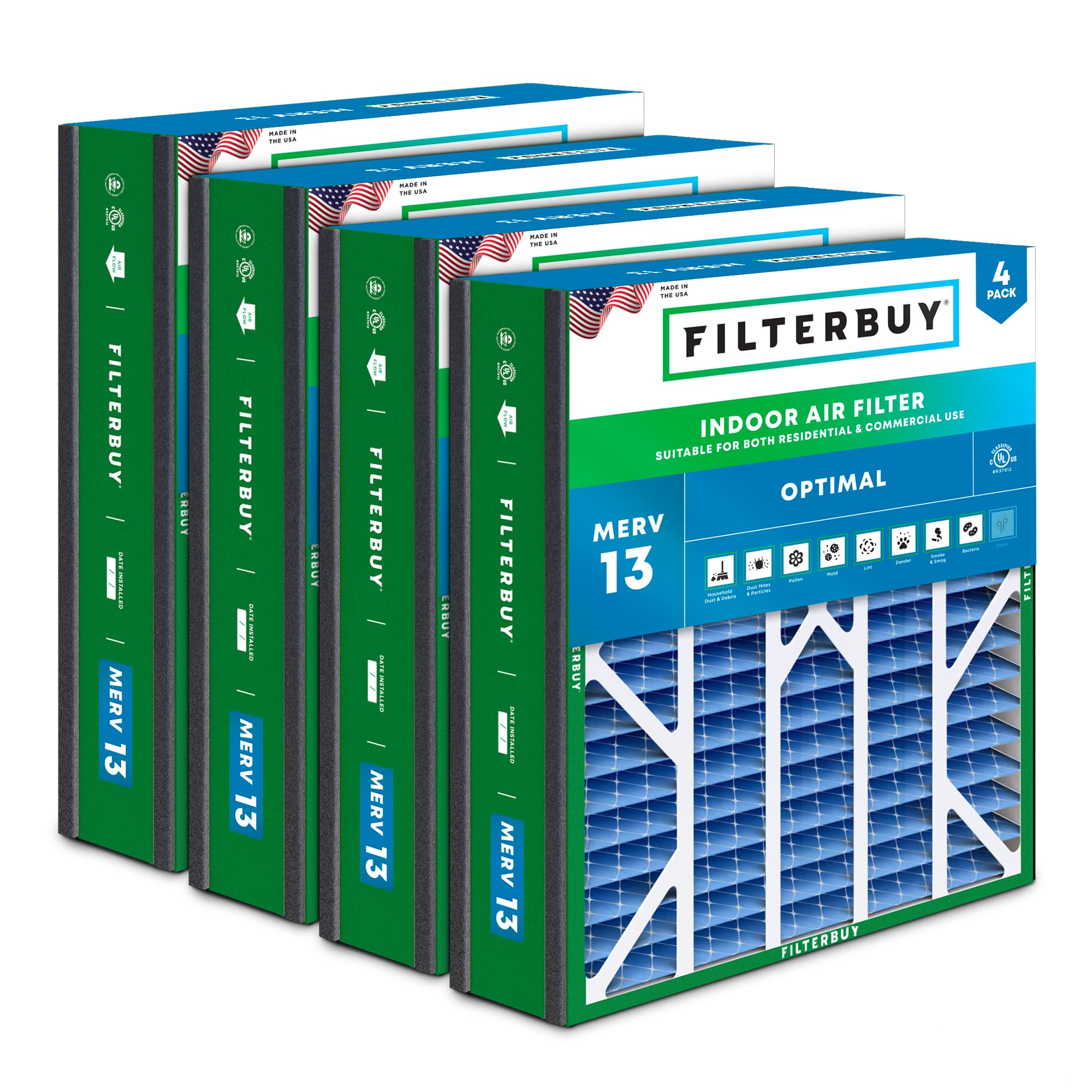
Day and Night 20X25X5 MERV 13 Replacement Filter
Actual Size: 19.63x24.13x4.88
 Free Delivery
  Factory-Direct Low Prices, Made in the USA
 Hassle-Free Returns & Free Exchanges
RESIDENTIAL AND/OR COMMERCIAL USE
Change Every 3 Months
Tip: Ensure you buy the exact air filter size for your system. Certain brands have precise dimensions that only fit their specific models. See related filters
Day and Night 20X25X5 MERV 13 Replacement Filter
Actual Size: 19.63x24.13x4.88
Free Delivery Factory-Direct Low Prices, Made in the USAHassle-Free Returns & Free ExchangesRESIDENTIAL AND/OR COMMERCIAL USE
Change Every 3 Months
Tip: Ensure you buy the exact air filter size for your system. Certain brands have precise dimensions that only fit their specific models. See related filters
Day and Night 20X25X5 MERV 13 Replacement Filter
Actual Size: 19.63x24.13x4.88
Free Delivery Factory-Direct Low Prices, Made in the USAHassle-Free Returns & Free ExchangesRESIDENTIAL AND/OR COMMERCIAL USE
Change Every 3 Months
About
- This is a list 20x25x5 MERV 13 air filter replacement for your furnace, air conditioner, heat pump, or HVAC system
- Actual air filter size: 19.63x24.13x4.88
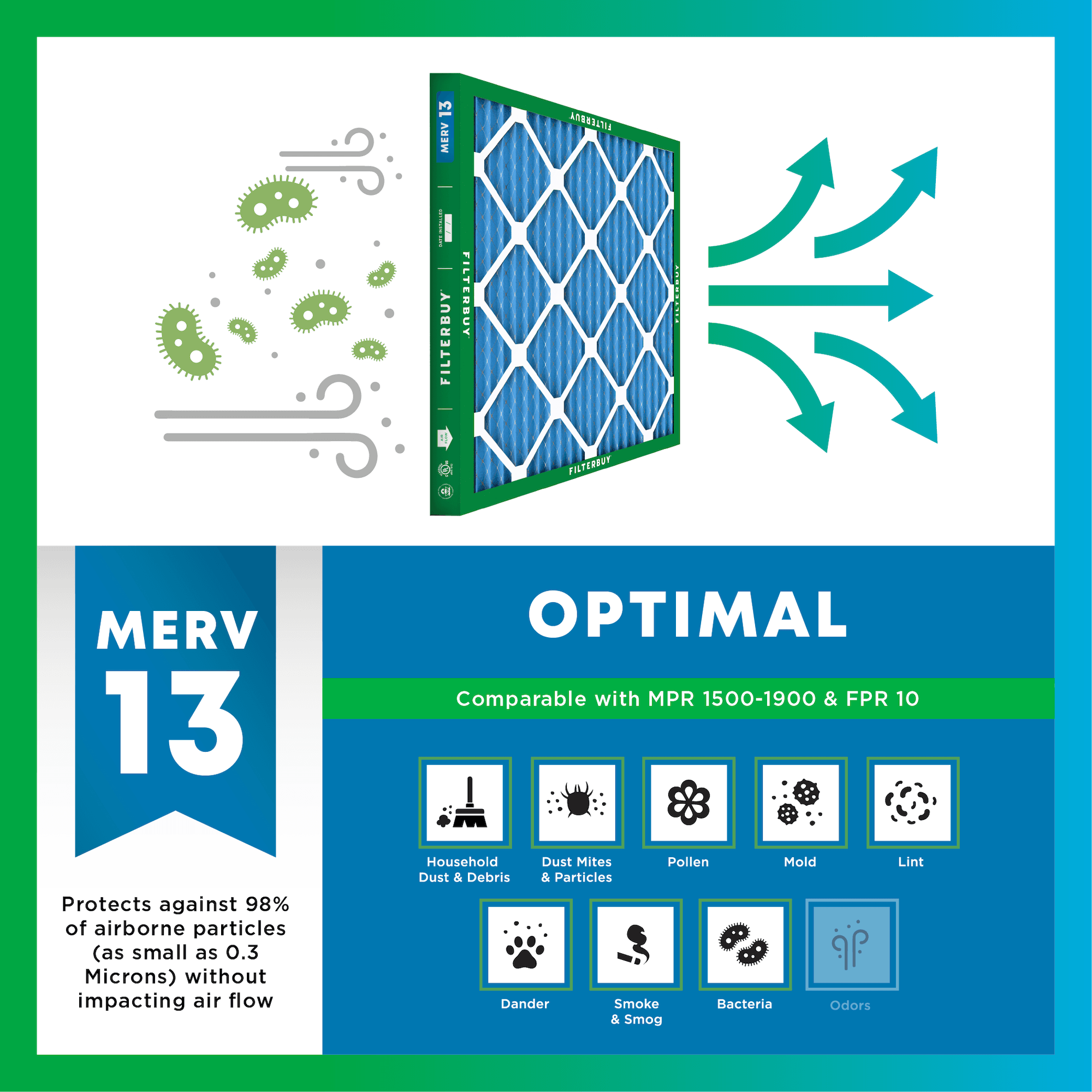
- MERV 13 synthetic media (comparable with MPR 1500/1900 and FPR 10) offers the best protection from dust, pollen, pet dander, mold, smog, bacteria, and virus carrying particles by trapping 98% of airborne particles without impacting air flow.
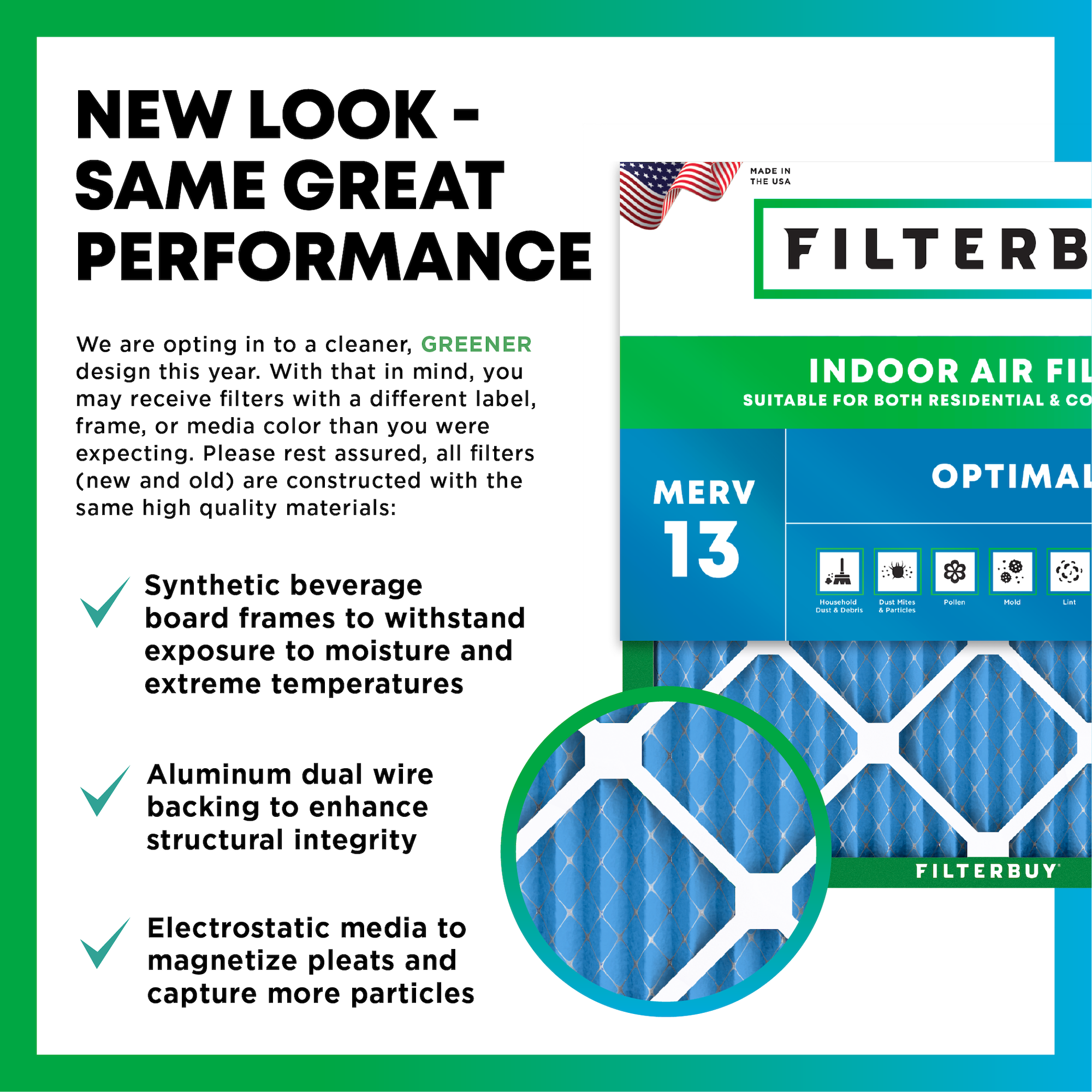
- High-quality construction means electrostatically charged pleated filter media, reinforced wire backing for structural integrity, and a durable frame to resist heat and humidity
- Built to last 3 months. 300% longer than fiberglass models
- 100% manufactured in the United States and designed with recyclable materials
- Learn more about 20x25x5 Air Filters
Important Whole House 5” Filter Compatibility note
Many HVAC brands have unique trimmed sizes of their 20x25x5 filters.
For example, a 20x25x5 made for Honeywell systems will not fit other brand systems.
⚠️ This quick step can save you from ordering the wrong size. ⚠️
Find Your Exact Match By Choosing Your Brand Below:
Find Your Exact Match By Choosing the Actual Size (Also known as the trimmed size):
Top-Rated Filters. American Made. Delivered Free.
At Filterbuy, we don't cut corners—we craft high-quality air filters right here in the USA and ship them to your doorstep for free. No delays, no gimmicks—just clean air, made easy. With thousands of five-star reviews and filters built for real life & every HVAC system, it's no wonder why over 4 million families trust Filterbuy.

Proudly Made In The USA

Fast, Free Shipping on Every Order

Premium Materials That Go The Distance

85,000+ 5-Star Reviews From Happy Customers

Save Up to 70% Per Filter with Packs
Things to Know About Filter Sizes

Nominal Size
- The rounded size printed on your filter or HVAC unit (e.g., 20x25x5).
- Usually whole numbers to make identifying and ordering easier.
- A label for compatibility—not the exact measurement.

Actual Size
- The true, trimmed dimensions of the filter (e.g., 19.63x24.13x4.88 inches).
- Filters are manufactured slightly smaller so they slide into the filter slot without forcing.
- If you don't know your nominal size, measure your filter to get the actual size, then round up to find the nominal size to search on our site.

Why the difference?
- Nominal sizes simplify shopping and standardize categories.
- Actual sizes ensure the filter fits properly inside your HVAC's filter rack.
How To Find Your Nominal Size When You Don't Know It


Measure length × width × depth with a tape measure to find the actual size.

Round up each dimension to the nearest whole number to get the nominal size. Example: 19.63x24.13x4.88 in → 20x25x5 nominal.

Search by nominal size on our site for the best fit.

Why Getting the Right Size Matters
- Too small? Air can bypass the filter, reducing air quality and efficiency.
- Too big? It won't fit—risking bent frames and airflow issues.
- Just right? You get maximum performance, better filtration, and cleaner air.

Why Choose a 5″ filter

5″ filters give you maximum filtration with minimal maintenance — lasting up to 12 months while handling higher MERV ratings without restricting airflow.
Sizing note:
- Requires a 5″ cabinet or system.
- Actual thickness varies by brand (~4¾″–5¼″), so check your model for the best fit.

Free Exchange Policy
If the filter you buy doesn't fit, we'll send you a better size.

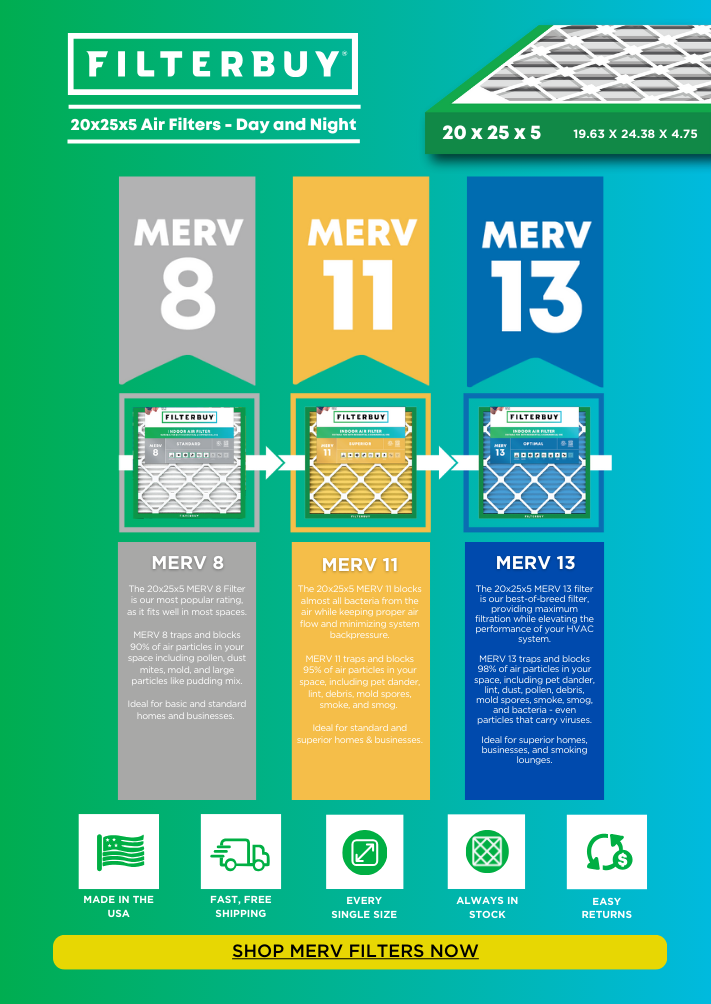
What's a MERV Rating?
MERV stands for Minimum Efficiency Reporting Value—but don't let the technical name fool you. It's just a way to rate how well an air filter traps stuff like dust, pollen, pet dander, and smoke. The higher the MERV number, the more particles it catches—and the cleaner your air will be.

Merv 8
Comparable to:FPR: 4-7
MPR: 600-1000
 Dust & Debris
 Dust Mites & Particles
 Pollen
 Mold
Mold Lint
Lint Dander
Merv 11
Comparable to:FPR: 6-9
MPR: 1200-1550
Dust & DebrisDust Mites & ParticlesPollenMoldLintDander Smoke & Smog
Merv 13
Comparable to:FPR: 10
MPR: 1900-2800
Dust & DebrisDust Mites & ParticlesPollenMoldLintDanderSmoke & Smog Bacteria
MERV 8
Comparable to:FPR: 4-7MPR: 600-1000


MERV 11
Comparable to:FPR: 6-9MPR: 1200-1550

MERV 13
Comparable to:FPR: 10MPR: 1900-2800
What Makes Our Filters Last 90 Days? Quality, From the Inside Out
We build every Filterbuy filter to deliver reliable 90-day performance—thanks to smart design and premium materials that do the heavy lifting. Here's what makes the difference:
Pleated Design
More pleats = more surface area to capture dust and debris, keeping your air cleaner longer.
Electrostatically Charged Media
Pleats are magnetized to attract and trap microscopic particles—like pet dander, pollen, and smoke.
Synthetic Beverage Board Frame
Engineered to resist warping in extreme temperatures and high humidity.

Aluminum Dual Wire Backing
A layer of metal reinforcement keeps pleats evenly spaced and structurally sound—no sagging, even at high airflow.
Made in the USA
Assembled with care. Built to perform. Ships fast, free, and reliably from our U.S. facilities.
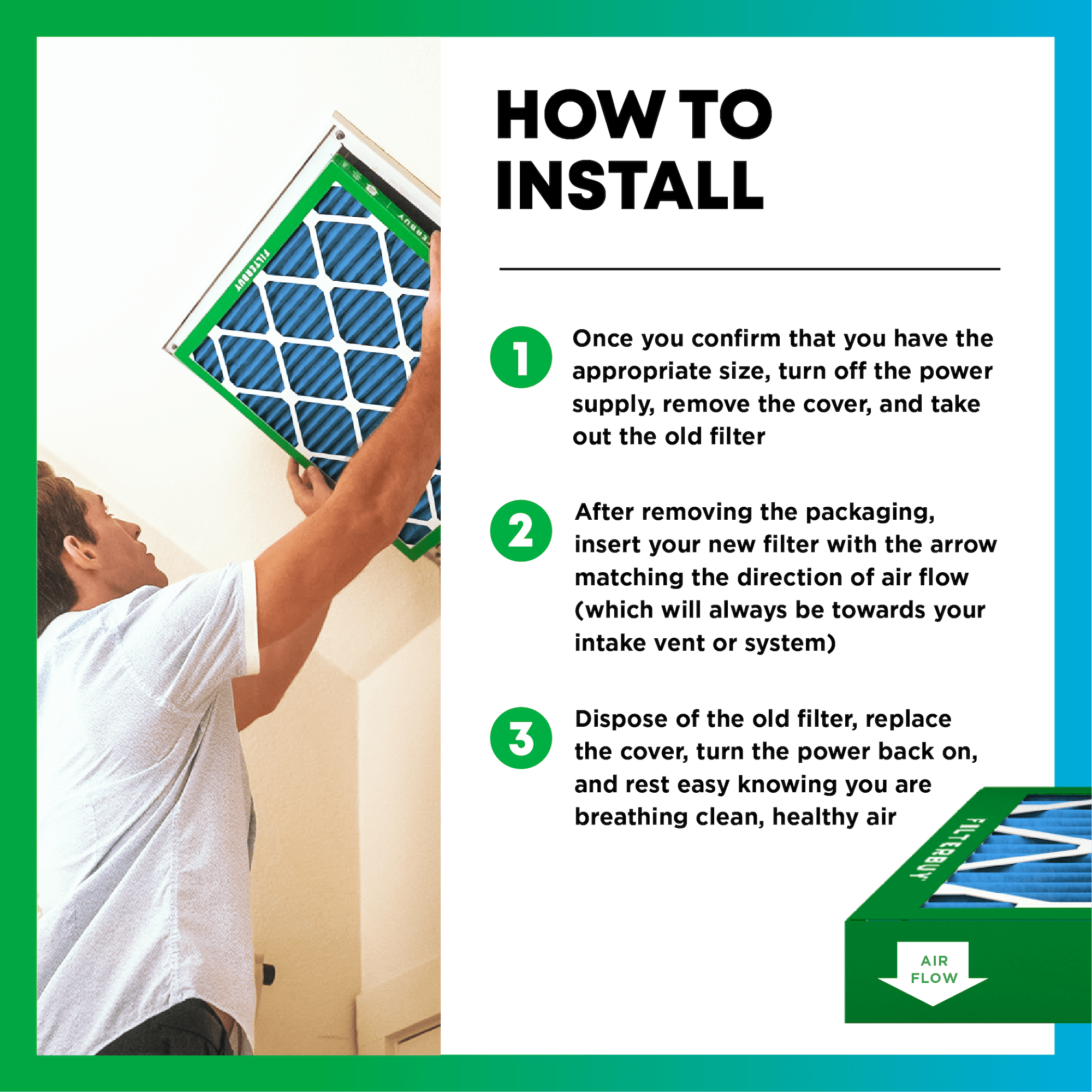
How to Install Your Filter in 4 Simple Steps

Turn Off Your HVAC SystemSafety first.

Remove The Old FilterLook for the airflow arrow and make note of the direction.

Slide In Your New FilterArrow should point toward the system (same direction as before).

Turn Your System Back OnAnd enjoy the fresh, clean air.

Never forget to replace your air filter again.
- Save 5% on every order
- Choose Your Delivery Schedule
- Edit, Skip, or Cancel Anytime.
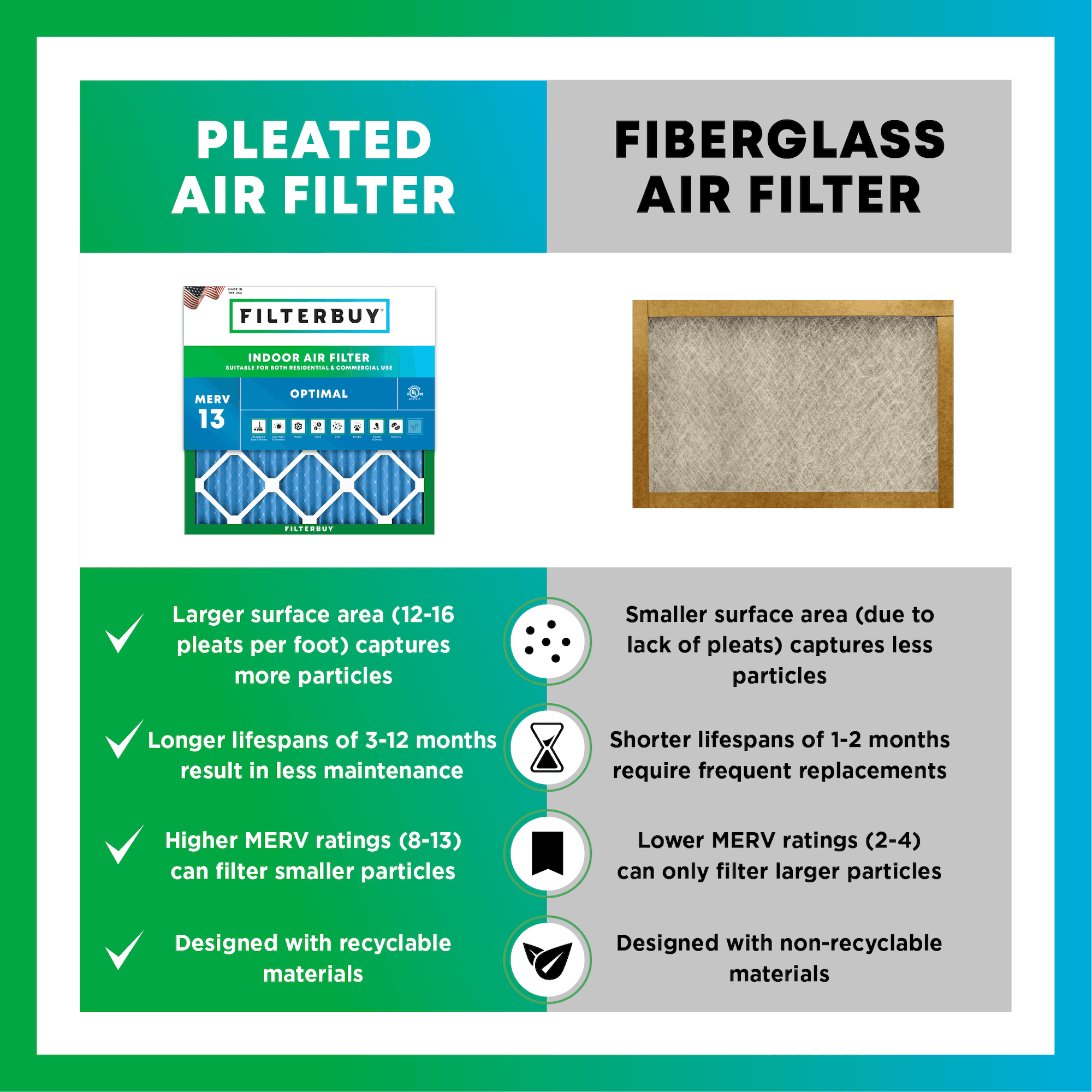
Pleated Filters vs. Fiberglass—What's the Difference?
Not all air filters are created equal. Pleated filters don't just last longer—they actually clean your air better. Here's how they stack up:

Pleated Filters
Efficiency:
High (MERV 8–13) – Traps more particles
Lifespan:
90 days – Long-lasting performance
Air Quality:
Excellent – Cleaner, healthier air
Materials:
Recyclable and durable

Fiberglass Filters
Efficiency:
Low (MERV 4 or less) – Misses small stuff
Lifespan:
30 days or less – Replace often
Air Quality:
Minimal – Basic protection only
Materials:
Thin, flimsy, and not recyclable
Pleated filters are a no-brainer—more protection, less hassle, and better air for your home.
How Often Should You Change Your Filter?
Changing your filter on time keeps your HVAC system running efficiently—and helps protect your lungs from dust, allergens, and airborne irritants. Here's how often to swap it out based on your needs:

Every 90 Days
Standard ScheduleFor most homes without pets or special air quality concerns. Great for general upkeep and energy efficiency.

Every 60 Days
If You Have Pets or AllergiesShedding fur, dander, and allergy triggers can build up fast. Changing your filter every two months helps keep the air fresher and symptoms at bay.

Every 30 Days
If You Have Respiratory Concerns or Live in Smog/Wildfire ZonesFor households affected by smoke, pollution, or respiratory conditions, monthly changes ensure maximum protection.

Want to stay on track? Set a reminder—or skip the stress with auto-delivery so fresh filters show up right when you need them.
Don't Just Take Our Word For It...
Got More Questions? We've Got Answers.
Product Specifications
| Nominal Size | 20 x 25 x 5 inches |
| Actual Size | 19.63 x 24.13 x 4.88 inches |
| Filter Type | Pleated |
| Media | Electrostatically Charged |
| Frame | Beverage Board |
| MERV Ratings Available | 8, 11, 13 |
| Lifespan | Up to 12 Months |
| Origin | Made in USA |
Best HVAC Upgrade? MERV 13 20x25x5 Day and Night Air Filter
Your Day and Night HVAC system filtered the air in your home while you slept last night. What it actually caught depends entirely on the filter sitting in that 20x25x5 cabinet slot. At MERV 13, that filter pulls particles as small as 0.3 microns out of the air stream — fine dust, smoke, pet dander, mold spores, and bacteria-carrying particles that most homeowners never see and rarely think about. At MERV 8, a meaningful portion of those particles recirculate instead. Upgrading that one component doesn’t require a service call or a new system. Slot the right filter in, and the difference starts with the next cycle.
TL;DR Quick Answers
MERV 13 20x25x5 Day and Night Air Filter
The MERV 13 20x25x5 is a deep-media cabinet filter built to fit Day and Night forced-air furnaces and air handlers. At MERV 13, it captures particles as small as 0.3 microns — fine dust, pet dander, mold spores, smoke particles, pollen, and bacteria-carrying particulates that lower-rated filters let pass through and recirculate. The 5-inch media depth gives it significantly more filter surface area than a standard 1-inch filter, which supports a 6-to-12-month replacement interval in most households.
Filter size: 20 x 25 x 5 inches
Efficiency rating: MERV 13, tested per ASHRAE Standard 52.2
System compatibility: Day and Night forced-air furnaces and air handlers with a deep-media 5-inch cabinet filter slot
Particle capture range: 0.3 to 10 microns across all three ASHRAE 52.2 particle size test groups
Replacement interval: Every 6 to 12 months depending on household dust load and pet ownership
EPA guidance: The EPA recommends MERV 13 as the minimum efficiency tier for households prioritizing fine particle capture and indoor air quality
Top Takeaways
• The EPA recommends MERV 13 as the minimum filtration tier for households that take fine particulate matter and indoor air quality seriously.
• The 20x25x5 deep-media format gives your HVAC system significantly more filter surface area than any 1-inch filter can provide, extending service life and keeping airflow steady even at MERV 13 efficiency.
• Day and Night HVAC systems with a deep-media cabinet filter slot accept the 20x25x5 format directly, with no system modifications, no technician visit, and no compatibility guesswork.
• Tested to ASHRAE 52.2 standards, MERV 13 captures particles as small as 0.3 microns — fine dust, smoke, pet dander, mold spores, pollen, and bacteria-carrying particles across all three particle size groups.
• A correctly seated MERV 13 20x25x5 filter keeps fine particles off HVAC coils, blower components, and heat exchanger surfaces, protecting equipment efficiency and reducing the wear that leads to early service calls.
• Most households replace a 20x25x5 MERV 13 filter once or twice a year — a fraction of the frequency required by standard 1-inch filters, which typically need swapping every 1 to 3 months.
• Filterbuy manufactures this filter in the U.S. to exact dimensional specifications and backs every order with direct customer support — no middleman between you and the people who built it.
What MERV 13 Means — and Why the Number Matters
ASHRAE Standard 52.2 gives every filter a number from 1 to 16 based on its minimum capture efficiency across three particle size ranges. MERV 13 performs in the most demanding of those ranges — 0.3 to 1.0 microns — which is where fine dust, smoke particles, pet dander, mold spores, and bacteria-carrying particles actually sit. Filters rated below MERV 13 miss that band. Moving from MERV 11 to MERV 13 opens a significantly wider capture window, and for most households dealing with pets, allergies, or general air quality concerns, that wider window is where the real gains show up.
The EPA recommends MERV 13 as the minimum efficiency tier for households prioritizing indoor air quality, and the 20x25x5 deep-media format makes that achievable without overloading a typical residential HVAC system. For background on how filtration technology has developed as a field, the Wikipedia article on air filter covers the foundational history and standards behind modern ratings.
Why the 20x25x5 Deep-Media Format Changes the Equation
A standard 1-inch filter and a 20x25x5 deep-media filter look similar on paper — same face dimensions, same slot opening. The 5 inches of depth change how the filter performs at every level. More media means more surface area for particles to get captured before airflow restriction becomes a concern, and that additional depth means the filter sustains performance over a much longer service window. That’s why 20x25x5 filters typically run 6 to 12 months between changes versus the 1 to 3 months most 1-inch filters require. If you’d rather think about your filter twice a year instead of every few weeks, the format answers that preference before MERV 13 efficiency even enters the conversation.
Day and Night System Compatibility
Day and Night builds their forced-air furnaces, air handlers, and packaged units with a deep-media cabinet filter housing made for 5-inch filters. That 20x25x5 slot is purpose-built for this format specifically. We engineer the Filterbuy MERV 13 20x25x5 to seat flush in those cabinets, with a beverage-board frame that holds its dimensions under normal residential static pressure. A filter that fits correctly eliminates the bypass gaps that make a MERV 13 rating meaningless in a poorly seated unit.
Before purchasing, check your current filter’s printed dimensions or pull up your owner’s manual — that’s the confirmation step worth taking before you order. If you want a grounded look at whether filter grade affects real-world performance, the Filterbuy resource on does air filter quality matter breaks down what actually changes between filter grades in home HVAC systems.
What This Filter Actually Captures
MERV 13 captures particles across all three ASHRAE 52.2 test groups — 0.3 to 1.0 microns (E1), 1.0 to 3.0 microns (E2), and 3.0 to 10.0 microns (E3). In practical terms, that covers:
• Fine household dust and PM2.5 particulate matter
• Smoke particles from cooking, candles, and combustion sources
• Pet dander and associated allergens
• Mold spores
• Pollen
• Bacteria-carrying particles
• Dust mites and their debris
• A MERV 8 or MERV 11 filter handles most of the coarser items on that list and misses most of the rest. The Filterbuy MERV 13 20x25x5 covers the full range.
Protecting Your HVAC Investment
Every particle that slips past an under-rated filter ends up somewhere — most of it settling on your evaporator coils, blower components, and heat exchanger surfaces. That buildup cuts heat transfer efficiency, strains the blower motor, and drives the kind of gradual component wear that turns into an unbudgeted service call. A well-fitted MERV 13 20x25x5 intercepts that material before it reaches your equipment. The higher capture rate means less debris settles on system components, and the format’s longer service life means the filter stays effective between changes, keeping your system running closer to its designed efficiency for most of the year.
Replacement Schedule Guidance
Plan on replacing the filter every 6 to 12 months, depending on your household’s dust load. A visual check every three months keeps you ahead of any surprises. Gradual darkening across the media face is expected and means the filter is working. Replace before the 6-month mark if you have pets or high seasonal dust loads. Single-occupant homes with no pets can typically stretch toward 12 months. One rule applies universally: don’t push past 12 months, even if the filter looks passable. Capture efficiency drops before the surface tells you it has.
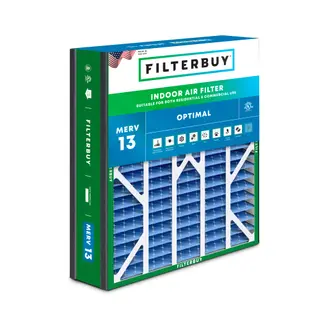
“After more than a decade of manufacturing deep-media 20x25x5 filters, we’ve learned that the frame fit matters as much as the MERV rating does — a filter that leaves bypass gaps undermines the efficiency you’re paying for, because the particles you’re trying to catch simply travel around it. That’s why we engineer the beverage-board frame to hold its dimensions under normal residential static pressure.”
— Filterbuy Manufacturing Team
7 Essential Resources
Source: air filter
URL: https://en.wikipedia.org/wiki/Air_filter
Wikipedia’s overview of air filter technology, types, ratings, and the history of mechanical filtration in HVAC and industrial applications. A reliable reference for the foundational concepts behind MERV ratings.
Source: does air filter quality matter
URL: https://filterbuy.com/resources/air-filter-basics/does-air-filter-quality-matter/
Filterbuy’s resource center breakdown of how filter quality affects real-world HVAC performance, air quality outcomes, and system protection — with practical guidance for homeowners choosing between filter grades.
Source: EPA Indoor Air Quality Guide
URL: https://www.epa.gov/indoor-air-quality-iaq/inside-story-guide-indoor-air-quality
The EPA’s homeowner guide to indoor air pollution sources, health effects, and practical steps for improving air quality at home — including specific guidance on air filtration and HVAC maintenance.
Source: What is a MERV Rating
URL: https://www.epa.gov/indoor-air-quality-iaq/what-merv-rating
The EPA’s official explanation of the Minimum Efficiency Reporting Value system, including a comparison of MERV tiers, particle size ranges, and the agency’s recommendation to use at least MERV 13 for fine particle filtration in home HVAC systems.
Source: Guide to Air Cleaners in the Home
URL: https://www.epa.gov/indoor-air-quality-iaq/guide-air-cleaners-home
EPA’s guidance on selecting furnace and HVAC filters for residential applications, including how MERV ratings compare to other filter rating systems and how to match filter efficiency to household air quality needs.
Source: ENERGY STAR Heating and Cooling Efficiency Guide
URL: https://www.energystar.gov/saveathome/heating-cooling
ENERGY STAR’s homeowner resource on HVAC efficiency, including filter replacement guidance and the direct connection between clean filtration, system energy consumption, and equipment longevity.
Source: American Lung Association: Clean Air Indoors
URL: https://www.lung.org/clean-air/indoor-air
The American Lung Association’s overview of indoor air pollutants, health impacts, and steps homeowners can take to reduce airborne irritants — including the role of HVAC filtration in protecting respiratory health.
3 Supporting Statistics
Americans spend approximately 90 percent of their time indoors, where concentrations of some pollutants are often 2 to 5 times higher than typical outdoor concentrations, according to EPA research.
Source: U.S. Environmental Protection Agency — Indoor Air Quality
URL: https://www.epa.gov/report-environment/indoor-air-quality
About 25 million U.S. children and adults currently have asthma, making indoor air quality a health priority for millions of households — particularly those with occupants sensitive to airborne particles and allergens.
Source: Centers for Disease Control and Prevention — Asthma
URL: https://www.cdc.gov/cdi/indicator-definitions/asthma.html
Space heating and air conditioning account for more than half — 52 percent — of a typical U.S. household's annual energy consumption, according to the Energy Information Administration. When a dirty or under-rated filter forces the HVAC system to work harder to maintain temperature, that figure gets worse.
Source: U.S. Energy Information Administration — Use of Energy in Homes
URL: https://www.eia.gov/energyexplained/use-of-energy/homes.php
Final Thoughts and Opinion
If you run a Day and Night system with a 20x25x5 cabinet slot, this upgrade requires nothing more than dropping a new filter into the slot you already have. The deep-media format handles MERV 13 efficiency without stressing your blower. You’re replacing it once or twice a year, and in between, it’s capturing the fine particles that matter most for household air quality.
We think MERV 13 is the right call for this filter format. The homeowners who’ve made the switch tend not to go back once they see what a year of lower-rated filtration leaves behind on the filter face. The evidence does the explaining.
Next Steps
1. Pull out your current filter and read the printed dimensions — or check your Day and Night owner’s manual. You’re looking for 20x25x5. That quick check takes about thirty seconds and avoids a return shipment.
2. Head to Filterbuy, select the 20x25x5 size, and choose MERV 13 as your efficiency rating. If the dimensions on your current filter aren’t clear, our team can verify before you order.
3. Remove the old filter and slide the Filterbuy MERV 13 20x25x5 into the cabinet with the airflow arrow pointing toward the blower. Close the access panel until it seats flush. If it doesn’t close cleanly, check the filter orientation.
4. Set a calendar reminder for a visual check at three months. Plan for a full replacement at six months if you have pets or allergy concerns, or at 12 months for lower-load households.
Frequently Asked Questions
Q: What does MERV 13 mean on an air filter?
A: MERV 13 stands for Minimum Efficiency Reporting Value 13, a filtration tier established by ASHRAE Standard 52.2. Filters reach that rating by demonstrating capture efficiency across three particle size groups down to 0.3 microns — which puts smoke, fine dust, pet dander, mold spores, pollen, and bacteria-carrying particles within its capture range. The EPA recommends MERV 13 as the minimum tier for households prioritizing fine particulate capture, and it performs meaningfully above both MERV 8 and MERV 11 in the sub-1-micron range where the air quality gains matter most. The rating also reflects minimum efficiency, meaning real-world performance often runs higher as the filter loads with captured material over its service life.
Q: Is a MERV 13 20x25x5 filter compatible with Day and Night HVAC systems?
A: Most Day and Night forced-air systems — furnaces and air handlers with a deep-media filter cabinet — are built for the 20x25x5 format. Running MERV 13 at the 5-inch depth falls well within the operating parameters of those systems because the 5-inch media depth produces lower static pressure than a 1-inch MERV 13 at equivalent efficiency. Before ordering, confirm your filter slot dimensions by reading the label on your current filter. If your system takes a different size, your owner's manual has the correct specification. We manufacture the Filterbuy MERV 13 20x25x5 to true dimensional specs for a flush, sealed fit in these cabinets.
Q: What particles does a MERV 13 20x25x5 filter capture?
A: A MERV 13 filter works across all three ASHRAE 52.2 particle size groups, from 0.3 to 10 microns, covering the full range of common residential air quality concerns. That includes fine household dust and PM2.5 particulate matter, smoke particles from cooking, candles, and combustion sources, pet dander and associated allergens, mold spores, pollen, bacteria-carrying particles in the sub-1-micron range, and dust mites along with the debris they leave behind. If it moves through a residential air system, MERV 13 catches it.
Q: How often should I replace a 20x25x5 furnace filter?
A: A 20x25x5 MERV 13 filter holds up well for 6 to 12 months in most residential HVAC systems, depending on household conditions. Homes with pets or heavy dust loads should target the 6-month mark, while average households without pets can typically stretch to 9 or 12 months. Run a visual check every 3 months regardless of your planned interval, and don't push past 12 months even if the filter looks passable — capture efficiency can decline before visible saturation appears on the media surface.
Q: Is MERV 13 too restrictive for a standard home HVAC system?
A: A 1-inch MERV 13 filter can push static pressure higher than some residential systems handle well. The 20x25x5 deep-media format solves that by giving the filter enough surface area to deliver MERV 13 efficiency at a pressure drop most residential blowers can manage. The 5-inch depth provides surface area that 1-inch high-efficiency filters simply can't match, which is why deep-media 5-inch filters exist specifically to bring high filtration efficiency to residential equipment without the airflow penalties that come with thinner options. If you have concerns specific to your system, an HVAC technician can confirm the right filter spec before you upgrade.
The Best Upgrade for Your HVAC System Is a Filter Change Away
Your Day and Night system is already built for MERV 13 — all that's missing is the right filter in the slot. Order the Filterbuy MERV 13 20x25x5 at Filterbuy.com and put cleaner air to work in your home.